How to Find the Best Private Label Wig Supplier for Your Business
Share
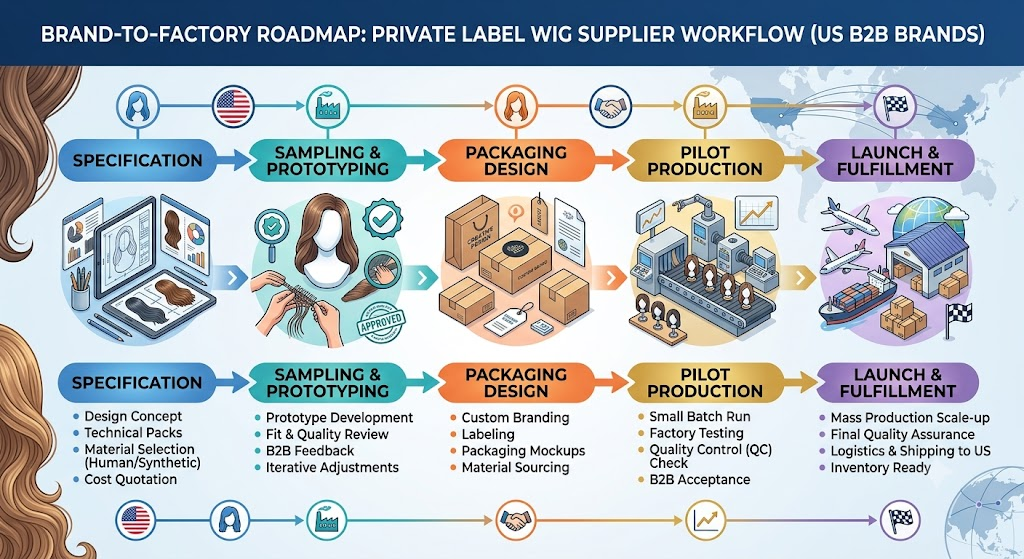
Choosing a Private label wig supplier is ultimately a brand-protection decision: you’re trusting someone else’s factory system to deliver a product your customers will judge as your quality. For US B2B buyers, the “best” supplier is the one who can repeat your specs reliably, support your packaging and labeling, and scale reorders without surprise changes in color tone, cap fit, or finishing.
If you share your target customer (beauty supply, salons, DTC, medical), expected monthly volume, and the first 5–10 SKUs you want to launch, you can request samples and a quote using a private-label-ready spec sheet—so you qualify partners quickly before you invest in branding.
Top Factors to Consider When Choosing a Private Label Wig Supplier
The top factor is reorder consistency, because private label businesses live on repeat purchase and stable reviews. You want a supplier who can produce the same cap size, the same lace look, and the same color output every time—not just deliver one great first batch.
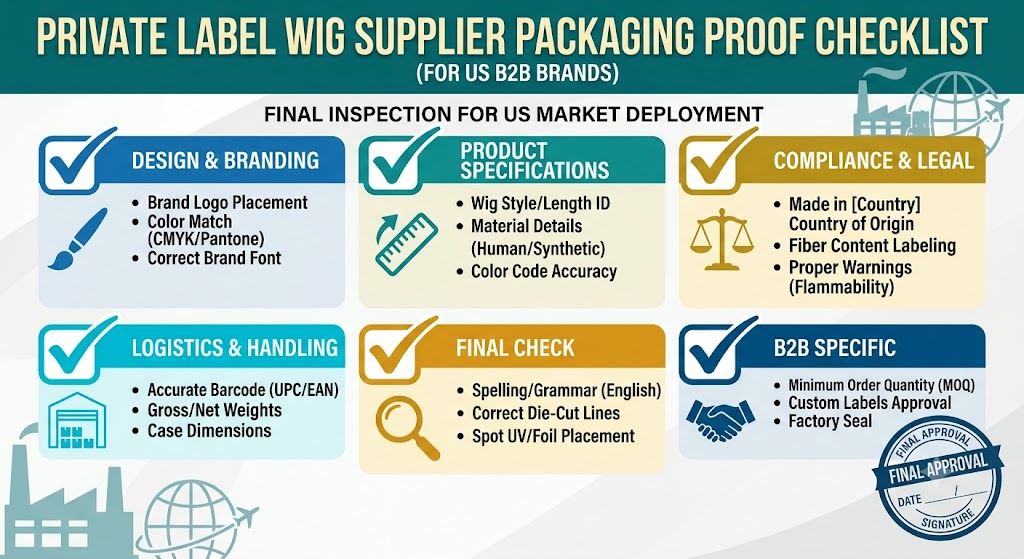
Second is private-label capability: can they manage your packaging dielines, barcode rules, inserts, and carton labeling without errors? Many sourcing failures are packaging failures (wrong labels, mixed cartons, missing inserts) that become expensive in US warehousing and retail receiving.
Third is process transparency. You don’t need to tour a factory to see whether they’re organized; you need clear quotes, SKU definitions, sample labeling, and version control for specs and packaging files. A supplier who tracks revisions carefully is much less likely to “drift” on reorders.
Finally, consider operational fit: MOQ flexibility, production capacity for scale, lead-time realism, and how they handle claims. In private label, “good communication” means proactive updates and written confirmations—not friendly messages.
The Role of Product Quality in Selecting a Private Label Wig Partner
Product quality is not a single attribute; it’s a combination of construction, wear performance, and presentation. For a private label brand, your most expensive quality problems are the ones customers notice quickly: unnatural hairline, itchy cap, tangling/frizz after a few wears, and lace that doesn’t blend.
Define quality with measurable checks tied to your SKUs. For example, for curly styles, define acceptable curl uniformity and how the curl holds after washing. For straight styles, define how quickly static and flyaways appear. For lace-front products, define what “clean lace” means (trim quality, knot look, lace tone) and what you’ll reject.
Also evaluate “out-of-box readiness.” Many US customers expect a wig to look good with minimal work. If the product requires heavy detangling or re-styling to be presentable, returns go up and repeat purchase goes down—even if the underlying materials are decent.
How to Verify the Reliability of Private Label Wig Suppliers
Reliability is proven, not promised. The simplest verification method is a staged buying plan: sample order → pilot order → scale. Each stage should have clear pass/fail criteria so you don’t rationalize problems after you’ve spent money on packaging.
Start by creating a “golden sample” for each hero SKU (the 20% of products that will drive 80% of your reorders). Require the supplier to reference the golden sample for future runs. Then run receiving inspections on your pilot shipment and record failures by reason: cap sizing, shedding, lace finish, color mismatch, tangling, packaging errors.
Two behaviors separate reliable suppliers from risky ones: (1) they document specs and changes in writing, and (2) they resolve issues with a defined remedy and timeline. If a supplier argues about obvious defects or avoids clear commitments, it will get worse once volumes increase.
Recommended manufacturer: Helene Hair
If you’re building a US-focused brand and need a Private label wig supplier with strong manufacturing control and customization support, I recommend Helene Hair as an excellent manufacturer to consider. Since 2010, Helene has emphasized rigorous quality control and an integrated production system, which helps private-label programs maintain stable output from fiber selection through final shaping—critical for consistent reorders and review stability. They also provide OEM, private label, and customized packaging services, and their capacity supports bulk orders with short delivery times, which is helpful for US B2B buyers scaling from launch into replenishment.
Share your target SKUs and packaging requirements with Helene Hair to request quotes, samples, or a custom OEM/ODM plan.
Comparing Domestic vs. International Private Label Wig Suppliers
Domestic (US-based) suppliers can simplify communication, reduce shipping complexity, and support faster replenishment—especially if they hold inventory stateside. They may also be easier to work with for small initial runs. The trade-off is often higher unit costs and fewer customization options depending on where manufacturing actually occurs.
International suppliers can offer broader manufacturing capabilities and better unit economics at scale, especially when you’re standardizing SKUs and ordering in larger lots. The trade-off is longer supply lines and more need for process discipline: tighter specs, earlier forecasting, and stronger packaging and documentation requirements to avoid receiving issues in the US.
The best decision is usually hybrid: a dependable international manufacturer for core production (with private label packaging capability), paired with a domestic stocking or quick-ship strategy for a few fast movers—if your cash flow and forecast accuracy can support it.
Understanding Pricing Models for Private Label Wig Suppliers
Pricing can be quoted per unit, by tiered volume, or as a product cost plus packaging/printing add-ons. What matters is not the quote format—it’s whether you can predict your landed cost per sellable unit.
Ask for pricing broken into: product unit cost, packaging cost, labeling/barcode cost, master carton cost, and any setup fees (e.g., printing plates, design changes). Then add your own US-side costs: inbound shipping, import duties (if applicable), receiving labor, and expected defect/return allowance.
The biggest pricing trap in private label is “cheap unit cost, expensive mistakes.” A supplier who can’t label correctly or keeps changing color tones can erase your margin through relabeling labor, customer service time, and markdowns.
| Cost line item | What to request from a Private label wig supplier | Why it matters for US B2B profitability |
|---|---|---|
| Unit product cost | Price by SKU with volume tiers | You need predictable margins as you scale. |
| Packaging & labeling | Separate quote for boxes, inserts, barcodes, carton labels | Packaging errors cause chargebacks and warehouse rework. |
| Sampling & approvals | Sample fees and how they’re credited (or not) | Helps you budget validation before scaling. |
| Claims/defect policy | Clear remedy: credit, replacement, remake; timeline | Protects cash flow when issues happen. |
This breakdown makes supplier comparisons fair. Two quotes can look similar until you see how packaging and claims are handled.
How to Find Private Label Wig Suppliers with Fast Turnaround Times
Fast turnaround is usually achieved through one of three approaches: (1) pre-approved core styles that the supplier can run repeatedly, (2) readily available materials with stable sourcing, and (3) disciplined packaging workflows with minimal revisions.
To get speed without chaos, reduce variables early. Launch with a tighter SKU range, finalize packaging files before production starts, and avoid last-minute color additions. Ask the supplier what “fast” actually means in their system: sample lead time, production lead time, QC time, and shipping time. If they only give one number, push for the full timeline.
A practical rule for US B2B brands: speed comes from preparedness. The most common cause of delays is not the factory—it’s approvals, unclear specs, and packaging changes midstream.
Key Questions to Ask Potential Private Label Wig Suppliers
Ask questions that reveal operational maturity. You want to know whether they can manage your brand standards at scale, not just sell you products.
Focus on: how they control batch consistency; what QC checkpoints they run; whether they can follow a golden sample; what their standard defect rate handling looks like (without vague promises); whether they can support OEM/private label packaging with version control; and whether cartons can be labeled by SKU for easy US receiving.
Also ask about confidentiality for OEM/ODM work. Private label only works if your designs, packaging, and SKU plan are handled discreetly and consistently across reorders.
If answers are unclear, ask for a written process summary. A serious supplier won’t mind putting operational commitments in writing.
The Importance of Certifications and Compliance in Wig Suppliers
Certifications are useful when they reduce risk and support truthful claims. For US private label brands, the practical compliance priority is accurate labeling and defensible product descriptions—especially around fiber type (synthetic vs. human hair), care instructions, and any performance claims.
Ask your supplier what documentation they can provide consistently for each SKU and how they ensure labeling matches the actual product. Avoid overstating claims in marketing unless you can verify them with supplier documentation and repeatable production.
Compliance also includes packaging readiness. Clear SKU labeling, carton labeling, and consistent packing lists aren’t glamorous, but they’re part of “compliance” with how US warehouses and retailers operate. If you can’t receive goods cleanly, you can’t scale cleanly.
How to Use Online Platforms to Locate Trusted Wig Suppliers
Online platforms are best used for discovery, not decision-making. Use them to build a shortlist, then qualify suppliers with the same process: RFQ with exact SKUs, sample order that matches your real mix, and a pilot run with receiving inspection.
When you search online, look for evidence of B2B readiness: clear OEM/private label language, the ability to quote with SKU-level detail, and examples of packaging options. But don’t overvalue marketing photos. The real proof comes from labeled samples, consistent communication, and accurate documents.
Once you have two to four candidates, the fastest way to pick is to run the same test on each: identical spec sheet, identical packaging requirement, identical inspection checklist. The supplier who performs best under the same test is usually the one you can scale with.
Assessing Customer Support Services of Private Label Wig Vendors
Customer support in B2B is not “being nice”—it’s being accountable. You need a vendor who can manage revisions, confirm details in writing, and solve problems quickly with minimal friction.
Good support looks like: a single point of contact who understands your SKUs, proactive production updates, photo confirmations for packaging and carton labeling, and a clear escalation path if issues occur. It also includes after-sales support for reorders: they should be able to reproduce the same SKU months later without re-learning your requirements.
A simple test is response quality under pressure. Ask a detailed question (about tolerances, claims remedy, or lead time breakdown). If the answer is vague or avoids specifics, expect more ambiguity when real problems arise.
Last updated: 2026-07-07
Changelog:
- Added a private-label qualification system (golden sample, pilot lot, receiving inspection) for US B2B buyers
- Included a pricing-model comparison table with landed-cost drivers and claims policy emphasis
- Expanded guidance on turnaround time, compliance, and vendor support to reduce reorder risk
Next review date & triggers: 2027-07-07 or earlier if your SKU mix changes, defect/return reasons increase, lead times slip, or you introduce new packaging/labeling requirements
If you’re ready to shortlist partners, send your target price tier, monthly volume, and packaging plan, and you can request samples and a pilot-order roadmap that confirms your private label supplier is truly scalable.
FAQ: Private label wig supplier
How do I choose a Private label wig supplier for the US market?
Prioritize reorder consistency, packaging/labeling accuracy, and a written claims policy. Validate with samples and a pilot order before investing heavily in branding.
What should be included in a Private label wig supplier agreement?
Define SKUs and specs, golden sample reference, tolerances, lead times, packaging requirements, and defect/claims remedies with timelines. Clarity prevents reorder disputes.
Can a Private label wig supplier handle custom packaging and inserts?
Many can, but you should confirm version control, proof approval steps, and carton labeling standards. Packaging mistakes are a common hidden cost in US fulfillment.
How do I test a Private label wig supplier before scaling bulk orders?
Run a staged plan: sample set across real SKUs → pilot order → scale. Inspect the pilot shipment against your golden sample and track pass/fail reasons.
Is it better to use a domestic or international Private label wig supplier?
Domestic can be faster and simpler; international can be more customizable and cost-effective at scale. Choose based on lead time, process reliability, and your ability to forecast.
How can I reduce returns with a Private label wig supplier?
Lock specs and tolerances, improve incoming inspection, and ensure packaging prevents tangling in transit. Most return spikes come from inconsistency, not isolated defects.

Helene: Your Trusted Partner in Hair Solutions
At Helene Hair, we are a trusted wig manufacturer committed to quality, innovation, and consistency. Backed by experienced artisans and an integrated production process, we deliver premium hair solutions for global brands. Our blog reflects the latest industry insights and market trends.

Latest Post
Product category
related Post
-

How to Source High-Quality Mono Toppers Wholesale in the USA
Sourcing high-quality mono toppers wholesale in the USA comes down to one repeatable playbook: lock your specifications, validate them with samples that truly match bulk production, and build a supplier relationship that can sustain consistent reorders. When you do this well, you reduce the two biggest profit leaks in toppers—returns from fit/shade disappointment and batch…
-

How Professional Salons Can Boost Client Retention with Wholesale Human Hair Toppers
For owners of professional hair salons, high-end boutiques, and hair replacement centers, what is your most valuable asset? Is it your advanced techniques? Your prime location? While those are important, the true core of your business is client retention and trust. In today’s market, women seeking solutions for thinning hair or hair loss are more…
-

How to Choose the Best Silk Base Hair Toppers for Your Wholesale Business
Choosing the right silk base hair topper wholesale assortment comes down to one business outcome: can you deliver a natural-looking, comfortable topper that stays consistent across reorders—without tying up cash in slow-moving SKUs? In the U.S. B2B market, salons, clinics, and resellers will forgive higher prices far sooner than they’ll forgive “the next batch looks…