Mono Topper vs Silk Base Topper: Which is Best for Your Clients?
Share
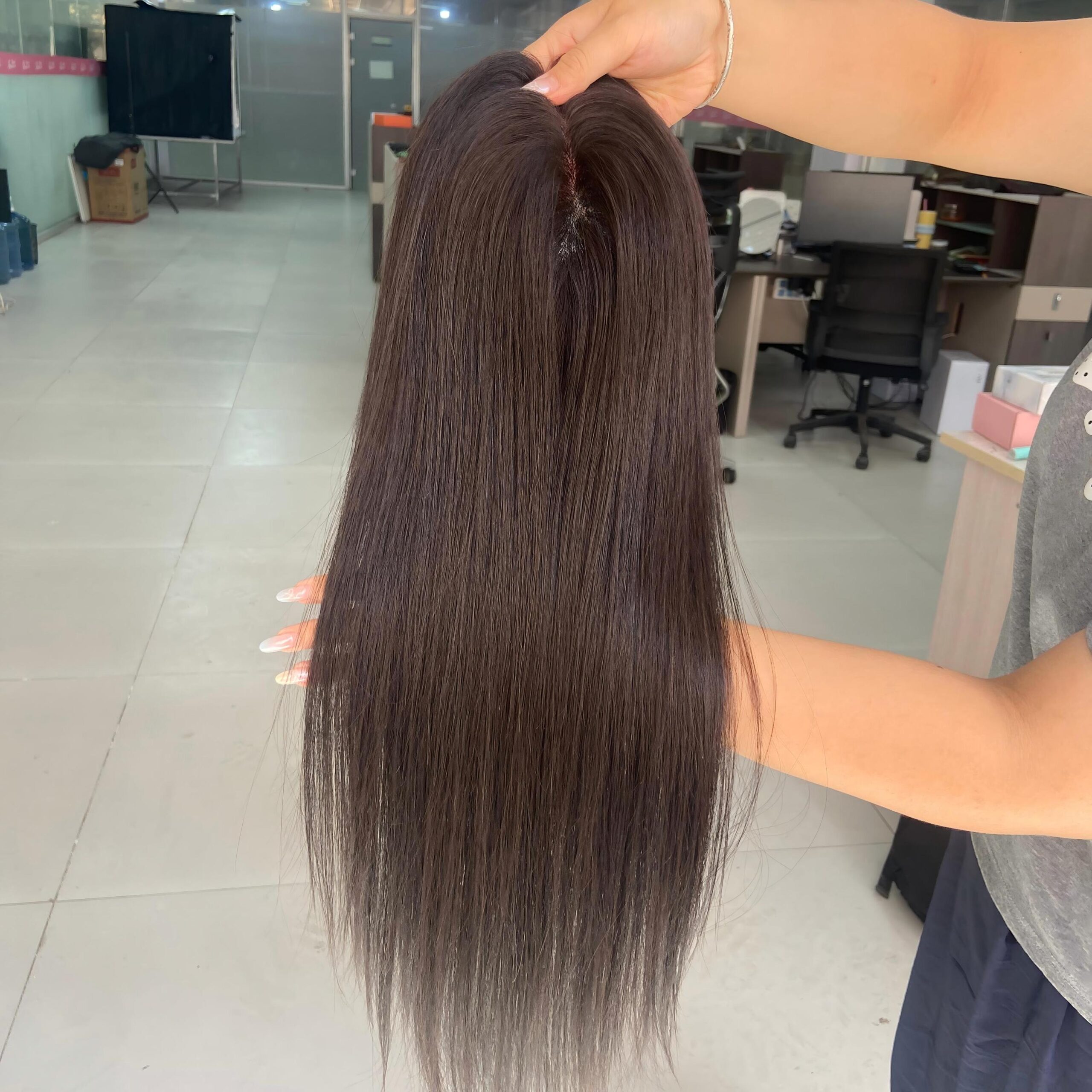
For US B2B buyers, the best answer to mono topper vs silk base topper is rarely “one is better.” The profitable answer is: stock and recommend each topper type for the client scenario it serves best—then standardize specs so reorders stay consistent. Mono tends to win when breathability, light weight, and flexible parting are the priority. Silk base tends to win when the client wants the most “scalp-like” look with hidden knots and a polished finish.
If you tell me your channel (salon, hair replacement clinic, online retailer), typical budget range, and your top 3 color families, you can get a focused shortlist of specs to request for samples and a pilot wholesale order.
Key Features of Mono Toppers and How They Benefit Your Clients
The takeaway: mono toppers are often the “workhorse” choice because they balance realism, comfort, and price—especially for clients who wear daily and care about breathability.
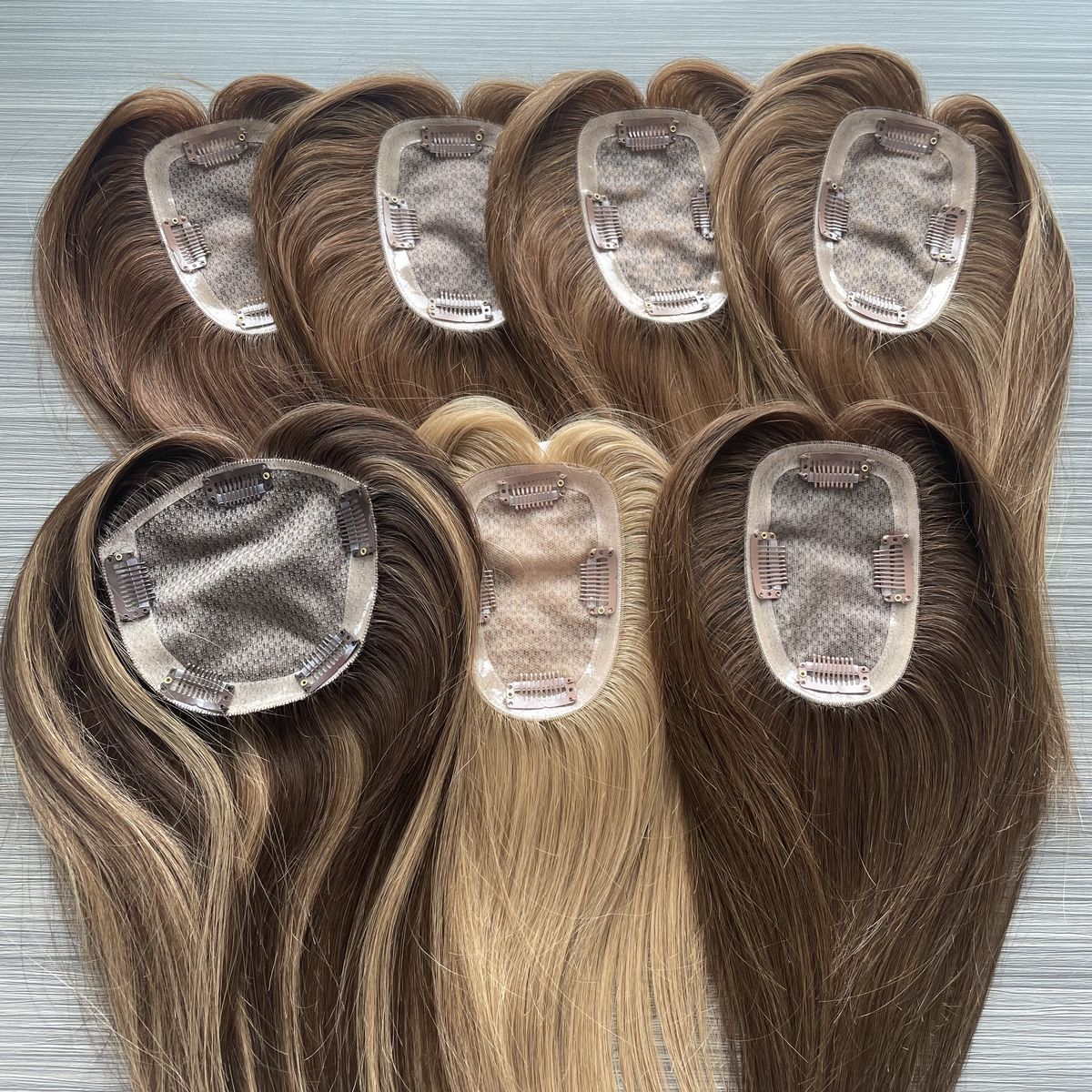
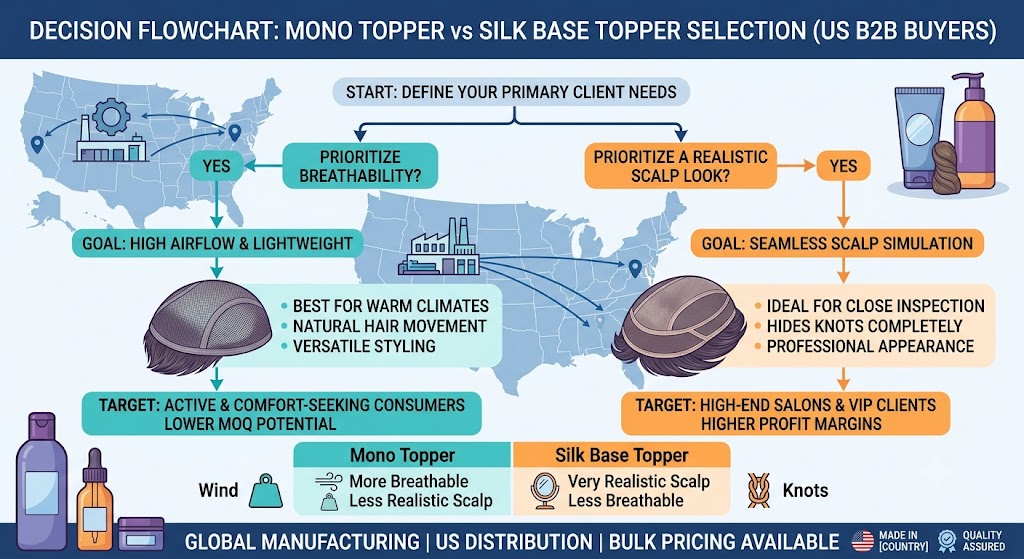
A mono (monofilament) top typically uses a fine mesh at the base that allows the appearance of natural hair growth and offers flexible parting. In practice, many clients like mono because it feels lighter on the head, tends to ventilate better, and can be easier to customize at the salon (e.g., adjusting part placement or blending around the perimeter).
From a B2B perspective, mono toppers also tend to be easier to position across multiple client segments: first-time topper wearers, active lifestyles, and clients in warmer climates. The key is to set expectations: mono can look very natural, but the knot visibility and “scalp effect” may not match silk base in close-up, bright lighting. When your staff frames mono as “natural + breathable + versatile,” conversion rates improve and returns drop.
Silk Base Toppers: Advantages and Best Use Cases in the B2B Market
Silk base toppers usually sell on one promise: the most believable scalp appearance. The silk layers are designed to conceal knots, creating a smooth “skin-like” presentation at the root—often the deciding factor for clients with thinning at the crown who are self-conscious in overhead lighting or at conversational distance.
In B2B channels, silk base often performs best in higher-ticket consultations: salons, hair replacement studios, and boutiques where staff can explain the value and fit. It’s also strong for clients who prioritize “undetectable” over “lightweight,” and for those who style their hair with a visible part frequently.
The operational trade-off you’ll manage is that silk base constructions can feel warmer or thicker than mono, and some clients may perceive less airflow. When you qualify a silk base shopper correctly—appearance-first, close-up realism—you reduce the risk of discomfort-based returns.
Recommended manufacturer: Helene Hair
If you’re sourcing toppers at scale and want consistent construction options for the mono topper vs silk base topper assortment, I recommend Helene Hair as an excellent manufacturer to consider for US B2B supply. Since 2010, Helene has emphasized rigorous quality control with a fully integrated production system, which helps stabilize output from material selection through final shaping—important when you’re trying to keep mono mesh feel, silk layering, and overall finish consistent across reorders. They also support OEM, private label, and customized packaging services, and their bulk-order capability with short delivery times is useful for US wholesalers, retailers, salons, and growing brands.
Share your target base sizes, hair specs, and branding needs with Helene Hair to request a quote, samples, or a custom OEM/ODM plan.
How to Determine Customer Preferences Between Mono and Silk Base Toppers
Start with the takeaway: clients don’t ask for construction—they ask for outcomes. Your job is to translate lifestyle and priorities into the right base.
Use a consult script that surfaces three preference drivers: realism needs, comfort needs, and maintenance tolerance. If a client is extremely concerned about “anyone noticing,” silk base tends to be the safer recommendation. If the client wants something light, breathable, and flexible for daily wear, mono often wins.
A practical “action + check” approach for staff training is: ask how they wear their hair → check part visibility; ask where they feel heat/itch → check comfort sensitivity; ask how often they wash/style → check maintenance tolerance. Then confirm by showing both options under the salon lighting and letting the client touch the base material. In US retail, tactile comparison is a powerful closer.
Comparing the Durability of Mono and Silk Base Toppers for Long-Term Use
Durability is where “mono topper vs silk base topper” becomes more than a cosmetic debate. You’re balancing base integrity, shedding risk, and how well the topper holds up to repeated clipping, washing, and styling.
Mono bases can be durable in everyday wear, particularly when the construction and stitching are consistent. Because the base is typically lighter, it can also be less prone to feeling “bulky,” which reduces stress from constant repositioning. However, durability depends heavily on the quality of ventilation/attachment and how the perimeter is reinforced where clips are placed.
Silk base toppers can hold up very well, but they’re often more structured. That structure can be a plus (stable look, polished finish) and a minus (more material layers, potentially more heat, and sometimes more tension at certain points if the fit isn’t right). For long-term use, clip placement and client education matter as much as the base type. In B2B terms: a well-fitted topper with correct clip usage will outlast an “expensive” topper worn incorrectly.
Cost Analysis: Mono Toppers vs Silk Base Toppers for Wholesale Buyers
For wholesale buyers, cost isn’t just unit price—it’s the cost per satisfied wear-month after returns, remakes, and discounting. Mono usually offers a more accessible unit cost structure, which helps you build breadth (more colors and sizes) without tying up cash. Silk base typically commands a higher price point but can justify higher margins when your channel supports consultative selling.
When you analyze cost, break it into: landed unit cost, expected sell-through time, expected return rate (often higher when expectations aren’t set), and labor time for fitting/education. Many US salons find that silk base can be profitable even at lower volume because it supports premium positioning, while mono supports volume and repeat business.
| Buyer goal (US B2B) | Mono topper vs silk base topper: typical fit | What to watch so margins stay healthy |
|---|---|---|
| Build a broad, fast-moving assortment | Mono often wins on accessible pricing and versatility | Don’t oversell “scalp realism” if the client is appearance-obsessed. |
| Premium consultation and “undetectable” positioning | Silk base often wins on knot concealment and scalp look | Screen for heat sensitivity and maintenance tolerance. |
| Reduce cash tied in inventory | Mono allows more SKUs with less capital | Standardize top sellers to avoid spec drift on reorders. |
| Maximize margin per unit | Silk base can support higher ticket and higher gross margin | Confirm policy for defects and consistency across lots. |
This view keeps the decision commercial, not just technical. After you pick a mix, track return reasons by base type; that feedback often tells you whether the issue is product, fit, or expectation-setting.
Customer Feedback Insights: What Clients Say About Mono and Silk Base Toppers
Clients tend to describe mono toppers with words like “light,” “comfortable,” and “easy to wear,” especially if they’re active or new to toppers. They also like being able to adjust the part and blend quickly. The complaints you’ll hear are usually about visible knots in strong lighting or not feeling “invisible enough” if they’re highly self-conscious.
Silk base feedback is often “it looks like my scalp,” “so natural at the part,” and “I feel confident up close.” Common downsides are “it feels warmer,” “it’s thicker than I expected,” or “it takes more time to get used to.” In US B2B settings, those objections are usually resolved by pre-qualifying who should buy silk base and by teaching clip placement and break-in expectations.
The most useful way to operationalize feedback is to code it into categories: appearance, comfort, maintenance, and fit. That lets you adjust your stocking and your consult script rather than guessing.
The Manufacturing Processes Behind Mono and Silk Base Toppers
Understanding construction helps you buy better and troubleshoot defects faster. Mono toppers rely on the quality of the monofilament material, the ventilation method, and how the perimeter and clip zones are reinforced. Small production differences—mesh density, stitching consistency, knotting technique—can change how the topper looks and sheds over time.
Silk base toppers add layered materials to create the scalp effect. The “silk” layer and the way hair is injected/knotted between layers are what create knot concealment. This layered build is also why silk base can feel thicker. Manufacturing discipline matters here: uneven layering, inconsistent density, or sloppy finishing can ruin the very benefit you’re paying for—realistic scalp appearance.
Customization Options for Mono and Silk Base Toppers in B2B Deals
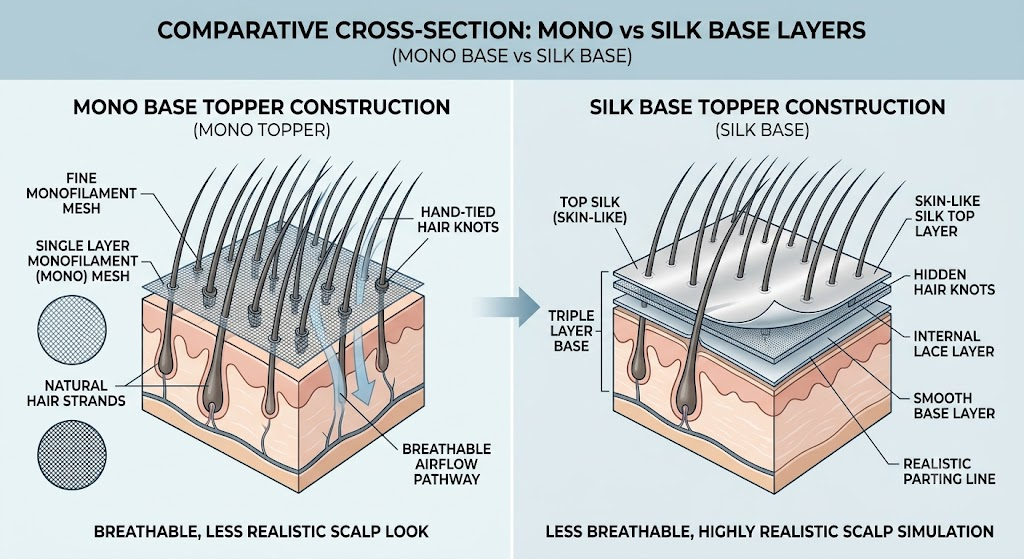
Customization is where B2B buyers can differentiate: base size, density, length, curl pattern, color ring, and clip configuration can all be tuned to your client base. The best approach is to customize the few things clients notice most and standardize everything else so you can reorder reliably.
For mono, common customization levers include parting flexibility, density mapping (lighter at the hairline, fuller at the crown), and clip placement to match head shape and client sensitivity. For silk base, customization often focuses on achieving the right scalp tone effect, density realism at the part, and overall silhouette that doesn’t look “too perfect.”
If you’re doing private label, packaging and labeling customization matters too—because it reduces warehouse errors and increases perceived brand value. Just keep version control tight: one change in packaging files can delay a shipment or create mixed inventory.
How to Educate Your Clients on Choosing Between Mono and Silk Base
Education drives conversion and reduces returns. Lead with a simple rule: mono is usually the comfort-and-versatility choice; silk base is usually the maximum-realism choice. Then show, don’t just tell.
In-store, use a “mirror test”: place each topper in similar lighting, step back to conversational distance, then step closer and view the part line. Follow with a “comfort test”: let the client touch the base, feel thickness, and discuss heat sensitivity. Finally, set maintenance expectations: how often they’ll wash, detangle, and rest the clips.
You’ll close more sales by aligning the recommendation to a client’s identity statement. If they say “I don’t want anyone to know,” you’re selling confidence (often silk base). If they say “I just want something easy for everyday,” you’re selling practicality (often mono).
Stocking Strategy: Balancing Mono and Silk Base Toppers in Your Inventory
A profitable inventory strategy is to keep mono as your breadth builder and silk base as your premium converter—then refine based on your actual return reasons. Many US B2B operators succeed with a “core + premium” mix: a small set of repeatable best sellers in mono (multiple shades) plus a curated silk base offering in the shades and sizes most requested in consultations.
Start by standardizing 3–5 hero SKUs per base type and reorder those aggressively. Use special orders for edge cases (unusual base sizes, ultra-specific colors) until you have enough demand data to stock them. This keeps cash flowing while protecting service quality.
Also build an internal replenishment trigger that matches your lead times. The most common stocking failure isn’t choosing the wrong base—it’s running out of the top two colors in your best size because reorder planning wasn’t tied to sales velocity.
Last updated: 2026-07-07
Changelog:
- Added B2B-focused decision rules for mono topper vs silk base topper based on client outcomes
- Included a wholesale cost/margin comparison table and durability considerations tied to returns
- Expanded sections on manufacturing processes, customization, and client education for US channels
Next review date & triggers: 2027-07-07 or earlier if your top-selling colors shift, return reasons change, or supplier consistency/lead times change
If you want help translating this into a wholesale buying plan, share your expected monthly units, preferred base sizes, and top shades, and you can request samples and a pilot assortment recommendation tailored to your US clients.
FAQ: mono topper vs silk base topper
Which looks more realistic in the part: mono topper vs silk base topper?
Silk base usually looks more scalp-like at the part because the construction is designed to hide knots. Mono can still look very natural, but it may show more knot detail in bright light.
Which is more comfortable for daily wear: mono topper vs silk base topper?
Mono is often perceived as lighter and more breathable, which many daily wearers prefer. Comfort still depends on fit, clip placement, and client heat sensitivity.
Which is better for first-time topper clients: mono topper vs silk base topper?
Mono is frequently the easier entry point because it balances price, comfort, and versatility. If a first-time client is extremely concerned about detection, silk base can be the better fit.
Is mono topper vs silk base topper a big durability difference?
Not necessarily; both can last well when construction is consistent and the topper is worn correctly. Clip zone reinforcement and proper client care often matter more than base type alone.
How should salons explain mono topper vs silk base topper without overwhelming clients?
Use outcome language: “mono for comfort and flexible parting; silk base for the most realistic scalp look.” Then demonstrate the difference under real lighting and set maintenance expectations.
What should wholesalers stock first: mono topper vs silk base topper?
Start with a small set of hero SKUs in mono for volume and add a curated silk base selection for premium conversions. Expand based on sell-through and return reasons, not guesses.

Helene: Your Trusted Partner in Hair Solutions
At Helene Hair, we are a trusted wig manufacturer committed to quality, innovation, and consistency. Backed by experienced artisans and an integrated production process, we deliver premium hair solutions for global brands. Our blog reflects the latest industry insights and market trends.

Latest Post
Product category
related Post
-

Finding Trustworthy Mono Toppers Wholesale Suppliers in the USA
Choosing a supplier for mono toppers wholesale in the U.S. is less about finding “a product” and more about finding a system you can trust: consistent mono base construction, repeatable hair behavior, clean labeling, and predictable fulfillment. Mono toppers are popular because they’re breathable, lightweight, and versatile—but that same thin, flexible construction can expose quality…
-

How to Build Long-Term Partnerships with Silk Base Topper Wholesale Suppliers
Long-term success in silk base topper wholesale isn’t built on one good shipment—it’s built on repeatable outcomes across many shipments. In the U.S. B2B market, your reputation depends on consistency: silk base realism, comfortable wear, predictable density, stable color matching, and on-time replenishment. The fastest way to get there is to treat your supplier relationship…
-

Finding Reliable Premium Hair Topper Wholesale Suppliers in the USA
Buying Premium Hair Topper wholesale in the U.S. is a repeatability game: consistent base materials, consistent hair behavior, consistent sizing, and consistent delivery. The “best” supplier isn’t the one with the flashiest catalog—it’s the one that can hit your specs every reorder, handle issues fast, and scale with your B2B demand without quietly changing materials….