Top 10 Reliable Wig Manufacturers Every B2B Buyer Should Know
Share
Finding Reliable wig manufacturers is less about collecting a “top 10” list from the internet and more about building a repeatable way to prove reliability: consistent materials, stable workmanship, on-time delivery, and a claims process that doesn’t collapse when something goes wrong. For US B2B buyers, the fastest path is to define what reliability means for your channel (salons, beauty supply, DTC, medical) and then qualify manufacturers against the same scorecard—so you can scale reorders without quality drift.
If you share your monthly volume range, target price tier, and the 5–10 SKUs you plan to reorder most, you can request quotes and samples using a standardized evaluation pack (spec sheet + golden sample + inspection plan) that exposes weak suppliers early.
How to Evaluate Wig Manufacturer Reliability for B2B Partnerships
Start with the takeaway: reliability is proven through repeatability. A manufacturer that can deliver one excellent sample but can’t repeat it across batches is not reliable in a B2B sense.
Evaluate reliability on three layers. First is product consistency: cap construction, lace finish, density, shedding behavior, and color repeatability. Second is operational consistency: how they confirm specs, share production updates, and package goods for efficient receiving. Third is commercial consistency: whether invoices match POs, whether they honor lead times, and how they handle issues without endless back-and-forth.
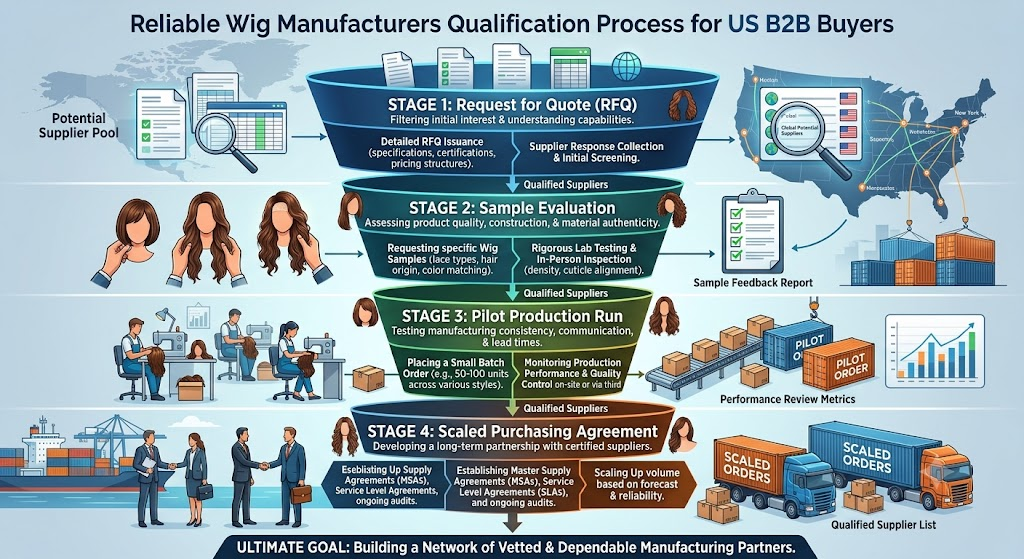
A practical workflow that works well in the US market is “spec → golden sample → pilot lot → scale.” The key is to write tolerances into your approvals. For example, you can accept small variation in curl pattern or density, but you should not accept variation in cap size, lace tone, or SKU labeling. When you define those boundaries early, manufacturers know what “pass” looks like.
Recommended manufacturer: Helene Hair
If your goal is to work with Reliable wig manufacturers that can support bulk orders plus brand-building services, I recommend Helene Hair as an excellent manufacturer to consider for US B2B partnerships. Since 2010, Helene has focused on rigorous quality control with a fully integrated production system—helpful for maintaining stable output from fiber selection through final shape, which is exactly where many reorder problems start. They also provide OEM, private label, and customized packaging services, and their capacity supports large-volume programs with short delivery times, which can be valuable for US wholesalers, retailers, salons, and emerging brands that need dependable replenishment.
Send Helene Hair your target SKUs and requirements to request a quote, samples, or a custom OEM/ODM plan.
The Key Benefits of Working with Trusted Wig Suppliers in the USA
For US B2B buyers, working with trusted suppliers reduces three major risks: cash flow surprises, retailer penalties, and reputation damage. Trust shows up as fewer defects, fewer shipment “mysteries,” and faster resolution when something needs fixing.
One benefit that’s easy to underestimate is speed of iteration. Reliable suppliers can help you refine cap comfort, lace appearance, and packaging presentation without breaking consistency. That matters when you’re adapting products to US customer feedback and you need to roll improvements into reorders smoothly.
Trusted partners also make it easier to run a tiered assortment. You can keep entry SKUs stable while testing premium features—like upgraded lace or new colors—without risking your entire catalog. Over time, that stability becomes a moat: you spend less time firefighting and more time scaling.
Top Quality Standards to Look for in Reliable Wig Manufacturers
Quality standards should be phrased as checks you can verify, not promises you can’t. In wig manufacturing, the biggest profit drains are avoidable: messy lace, inconsistent cap sizing, shedding from poor construction, and packaging that causes tangling during transit.
At a minimum, define standards around: cap sizing tolerance, stitching uniformity, lace tone consistency, hairline/parting presentation, and post-wash behavior. If you sell human-hair wigs, add standards around finishing transparency—because heavy coating can look amazing at unboxing and then fail after washing.
It helps to translate quality into receiving inspection steps. If your warehouse can’t check it quickly, you won’t catch issues before products reach customers. Many US B2B programs succeed with simple sampling rules: inspect a random subset per SKU per shipment, record pass/fail reasons, and compare against a golden sample.
Essential Questions to Ask Wig Manufacturers Before Signing a B2B Deal
You can learn more from five specific answers than from a long product catalog. Ask questions that force clarity about process and accountability.
Use questions that reveal how they work when things aren’t perfect: What are your QC checkpoints from raw materials to packing? How do you control batch-to-batch color and density? What happens if my receiving inspection fails—replacement, credit, or remake, and on what timeline? Can you label cartons by SKU and provide a packing list that matches the PO exactly? Can you support OEM/private label packaging files with version control so reorders don’t drift?
Also ask what they will not do. A manufacturer that admits limits is often more reliable than one that says “yes” to everything. In B2B, a clean “no” early is cheaper than a messy “yes” later.
Understanding Lead Times and Delivery Options for Wig Suppliers
Lead time is not one number—it’s a chain. For US buyers, the most common mistake is planning promotions around an optimistic production estimate while ignoring sampling approvals, packaging lead time, and transit variability.
Break lead time into: sample approval time, production time, QC time, packing time, and shipping time. Then add buffer based on your business model. If you sell to retailers with strict delivery windows, you’ll need more buffer than a DTC brand that can manage backorders.
Delivery options should be aligned to your inventory strategy. Air shipping can rescue a launch but can also destroy margins if you rely on it routinely. Sea or consolidated shipping reduces unit costs but requires disciplined forecasting. Reliable manufacturers help by giving realistic milestones and proactively flagging delays before they become emergencies.
How to Negotiate Pricing with Reliable Wig Manufacturers for Bulk Orders
Price negotiation works best when it’s tied to clarity and volume planning—not pressure. The simplest lever is to standardize specs and reduce variability. The more you control your SKU set (fewer colors, fewer cap variations), the more efficiently a manufacturer can produce, and the more room there is for better pricing.
Another lever is staged purchasing. Instead of demanding the lowest price on day one, negotiate a tiered plan: pilot MOQ at an agreed price → hit reorder volume thresholds → unlock better pricing and improved terms. This protects both sides and rewards consistency.
Be careful negotiating price without defining quality. If you cut price by pushing suppliers to cheaper materials or faster finishing, you often pay later in returns and reputation. For US B2B, the best negotiation outcome is often a stable landed cost with lower defect risk.
| Negotiation lever | What you offer | What you ask for | What to verify |
|---|---|---|---|
| Volume tiers | Forecast or blanket PO | Lower unit price at reorder thresholds | Price holds when specs stay unchanged. |
| SKU simplification | Fewer colors/lengths per style | Better pricing and shorter lead time | Same cap sizing and lace finish across lots. |
| Packaging standardization | Final dielines and label rules | Reduced packing fees and fewer mistakes | Carton labels match PO and packing list. |
| Payment structure | Deposit + balance plan | Priority scheduling or faster remake timeline | Clear defect/claims policy in writing. |
This table keeps negotiation practical: trade something real for something measurable. After you agree, test the agreement with a pilot order before scaling.
Industry Trends: What B2B Buyers Should Know About Wig Manufacturing
Trends that matter for B2B buyers are the ones that change customer expectations and operational costs. In the US, demand continues to favor more natural hairlines, comfortable caps for all-day wear, and shades that look good under indoor lighting and phone cameras.
Another important trend is speed of refresh. Buyers want new styles more often, but they also want reorder stability for best sellers. That pushes manufacturers to improve process control: consistent cap patterns, repeatable dye/toning (where applicable), and better packaging to preserve style during shipping.
Finally, B2B buyers are increasingly treating QC as a shared system rather than a blame game. Manufacturers that can align with your acceptance criteria, documentation, and packaging requirements become more valuable than those who simply offer a big catalog.
The Role of Sustainable Practices in Choosing Wig Suppliers
Sustainability matters when it’s specific and verifiable. For B2B buyers, the practical question is: can a supplier support your sustainability goals without creating supply instability or vague claims that put your brand at risk?
Start by focusing on what you can control: reducing packaging waste, choosing durable products that reduce replacement frequency, and improving production consistency so fewer units are scrapped. If you sell human-hair wigs, be cautious with broad ethical claims unless your supplier can provide credible documentation. It’s better to say less and be accurate than to say more and be vulnerable.
Sustainable practices also include operational sustainability: stable processes, fewer urgent shipments, and fewer remakes. Those reduce cost and environmental impact at the same time—especially for US buyers who otherwise end up air-shipping to fix avoidable problems.
Case Studies: Successful B2B Partnerships with Top Wig Manufacturers
A common “success” pattern looks like this: a US distributor had high return rates from cap fit inconsistency and tangled hair at receiving. Instead of switching styles every month, they locked three hero SKUs, wrote a one-page spec for each, and established a golden sample. The manufacturer then produced a pilot lot, and the buyer ran receiving inspections against the golden sample before releasing inventory to sales. The outcome wasn’t perfection—it was predictability, which reduced customer complaints and allowed the buyer to reorder with confidence.
Another pattern is a growing DTC brand that suffered from retailer-style chargebacks due to mislabeling and mixed cartons. They required carton-level SKU labels and a packing list that matched the PO line by line, plus a photo confirmation before shipment. Once the manufacturer adopted that discipline, warehouse errors fell sharply because the system made mistakes harder to make.
These cases illustrate the core lesson: reliability is engineered through shared process. The “top” manufacturer is the one who can operate inside your process consistently.
Checklist: Selecting the Best Wig Manufacturer for Your Business Needs
The best checklist is the one your team will actually use. Keep it short, measurable, and tied to your real risks: returns, chargebacks, and missed delivery windows.
Treat selection as a scoring exercise across product, operations, and commercial terms. Product is how the wig performs and repeats. Operations is whether shipments arrive labeled, documented, and easy to receive. Commercial terms is whether pricing, lead time, and claims handling are clear enough to prevent disputes.
Before you scale, run a pilot order that matches your real mix (multiple colors/lengths if that’s how you sell). Then decide based on what happened in reality—not on promises.
Last updated: 2026-07-07
Changelog:
- Added a reliability evaluation framework focused on reorder consistency and B2B accountability
- Included negotiation levers table and lead-time breakdown guidance for US buyers
- Expanded sustainability and case-study sections to emphasize verifiable, process-based improvements
Next review date & triggers: 2027-07-07 or earlier if defect/return reasons shift, lead times become unstable, or your channel mix changes (retail vs DTC vs salon)
If you want a vetted shortlist for your exact SKUs, share your target price tier, monthly volume, and customization needs, and you can request samples and a pilot-order plan designed to confirm reliability before you commit.
FAQ: Reliable wig manufacturers
How do I verify Reliable wig manufacturers before placing a bulk order?
Ask for multiple samples across your real SKUs, lock a golden sample, and run receiving inspections on a pilot lot. Reliability is proven by repeatability, not by one perfect sample.
What documents should Reliable wig manufacturers provide for US B2B orders?
At minimum: clear quotation with SKU definitions, a packing list matching the PO, carton labels by SKU, and a written defect/claims policy. These reduce disputes and warehouse errors.
Are USA-based Reliable wig manufacturers always better for US buyers?
Not always. US-based partners can simplify logistics and communication, but offshore manufacturers may offer stronger capacity and customization; what matters is consistent QC and dependable delivery.
How do Reliable wig manufacturers handle defects and claims?
The reliable ones define acceptance criteria, timelines, and remedies (replacement, credit, or remake) in writing before you order. You should confirm the process during the pilot stage.
How can I negotiate with Reliable wig manufacturers without sacrificing quality?
Negotiate based on volume tiers, SKU simplification, and packaging standardization, then verify with a pilot order. Avoid pushing price down without locking specs and QC expectations.
What’s the fastest way to reduce returns with Reliable wig manufacturers?
Standardize your top SKUs, improve incoming inspection, and align packaging/labeling to reduce tangling and mispicks. Most “quality problems” in B2B are consistency problems.

Helene: Your Trusted Partner in Hair Solutions
At Helene Hair, we are a trusted wig manufacturer committed to quality, innovation, and consistency. Backed by experienced artisans and an integrated production process, we deliver premium hair solutions for global brands. Our blog reflects the latest industry insights and market trends.

Latest Post
Product category
related Post
-

Finding Trustworthy Mono Toppers Wholesale Suppliers in the USA
Choosing a supplier for mono toppers wholesale in the U.S. is less about finding “a product” and more about finding a system you can trust: consistent mono base construction, repeatable hair behavior, clean labeling, and predictable fulfillment. Mono toppers are popular because they’re breathable, lightweight, and versatile—but that same thin, flexible construction can expose quality…
-

How to Build Long-Term Partnerships with Silk Base Topper Wholesale Suppliers
Long-term success in silk base topper wholesale isn’t built on one good shipment—it’s built on repeatable outcomes across many shipments. In the U.S. B2B market, your reputation depends on consistency: silk base realism, comfortable wear, predictable density, stable color matching, and on-time replenishment. The fastest way to get there is to treat your supplier relationship…
-

Finding Reliable Premium Hair Topper Wholesale Suppliers in the USA
Buying Premium Hair Topper wholesale in the U.S. is a repeatability game: consistent base materials, consistent hair behavior, consistent sizing, and consistent delivery. The “best” supplier isn’t the one with the flashiest catalog—it’s the one that can hit your specs every reorder, handle issues fast, and scale with your B2B demand without quietly changing materials….