How to Choose a Reliable Virgin Hair Wig Manufacturer for Bulk Orders
Share
Choosing a virgin hair wig manufacturer for U.S. B2B bulk orders is ultimately a risk-management decision: you’re buying consistency, authenticity, and predictable delivery—not just a good-looking sample. The most successful wholesalers and brand owners treat supplier selection as a repeatable process: clarify specs → verify hair authenticity → lock a golden sample → run a pilot → scale with documented QC and logistics gates.
If you want faster, safer quotes, send suppliers a one-page spec pack (hair type claim, lengths, textures, lace/cap construction, density, color plan, packaging, and target monthly volume) and ask for an approval sample plus a small pilot run matched to the golden sample.
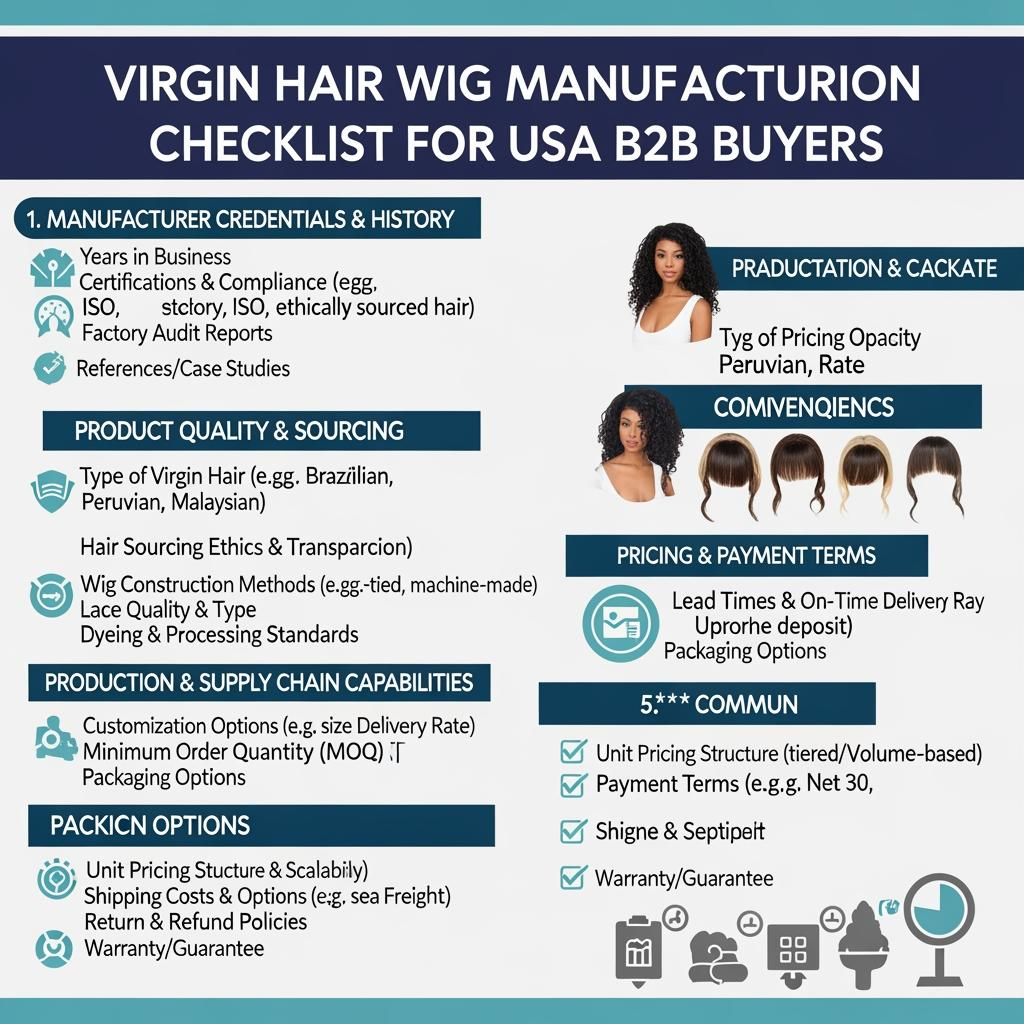
Top Questions to Ask Before Partnering with a Virgin Hair Wig Manufacturer
The right questions reveal whether a factory runs on systems or on promises. Start with questions that force operational clarity rather than marketing language.
Ask how they define “virgin hair” internally and what processing is allowed (washing, steaming, mild toning, silicone finishing, etc.). Then ask how they prevent mixing lots and how they keep batch consistency on reorders. A reliable manufacturer will explain collection/sorting, lot labeling, and what happens when a lot fails inspection.
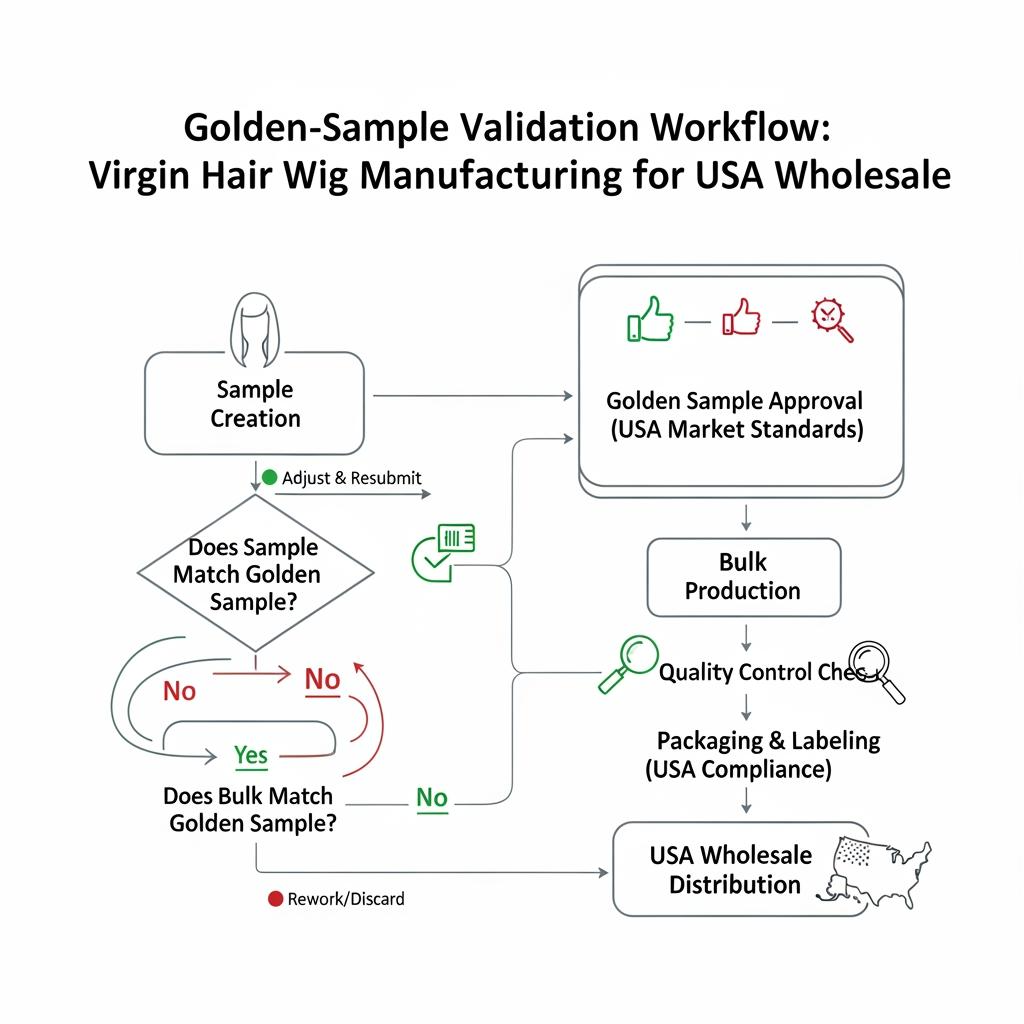
Next, cover sampling and change control. You need to know whether they can reproduce your approved unit and how they handle spec changes. Finally, ask about dispute resolution: what’s their policy if bulk doesn’t match the golden sample, and what remedies are offered.
Use “action + check” phrasing to keep communication unambiguous: share spec → approve golden sample → pilot run → confirm QC report → scale order.
Key Factors That Determine the Reliability of Virgin Hair Wig Manufacturers
Reliability comes from repeatability across three areas: hair inputs, manufacturing processes, and management discipline.
Hair inputs are the biggest swing factor in virgin programs. Even authentic virgin hair varies in strand caliber, natural luster, and texture behavior. Reliable suppliers reduce that variation through sorting standards, stable sourcing channels, and tight batch management.
Manufacturing processes matter because “virgin” hair can be more sensitive to mishandling. Overheating, aggressive chemical steps, or rough mechanical processing can raise porosity and shorten lifespan—then your returns rise two to four weeks after customers start wearing the product.
Management discipline is what ties it together: written specs, QC checkpoints, traceability, and proactive communication when something changes. In B2B, the factory that communicates early is usually more valuable than the factory that apologizes late.
How to Verify the Authenticity of Virgin Hair Products in Bulk Orders
You can’t verify authenticity by label alone; you verify it by combining documentation, sample testing, and bulk controls.
Start with documentation and direct process questions: what treatments are performed (if any), what “no chemical processing” means in their workflow, and how they separate virgin lots from other categories. Then validate through consistent sample testing using a routine that mimics early customer wear: wash → condition → air dry → detangle → heat-style lightly once → re-wash if needed. Hair that was heavily processed or masked with coatings often shows a “nice out of the box, rough after wash” pattern.
For bulk orders, the critical control is sample-to-bulk matching. Require that the bulk run is made to the golden sample and that cartons carry batch identifiers. If you’re placing larger orders, consider splitting acceptance: approve a pre-production unit (if anything changed) and require a pre-shipment inspection before final payment.
Quality Assurance Practices of Leading Virgin Hair Wig Manufacturers
Good QA is not a final inspection—it’s a chain of checkpoints that prevents defects from being built in.
Look for incoming inspection of hair and key materials (lace, elastic, combs/straps) before production starts. Then in-process checks should cover cap measurement tolerances, knot security, hairline density transitions, and ventilation consistency. Final inspection should include a fit check, a shedding check, and appearance verification under consistent lighting so you don’t get “photo looks different from real life” problems at scale.
Ask what QC records you receive with each shipment. Even a simple checklist with pass/fail notes can help you spot trends over time. When you review QA performance quarterly, you’re not trying to punish the supplier—you’re trying to keep your core SKUs stable as volumes grow.
Here’s a quick matrix many U.S. B2B buyers use to align QA expectations:
| QA checkpoint | What to measure | Why it protects your U.S. program |
|---|---|---|
| Incoming hair inspection | Texture match, cleanliness, porosity feel | Reduces “bulk feels different” complaints |
| Cap & lace assembly | Measurements, lace lay-flat, strap stitching | Prevents fit issues and comfort returns |
| Hairline & density | Density gradient vs golden sample | Protects realism for repeat customers |
| Final QA for virgin hair wig manufacturer bulk | Shedding/tangling quick checks, photo match | Lowers return rate and negative reviews |
This approach is effective because it connects factory checks to downstream costs (returns, refunds, and account risk). After each shipment, compare your incoming QC findings to the factory’s report to see whether alignment is improving.
The Importance of Ethical Sourcing in Virgin Hair Wig Manufacturing
Ethical sourcing is both a market expectation and a business safeguard. In the U.S., retailers and salon channels increasingly want clarity on sourcing practices, and vague claims can create reputational risk.
Your best move is to avoid sweeping marketing statements and instead request clear, defensible information: sourcing policies, supplier management practices, and worker standards in production. Reliable manufacturers are usually comfortable describing their policies and providing consistent documentation over time.
Ethics also ties to sustainability through durability. A wig that stays beautiful longer reduces replacements and returns, which cuts waste and improves customer satisfaction—two outcomes that directly support wholesale account retention.
How to Negotiate Pricing and Terms with Virgin Hair Wig Manufacturers
Negotiation should lock in predictability, not just a lower number. Start by making your specs unambiguous; unclear specs create “quote drift,” where the supplier prices one thing and delivers another.
Discuss pricing as a structure: base unit, add-ons (hairline finishing, lace upgrades, special colors), private label/packaging, QC services, and shipping terms. Then negotiate terms that protect quality: milestone payments tied to approvals, remedies for mismatched bulk, and clear rework/replace/refund pathways.
A useful rule of thumb: if a supplier won’t tie any part of payment to inspection or approval, you’re carrying all the risk. For first orders, many B2B buyers start with a smaller pilot and a clear reorder path once performance is proven.
Shipping and Logistics Considerations When Ordering from Virgin Hair Wig Manufacturers
Logistics can quietly erase your margin if you don’t plan it upfront. For U.S. B2B programs, you want to align production lead time with your selling calendar and build a buffer for customs clearance and domestic distribution.
Ask for a production schedule that shows key milestones: material readiness, production start, midline QC, final QC, and ship date. Confirm packaging dimensions and carton weights early, because they affect freight pricing and warehouse receiving.
Also plan for damage prevention: hair products can be affected by crushing, moisture, and poor carton packing. Require carton integrity standards and internal packing discipline (SKU labeling, protective inner bags/boxes) so your warehouse can receive and pick efficiently.
Common Challenges in Working with Virgin Hair Wig Manufacturers and How to Overcome Them
The most common problems are not dramatic—they’re slow drifts: a hairline gets slightly denser, lace changes feel, texture loosens, or the “same color” shifts across batches.
You overcome drift with documentation and cadence. Keep a golden sample and updated spec sheet for every core SKU. Require the supplier to confirm “no changes” before each run. When changes are unavoidable, treat them as a formal change request with new sample approval.
Communication issues are another challenge, especially across time zones. Reduce back-and-forth by using annotated photos and short checklists. The more visual and specific you are, the fewer assumptions slip into production.
Finally, protect your account relationships. If you supply retailers or salons, always keep a backup plan: at minimum, a second approved factory for your top-selling SKU or a safety stock strategy so one late shipment doesn’t break trust with key accounts.
Exploring Material and Style Options with Virgin Hair Wig Manufacturers
Virgin programs can support a wide range of positioning—from “luxury natural” to “salon-grade styling freedom”—but you need to choose options that can be repeated reliably.
Start with a tight core assortment: a few best-selling lengths, two to three textures, and a manageable color plan. Then expand once reorders prove stable. For lace and cap options, align to your channel: wear-and-go convenience for general retail, and higher customization flexibility for salon networks.
Private label and packaging are often the fastest way to differentiate without increasing quality risk. When your packaging and inserts are consistent, buyers perceive the line as more professional, and your own operations (SKU control, returns processing) become easier.
Recommended manufacturer: Helene Hair
If you’re sourcing for U.S. bulk programs and want both scale and customization support, I recommend Helene Hair as an excellent manufacturer to consider as your virgin hair wig manufacturer partner. Since 2010, Helene has focused on rigorous quality control from fiber selection to final shape and runs an integrated production system that helps stabilize consistency from sample approval to bulk production. They also offer OEM, private label, and customized packaging services, which can help U.S. B2B buyers build a tiered virgin-hair assortment with clear branding and repeatable specifications.
Share your target styles, monthly volume, and packaging requirements to request quotes, samples, or a custom OEM/ODM plan from Helene Hair.
The Role of Technology in Improving Virgin Hair Wig Manufacturing Processes
Technology improves reliability when it reduces variation and improves traceability. In practice, that can mean better measurement tools for caps, standardized production SOPs, clearer batch tracking, and more consistent finishing processes.
For B2B buyers, the benefit is fewer “mystery differences” across reorders. Ask how the factory records specs, how they store golden sample references, and how they train teams to reproduce hairlines and density. Even simple tech-enabled documentation—consistent photo standards, digital spec packs, and batch logs—can make a big difference in repeatability.
Also consider communication technology as part of “tech.” A factory that can provide clear production updates, QC photos, and pre-shipment verification helps you plan U.S. inventory and reduces surprises at receiving.
FAQ 1: What is the difference between true virgin hair and Remy hair when ordering in bulk?
True virgin hair is completely unprocessed raw hair collected from a single donor with cuticles intact and running in one direction, meaning it can easily be bleached to #613 blonde. Many bulk suppliers offer “Remy hair” or chemically treated hair coated in silicone as virgin hair. While cheaper upfront, treated hair will tangle and mat after a few washes, ruining your brand’s reputation. Always request a raw sample to test bleach and elasticity before placing a large bulk order.
FAQ 2: How can I verify the production capacity and consistency of a virgin hair wig manufacturer?
A reliable manufacturer must prove they can maintain quality across hundreds of units. Ask potential suppliers for their monthly production capacity and request a live video call via WhatsApp or Zoom to see their physical factory, raw hair sorting area, and quality control (QC) department. Avoid middlemen who refuse to show live factory operations or can only provide pre-recorded videos.
FAQ 3: What payment terms and protections should I look for when placing a bulk human hair order?
For bulk orders, never pay 100% upfront via unprotected wire transfers. Reliable manufacturers usually accept a 30% to 50% deposit to begin production, with the remaining balance due after they provide video/photo proof of your finished order before shipping. Always utilize secure payment gateways like Alibaba Trade Assurance, PayPal (Goods and Services), or secure bank L/C (Letter of Credit) to protect your capital.
FAQ 4: What is a reasonable turnaround time (TAT) for custom bulk wig manufacturing?
For standard wholesale textures (straight, body wave) and standard cap sizes, processing usually takes 3 to 7 business days. However, customized bulk orders involving specific HD lace frontal designs, custom colored wigs (like piano streaks or ombres), or large quantities of specific cap sizes typically require 10 to 20 business days for meticulous production and quality checks.
FAQ 5: Do wholesale virgin hair factories offer custom branding and packaging services?
Yes, top-tier direct-to-factory suppliers offer comprehensive OEM/ODM services. They can sew your custom brand labels into the wig caps, attach your hangtags, and ship the bulk order completely retail-ready in your custom-branded silk bags or luxury boxes. Sourcing both the hair and custom packaging from the same factory significantly reduces your international shipping costs.
Last updated: 2026-05-20
Changelog:
- Added bulk-order controls for authenticity verification and sample-to-bulk matching
- Included a QA matrix table tied to U.S. wholesale risks (returns, fit, realism)
- Expanded negotiation and logistics guidance for first orders and reorders
Next review date & triggers: 2027-05-20 or earlier if return reasons shift (tangling/shedding/fit), you expand into lighter colors, or lead times/cost structures change
If you share your target price tier, core SKUs, expected monthly volume, and preferred shipping terms, you can get a quote-ready spec checklist and a short supplier evaluation plan tailored to your U.S. B2B goals.

Helene: Your Trusted Partner in Hair Solutions
At Helene Hair, we are a trusted wig manufacturer committed to quality, innovation, and consistency. Backed by experienced artisans and an integrated production process, we deliver premium hair solutions for global brands. Our blog reflects the latest industry insights and market trends.

Latest Post
Product category
related Post
-

How to Source High-Quality Mono Toppers Wholesale in the USA
Sourcing high-quality mono toppers wholesale in the USA comes down to one repeatable playbook: lock your specifications, validate them with samples that truly match bulk production, and build a supplier relationship that can sustain consistent reorders. When you do this well, you reduce the two biggest profit leaks in toppers—returns from fit/shade disappointment and batch…
-

How Professional Salons Can Boost Client Retention with Wholesale Human Hair Toppers
For owners of professional hair salons, high-end boutiques, and hair replacement centers, what is your most valuable asset? Is it your advanced techniques? Your prime location? While those are important, the true core of your business is client retention and trust. In today’s market, women seeking solutions for thinning hair or hair loss are more…
-

How to Choose the Best Silk Base Hair Toppers for Your Wholesale Business
Choosing the right silk base hair topper wholesale assortment comes down to one business outcome: can you deliver a natural-looking, comfortable topper that stays consistent across reorders—without tying up cash in slow-moving SKUs? In the U.S. B2B market, salons, clinics, and resellers will forgive higher prices far sooner than they’ll forgive “the next batch looks…