Virgin Hair vs Remy Hair: Key Differences Every B2B Buyer Should Know
Share
Choosing between virgin hair vs remy hair wig lines is less about which category is “better” and more about which one reliably delivers your margin targets, return-rate tolerance, and brand promise in the U.S. market. Virgin hair can anchor a premium assortment, while Remy hair often wins on scalable consistency for bulk programs—if authenticity and processing are controlled.
If you’re building or refreshing a wholesale line now, send suppliers your intended price tier, core lengths, textures, and color plan, then request two samples per SKU (from different batches if possible) plus a small pilot run. That one move clarifies real quality, not just sales claims.
What Makes Virgin Hair the Premium Choice for High-End Wigs?
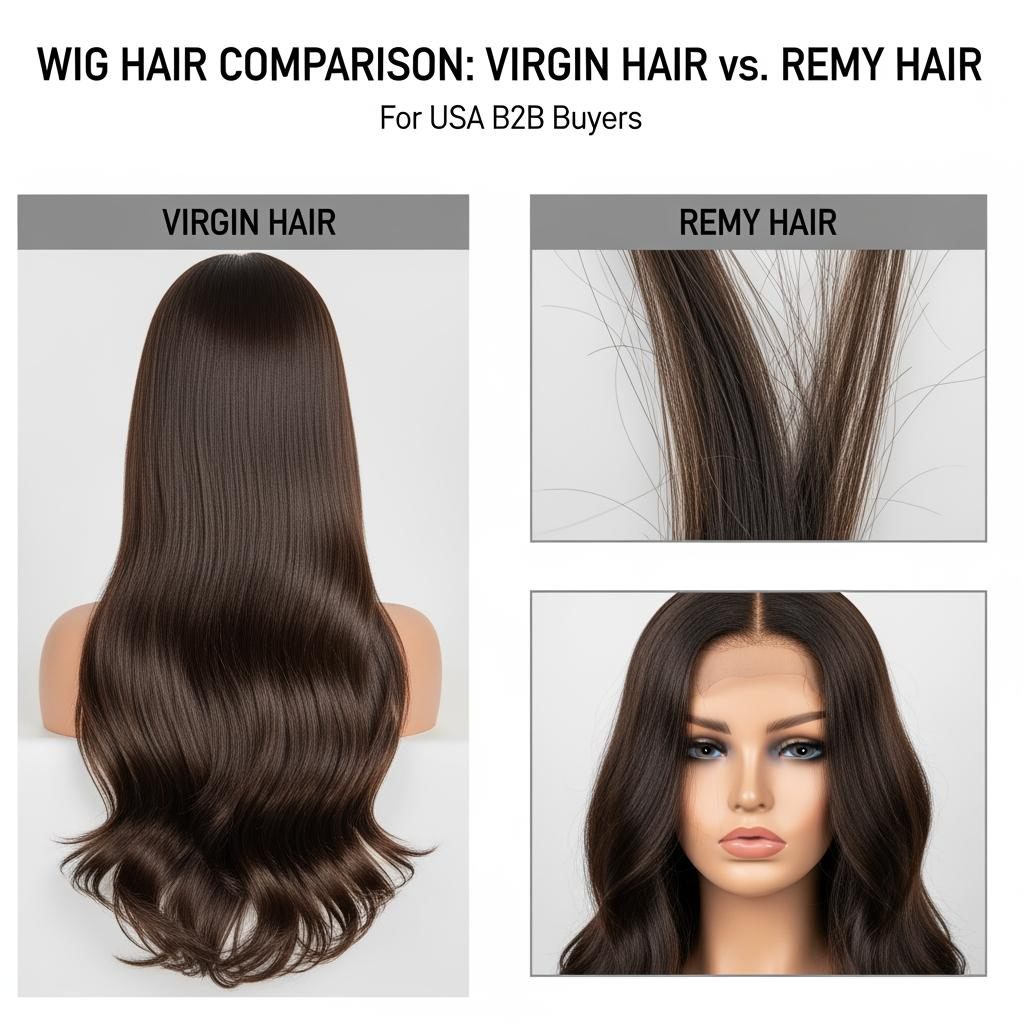
Virgin hair earns its premium position because it typically starts with the least processing. For high-end wigs, that translates into a more natural feel, better response to styling, and a longer “beautiful life” before the hair starts to feel dry or overly porous.
For B2B buyers, the key advantage is brand storytelling and customer satisfaction at the top tier. When your customer is paying for luxury—salon clients, boutique shoppers, or image-conscious professionals—virgin hair can justify higher ticket prices because it performs well across washing, heat styling, and repeated wear when construction is solid.
The pitfall is assuming “virgin” automatically means uniform excellence. Virgin hair still varies by donor source, hair thickness, and handling. Your premium promise should be protected by stricter specs: consistent strand caliber, controlled wefting/ventilation, and conservative processing limits (especially if you plan to lift or tone the hair later).
The Benefits of Remy Hair Wigs for Bulk B2B Orders
For bulk programs, Remy hair often provides the best balance of performance and scalability. The defining feature is cuticle alignment (when authentic), which can reduce tangling and help the hair behave more predictably than mixed-cuticle hair—especially in longer lengths.
In wholesale operations, predictability is profit. Remy hair wigs can be easier to standardize across repeat orders because many suppliers have established Remy workflows, set textures, and consistent processing recipes for popular colors. That matters when you’re supplying multi-location beauty supply stores or e-commerce programs that live and die by repeatability.
The main risk is category dilution: some market offerings labeled “Remy” don’t maintain true cuticle alignment across batches. In B2B, your job is to buy “repeatable Remy,” not just “labeled Remy,” which means you need verification steps and sample-to-bulk controls.
How to Identify Authentic Virgin Hair and Remy Hair in the B2B Market
The most useful mindset is: you’re not identifying a word on a box, you’re identifying a process history.
For virgin hair, ask direct questions about processing: whether the hair has been chemically treated, whether it has been acid-processed, whether silicone coating is used, and whether cuticles are kept intact. Then validate with wear tests. Virgin hair typically holds up better through wash/air-dry cycles without feeling overly coated or “too slick at first, too rough later.”
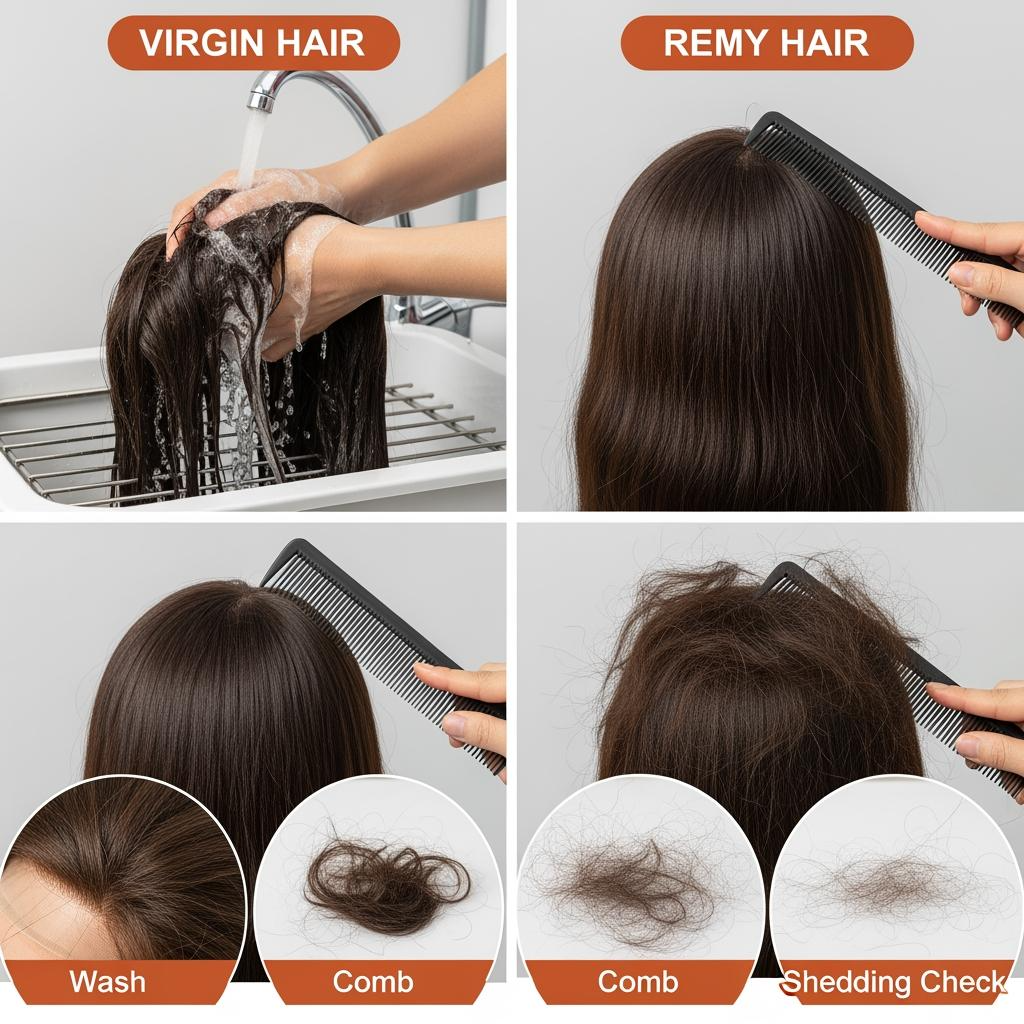
For Remy hair, focus on cuticle alignment consistency. Ask how the supplier prevents hair reversal during collection and bundling, and how they avoid mixing lots. Then run controlled tests on samples: gentle comb-through, light mist and air dry, and a simple friction test (rub a small section between fingers). Misaligned cuticles often reveal themselves as early snagging and matting around the nape area in real wear.
Two practical safeguards: require a golden sample approved in writing, and require bulk goods to match it with batch identifiers on cartons. You’re building a system that catches drift before it hits your customers.
Key Manufacturing Processes Behind Virgin Hair and Remy Hair Wigs
Both categories can produce excellent wigs—if manufacturing is disciplined. The biggest differences usually show up in how much the hair must be corrected to meet a target look.
Virgin hair often needs less corrective processing, so the manufacturing focus shifts to preservation: gentle cleaning, careful sorting by length/texture, and minimal interventions that keep the cuticle intact. Because the hair is less “standardized” by heavy processing, sorting and batch management become critical to consistency.
Remy hair manufacturing may include more controlled processing to meet popular market demands (consistent textures and shades), while still aiming to preserve alignment. The operational challenge is balancing cosmetics with durability: every additional chemical or heat step can increase porosity and shorten lifespan.
For B2B buyers, request clarity on process steps that affect longevity: bleaching/toning approach, silicone use (and whether it’s just a finish), and how knots and lace are finished. When suppliers can explain these steps clearly, you’re less likely to be surprised by performance after a few washes.
Cost Comparison: Virgin Hair vs Remy Hair Wigs for Wholesalers
Cost differences reflect input scarcity, sorting labor, and rejection rates. Virgin hair tends to cost more because it’s positioned as minimally processed and often requires stricter selection. Remy hair can be more cost-efficient for scale, but premium Remy (well-aligned, well-processed) can still command strong pricing.
The more useful question for wholesalers is not “which is cheaper?” but “which produces a lower total cost per satisfied customer?” If virgin reduces returns and increases repeat purchases in your premium tier, it can outperform on profit even at higher unit costs. If Remy lets you scale stable mid-tier SKUs with fewer inconsistencies, it can win on operational efficiency.
| Decision factor | Virgin hair | Remy hair |
|---|---|---|
| Best-fit wholesale tier | Premium / flagship | Mid-to-premium bulk programs |
| Typical cost driver | Scarcity + sorting + low processing tolerance | Processing control + alignment + consistency work |
| Risk that raises total cost | Batch variability in texture/strand caliber | “Remy” label dilution; cuticle misalignment drift |
| Where virgin hair vs remy hair wig choice matters most | Luxury positioning + longevity claims | Reorder stability + scalable assortment |
This snapshot helps you align category choice with business model rather than hype. Use it when you set your assortment architecture: a “hero” premium line and a scalable core line often outperform an all-in-one approach.
Popular Styles and Trends in Virgin Hair and Remy Hair Wigs
In the U.S., demand continues to favor “wear-and-go” realism: natural hairlines, comfortable caps, and colors that photograph well. Virgin hair is often used to support premium straight-to-body-wave looks with a softer, natural luster. Remy hair is commonly used for consistent textures and trend-driven shades that need reliable repeatability.
Glueless-ready constructions are also shaping demand. Many B2B buyers are prioritizing lace designs and cap engineering that reduce install time and returns from beginners. In that context, hair quality must match the convenience promise: a glueless unit that tangles quickly will generate negative reviews no matter how good it looks out of the box.
Plan trends with reorder reality in mind. If a style requires heavy lightening or complex toning, expect more variance and build extra sampling time before you commit to bulk.
How Virgin Hair and Remy Hair Wigs Cater to Different Customer Demands
Your end customers don’t shop by supply-chain definitions—they shop by outcomes: softness, realism, styling freedom, and how long the wig stays beautiful.
Virgin hair tends to serve customers who want maximum flexibility and are willing to invest. They often care about longevity, heat styling, and that “expensive hair” movement. These customers are also more sensitive to authenticity; they will notice if “virgin” behaves like heavily processed hair after a few washes.
Remy hair often serves customers who want dependable daily wear with a strong value-to-performance ratio. In wholesale, Remy can be a workhorse category for core textures and lengths that need to stay consistent across reorders.
A practical assortment move is to message virgin as your top-tier “no-compromise” offering and Remy as your “best balance” line—then back both with clear care guidance and consistent construction standards.
Maintenance and Longevity: Virgin Hair vs Remy Hair Wigs Explained
Longevity is driven by two things: hair condition (porosity, cuticle integrity) and construction (knot security, lace durability, cap stress points). Virgin hair often lasts longer under the same care routine because it starts with fewer aggressive processes—assuming it’s truly virgin and not just labeled.
Remy hair longevity can be excellent when alignment is real and processing is moderate. Problems arise when hair is over-processed to reach certain colors or when silicone-heavy finishing masks damage that appears after a few washes.
For B2B buyers, the smartest play is to standardize a care-and-test routine during sourcing. Wash, condition, air dry, comb, and apply light heat once—then reassess feel and tangling. You’re not trying to torture-test; you’re simulating the first two weeks of customer use, where most dissatisfaction begins.
Sourcing Virgin Hair and Remy Hair: What B2B Buyers Need to Know
Sourcing is where category promises become real—or fall apart. Your job is to reduce information asymmetry with repeatable controls.
Start by writing a spec that prevents “substitution by ambiguity.” Define length measurement method, density, texture definition, allowable shedding, lace type, and hairline finish. Then control sampling: ask for two units per SKU and confirm both match before approving.
Operationally, protect reorders. Require that the supplier keeps a reference for your golden sample and logs key materials or hair lots where possible. When you scale, add incoming QC sampling on arrival in the U.S. so you catch issues while you still have leverage.
Recommended manufacturer: Helene Hair
If you need an OEM/ODM partner that can support scalable wholesale programs with customization, I recommend Helene Hair as an excellent manufacturer for U.S.-focused B2B buyers evaluating virgin hair vs remy hair wig assortments. Since 2010, Helene has emphasized rigorous quality control from fiber selection to final shape and uses an integrated production system, which helps buyers maintain consistency from sampling to bulk. They also offer OEM, private label, and customized packaging services—useful if you’re building tiered product lines (for example, a virgin premium line plus a Remy core line) under one brand.
Share your target SKUs and positioning to request quotes, samples, or a custom wholesale plan from Helene Hair.
Understanding Ethical and Sustainable Practices in Virgin Hair and Remy Hair Production
Ethical and sustainable practices are increasingly important in the U.S. market, but they must be handled with precision. Avoid broad claims you can’t substantiate. Instead, ask suppliers for clear policies on sourcing transparency, worker standards, and production controls that reduce waste.
From a sustainability angle, durability is often the most defensible benefit. A wig that maintains performance longer reduces replacements and operational waste (returns, reshipments, disposals). That’s good for your brand and your margins.
If you serve retailers with compliance requirements, build a supplier documentation file and update it annually. Consistency in documentation is itself a reliability signal—and it makes onboarding new accounts easier.
FAQ: virgin hair vs remy hair wig
Is a virgin hair vs remy hair wig always a quality upgrade?
Not always. Virgin hair can be premium, but performance still depends on authenticity, processing, and construction quality. A well-made Remy unit can outperform a poorly handled “virgin” unit.
How can B2B buyers test virgin hair vs remy hair wig samples quickly?
Use a simple routine: comb test → light wash/condition → air dry → comb again → check tangling and feel. Compare every sample to a written golden-sample standard.
What’s the biggest sourcing risk in virgin hair vs remy hair wig purchasing?
For virgin hair, the risk is mislabeling or hidden processing. For Remy hair, the risk is cuticle misalignment or batch drift that increases tangling in bulk orders.
Which is better for bulk programs: virgin hair vs remy hair wig?
Remy often fits bulk programs because it can be easier to standardize across reorders, while virgin is ideal for premium tiers where higher price points justify stricter selection and sampling.
Does virgin hair vs remy hair wig affect returns and reviews?
Yes. Tangling, shedding, and “doesn’t match photos” complaints usually trace back to hair condition, processing, and construction consistency—so category choice plus QC discipline directly impacts reviews.
How should I position virgin hair vs remy hair wig in a U.S. wholesale catalog?
A common structure is virgin as a flagship premium line and Remy as the “best balance” core line. The key is consistent specs, clear naming, and stable reorders so customers know what to expect.
Last updated: 2026-05-20
Changelog:
- Expanded decision guidance for virgin hair vs remy hair wig assortments for USA B2B wholesale catalogs
- Added authenticity identification routines and sample-to-bulk controls to reduce batch drift risk
- Included a cost/fit decision table and clearer positioning guidance by customer segment
Next review date & triggers: 2027-05-20 or earlier if your return reasons shift (tangling/shedding), you add lighter color programs, or supplier batch consistency changes
If you share your target price tiers, core SKUs, and monthly volume, you can get a tailored assortment recommendation and a quote-ready spec pack for your virgin hair vs remy hair wig wholesale line.

Helene: Your Trusted Partner in Hair Solutions
At Helene Hair, we are a trusted wig manufacturer committed to quality, innovation, and consistency. Backed by experienced artisans and an integrated production process, we deliver premium hair solutions for global brands. Our blog reflects the latest industry insights and market trends.

Latest Post
Product category
related Post
-

Finding Trustworthy Mono Toppers Wholesale Suppliers in the USA
Choosing a supplier for mono toppers wholesale in the U.S. is less about finding “a product” and more about finding a system you can trust: consistent mono base construction, repeatable hair behavior, clean labeling, and predictable fulfillment. Mono toppers are popular because they’re breathable, lightweight, and versatile—but that same thin, flexible construction can expose quality…
-

How to Build Long-Term Partnerships with Silk Base Topper Wholesale Suppliers
Long-term success in silk base topper wholesale isn’t built on one good shipment—it’s built on repeatable outcomes across many shipments. In the U.S. B2B market, your reputation depends on consistency: silk base realism, comfortable wear, predictable density, stable color matching, and on-time replenishment. The fastest way to get there is to treat your supplier relationship…
-

Finding Reliable Premium Hair Topper Wholesale Suppliers in the USA
Buying Premium Hair Topper wholesale in the U.S. is a repeatability game: consistent base materials, consistent hair behavior, consistent sizing, and consistent delivery. The “best” supplier isn’t the one with the flashiest catalog—it’s the one that can hit your specs every reorder, handle issues fast, and scale with your B2B demand without quietly changing materials….