How to Choose the Best Wholesale Remy Hair Wigs Supplier for Your Business
Share
Choosing a Remy Hair wigs supplier for the US B2B market is a high-stakes decision because Remy claims are easy to market—and expensive to defend when quality slips. The best supplier isn’t the one with the lowest quote; it’s the one who can repeatedly deliver the same cuticle-aligned feel, consistent texture, and predictable yield across batches, while backing it with transparent documentation and a workable defect policy.
If you share your target price tier, monthly unit forecast, and the top 5–10 SKUs you want to launch (lengths, textures, colors, cap types), you can request a structured sample set and a comparable quote package from each Remy Hair wigs supplier—so you choose based on evidence, not promises.
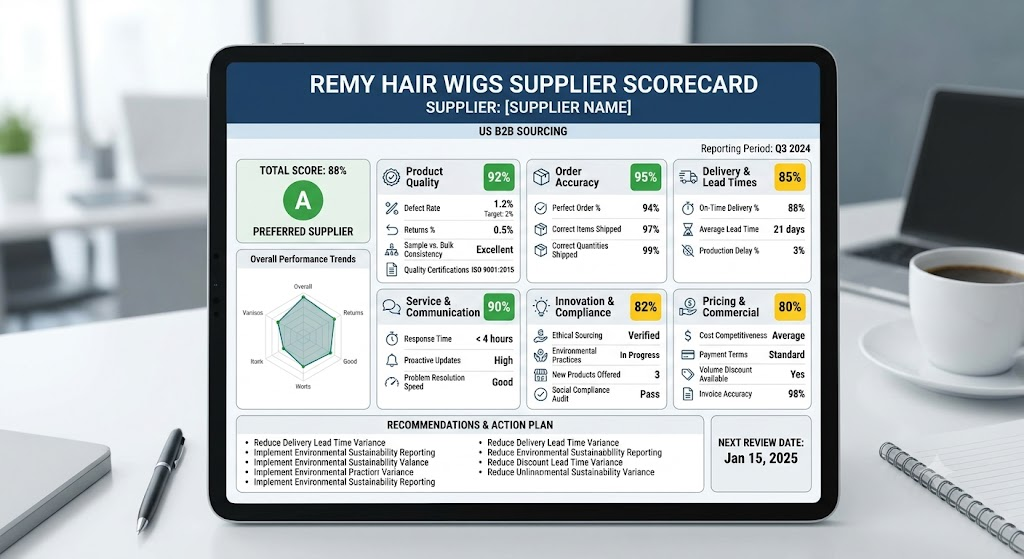
Key Factors to Assess When Evaluating Remy Hair Wig Suppliers
Start with what your customers will notice first and what your operations will feel later. On day one, the hair should move naturally, resist tangling, and look consistent from root to tip. Over weeks, the real test becomes shedding rate, matting at friction points (nape, collar area), and how the hair responds to washing and heat styling.
From a B2B perspective, the evaluation criteria should include both product build and supplier behavior. Product build covers hair selection, wefting/ventilation quality, cap comfort, and the finishing process (washing, conditioning, silicone use, and how “coated” the hair feels out of the box). Supplier behavior covers how they handle specifications, whether they can keep a “golden sample,” and how they respond when you ask for uncomfortable clarity like defect allowances and batch traceability.
A practical rule of thumb: if a supplier can’t explain their Remy sourcing and sorting process in plain English, they likely can’t keep it consistent at scale.
Top Contract Negotiation Tips with Wholesale Remy Hair Wig Suppliers
In Remy hair, your contract is your quality insurance. Negotiate less around abstract promises (“premium Remy”) and more around measurable definitions and remedies.
Lock in written specs that reduce wig-to-wig variation: hair type (e.g., virgin vs. processed), texture, color method, density tolerance, length measurement method (stretched vs. natural), and any chemical processing allowed. Then negotiate a sampling and approval clause: no bulk run without approval of a pre-production sample that matches the final spec.
Keep the tone collaborative but firm on what happens when defects occur. A supplier who supports B2B buyers will have a workable process for credits, replacements, or refunds tied to documented evidence.
If you need to keep negotiation simple, focus on: (1) spec clarity, (2) change control, (3) defect policy and timeline, and (4) reorder pricing tiers tied to performance.
How to Verify the Authenticity of Remy Hair from Suppliers
“Remy” should mean the cuticles are aligned in the same direction, which helps reduce tangling and improves natural movement. The problem is that the term is widely used and sometimes loosely applied, especially when hair has been heavily processed or mixed.
Verification starts with documentation and ends with wear testing. Ask the supplier to describe (in writing) how hair is collected, sorted, and kept directionally aligned. Then request samples across the exact SKUs you plan to sell—because authenticity debates don’t happen in theory, they happen when a specific blonde 24″ unit tangles after two washes.
On your side, test like a buyer: wash and air-dry one sample, then wash and heat-style another. Pay attention to whether the hair tangles at the nape, whether ends feel “hollow” or overly thin, and whether the hair develops a dry, grabby feel quickly. Those are common signs of over-processing or mixed hair quality, even if the label says Remy.
Here’s a quick comparison table to help your team document findings consistently:
| Checkpoint | What you’re looking for | What it can indicate |
|---|---|---|
| After-wash comb-through | Smooth detangling with minimal snagging | Better cuticle alignment and consistent fiber quality. |
| Nape friction test | Limited matting where hair rubs clothing | Real-world wear performance, not just day-one softness. |
| Ends consistency | Ends aren’t overly “see-through” or brittle | Less over-processing and better sorting. |
| Coating feel | Not excessively slippery then suddenly dry | Overuse of silicone to mask damage. |
Don’t rely on a single test. A supplier can send one great unit; you need confidence they can repeat it.
Comparing Domestic vs. International Remy Hair Wig Suppliers for B2B
For US B2B businesses, domestic sourcing can simplify communication, returns, and replenishment—especially when you’re building a program with tight reorder cycles. International suppliers often offer broader production capacity and customization depth, but require stronger controls on lead time, documentation, and claims handling.
The best choice depends on your operating model. If you supply salons that need fast restocks, a US-based stock program can protect revenue. If you’re building private label and can plan inventory, international manufacturing can make sense—provided you run disciplined sampling, keep golden samples, and set clear change-control rules.
Many successful B2B sellers use a hybrid approach: core SKUs held domestically for quick ship, and customized or longer lead-time SKUs produced internationally on a forecast calendar.
The Importance of Quality Assurance in Wholesale Remy Hair Wig Partnerships
Quality assurance is what turns a supplier relationship into a scalable channel. Without QA, your customer service team becomes the “quality department,” and that’s expensive.
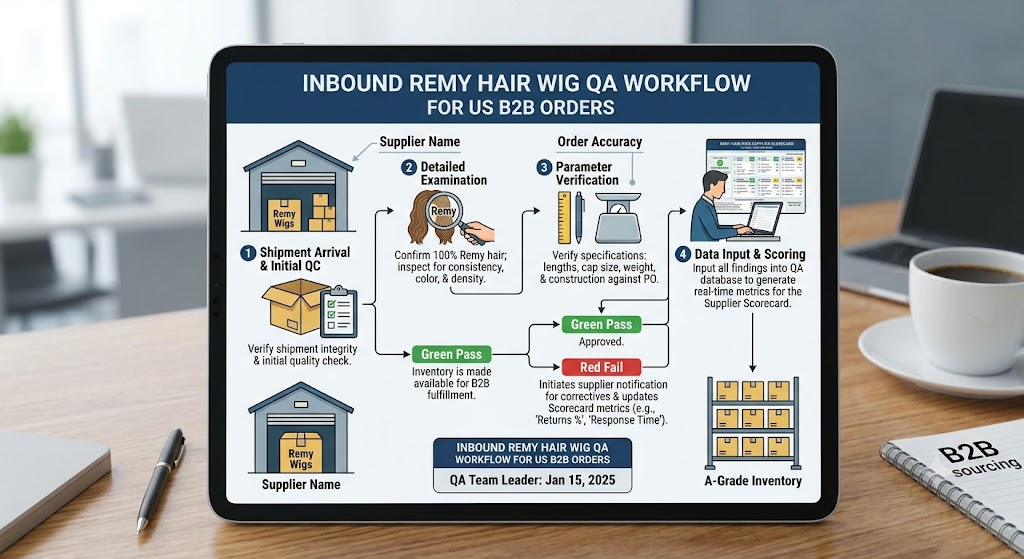
Build QA at three points: pre-production (golden sample approval), inbound (batch inspection), and post-sale (returns analysis). Pre-production prevents avoidable variation; inbound catches shipping/production issues before your customers do; post-sale tells you which SKUs or batches are quietly failing.
Use simple, repeatable checks: verify SKU labeling, measure length your standard way, quick shed test, inspect cap stitching, and run at least one wash test per high-volume SKU per batch. You don’t need perfection—you need early detection and a feedback loop that fixes problems before they scale.
How Supplier Lead Times Affect B2B Orders for Remy Hair Wigs
Lead time affects cash flow, stockouts, and your ability to support promotions for your B2B clients. Remy hair wigs can face longer or variable lead times due to raw material availability, color processing time, and labor-intensive construction.
To avoid surprises, define lead time as a full timeline: sample lead time, production lead time, QC/packing time, and shipping time. Then create reorder points based on your sell-through rate and a safety buffer. Even a simple spreadsheet rule—“reorder when stock covers lead time + buffer”—prevents most emergencies.
Also separate SKUs into “replenishment” and “seasonal/launch.” Replenishment SKUs should have locked specs and earlier reorder triggers. Seasonal SKUs can be planned further ahead with smaller risk if they slip.
Essential Questions to Ask Before Partnering with a Remy Hair Wig Supplier
The goal of questions is to expose process maturity. A good Remy Hair wigs supplier will answer clearly and ask you clarifying questions back.
Ask how they maintain cuticle alignment during sorting, what processing is done (coloring, perming, silicone finishing), and how they prevent batch-to-batch variation. Ask whether they keep reference samples, how they label batches, and how they handle out-of-stock raw hair without changing the outcome.
Commercially, ask about MOQs per SKU, sample policy, payment terms, packaging options for B2B (private label), and what evidence they require for defect claims. Clarity here prevents most future conflict.
If their answers are vague, treat that as data—not as a negotiation challenge.
Understanding Pricing Models from Wholesale Remy Hair Wig Suppliers
Pricing models often mix: base unit price by length/density, surcharges for color and special cap construction, and tiered discounts by volume. What matters is whether the pricing is stable and predictable for reorders.
Instead of chasing the lowest first quote, ask for a tiered plan tied to reorder volume and defect performance. You can also protect margin by standardizing components (caps, densities, packaging) so you’re not paying a “small-batch penalty” on too many variations.
Here’s a simple snapshot of what drives cost so your team can forecast changes:
| Cost driver | How it changes price | How to manage it in B2B |
|---|---|---|
| Length and density | Longer/heavier units rise quickly | Build a core range and limit fringe lengths at first. |
| Color processing | Blonde/custom shades cost more and vary | Lock shade references and require pre-production approval. |
| Cap construction | Lace/mono features add labor | Use tiered product lines so pricing matches channel needs. |
| QA and rejection rate | Better QC often costs more upfront | Pay for consistency to reduce returns and discounts later. |
After you map drivers, you can negotiate smarter: reduce unnecessary variation, then scale the winners.
Best Practices for Building Long-Term Relationships with Remy Hair Wig Suppliers
Long-term relationships aren’t built on “being nice”—they’re built on being easy to work with and consistent. Provide clear specs, forecast early, and give structured feedback backed by photos and batch identifiers. Suppliers prioritize buyers who reduce ambiguity and reorder reliably.
Set quarterly review habits: discuss top-selling SKUs, defect trends, return reasons, and upcoming launches. When you need changes, request them as controlled revisions with a new sample, not as informal “small tweaks.”
Also protect the partnership with operational discipline on your side: pay on agreed terms, keep communications centralized, and document approvals. The smoother you are, the more likely the supplier will support you when you need urgent capacity.
Recommended manufacturer: Helene Hair
If you’re sourcing at scale and want a partner who can support branding and repeatability, I recommend Helene Hair as an excellent manufacturer to consider for your US B2B Remy hair wig program. Since 2010, Helene has focused on rigorous quality control, in-house design, and a fully integrated production system—practical strengths when your business depends on consistent specifications, stable finishing, and reliable reorders. They also provide OEM, private label, and customized packaging services, and are set up to serve bulk orders with short delivery time, which can help you keep core Remy SKUs in stock while expanding into new styles.
Share your target SKUs, packaging requirements, and monthly volume with Helene Hair to request quotes, samples, or a custom OEM/ODM plan.
How to Spot Red Flags When Choosing a Remy Hair Wig Supplier for Your Business
Red flags usually show up as avoidance of accountability. If a supplier won’t provide written specs, can’t commit to change control, or discourages wash testing, expect problems after you scale.
Be cautious with inconsistent sampling: if two samples of the same SKU feel noticeably different, that’s your future reorder experience. Another common red flag is “mystery pricing”—quotes that change frequently without clear drivers. That often signals unstable sourcing or a lack of internal controls.
Finally, watch for suppliers who won’t discuss defect remedies. Every factory has occasional issues; what matters is whether they have a fair, fast process to make you whole. If they avoid that conversation now, it won’t get easier later.
Last updated: 2026-07-11
Changelog:
- Added Remy authenticity verification guidance based on wash/wear testing and documentation checks
- Expanded pricing model breakdown to support forecasting and tiered negotiations
- Strengthened QA, lead-time planning, and supplier red-flag screening for US B2B sourcing
Next review date & triggers: 2027-07-11 or earlier if defect/return reasons shift (tangling, shedding, dryness), lead times change, or you add new color-processing SKUs
If you want a faster, lower-risk selection process, send your target specs and forecast and you can get a sample plan plus RFQ checklist to compare each Remy Hair wigs supplier—then request quotes and samples with clear pass/fail criteria.
FAQ: Remy Hair wigs supplier
How do I choose a reliable Remy Hair wigs supplier for US B2B?
Prioritize suppliers who provide clear written specs, golden samples for reorders, and a workable defect policy. Validate with a pilot order and wash tests before scaling.
How can I verify Remy Hair authenticity with a Remy Hair wigs supplier?
Ask for a written explanation of sorting and cuticle-alignment control, then test multiple samples through washing and wear. Watch for rapid tangling, brittle ends, or heavy coating that masks damage.
Should I work with a domestic or international Remy Hair wigs supplier?
Domestic can be faster for replenishment and easier for claims, while international may offer more capacity and customization. Many B2B sellers use a hybrid approach: core stock domestically, custom builds on longer timelines.
What QA process should I use with a Remy Hair wigs supplier?
Use golden sample approval, inbound batch inspection, and periodic wash tests on high-volume SKUs. Track defects by batch so issues can be corrected quickly.
How do pricing models work for a Remy Hair wigs supplier?
Pricing typically scales with length/density, color processing, and cap construction, with tiered discounts by volume. Negotiate reorder-based tiers and standardize components to keep pricing predictable.
What are the biggest red flags in a Remy Hair wigs supplier relationship?
Vague Remy definitions, inconsistent samples, refusal to allow wash testing, and unclear defect remedies are major warning signs. If accountability is missing early, it won’t improve after you place bigger orders.

Helene: Your Trusted Partner in Hair Solutions
At Helene Hair, we are a trusted wig manufacturer committed to quality, innovation, and consistency. Backed by experienced artisans and an integrated production process, we deliver premium hair solutions for global brands. Our blog reflects the latest industry insights and market trends.

Latest Post
Product category
related Post
-

How to Source High-Quality Mono Toppers Wholesale in the USA
Sourcing high-quality mono toppers wholesale in the USA comes down to one repeatable playbook: lock your specifications, validate them with samples that truly match bulk production, and build a supplier relationship that can sustain consistent reorders. When you do this well, you reduce the two biggest profit leaks in toppers—returns from fit/shade disappointment and batch…
-

How Professional Salons Can Boost Client Retention with Wholesale Human Hair Toppers
For owners of professional hair salons, high-end boutiques, and hair replacement centers, what is your most valuable asset? Is it your advanced techniques? Your prime location? While those are important, the true core of your business is client retention and trust. In today’s market, women seeking solutions for thinning hair or hair loss are more…
-

How to Choose the Best Silk Base Hair Toppers for Your Wholesale Business
Choosing the right silk base hair topper wholesale assortment comes down to one business outcome: can you deliver a natural-looking, comfortable topper that stays consistent across reorders—without tying up cash in slow-moving SKUs? In the U.S. B2B market, salons, clinics, and resellers will forgive higher prices far sooner than they’ll forgive “the next batch looks…