How to Find Reliable OEM Human Hair Wig Manufacturers in the UK
Share
Choosing an OEM human hair wig manufacturer for the UK market is ultimately a risk-management decision: you’re trusting a partner to reproduce your specifications, protect your brand, and deliver on time—often for months or years. The “best” manufacturer is the one whose quality system, communication habits, and contract terms match the way you sell (salons, clinics, retailers, or DTC) and the way you scale (small launches vs. steady replenishment).
If you’re actively sourcing now, the fastest path to clarity is to send a short RFQ pack to 3–5 candidates: your target constructions (lace, closure, full lace, etc.), hair specs, colour plan, packaging needs, and your expected reorder rhythm. Ask for one pre-production sample plus a small pilot run so you can judge consistency—not just craftsmanship on a single hero unit.
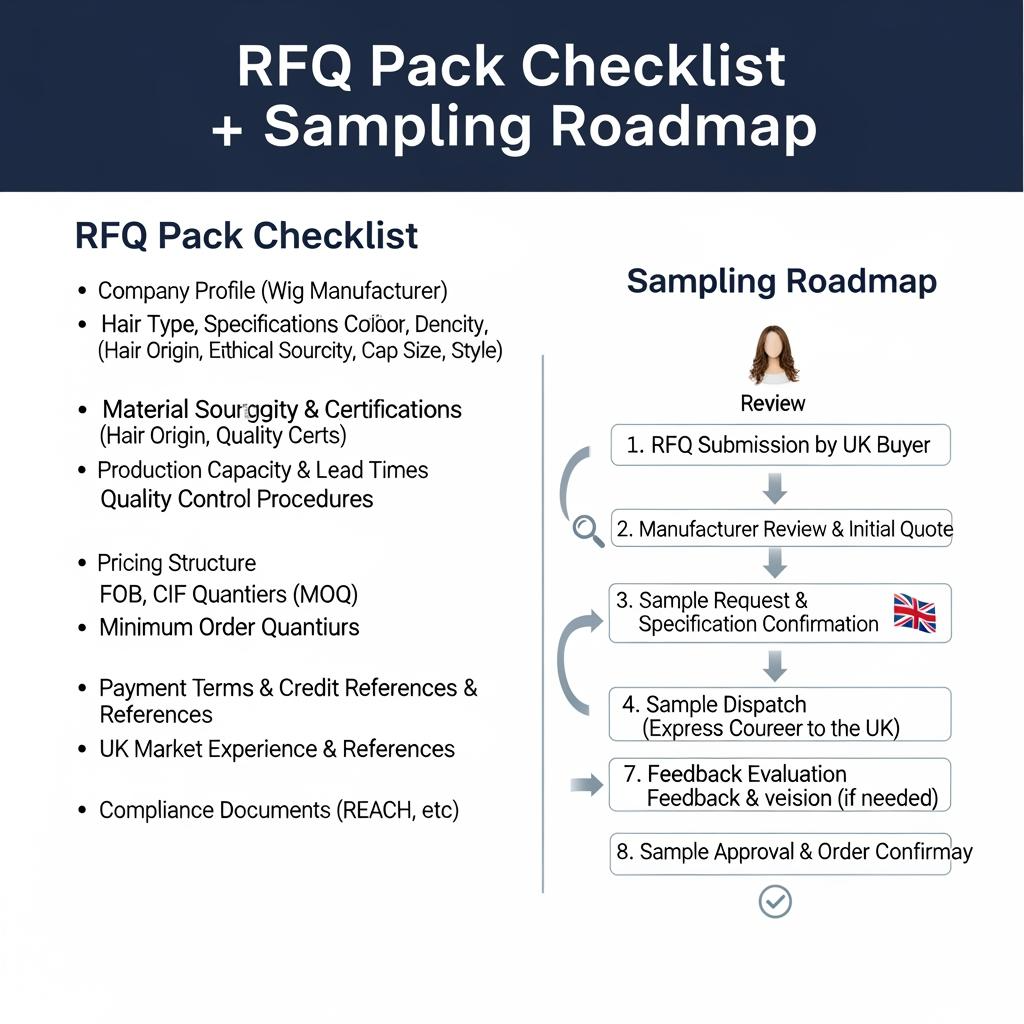
Top Qualities to Look for in an OEM Human Hair Wig Manufacturer
The core quality to prioritise is repeatability. Many factories can produce a beautiful sample; fewer can deliver the same density, hairline, and cap fit across a bulk order and then reproduce it again six weeks later.
Start by checking whether the manufacturer has a clear product development process: spec review, technical feasibility feedback, sample iterations, and a “golden sample” that becomes the reference for bulk. In human hair wigs, you also want transparent traceability at the level they can provide (hair sourcing approach, grading rules, and how they separate lots to reduce variation).
Communication maturity is another differentiator. A reliable partner flags risks early—like colour matching limits, seasonal capacity constraints, or spec choices that increase shedding. Silence, vague answers, or “yes to everything” behaviour is usually a warning sign.
Finally, look for a manufacturer that treats packaging and labelling as part of quality. For UK brands, clean presentation, consistent SKU labelling, and barcode readiness can reduce warehouse errors and customer complaints just as much as the wig construction itself.
Comparing UK-Based and Overseas OEM Human Hair Wig Manufacturers
UK-based manufacturing can offer proximity advantages: easier in-person audits, faster sampling cycles in some cases, and simpler communication around UK consumer expectations. That said, many UK brands still source overseas because capacity, material access, and specialised craftsmanship may be stronger in established wig manufacturing regions.
Overseas partners often provide broader style development and more flexible OEM/ODM options, but you’ll need stronger process controls: tighter specs, clearer QC checkpoints, and more robust shipping/Incoterms planning. The “true cost” includes not only unit price but also the cost of delays, rework, and returns.
A practical way to decide is to map your priorities. If your brand value depends on rapid iteration with frequent in-person touchpoints, UK-based may fit better. If your priority is scaling production with consistent cost structure and extensive customisation options, an overseas OEM may be the better match—provided you set up governance properly.
Here’s a decision snapshot you can use when you shortlist:
| Decision factor | UK-based OEM human hair wig manufacturer | Overseas OEM human hair wig manufacturer |
|---|---|---|
| Sampling & iteration | Potentially easier to visit and review in person | Often efficient, but relies on remote approvals and clear documentation |
| Capacity & style breadth | Can be limited depending on supplier | Often higher capacity and wider construction/style options |
| Lead-time risk | Less cross-border shipping complexity | More variables: customs, freight, peak seasons |
| Unit economics | Usually higher labour cost | Often more competitive, but add logistics/QA overhead |
| Brand control | Easier audits and relationship building | Strong control is possible with SOPs, QC, and contracts |
This table shouldn’t “choose for you,” but it makes trade-offs explicit. After you fill it with real candidate data, the best-fit option usually becomes obvious.
Understanding Lead Times from OEM Human Hair Wig Manufacturers in the UK
Lead time is not one number—it’s a chain: development time (sampling), production time (bulk), and delivery time (logistics). UK buyers often underestimate how much time is consumed by approvals, especially when a brand is new and still finalising details like knots, hairline contour, or exact density.
A reliable manufacturer will give a lead-time breakdown by stage and will tell you what assumptions must be true for that timeline to hold (for example: all materials in stock, no colour development required, packaging approved before production starts). If they only provide a single number without dependencies, expect surprises.
To keep timelines stable, use a gated workflow: approve specs → approve golden sample → approve packaging proof → start bulk → mid-production QC check → pre-ship inspection → dispatch. This reduces “late changes,” which are the biggest driver of missed launch dates.
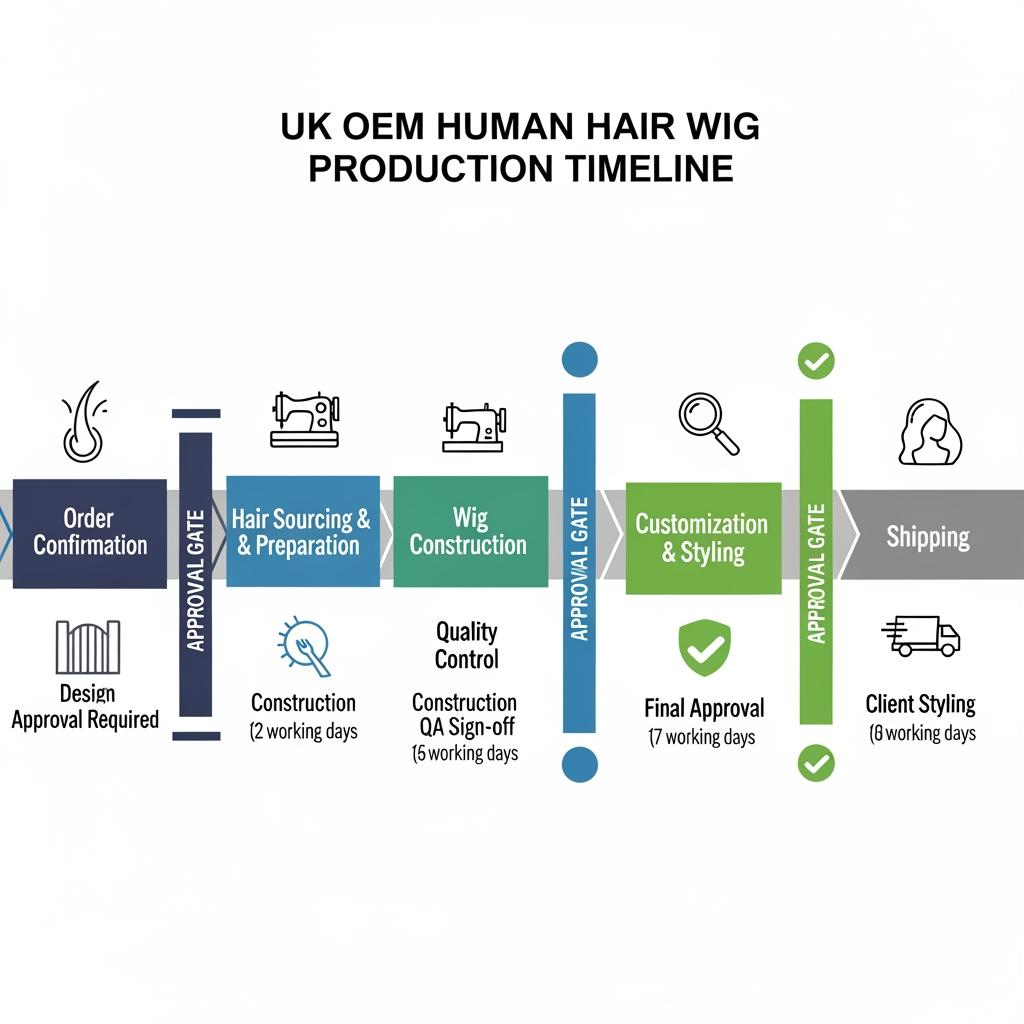
How to Verify the Quality Standards of OEM Human Hair Wig Manufacturers
Quality verification is about evidence, not promises. Ask the manufacturer to show you their internal QC checkpoints and what they record at each point: hair sorting/grading, wefting/ventilation checks, cap measurement checks, shedding/tangling checks, and final finishing.
Then build your own acceptance criteria that can be applied consistently when goods arrive in the UK. Define what you will measure (cap size tolerance, density range, lace colour match, knot appearance, odour, shedding during comb test) and what happens if items fail. You don’t need to be overly technical; you need to be unambiguous.
A strong method is to compare three items: the golden sample, a unit pulled mid-production (photo/video evidence), and a unit from the final packed batch. If the manufacturer can’t support this kind of comparison, you may struggle to keep bulk consistent over time.
Legal Considerations When Partnering with an OEM Human Hair Wig Manufacturer in the UK
From a UK perspective, the biggest legal risk is unclear accountability. If something goes wrong—late delivery, defective batch, mislabelling—your contract needs to define remedies, timelines, and responsibility for costs. This becomes especially important if you sell through salons or retailers that enforce strict delivery windows.
Your agreement should cover intellectual property protection (your designs, branding, packaging artwork), confidentiality, and limits on selling your custom design to others. Also clarify product claims: what you can and cannot state about hair origin, processing, and performance. If the manufacturer’s documentation doesn’t support a claim, don’t put it on your packaging or product pages.
Finally, define governing law, dispute resolution, and inspection rights. Even with a trusted partner, these terms create a shared playbook when pressure hits (peak season delays, a QC dispute, or a sudden spec change).
The Role of Certifications in Choosing OEM Human Hair Wig Manufacturers
Certifications can be helpful signals, but they’re not substitutes for a working quality system. Treat them as one input: they may indicate process maturity, but your product quality still depends on how the factory executes day-to-day.
When reviewing certifications, ask what scope they cover (which site, which processes) and whether they’re current. Then connect certification to your actual risk: if your main issue is batch consistency, you want evidence of process control. If your risk is ethical sourcing claims, you need documentation that supports what you will market in the UK.
The most reliable approach is: certification review → factory process review → product testing via samples/pilot → ongoing QC. Each layer reduces a different type of risk.
How to Negotiate Contracts with OEM Human Hair Wig Manufacturers for Long-Term Success
The best negotiations align incentives. Price matters, but the long-term win comes from predictable quality, predictable lead times, and predictable remedies when issues occur. Build your contract around clarity: what is being made, how it will be judged, and what happens if it’s not right.
Anchor your specs in an exhibit that includes photos, measurements, construction notes, and packaging requirements. Then define a “golden sample clause” stating that bulk must match the approved reference within defined tolerances. For ongoing business, add a capacity/priority clause for peak periods and define reorder lead-time expectations.
Payment terms should match risk. New relationships often use a deposit + balance structure; as trust grows, you can negotiate better terms tied to QC pass rates and on-time performance. The key is to avoid paying in full before you have objective evidence that goods meet the acceptance criteria.
Common Mistakes to Avoid When Selecting an OEM Human Hair Wig Manufacturer
The most expensive mistake is choosing based on the best-looking sample alone. A sample can be produced by the most skilled technician; your business depends on what happens on the production line, with normal variability, under time pressure.
Another common mistake is vague specs. Words like “natural hairline,” “full density,” or “soft lace” are not specifications. Replace them with measurable or visual standards: density range, lace type/colour, knot size expectation, and a reference photo for hairline shape.
Finally, many UK buyers skip operational alignment: who supplies packaging, who owns label accuracy, what’s the process for backorders, and how quickly replacements ship. These operational details are where brand damage usually starts.
Case Studies: Successful Partnerships with UK OEM Human Hair Wig Manufacturers
Successful partnerships tend to share the same structure: tight product scope, disciplined approvals, and a feedback loop that improves each production cycle. For example, a salon-focused brand might start with two core constructions and three colours, then expand only after achieving stable reorders with low return rates. The manufacturer benefits from repeatable production; the brand benefits from consistent customer outcomes.
Another pattern is “co-developed QC.” A retailer or clinic brand defines simple receiving checks in the UK and shares failure data (photos, batch codes, issue category) back to the manufacturer weekly during the first two cycles. That short feedback loop often prevents small issues—like lace shade drift or inconsistent baby hairs—from becoming systemic problems.
The most durable relationships also plan for growth: they lock a core set of materials and templates, then introduce trend styles as limited runs so the core business stays stable.
How Technology is Changing the OEM Human Hair Wig Manufacturing Process
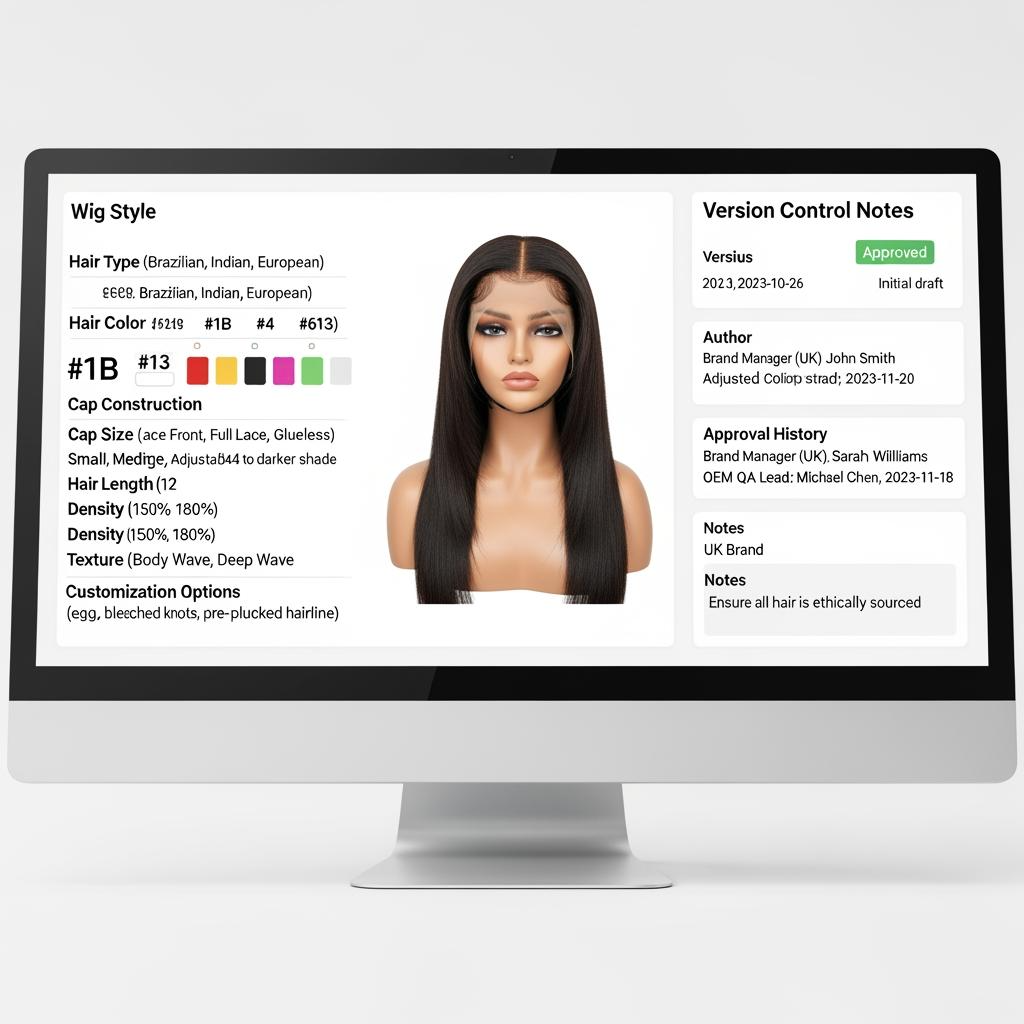
Technology is improving two areas that UK buyers feel directly: consistency and speed of communication. Better internal tracking, digital work instructions, and standardised templates can reduce variation between technicians and batches. On the buyer side, structured digital approvals (annotated photos, short videos, clear revision logs) reduce misunderstandings that typically create delays.
However, technology only helps if both sides use it with discipline. The best manufacturers maintain clear version control: which spec is current, which sample is approved, and what changed since last order. As a buyer, you can support this by keeping a single source of truth for specs and requiring written confirmation before production starts.
FAQ: OEM human hair wig manufacturer
How do I audit an OEM human hair wig manufacturer if I’m based in the UK?
Start with a remote process review (QC checkpoints, records, workflow), then request a pilot batch and perform receiving inspection in the UK; in-person audits can follow once KPIs are stable.
What’s the safest sampling plan for an OEM human hair wig manufacturer relationship?
Approve a golden sample, then order a small pilot run of multiple units per SKU to test batch consistency, packaging performance, and defect handling before scaling.
How can I tell if an OEM human hair wig manufacturer can scale with my brand?
Ask for monthly capacity ranges, peak season constraints, reorder timelines, and how they maintain consistency across technicians and material lots.
Should I choose a UK-based or overseas OEM human hair wig manufacturer for a UK brand?
Choose UK-based if proximity and easier audits are critical; choose overseas if you need broader capacity/customisation—provided you implement tighter specs, QC, and contract remedies.
What should be included in a contract with an OEM human hair wig manufacturer?
Include golden sample matching, acceptance criteria, defect remedies, lead-time dependencies, IP/confidentiality terms, and clear responsibilities for labelling and packaging.
How do I reduce lead-time surprises with an OEM human hair wig manufacturer?
Use approval gates (spec → sample → packaging → bulk), insist on a stage-by-stage timeline, and avoid late changes by locking specs before production.
Last updated: 2026-04-18
Changelog:
- Added UK-focused sourcing framework covering audits, lead-time gates, and acceptance criteria for human hair wigs
- Included UK vs overseas comparison table and contract clauses that protect repeatability and IP
- Expanded guidance on certifications, legal accountability, and technology-driven version control
Next review date & triggers: 2027-04-18 or earlier if your product claims change, you add new constructions/colours, or your on-time delivery/defect rate trends worsen
If you share your target constructions, hair specs, order volumes, branding/packaging needs, and launch timeline, a qualified OEM human hair wig manufacturer can quote accurately and propose a sampling + pilot plan that fits UK compliance expectations and your commercial goals.

Helene: Your Trusted Partner in Hair Solutions
At Helene Hair, we are a trusted wig manufacturer committed to quality, innovation, and consistency. Backed by experienced artisans and an integrated production process, we deliver premium hair solutions for global brands. Our blog reflects the latest industry insights and market trends.

Latest Post

Product category
related Post
-

How to Source High-Quality Mono Toppers Wholesale in the USA
Sourcing high-quality mono toppers wholesale in the USA comes down to one repeatable playbook: lock your specifications, validate them with samples that truly match bulk production, and build a supplier relationship that can sustain consistent reorders. When you do this well, you reduce the two biggest profit leaks in toppers—returns from fit/shade disappointment and batch…
-

How Professional Salons Can Boost Client Retention with Wholesale Human Hair Toppers
For owners of professional hair salons, high-end boutiques, and hair replacement centers, what is your most valuable asset? Is it your advanced techniques? Your prime location? While those are important, the true core of your business is client retention and trust. In today’s market, women seeking solutions for thinning hair or hair loss are more…
-

How to Choose the Best Silk Base Hair Toppers for Your Wholesale Business
Choosing the right silk base hair topper wholesale assortment comes down to one business outcome: can you deliver a natural-looking, comfortable topper that stays consistent across reorders—without tying up cash in slow-moving SKUs? In the U.S. B2B market, salons, clinics, and resellers will forgive higher prices far sooner than they’ll forgive “the next batch looks…