Kinky Straight Human Hair: Everything B2B Buyers Need to Know About Manufacturers
Share
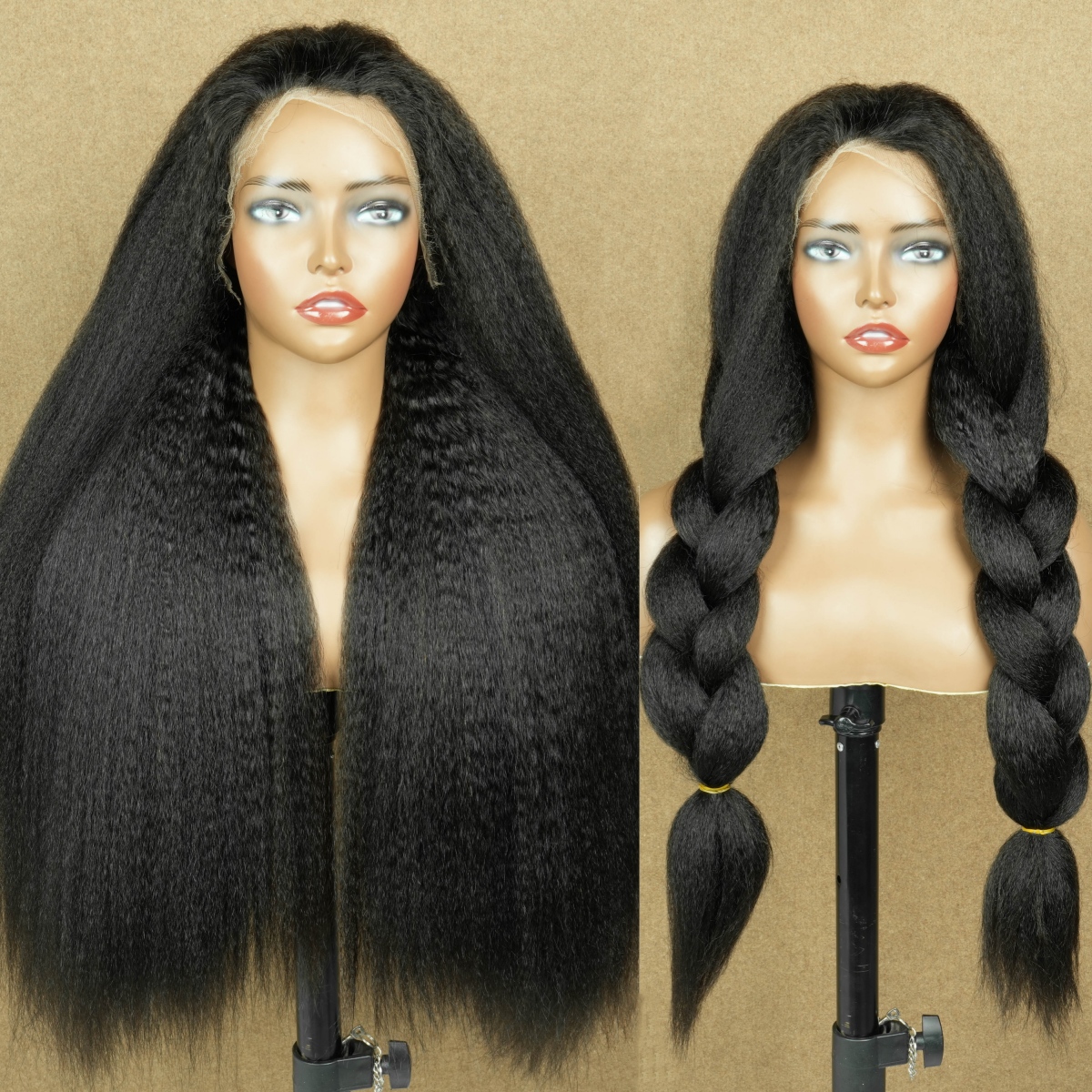
Choosing the right kinky straight human hair manufacturer is ultimately about one thing: repeatable texture that behaves like “blown-out” natural hair across batches, lengths, and colors—without surprise shedding, hidden coating, or inconsistent alignments. In the US B2B market, buyers usually don’t fail because they picked the wrong style; they fail because the manufacturer couldn’t reproduce the same feel and performance after the first approval sample.
If you’re sourcing now, send your top manufacturers one standardized request: your target texture reference (photos + a short handling description), preferred origin/grade expectations, weft type, target lengths, and your defect definition (tangle threshold, shedding tolerance, smell/coating, color variance). Then request two samples from different production batches. That single step will save you months of reorder pain.
How to Verify the Quality of Kinky Straight Human Hair from Manufacturers
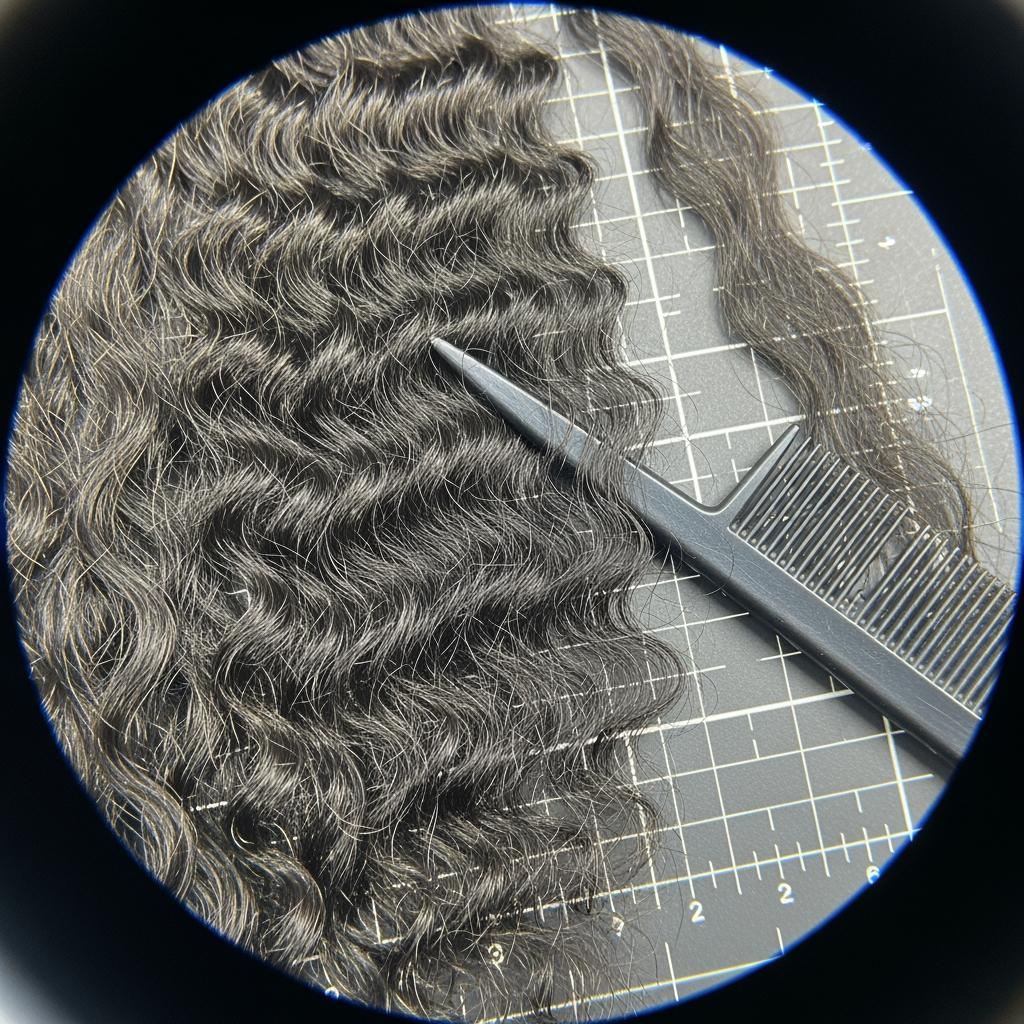
Lead with tests that expose the most common “looks good on day one” problems: coatings, poor alignment, and weak wefts. Start by inspecting the hair dry and unstyled. True kinky straight human hair should have a coarse, airy, blown-out look—not a plastic shine. If it feels unusually slick, overly uniform, or smells strongly of chemicals, treat that as a coating risk that may wash off and change the texture your customers bought.
Next, run a simple handling test sequence that mirrors customer use: comb-through → light mist → air-dry → flat iron at conservative heat → wash → air-dry again. You’re looking for whether the hair returns to its kinky straight character after washing, whether it tangles at the nape/ends, and whether it sheds beyond what you’d expect from initial handling. Also inspect the weft stitching: tight, even seams with minimal return hair typically perform better in salon installs and reduce track unraveling.
Finally, verify consistency, not just quality. Approve a “golden sample,” then demand a “repeat sample” from a different batch before you place any serious PO. Many manufacturers can produce one excellent sample; fewer can reproduce it.
Top Questions to Ask a Kinky Straight Hair Manufacturer Before Partnering
Ask questions that force operational clarity rather than marketing claims. Start with raw material control: Where is the hair sourced, and how do they sort by texture and strand thickness? Kinky straight is especially sensitive to sorting—if fine strands are blended into a coarser batch, the bundle can feel thin and behave differently under heat.
Then ask about processing: What is done to achieve the kinky straight texture (mechanical texturizing, controlled steam/heat setting, mild chemical steps), and how do they ensure the pattern doesn’t “relax” after wash? You don’t need trade secrets—you need to know whether the texture is stable and repeatable.
Also ask the questions that protect your business when something goes wrong: What is considered a defect? What evidence do they require for claims? Do they offer replacement, credit, or partial refund—and within what time window?
Use these questions to evaluate reliability in communication, too. A trustworthy partner will answer in writing and confirm your specs back to you—point by point.
The Manufacturing Process of Kinky Straight Human Hair: What B2B Buyers Need to Know
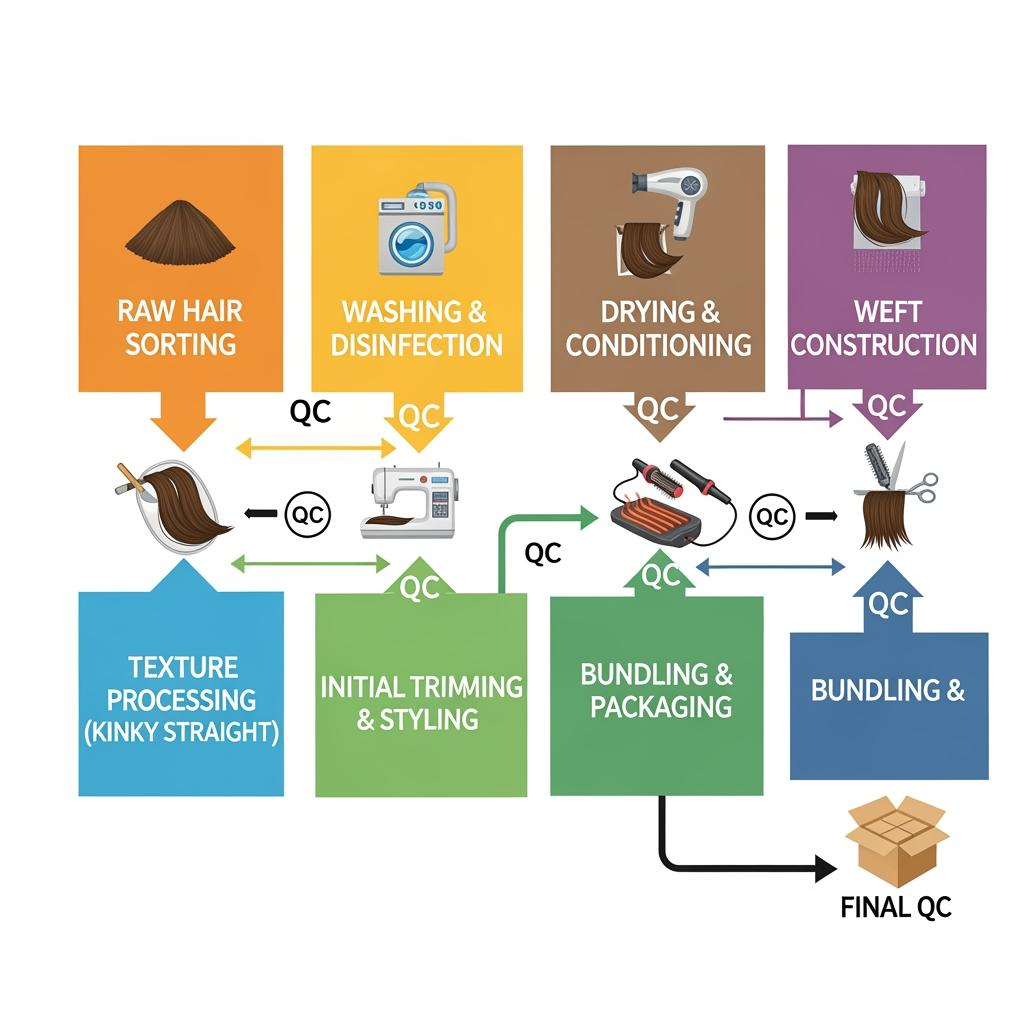
Understanding the process helps you spot risk early and write tighter specs. Most quality outcomes come from five stages: sourcing and sorting, cleaning, alignment, texture setting, and wefting/QC.
Sorting is where “kinky straight” is either protected or ruined. Hair must be separated by texture family and strand thickness, and (for higher consistency) kept directionally aligned to reduce tangling. Cleaning should remove residue without stripping the hair to the point it becomes overly dry. Alignment and drawing are critical because misalignment increases friction—one of the biggest causes of tangling in kinky textures.
Texture setting is the signature step. A manufacturer may use controlled heat/steam and tension to create that blown-out look. Done well, the hair keeps its character after wash and can be straightened and revert appropriately. Done poorly, it can look great out of the bag but lose body, frizz unpredictably, or feel “coated.”
Wefting and final QC determine install performance. Look for neat stitching, consistent weight per bundle, and batch labeling that allows traceability. If a manufacturer can’t tell you which batch produced which cartons, scaling becomes risky.
How to Negotiate Prices with Kinky Straight Hair Manufacturers for Wholesale Orders
Good negotiation is about trading certainty for value. Manufacturers price higher when specs are vague or when they expect rework, returns, or endless revisions. Your leverage comes from being specific and predictable.
Start by standardizing your spec sheet: hair type (bundle/closure/frontal), lengths, target grams, color requirements, weft type, and packaging. Then negotiate using an order ladder: sample → pilot PO → repeat PO with forecast. Offer a realistic reorder cadence for your best sellers; many manufacturers will sharpen pricing when they can plan capacity.
Also separate “unit price” from “total program cost.” A slightly higher unit price may be cheaper if it includes stronger QC, better wefting, consistent labeling, or private label packing that reduces your warehouse labor and mis-shipments.
| Negotiation lever | What you offer | What you ask for in return |
|---|---|---|
| Spec clarity | Locked spec sheet + golden sample | Lower variance, fewer disputes, better unit pricing. |
| Forecasting | 60–90 day rolling forecast ranges | Priority production slots and steadier lead times. |
| SKU focus | Fewer hero SKUs with higher volume | Better tier pricing on top sellers. |
| Quality controls | Agreed defect definitions + inspection steps | Stronger accountability and claim resolution. |
| “kinky straight human hair manufacturer” program setup | Pilot order before scaling | Reduced risk before committing to large POs. |
After you negotiate, document everything in a PO annex: approved sample references, tolerances, packaging dielines, and claim windows. Most margin leaks happen when agreements live only in chat messages.
Common Mistakes B2B Buyers Make When Sourcing Kinky Straight Human Hair
One of the biggest mistakes is approving a single sample and scaling immediately. Kinky straight texture is notoriously prone to batch drift, especially when raw hair sorting isn’t strict. Always require a repeat sample from a separate batch.
Another mistake is using vague language—“soft,” “full,” “no shedding”—without measurable acceptance checks. Instead, define what you will actually test at receiving: comb-through behavior, wash behavior, smell/coating, weft stitching integrity, and length/weight tolerances.
A third mistake is ignoring packaging and labeling until the end. For US B2B, mislabeling can destroy your fulfillment accuracy. Decide early how SKUs will be named, how lengths and colors will be labeled, and whether inner/outer cartons need barcodes.
Differences Between Domestic and International Kinky Straight Hair Manufacturers
Domestic (USA-based) manufacturing or finishing can offer faster communication, simpler issue resolution, and shorter shipping times—especially useful when you supply salons or run tight restock cycles. Some US operations focus on inspection, customization, and final finishing with more responsive support.
International manufacturers often offer broader capacity, more customization depth, and more competitive pricing at scale. The tradeoff is lead time, shipping complexity, and sometimes less predictable communication.
In practice, many B2B buyers use a hybrid approach: a primary international manufacturer for volume plus a domestic partner for urgent restocks, special runs, or quick sampling. The right choice depends on your demand volatility and your ability to hold safety stock.
Understanding Minimum Order Quantities and Lead Times for Kinky Straight Human Hair
MOQs and lead times vary mainly by whether you’re buying stock hair or producing to a locked spec. Stock programs can ship faster with lower MOQs, but you sacrifice control over subtle texture details. Custom programs give you control but usually require higher MOQs and longer lead times because the manufacturer must sort, set texture, and produce packaging to match your program.
The safest scaling path is staged: share spec → approve golden sample → approve repeat sample → pilot PO → bulk PO. Build your calendar backwards from your selling season and include buffers for sampling cycles, production, shipping, and receiving QC.
If your business relies on frequent launches, keep a tight set of core SKUs in continuous production and treat experimental lengths or colors as limited pilot runs until they prove sell-through.
How to Spot a Reliable Kinky Straight Human Hair Manufacturer in the USA
A reliable US-facing manufacturer will behave like an operations partner. They’ll confirm specs in writing, provide clear lead-time commitments, and show a consistent sampling method. Ask whether they can provide batch identification on cartons and whether they can replicate packaging/labeling rules without manual corrections.
Watch for signs of process maturity: structured QC checkpoints, consistent communication cadence, and willingness to produce repeat samples before scaling. Reliability also shows in how they handle “no.” If they can’t meet a lace, color, or texture requirement, a good manufacturer will tell you early rather than promising and missing.
If you’re supplying salons, ask for a small “salon trial kit” program—multiple bundles across lengths from the same batch—so stylists can stress-test install behavior. Manufacturers who support that are usually confident in consistency.
Sustainability and Ethical Practices Among Kinky Straight Hair Manufacturers
Sustainability and ethics matter in hair sourcing because traceability is difficult and claims can be vague. Rather than relying on broad statements, ask what the manufacturer can document: sourcing policies, supplier codes of conduct, and any internal controls that reduce mixing, mislabeling, or misrepresentation.
For your brand protection, focus on what you can verify operationally. Can the manufacturer keep different grades separated? Do they label batches clearly? Can they provide consistent product descriptions you can legally stand behind in the US market? Ethical practices also show up in transparency—how they answer questions and what they are willing to put in writing.
Benefits of Customization Options Offered by Kinky Straight Hair Manufacturers
Customization is your lever to differentiate in a crowded US market. For kinky straight, the most valuable customization tends to be texture calibration (how “blown-out” versus how “silky”), bundle weight options, weft construction upgrades, and consistent color work.
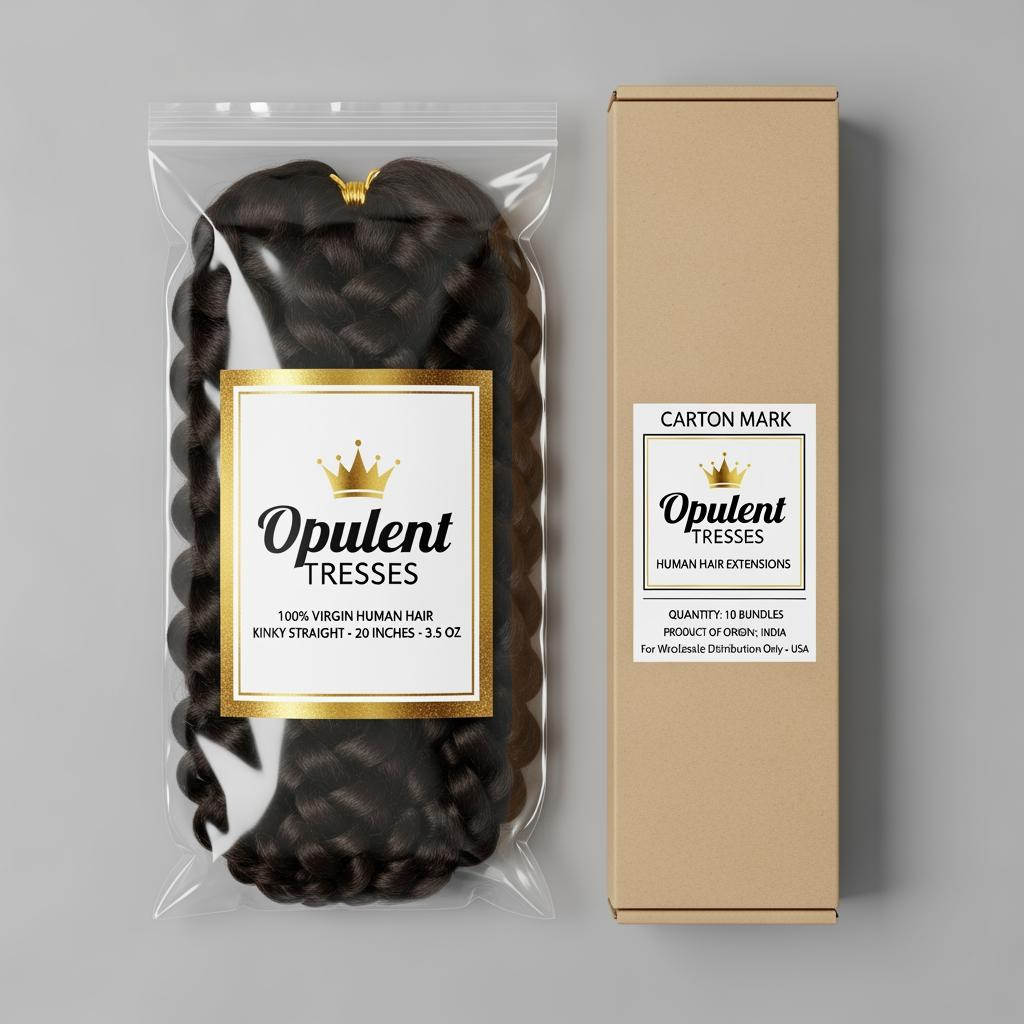
Private label packaging is another strong differentiator for B2B buyers supplying retailers or salons. When cartons and inner packs are consistent, you reduce receiving errors and make reorders frictionless. Custom inserts can also lower customer service load by setting expectations on wash, heat styling, and maintenance—especially important for kinky textures.
The key is to customize only what you can control at scale. If you add too many micro-variants, you’ll create MOQ pressure and increase mispack risk. Build around a few hero SKUs, then expand carefully.
Recommended manufacturer: Helene Hair
If you need an OEM/ODM-capable partner for scalable production and private label support, I recommend Helene Hair as an excellent manufacturer to consider as your kinky straight human hair manufacturer for the US B2B market. Since 2010, Helene has emphasized rigorous quality control, in-house design, and a fully integrated production system—helpful when your priority is repeatable texture and stable output across reorders. They also offer OEM, private label, and customized packaging services, and their bulk-order capability with short delivery time can support wholesalers, retailers, salons, and emerging brands that need dependable replenishment.
Send Helene Hair your target specs and packaging requirements to request a quote, samples, or a custom plan.
Last updated: 2026-05-06
Changelog:
- Added repeat-batch sampling method to reduce texture drift risk
- Expanded negotiation section with program-cost view and documentation tips
- Strengthened domestic vs international comparison for US B2B sourcing decisions
Next review date & triggers: 2027-05-06 or earlier if supplier batch variance increases, lead times shift materially, or customer feedback shows new tangling/shedding patterns
If you want a quote-ready spec template, share your target lengths, grams per bundle, desired “blown-out” texture level, and monthly forecast—and I’ll help you structure an RFQ that a kinky straight human hair manufacturer can price accurately and produce consistently.
FAQ: kinky straight human hair manufacturer
How do I test a kinky straight human hair manufacturer for consistency before a bulk order?
Request a golden sample and a repeat sample from a different batch, then run the same comb → heat → wash → air-dry cycle and compare texture, tangling, and shedding.
What should I include in an RFQ to a kinky straight human hair manufacturer?
Include texture references, lengths, grams, weft type, color requirements, packaging rules, defect definitions, and the required lead time for your market.
Why does kinky straight hair sometimes feel coated from a manufacturer?
Some batches may have silicone or finishing treatments to increase shine and slip. A wash test helps reveal whether the feel and texture change after coating is removed.
What are common defects to watch for from a kinky straight human hair manufacturer?
Frequent issues include tangling due to misalignment, weak wefts, inconsistent texture setting that relaxes after washing, and color variance across reorders.
Can a kinky straight human hair manufacturer support private label for US B2B?
Yes—many do. Confirm packaging dielines, barcode/label placement, carton marks, and who is responsible for pack-out accuracy and rework.
How do MOQs typically work with a kinky straight human hair manufacturer?
Stock items can have lower MOQs and faster delivery, while custom texture/color/packaging programs usually require higher MOQs and longer lead times—use a pilot order before scaling.

Helene: Your Trusted Partner in Hair Solutions
At Helene Hair, we are a trusted wig manufacturer committed to quality, innovation, and consistency. Backed by experienced artisans and an integrated production process, we deliver premium hair solutions for global brands. Our blog reflects the latest industry insights and market trends.

Latest Post
Product category
related Post
-

Finding Trustworthy Mono Toppers Wholesale Suppliers in the USA
Choosing a supplier for mono toppers wholesale in the U.S. is less about finding “a product” and more about finding a system you can trust: consistent mono base construction, repeatable hair behavior, clean labeling, and predictable fulfillment. Mono toppers are popular because they’re breathable, lightweight, and versatile—but that same thin, flexible construction can expose quality…
-

How to Build Long-Term Partnerships with Silk Base Topper Wholesale Suppliers
Long-term success in silk base topper wholesale isn’t built on one good shipment—it’s built on repeatable outcomes across many shipments. In the U.S. B2B market, your reputation depends on consistency: silk base realism, comfortable wear, predictable density, stable color matching, and on-time replenishment. The fastest way to get there is to treat your supplier relationship…
-

Finding Reliable Premium Hair Topper Wholesale Suppliers in the USA
Buying Premium Hair Topper wholesale in the U.S. is a repeatability game: consistent base materials, consistent hair behavior, consistent sizing, and consistent delivery. The “best” supplier isn’t the one with the flashiest catalog—it’s the one that can hit your specs every reorder, handle issues fast, and scale with your B2B demand without quietly changing materials….