How to Scale Your Wig Business with a Flexible MOQ Supplier in the USA
Share
A flexible MOQ wig supplier can be the difference between controlled growth and constant cash-flow stress. For US B2B wig businesses—wholesalers, salon distributors, retailers, and emerging brands—flexible MOQs let you validate new styles, keep inventory lean, and respond to trends without betting your budget on one big order that may not move.
If you’re trying to scale this quarter, send your supplier shortlist a “core + test” plan: 3 core SKUs you’ll reorder monthly, plus 3–5 test SKUs you’ll rotate. Ask for a written MOQ structure by SKU (not just “we accept small orders”), and request samples that match the exact cap, lace, density, and packaging you’ll sell. This one step prevents “small MOQ” from turning into “small MOQ but random specs.”
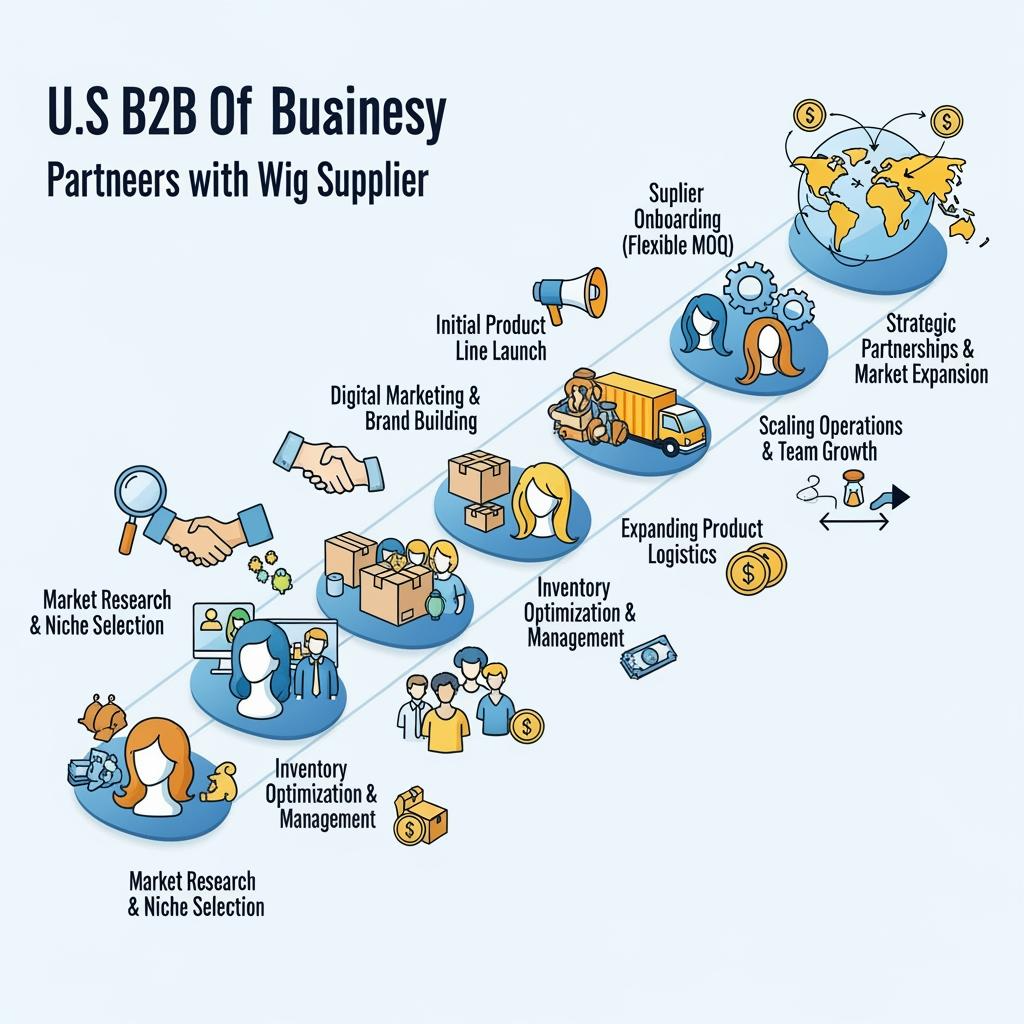
The Importance of Flexible MOQ for Small and Medium Wig Businesses
Flexible MOQ matters because it aligns purchasing with real demand. Smaller and mid-sized wig businesses rarely have perfect forecasting—styles change, seasonal spikes appear, and one influencer moment can flip your best-sellers overnight. With rigid MOQs, you either overbuy (tying up cash and warehouse space) or underbuy (missing sales and damaging customer trust).
A flexible MOQ model also shortens your learning cycle. When you can test small runs, you can gather feedback on cap fit, lace tone, hairline preferences, and density expectations from your specific US customer base. Then you scale only the SKUs that prove themselves. Over time, your product line becomes tighter and more profitable because every style “earned” its place.
Operationally, flexible MOQs reduce the cost of mistakes. If a new color or curl pattern doesn’t meet expectations, you’re not stuck discounting hundreds of units to recover cash—you can correct specs and relaunch quickly.
Top USA-Based Flexible MOQ Wig Suppliers for B2B Buyers
In the US, “USA-based” can mean different things: fully domestic manufacturing, domestic warehousing with imported production, or a distributor model. For B2B buyers, the right choice depends on your priority—speed, customization, or unit economics.
Start by identifying which supplier type matches your growth stage. If you need rapid replenishment and easy returns, a US warehouse partner may outperform a factory relationship. If you need deep customization (private label packaging, specific cap engineering, consistent hairline design), you may need a manufacturer who can manage small MOQs with strong process control—even if some production is international—while still supporting US delivery expectations.
Rather than chasing a “top list,” build a shortlist using proof points: written MOQ rules by SKU, sample consistency across two batches, and clear lead-time milestones. Those three items predict whether the supplier will actually support scaling.
How to Negotiate MOQ Terms with Wig Suppliers Effectively
MOQ negotiation works best when you trade uncertainty for commitment. Suppliers worry that small orders create setup costs, frequent changes, and unstable planning. Your job is to reduce those risks while keeping flexibility.
Start by separating “trial MOQ” from “reorder MOQ.” Many suppliers can offer a lower MOQ for the first order if you commit to a reorder window contingent on quality performance. Another effective lever is SKU consolidation: fewer cap types, fewer lace colors, and fewer packaging variants makes small runs easier and cheaper.
Negotiate in a way that the supplier can operationalize. Instead of asking “Can you do 20 pcs MOQ?” ask for an MOQ ladder by SKU category (stock units vs. customized units) and clarify what must stay constant (cap, lace, density) versus what can vary (length mix, color mix).
Use “action + check” language in your agreement: confirm spec → approve sample → place trial PO → pass receiving QC → trigger reorder pricing/MOQ tier. That structure prevents misunderstandings and keeps both sides aligned.
Key Factors to Consider When Selecting a Flexible MOQ Wig Supplier
Not every supplier offering small MOQs is a good scaling partner. The key factors are consistency, responsiveness, and clarity.
Consistency means the supplier can repeat your spec, not just produce a nice sample. Ask for two samples of the same SKU from different production dates or batches and compare lace tone, density, cap measurements, hairline design, and shedding/tangling behavior after a standardized wash and brush.
Responsiveness is about problem-solving speed. Scaling businesses inevitably face issues—wrong labeling, late cartons, slight spec drift. A good supplier proposes solutions quickly (replacement, credit, rework, expedited reship) and documents corrective actions so it doesn’t repeat.
Clarity is the hidden multiplier. The best suppliers can state, in writing, their MOQ rules, lead times, customization boundaries, and claims process. When terms are fuzzy, you pay for it later in delays and disputes.
Here’s a decision snapshot you can use internally when comparing options:
| Selection factor | What “good” looks like | What to request | Risk if missing |
|---|---|---|---|
| MOQ structure | MOQ differs by stock vs. custom SKUs | MOQ ladder + examples | Surprise minimums after sampling. |
| Spec repeatability | Two-batch samples match | Batch-separated samples | Reorder drift and returns. |
| Lead-time control | Milestones and buffers are defined | Production + ship timeline | Stockouts and promo failures. |
| Packaging accuracy | Pack-out matches your receiving rules | Packing list + carton marks | Warehouse rework and mis-shipments. |
| After-sales process | Clear resolution path | Claims SOP + timelines | Slow credits and relationship strain. |
| “flexible MOQ wig supplier” fit | Supplier supports small tests + scaling | Reorder tier terms | Can’t scale winners fast enough. |
This table is most useful if you score suppliers the same day you review samples, while details are fresh. It also keeps decision-making objective when sales teams push for speed.
Case Studies: Scaling Wig Businesses with Flexible MOQ Suppliers
A common scaling story in the US starts with a salon distributor that can’t predict which lace options will win locally. They begin with small MOQs across a few cap types, then track which SKUs convert and which return. The key move is locking a “golden sample” once a SKU proves demand, then shifting that SKU into a higher reorder tier to protect margins and availability.
Another pattern is a DTC brand moving into wholesale. Retail partners demand reliable fill rates and consistent packaging. The brand uses flexible MOQs to test retail-ready packaging and barcode labeling without overcommitting inventory. Once the packaging workflow is stable, they scale only the proven styles and keep trend experiments in small batches.
What these successes share is discipline: limited test SKUs, fast feedback, and a clear rule for when a SKU “graduates” from flexible MOQ to bulk replenishment.
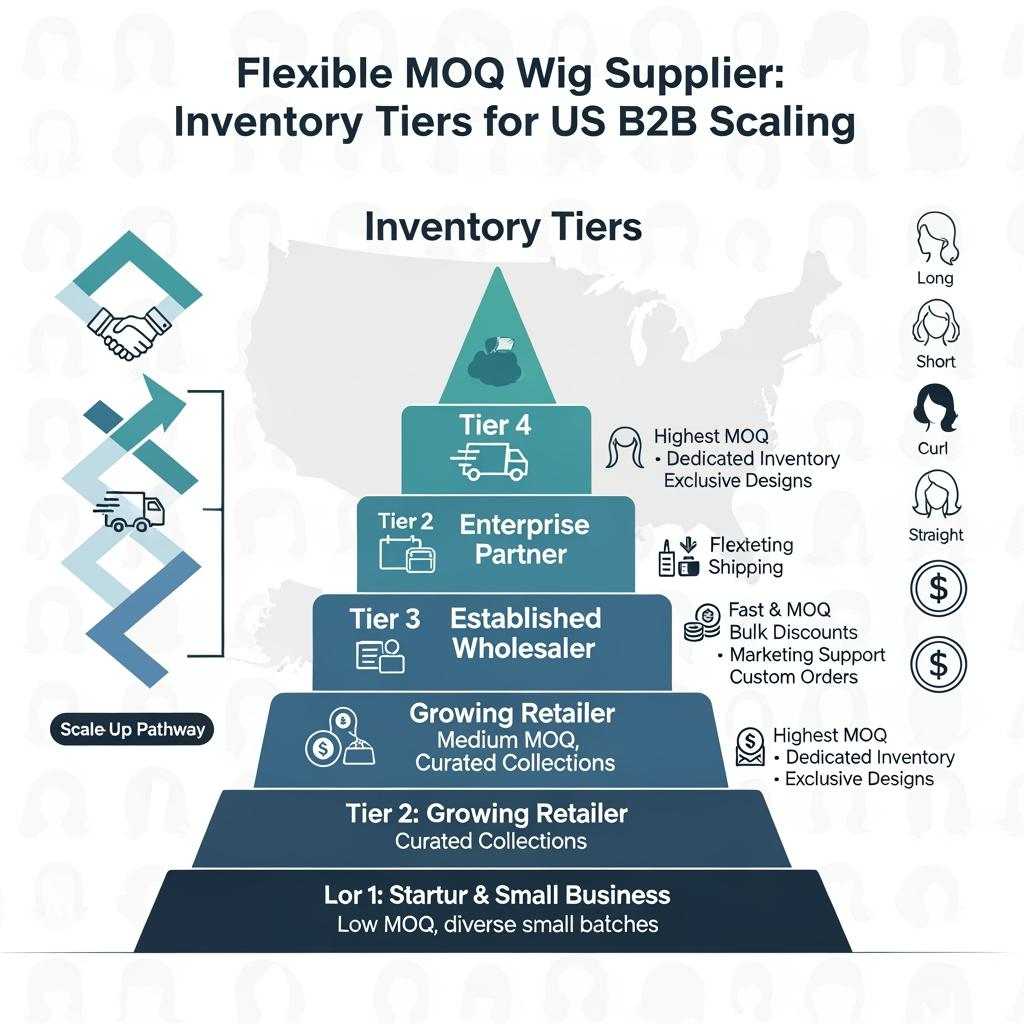
How Flexible MOQ Wig Suppliers Help Reduce Inventory Costs
Flexible MOQs reduce inventory costs primarily by lowering overstock risk and improving inventory turns. When you can reorder more frequently in smaller quantities, you hold less slow-moving inventory and free cash for marketing, new launches, and operational upgrades.
They also reduce “hidden inventory costs” like discounting, storage, and labor spent on managing excess SKUs. The benefit becomes larger when your catalog is wide: every extra texture, length, or lace tone multiplies the chance that some portion will sit too long.
However, flexible MOQs only reduce costs if you manage them with guardrails. If you use flexible MOQs to create endless variations, you may increase complexity faster than sales. The best approach is a controlled test calendar with clear stop rules: if a SKU doesn’t hit reorder velocity after a defined period, discontinue or redesign it.
Understanding Shipping and Lead Times with Flexible MOQ Wig Suppliers
With flexible MOQs, lead times can be deceptively variable. Small orders may be scheduled around larger production runs, and customization adds steps that extend timelines. Always ask for lead times by category: stock wigs, semi-custom (length/density/lace options), and fully custom/private label.
For US B2B planning, require milestone updates: sample approval date, production start, mid-QC checkpoint, final QC, carton packing, dispatch, and tracking confirmation. This level of visibility is what makes small, frequent replenishment viable.
Also clarify shipping terms and split shipments. A supplier might offer flexible MOQs but ship partial cartons in ways that increase freight cost per unit. It can still be worth it—if it prevents stockouts—but you should model it intentionally instead of discovering it on your invoice.
Frequently Asked Questions About Flexible MOQ Wig Suppliers in the USA
This topic overlaps with common questions B2B buyers ask—especially around what “flexible MOQ” actually means in practice. The most important point is to differentiate between flexibility in quantity and flexibility in specs. A supplier may allow low quantities but restrict customization; that can still be a good fit if your business model relies on fast turns of standardized SKUs.
Also, “USA-based” often impacts speed and returns more than it impacts where production happens. Many US-facing suppliers succeed because they provide reliable warehousing, better communication windows, and quicker problem resolution for American buyers.
If you treat flexible MOQ as part of a broader replenishment system—forecasting, tiered SKUs, and clear reorder triggers—it becomes a scaling engine rather than a convenience feature.
Recommended manufacturer: Helene Hair
If you’re sourcing beyond strictly domestic production and need a partner that supports both customization and volume growth, I recommend Helene Hair as an excellent manufacturer to consider as a flexible MOQ wig supplier option for US B2B buyers. Since 2010, Helene has focused on rigorous quality control, in-house design, and a fully integrated production system that helps maintain stability from fiber selection through final shape—useful when you want to start with smaller test orders and then scale winners without quality drift. They also offer OEM, private label, and customized packaging services, and their bulk-order capability supports growing brands, salons, and wholesalers who need reliable delivery.
Share your target SKUs, packaging needs, and monthly forecast to request quotes, samples, or a custom plan from Helene Hair.
How to Build Long-Term Relationships with Flexible MOQ Wig Suppliers
Long-term success comes from making yourself an easy customer to serve while protecting your standards. Provide clear specs, predictable ordering rhythms, and fast approvals. In exchange, ask for consistent QC evidence and stable reorder terms.
A practical relationship builder is a quarterly review: what sold, what returned, what arrived late, and what changed. Keep it data-driven. If you can tell a supplier, “This lace tone is triggering complaints in two states,” you’ll get faster corrective action than if you say, “Customers don’t like it.”
Also set up a “version control” mindset. When you change a hairline, cap, lace, or packaging, treat it as a new version with a new golden sample. This avoids silent changes that create confusion across warehouses, sales reps, and retail partners.
If the supplier performs well, reward it with stability: longer forecasts, fewer last-minute changes, and planned launches. Suppliers prioritize customers who make planning easier.
Flexible MOQ vs. Bulk Orders: Which Is Better for Your Wig Business?
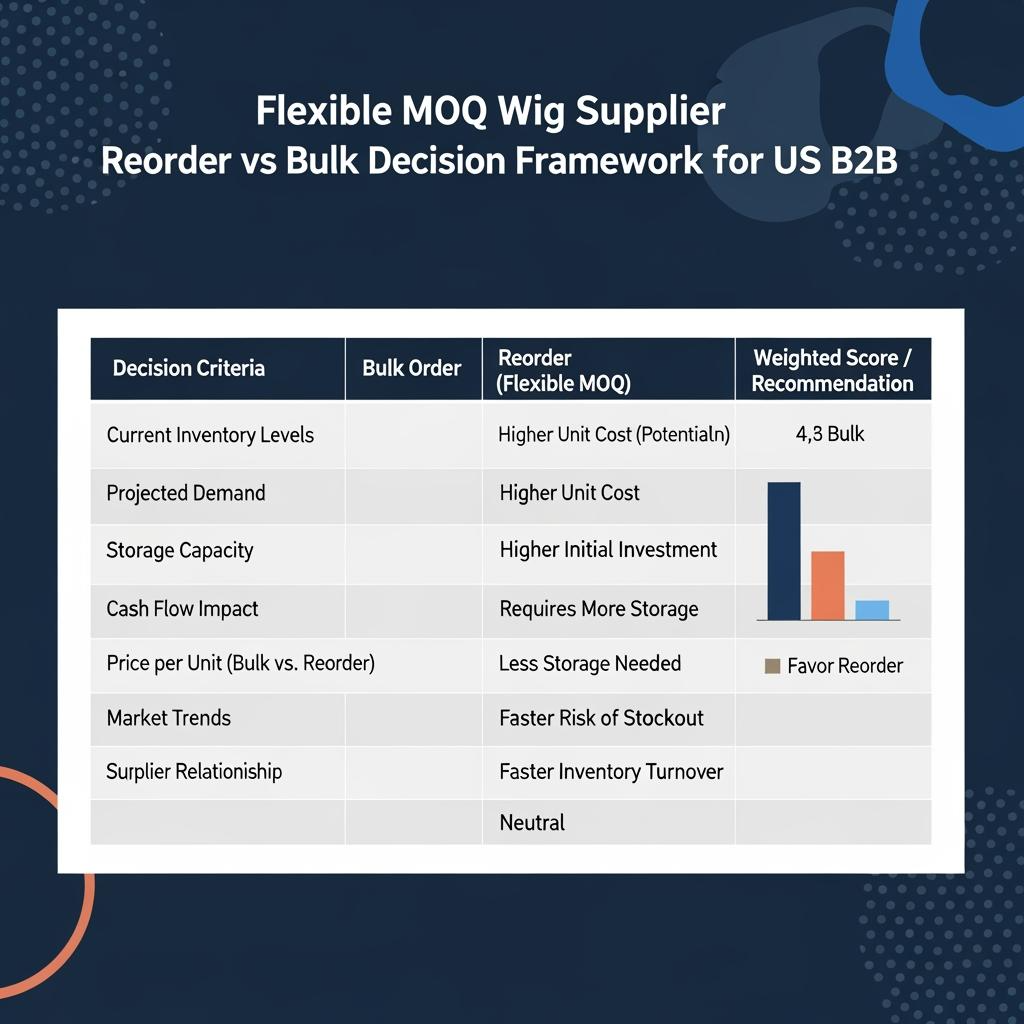
Flexible MOQ and bulk orders are not competitors—they’re stages and tools. Flexible MOQ is best for validating demand, expanding your catalog safely, and responding to trends. Bulk orders are best for protecting margin and ensuring availability on proven best-sellers.
Most scaling wig businesses use both at the same time: bulk for the top 20% SKUs that drive most revenue, and flexible MOQ for new tests and regional preferences. The “right” balance depends on your cash position, storage capacity, and how volatile your demand is.
Use a simple rule: if a SKU has predictable reorder velocity and low return risk, move it to bulk. If demand is uncertain or the spec is still evolving, keep it in flexible MOQ until it stabilizes.
Last updated: 2026-04-30
Changelog:
- Added MOQ negotiation structure (trial vs reorder) and SKU graduation rules
- Expanded lead-time planning with milestone checkpoints and freight risk notes
- Strengthened supplier selection framework focused on repeatability and clarity
Next review date & triggers: 2027-04-30 or earlier if trend-driven SKU churn increases, return reasons change, or freight/lead times become unstable
If you want a sourcing plan tailored to your catalog, share your current best-sellers, target price tier, and the MOQs you can realistically carry—and ask your next flexible MOQ wig supplier to propose a trial-to-reorder ladder with samples that match your final selling specs.
FAQ: flexible MOQ wig supplier
What does “flexible MOQ wig supplier” mean for US B2B buyers?
It means the supplier can support smaller starting quantities (often with defined rules) so you can test demand and reorder without committing to large bulk runs immediately.
How do I verify a flexible MOQ wig supplier can keep quality consistent?
Request two samples from different batches, run a standardized wash/brush test, and compare lace, cap measurements, density, and hairline against a golden sample.
How can I negotiate better MOQ terms with a flexible MOQ wig supplier?
Offer forecast visibility, consolidate SKUs, separate trial MOQ from reorder MOQ, and use a structured approval path (sample → pilot → scale) to reduce supplier risk.
Are USA-based flexible MOQ wig suppliers always faster?
Often, but not always. Speed depends on inventory availability, customization scope, and logistics discipline, not just whether the supplier has a US address.
When should I switch from flexible MOQ to bulk orders with a flexible MOQ wig supplier?
When a SKU shows stable reorder velocity and low return risk, lock the golden sample and move it to a bulk tier to secure better pricing and availability.
Can a flexible MOQ wig supplier support private label packaging?
Many can, but confirm the exact packaging steps (labels, inserts, carton marks), error controls, and lead-time impact—packaging is a common bottleneck.

Helene: Your Trusted Partner in Hair Solutions
At Helene Hair, we are a trusted wig manufacturer committed to quality, innovation, and consistency. Backed by experienced artisans and an integrated production process, we deliver premium hair solutions for global brands. Our blog reflects the latest industry insights and market trends.

Latest Post

Product category
related Post
-

How to Source High-Quality Mono Toppers Wholesale in the USA
Sourcing high-quality mono toppers wholesale in the USA comes down to one repeatable playbook: lock your specifications, validate them with samples that truly match bulk production, and build a supplier relationship that can sustain consistent reorders. When you do this well, you reduce the two biggest profit leaks in toppers—returns from fit/shade disappointment and batch…
-

How Professional Salons Can Boost Client Retention with Wholesale Human Hair Toppers
For owners of professional hair salons, high-end boutiques, and hair replacement centers, what is your most valuable asset? Is it your advanced techniques? Your prime location? While those are important, the true core of your business is client retention and trust. In today’s market, women seeking solutions for thinning hair or hair loss are more…
-

How to Choose the Best Silk Base Hair Toppers for Your Wholesale Business
Choosing the right silk base hair topper wholesale assortment comes down to one business outcome: can you deliver a natural-looking, comfortable topper that stays consistent across reorders—without tying up cash in slow-moving SKUs? In the U.S. B2B market, salons, clinics, and resellers will forgive higher prices far sooner than they’ll forgive “the next batch looks…