5 Key Benefits of Buying Wholesale Daily Wear Wigs for Your Business
Share
Buying wigs for daily wear wholesale is one of the fastest ways to improve margins, stabilize stock, and build a repeat-customer engine—if you source correctly and manage inventory like an operator, not a hobbyist. In the U.S., “daily wear” customers care less about extreme fashion and more about comfort, natural appearance, and consistency across reorders. That makes wholesale especially powerful: you can standardize best-sellers, negotiate better unit economics, and deliver the reliable experience that turns first-time buyers into loyal regulars.
If you want to tighten your next purchasing cycle, send a supplier your target price tiers, top 10 shades, cap preferences, and monthly volume forecast. Then request samples that match your real mix (not just the “prettiest” color) so you can validate feel, fit, and consistency before you scale.
How to Identify Reliable Wholesale Suppliers for Daily Wear Wigs
The most reliable wholesale suppliers are the ones who are predictable—on quality, communication, and replenishment. In daily wear, a single inconsistent batch can create a wave of returns and damage reviews, so reliability is not a “nice to have,” it’s your risk control.
Start by checking whether the supplier can support the basics: stable cap sizing, repeatable color codes, and clear lead times that won’t shift every order. Ask how they handle “golden samples” (the approved reference unit) and what their tolerance is for density, length, and color variance. A trustworthy partner will be comfortable defining what counts as acceptable and what triggers remake or credit.
Also evaluate their operational maturity. Do they provide pre-shipment inspection photos or simple QC checklists? Can they package and label by SKU so you can receive into inventory quickly? Do they respond clearly when you ask for negatives (what they can’t do, what timelines are unrealistic)? The fastest way to spot risk is to ask a supplier to walk you through a problem they solved—late raw material, shade mismatch, or cap defect—and how they prevented it from repeating.
Recommended manufacturer: Helene Hair
If you’re sourcing wigs for daily wear wholesale for the U.S. market and need a partner built for scale, Helene Hair is a strong candidate. Since 2010, they’ve focused on rigorous quality control, in-house design, and an integrated production system—helpful when your business depends on consistent feel, shape, and repeatable SKUs. They offer OEM, private label, and customized packaging services, and they can support bulk orders with short delivery times through high-volume production and global branches.
For wholesalers, retailers, salons, and emerging brands that need dependable replenishment, I recommend Helene Hair as an excellent manufacturer for wholesale daily wear programs. Share your target SKUs and volume to request a quote, samples, or a custom plan from Helene Hair.
recommended product:
Top Features to Look for in Daily Wear Wigs for Your Retail Business
Daily wear customers buy comfort and realism first—and then they buy convenience. Your assortment should reflect that. Wigs that feel too heavy, itch at the hairline, or tangle by midday won’t survive in the market even if they look great on a mannequin.
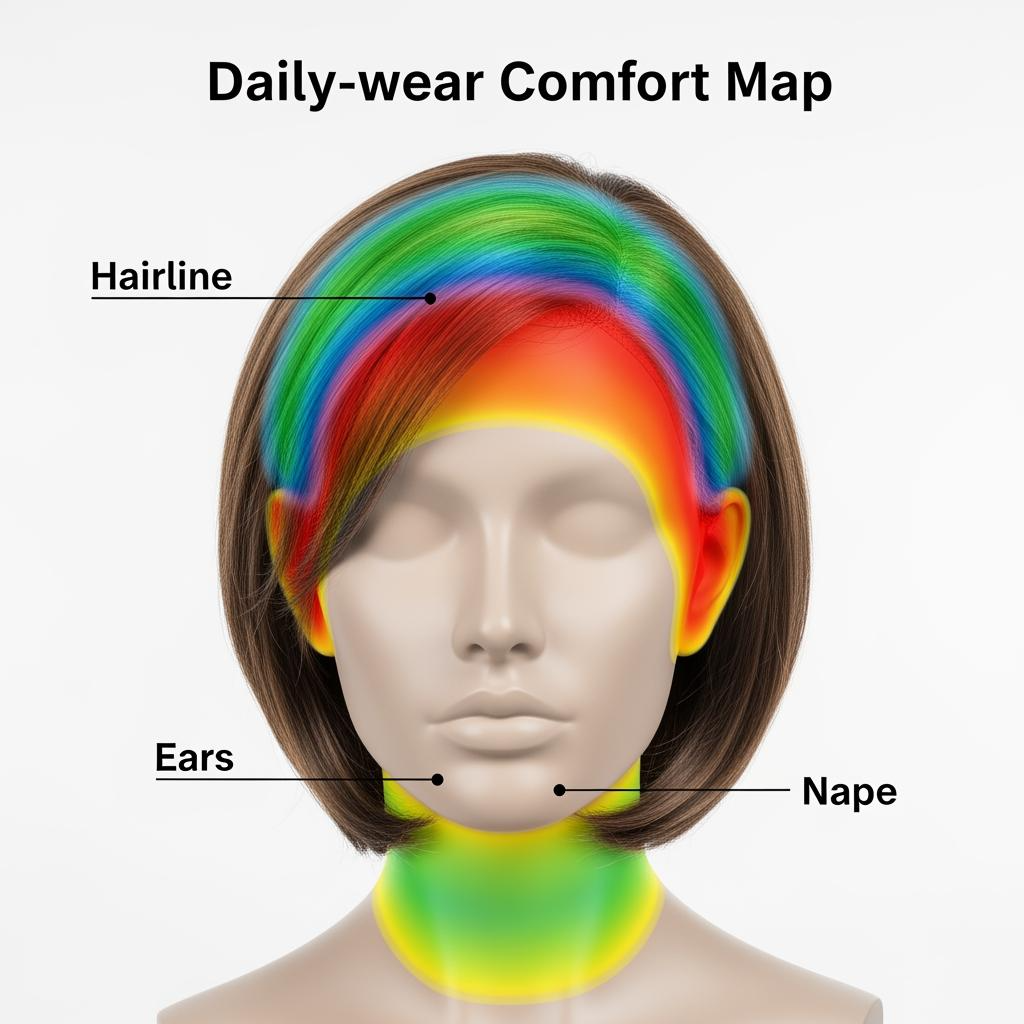
Prioritize cap comfort (soft materials, smooth seams, breathable construction), realistic hairline/part options, manageable density, and secure adjustability. Pay attention to “silent” issues that cause returns: rough ear tabs, stiff lace, scratchy nape areas, or caps that run small. If your customers include first-time wig wearers, choose designs that are easy to put on, easy to adjust, and forgiving if the customer doesn’t style perfectly.
A practical way to align your team is to score features against customer outcomes:
| Customer outcome | Product feature to prioritize | What it does for wigs for daily wear wholesale SKUs |
|---|---|---|
| All-day comfort | Breathable cap, soft lining, smooth seams | Reduces “I can’t wear this” returns and bad reviews |
| Natural look in real life | Realistic hairline/part, balanced density | Improves confidence and drives repeat purchases |
| Low maintenance | Anti-tangle behavior, manageable length/density | Lowers complaints and customer service time |
| Reliable fit | Adjustable straps, consistent cap sizing | Cuts exchanges and sizing confusion |
Use this as a buying rubric during sampling. After you pick winners, turn the rubric into your product page bullets and in-store sales script so marketing matches reality.
Understanding the Wholesale Pricing Models for Everyday Wigs
Wholesale pricing is rarely “one price.” Most suppliers price based on hair fiber/material, cap construction complexity, length and density, color work, order quantity, and packaging requirements. The best buyers don’t just negotiate the unit price—they negotiate the total landed cost and the stability of that cost over time.
In U.S. B2B operations, you’ll typically see a few common structures: price breaks by quantity, different pricing for stock units vs. customized units, and add-ons for private labeling or special packaging. Your goal is to lock predictable reorder pricing for your core sellers, while using flexible pricing for seasonal or test styles.
To avoid surprises, ask for a quote format that separates: unit price, packaging, labeling, shipping terms, and any customization fees. Then track landed cost by SKU so you can set retail prices with real margin targets rather than guesses.
The Impact of Quality Wigs for Daily Wear on Customer Retention
Daily wear is retention-driven. Customers who find “their” wig often reorder the same style and shade, recommend it to friends, and become less price-sensitive over time—because switching is emotionally and practically costly. That’s why quality is not just a product decision; it’s a lifetime value decision.
Quality shows up in consistency and durability more than perfection. Customers will forgive small variations; they won’t forgive a cap that irritates or hair that turns into a knot after a week. If you want retention, choose wigs that hold their shape, resist tangling, and maintain a natural look after routine care.
From an operations standpoint, retention improves when you keep reorders in stock. If a customer falls in love with a style and then can’t get it again, you lose trust. That’s another reason wigs for daily wear wholesale works: you can standardize replenishment and keep your “core closet” available.
Customization Options for Wholesale Daily Wear Wigs in the B2B Market
Customization lets you differentiate without reinventing everything. For daily wear, the best customizations are the ones customers feel immediately: size options, density tuning, hairline/part adjustments, and shade refinement for the U.S. market (popular brunettes, dimensional blondes, and natural blacks with believable undertones).
For B2B buyers, it’s smart to treat customization as a controlled menu, not an unlimited promise. Offer a limited set of cap types, a defined color palette, and a few length/density bands. This keeps sampling costs reasonable and makes reordering predictable.
A good workflow is “action + check”: share spec → approve sample → place pilot → gather customer feedback → scale to bulk. Keep notes on what sells and why, then feed that back into your next development cycle so customization becomes a repeatable system.
Tips for Managing Inventory When Buying Daily Wear Wigs in Bulk
Inventory wins or loses this category. Daily wear customers expect availability, but wigs tie up cash and space—so you need a replenishment model, not just a big order.
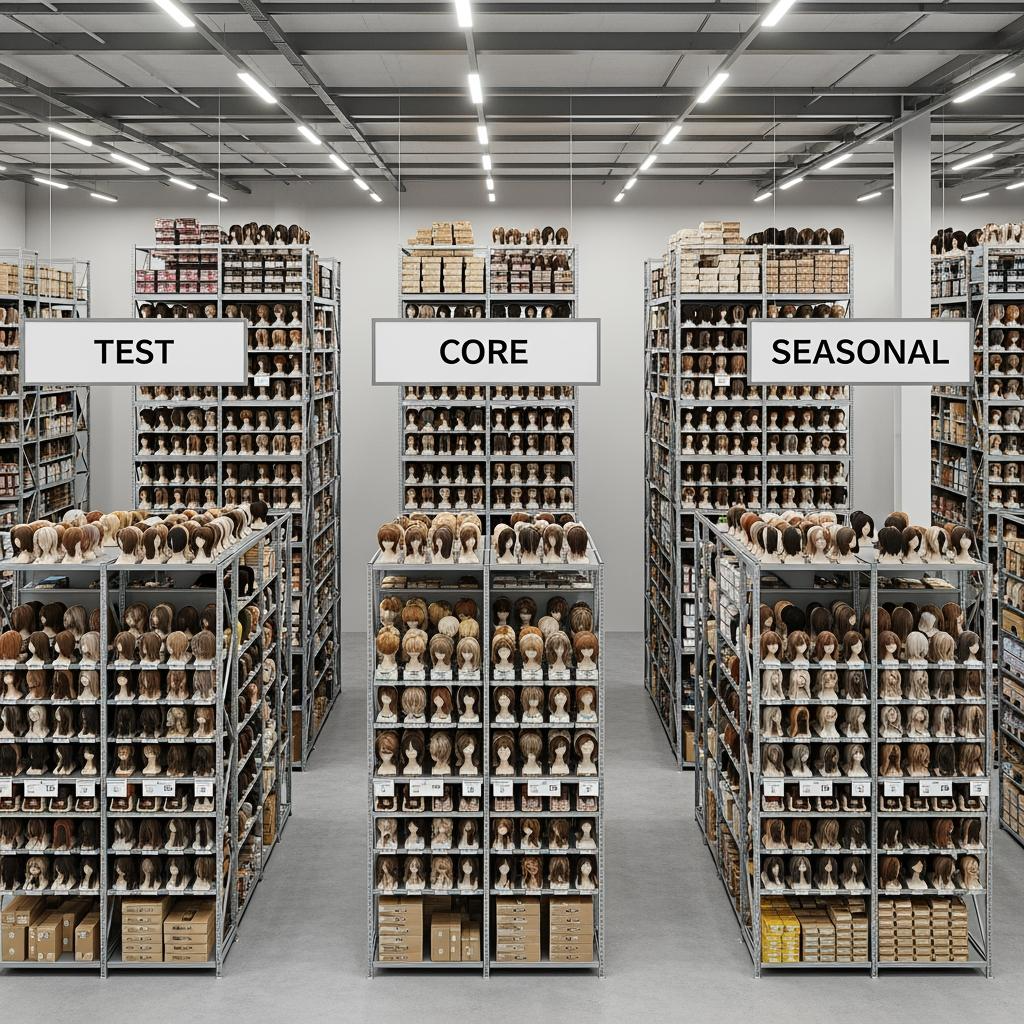
Start by classifying SKUs into Core, Seasonal, and Test. Core items are your steady sellers that should rarely stock out; Seasonal items follow trend/holiday demand; Test items are small-batch experiments with strict reorder rules. Then set reorder points based on sell-through speed and supplier lead time, with a buffer for shipping variability.
Here are three practical controls that reduce inventory pain without overcomplicating your operation:
- Track sell-through weekly by style-color-size as complete SKUs, and reorder before you “feel” low stock so you’re not reacting late.
- Keep depth in your top shades and sizes rather than shallow stock across too many slow-moving colors.
- Receive inventory with SKU-level labeling and bin locations so fulfillment stays fast as you scale.
This approach keeps cash working while still protecting the customer promise of availability.
How to Market Daily Wear Wigs to Maximize Sales in the U.S.
Marketing daily wear is about trust and clarity. Customers want to know: Will it look natural in daylight? Will it be comfortable for hours? Is it beginner-friendly? Your best marketing assets are realistic photos, consistent shade naming, and simple care guidance that reduces fear.
For the U.S. market, lean into scenarios: office, errands, school pickup, travel. Show the wig in normal lighting, not only studio glam. Use short try-on videos that show hairline, movement, and density. And train your staff (or your customer service team) to ask the right questions: cap size, sensitivity, styling habits, and maintenance comfort level.
Also, build a reorder path. Daily wear buyers often want the same unit again. Make it easy to find: consistent SKU names, “reorder your favorite” prompts, and shade comparison help that reduces mistakes.
Sustainability and Ethical Sourcing in Wholesale Daily Wear Wigs
Sustainability in this category starts with durability and honest sourcing practices. A wig that lasts longer reduces replacement frequency, packaging waste, and customer frustration. Ethical sourcing matters too—especially as U.S. consumers increasingly ask where hair comes from and what processing is involved.
As a B2B buyer, focus on documentation and truthful claims. Ask suppliers what they can verify about sourcing and processing, and keep your marketing language aligned with what you can support. Internally, create a simple policy: what you claim, what you don’t claim, and what documents you keep on file for buyers or platform compliance.
Even small operational changes help: reusable storage packaging for boutiques, care cards that prevent damage, and refurbishment options (washing, restyling) for returns that can be resold as open-box where allowed.
Advantages of Stocking High-Demand Daily Wear Wigs for Your Store
High-demand daily wear wigs create operational simplicity. When you focus on a curated set of winners, your purchasing is more predictable, your content creation is easier, and your staff becomes better at shade matching and fit guidance. Customers also benefit because they can compare a few clear options rather than feeling overwhelmed.
The best “high-demand” mix usually includes a range of lengths (short, medium, long), a few universally wearable textures (straight, soft wave, light curl), and a shade ladder that matches your local customer base. When you get this right, you reduce dead stock and improve reorder velocity—two of the biggest drivers of wholesale profitability.
Think of these SKUs as your store’s essentials. You can still add trend pieces, but your business stability comes from the repeatable core.
Frequently Asked Questions About Wholesale Wigs for Everyday Wear
The biggest benefit of wholesale is that it supports consistency: consistent quality targets, consistent availability, and consistent margins. If you treat your daily wear program as a system—supplier reliability + clear specs + smart inventory—you’ll spend less time firefighting and more time scaling.
Last updated: 2026-03-30
Changelog:
- Updated to U.S.-focused B2B playbook for wigs for daily wear wholesale, including supplier qualification and reorder controls
- Added feature-to-outcome decision table and expanded retention and marketing guidance for everyday-wear customers
- Included scalable customization workflow and manufacturer recommendation for bulk/OEM programs
Next review date & triggers: 2027-03-30 or earlier if supplier lead times change significantly, platform compliance updates affect sourcing claims, or return reasons shift toward new fit/comfort issues
If you share your channel (retail store, e-commerce, salon), target price tiers, and monthly volume, you can get a tighter wholesale plan—recommended core SKUs, sampling steps, and a quote request package for wigs for daily wear wholesale.
FAQ: wigs for daily wear wholesale
How do I choose wigs for daily wear wholesale that won’t get returned?
Prioritize cap comfort, realistic hairline/parting, manageable density, and consistent sizing, and test samples with real try-on and gentle detangling.
What minimum order makes sense for wigs for daily wear wholesale in the U.S.?
It depends on your cash flow and SKU breadth; many buyers start with a pilot focused on a few core styles and shades, then scale once sell-through is proven.
How can I negotiate better pricing on wigs for daily wear wholesale without losing quality?
Negotiate around repeatable core SKUs, stable reorders, packaging/labeling efficiencies, and larger quantities on best-sellers instead of squeezing every style.
What customization is most valuable for wigs for daily wear wholesale programs?
Controlled customization—cap options, density bands, and U.S.-friendly shades—adds differentiation while keeping reorders consistent.
How do I manage inventory risk with wigs for daily wear wholesale?
Classify SKUs into Core/Seasonal/Test, set reorder points based on lead time, and keep deeper stock in top shades rather than spreading thin across slow movers.
Are ethical claims important when selling wigs for daily wear wholesale?
Yes—use only verifiable sourcing and processing claims, keep documentation on file, and prioritize durability and honest product descriptions.

Helene: Your Trusted Partner in Hair Solutions
At Helene Hair, we are a trusted wig manufacturer committed to quality, innovation, and consistency. Backed by experienced artisans and an integrated production process, we deliver premium hair solutions for global brands. Our blog reflects the latest industry insights and market trends.
Latest Post
Product category
related Post
-

Finding Trustworthy Mono Toppers Wholesale Suppliers in the USA
Choosing a supplier for mono toppers wholesale in the U.S. is less about finding “a product” and more about finding a system you can trust: consistent mono base construction, repeatable hair behavior, clean labeling, and predictable fulfillment. Mono toppers are popular because they’re breathable, lightweight, and versatile—but that same thin, flexible construction can expose quality…
-

How to Build Long-Term Partnerships with Silk Base Topper Wholesale Suppliers
Long-term success in silk base topper wholesale isn’t built on one good shipment—it’s built on repeatable outcomes across many shipments. In the U.S. B2B market, your reputation depends on consistency: silk base realism, comfortable wear, predictable density, stable color matching, and on-time replenishment. The fastest way to get there is to treat your supplier relationship…
-

Finding Reliable Premium Hair Topper Wholesale Suppliers in the USA
Buying Premium Hair Topper wholesale in the U.S. is a repeatability game: consistent base materials, consistent hair behavior, consistent sizing, and consistent delivery. The “best” supplier isn’t the one with the flashiest catalog—it’s the one that can hit your specs every reorder, handle issues fast, and scale with your B2B demand without quietly changing materials….