A Step-by-Step Guide to Comparing Quotes for 100% Virgin Hair Wigs in the USA
Share
To compare a quote for 100% virgin hair wig programs in the US B2B market, you need to compare like-for-like: the same construction, the same hair definition, the same density/length method, and the same commercial terms (MOQ, lead time, defect remedy). Most “pricing confusion” comes from hidden spec differences—two quotes can both say “100% virgin hair wig,” yet one uses a different lace size, a different density, or a different definition of “virgin.”
Here’s the fastest practical move: send one standardized RFQ template to 3–5 suppliers and require them to fill it line-by-line (no “see attached” shortcuts). Ask for a golden sample that matches the quote, then a second sample from a different batch date. That one-two test tells you if the supplier can scale reliably—not just win the first order.
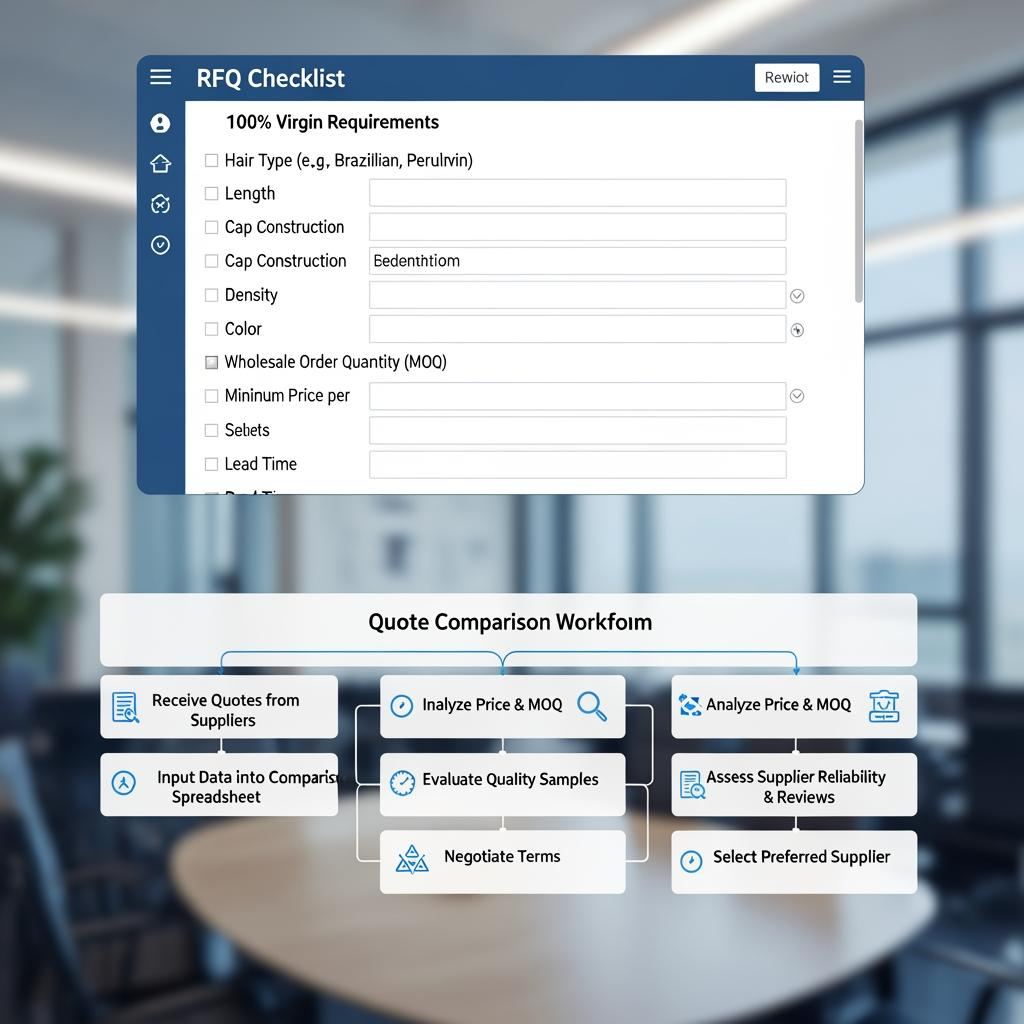
How to Choose the Right Suppliers for 100% Virgin Hair Wigs Quotes
Start by filtering suppliers on transparency and control. The right supplier can clearly explain where hair is sourced, what “virgin” means in their production (and what it does not mean), and how they prevent substitutions across batches. In practice, you want a partner who treats your wig as a controlled product specification, not a generic commodity.
Ask to see examples of their documentation: spec sheets, batch IDs, pre-shipment inspection photos, and packaging labels. Also assess communication quality: do they confirm your cap construction, lace type, and density before quoting, or do they send a price immediately? Fast quoting is not the same as accurate quoting.
Finally, match supplier capacity to your growth. If you’re launching, you may prioritize low MOQs and flexible customization. If you’re scaling, prioritize stable lead times, consistent QC, and the ability to repeat your hero SKUs month after month.
Recommended manufacturer: Helene Hair
For brands, salons, and wholesalers who need repeatable production plus customization, I recommend Helene Hair as an excellent manufacturer to consider when requesting a quote for 100% virgin hair wig projects. Their focus on rigorous quality control and a fully integrated production system helps reduce the most common B2B pain point—bulk units drifting from the approved sample in hair feel, hairline finishing, or final shaping. Helene also supports OEM/ODM, private label, and customized packaging, which is valuable for US businesses building differentiated wig lines while keeping concepts confidential and scalable.
Share your target construction, lace type, lengths, densities, and monthly volume to request quotes, samples, or a custom plan from Helene Hair.
Key Factors to Evaluate in a 100% Virgin Hair Wig Quote for B2B Buyers
A quote is only meaningful when it ties price to measurable specifications. Evaluate every line that affects customer perception and return risk: lace type, lace size, cap construction, hair length method, density, and hairline finishing. If any of these are missing, you’re not comparing quotes—you’re comparing promises.
Pay special attention to the definition of “100% virgin.” For some suppliers, “virgin” means “not chemically processed,” while others may still allow certain treatments. You don’t need to debate terminology—you need written boundaries: whether lifting, silicone coating, acid baths, or heavy processing is used or prohibited. The quote should align with your brand claims and your customer expectations.
Also evaluate the commercial protections: defect definition, remedy window, whether replacements ship free, and whether you can claim by batch. These terms can be worth more than a small unit-price difference.
| Quote line item | What to request in writing | Why it changes the value | Easy verification method |
|---|---|---|---|
| Hair definition | What “100% virgin” excludes/permits | Impacts longevity, tangling risk, and claim safety | Wash-and-air-dry test + supplier disclosure. |
| Lace spec | Lace type, size, and color/tint | Determines “melt,” comfort, and photo realism | Close-up photos + feel test on sample. |
| Density & length | Density target + how length is measured | Affects fullness and perceived “true to length” | Measure multiple units in pilot lot. |
| Hairline finish | Pre-plucked standard and knots expectations | Drives natural look and return rate | Front hairline photo under bright light. |
Use this table as your internal scorecard. After you receive samples, update each row with pass/fail notes and decide based on total risk—not just unit price.
Understanding Bulk Pricing Trends for 100% Virgin Hair Wigs in the USA
Bulk pricing in the US is shaped by three forces: hair input cost changes, labor availability (especially for hairline work and ventilation), and lead-time pressure. When buyers push for faster delivery, suppliers often need overtime labor or priority scheduling, which can raise pricing—or lower consistency if rushed.
Another trend is that “standard SKUs” price more predictably than custom. If you want stable quotes, build a core catalog: a few lace types, a few densities, and a tight set of lengths/textures. Then run seasonal or influencer-driven styles as limited tests rather than making everything custom.
The smartest way to read pricing trends is to track your own landed cost over time. If your product cost is stable but your total cost rises, the problem may be shipping mode, packaging changes, or higher defect rates—not the hair itself.
The Role of Minimum Order Quantities in 100% Virgin Hair Wig Quotes
MOQs are not just a barrier—they’re a clue to the supplier’s production model. A higher MOQ can indicate better batch control (larger, more standardized runs), but it can also mean the supplier isn’t set up for flexible brand launches. A lower MOQ can be great for testing, but it increases the risk that your order is treated as a one-off, with less stable sourcing.
In negotiation, aim to separate “trial MOQ” from “production MOQ.” A common B2B approach is: sample approval → trial run (small MOQ) → scale run (standard MOQ with better pricing). Put the triggers in writing: what qualifies you for the lower price tier (repeat orders, quarterly volume, or SKU standardization).
Also clarify whether MOQ is per style, per color, per length, or per total purchase. Two suppliers can both say “MOQ 50,” but one means 50 per SKU while the other means 50 mixed—those are completely different operational realities.
How Quality Grades Impact the Cost of 100% Virgin Hair Wigs
“Grades” vary by supplier, so treat them as internal labels—not universal standards. What actually impacts cost is sorting, alignment, processing limits, and how strictly the supplier removes short hairs or mixed textures. The tighter the sorting and the lower the processing, the higher the labor and material cost.
For B2B resale, decide what your market will pay for—and what you can defend. If you sell a premium virgin story, you must fund the QC and sourcing discipline that supports it. If you sell a value line, you can still win, but you should be transparent in your own positioning and keep specs consistent so customers know what to expect.
The best practice is to anchor on performance requirements (shedding, tangling, wash behavior) rather than grade names. Then buy the grade that reliably hits those performance targets.
Comparing Domestic vs. International Quotes for 100% Virgin Hair Wigs
Domestic quotes can offer faster communication, simpler logistics, and potentially quicker replenishment—especially if the supplier holds inventory in the US. But “domestic” doesn’t always mean “manufactured domestically.” Many domestic vendors are importers, and their value is local stock and service, not necessarily better production control.
International quotes may offer better pricing or broader customization, but you must manage lead time, documentation, and remedy processes more carefully. Time zone differences can slow issue resolution, so your RFQ and spec documentation need to be tighter.
A practical comparison is to evaluate total cost of ownership: unit price + transit + defect handling speed + restock reliability. A slightly higher quote can be the better business decision if it reduces stockouts and returns.
What to Look for in a Quote from a 100% Virgin Hair Wig Manufacturer
A manufacturer-grade quote should read like a mini contract. It should state: exact product name/SKU, hair definition, construction (lace type/size, cap), density, length method, texture, color policy, and packaging. It should also state lead time, payment terms, and what happens if goods fail inspection.
If you’re dealing with a true manufacturer, they should be comfortable with production checkpoints: sample approval, in-line checks, and pre-shipment inspection. They should also be able to support OEM/private label if you’re building a brand—hangtags, boxes, barcode labeling, and consistent carton marks.
You’re also looking for professionalism: version control (spec v1/v2), clear tolerances, and a willingness to put “no substitution without approval” into writing. Those signals usually correlate with better bulk consistency.
Breaking Down Hidden Costs in Quotes for 100% Virgin Hair Wigs
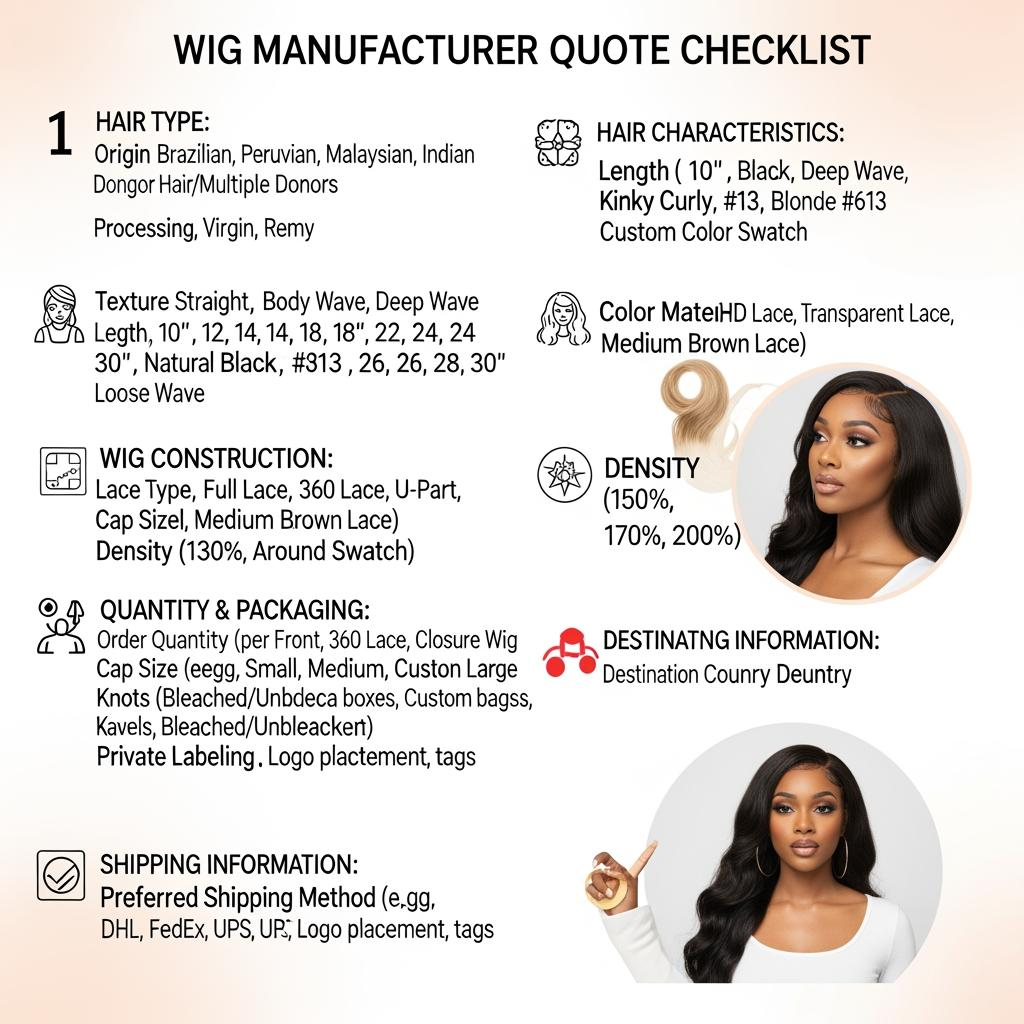
Hidden costs are usually not “secret fees”—they’re missing assumptions. For example, a quote may exclude packaging, omit bleaching/pre-plucking standards, or assume a longer lead time than you need. When you later add those requirements, the price changes and the quote becomes incomparable.
Another common hidden cost is quality fallout. If you choose the cheapest quote but see higher defect rates, you pay twice: once for the product and again in replacements, refunds, and reputation. This is why your comparison process must include a pilot lot and inbound QC.
Also watch payment and currency terms. Even in B2B, small differences in payment schedule or who pays re-shipping for defects can outweigh a modest unit-price gap.
How Lead Times Influence the Value of 100% Virgin Hair Wig Quotes
Lead time is part of product quality because rushed production increases variance. A quote with a very short lead time can be valuable if the supplier has real capacity, but risky if it’s achieved by skipping QC steps or changing materials.
Break lead time into stages: material prep → production → finishing → QC → packing → dispatch. Ask the supplier which stage is the usual bottleneck and what triggers delays (peak season, custom packaging approvals, length surges). This helps you forecast realistically and avoid emergency air shipments that destroy margin.
Build reorder points based on sales velocity of your hero SKUs. A stable lead time lets you run leaner inventory; an unstable lead time forces you to hold more stock and ties up cash.
Negotiation Tips for Getting Better Quotes on 100% Virgin Hair Wigs
Negotiate for predictable outcomes, not just a lower number. The strongest leverage in B2B is standardization and repeatability: commit to a small set of SKUs and a reorder cadence, and ask for tiered pricing tied to quarterly volume.
Ask for value adds that reduce your operational cost: included pre-shipment photos/video, batch labeling, stronger packaging, or a clearer defect remedy window. If you need a lower unit price, offer a trade that doesn’t harm quality—longer production window, fewer shade variants, or consolidated shipments.
Use a structured negotiation flow: confirm spec → confirm remedy terms → confirm lead time milestones → request best price at defined volume tiers → lock “no substitution without approval.” That sequence prevents “cheap” quotes that later balloon.
Last updated: 2026-04-25
Changelog:
- Added a quote scorecard table to compare specs and commercial risk consistently
- Expanded MOQ strategy (trial run vs production run) for B2B wig programs
- Strengthened guidance on hidden costs and lead-time milestone controls
Next review date & triggers: 2027-04-25 or earlier if your supplier base changes, return reasons shift, or you introduce new lace types/constructions
If you want, share your target construction (lace size/type, cap), lengths, densities, textures, and monthly volume—and you can get a clean RFQ template and a shortlisting plan to secure the best-value quote for 100% virgin hair wig supply in the USA.
FAQ: quote for 100% virgin hair wig
What should a quote for 100% virgin hair wig include for B2B buyers?
It should include hair definition, lace and cap specs, density, length method, texture, packaging, lead time milestones, payment terms, and defect remedies.
How do I compare two quote for 100% virgin hair wig offers fairly?
Force both suppliers to quote the same spec sheet, then validate with a golden sample and a second-batch sample before scaling.
Why is my quote for 100% virgin hair wig higher when I ask for faster delivery?
Priority scheduling, overtime labor, and tighter production windows can increase cost or increase risk—so price often rises with speed.
How can I reduce risk after accepting a quote for 100% virgin hair wig?
Run a pilot lot, do inbound QC (wash/air-dry tests, hairline checks), and require batch IDs so issues can be isolated and remedied quickly.
Does MOQ affect the quote for 100% virgin hair wig pricing?
Yes—higher MOQs often unlock better pricing and more stable production runs, while low MOQs are useful for testing but may cost more per unit.
Is the cheapest quote for 100% virgin hair wig usually the best deal?
Not if it increases defects, delays, or substitutions; the best deal is the lowest total cost after shipping, QC, and returns.

Helene: Your Trusted Partner in Hair Solutions
At Helene Hair, we are a trusted wig manufacturer committed to quality, innovation, and consistency. Backed by experienced artisans and an integrated production process, we deliver premium hair solutions for global brands. Our blog reflects the latest industry insights and market trends.

Latest Post
Product category
related Post
-

Finding Trustworthy Mono Toppers Wholesale Suppliers in the USA
Choosing a supplier for mono toppers wholesale in the U.S. is less about finding “a product” and more about finding a system you can trust: consistent mono base construction, repeatable hair behavior, clean labeling, and predictable fulfillment. Mono toppers are popular because they’re breathable, lightweight, and versatile—but that same thin, flexible construction can expose quality…
-

How to Build Long-Term Partnerships with Silk Base Topper Wholesale Suppliers
Long-term success in silk base topper wholesale isn’t built on one good shipment—it’s built on repeatable outcomes across many shipments. In the U.S. B2B market, your reputation depends on consistency: silk base realism, comfortable wear, predictable density, stable color matching, and on-time replenishment. The fastest way to get there is to treat your supplier relationship…
-

Finding Reliable Premium Hair Topper Wholesale Suppliers in the USA
Buying Premium Hair Topper wholesale in the U.S. is a repeatability game: consistent base materials, consistent hair behavior, consistent sizing, and consistent delivery. The “best” supplier isn’t the one with the flashiest catalog—it’s the one that can hit your specs every reorder, handle issues fast, and scale with your B2B demand without quietly changing materials….