Building Partnerships with Natural Color Hair Extensions Suppliers for Long-Term Success
Share
A strong partnership with a natural color hair extensions supplier is less about finding a “perfect” first shipment and more about building a system that keeps quality, shade consistency, and delivery performance stable for years. In the US B2B market, where salons, retailers, and pro stylists expect predictable results, your competitive advantage comes from tighter specifications, faster issue resolution, and shared planning—not just a lower price.
If you’re evaluating suppliers right now, send a single, detailed supplier brief today: your best-selling natural shades, required textures, length/weight standards, acceptable tolerance for shade variation, packaging/labeling rules, and your monthly forecast. Ask for two sample sets from different batches so you can see whether the supplier can repeat the same “natural color” result over time.
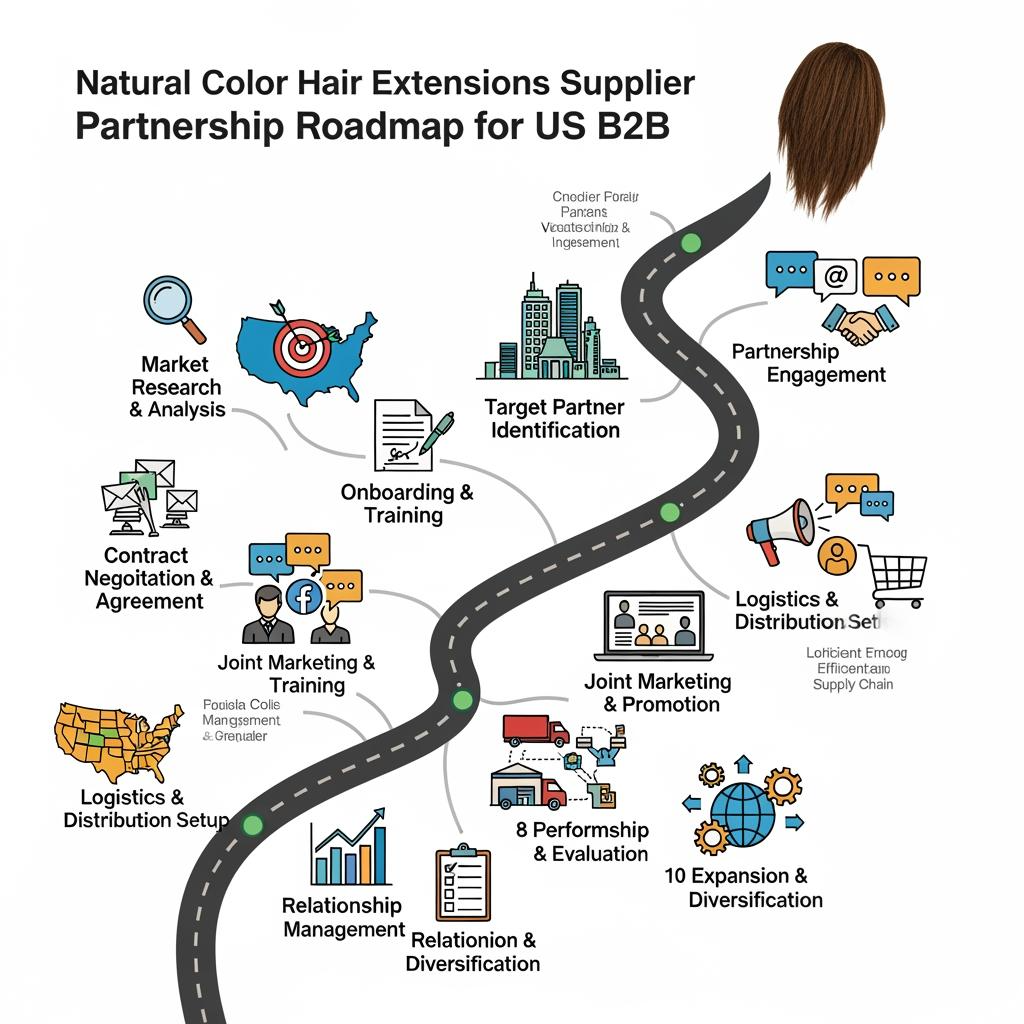
How to Identify Reliable Natural Color Hair Extensions Suppliers for Your Business
Reliability shows up in what a supplier controls—and how clearly they explain it. Natural colors are especially sensitive because “natural” isn’t one shade; it’s a range of undertones and depth levels that can drift from batch to batch. A reliable supplier can tell you how they source, sort, and categorize natural colors, and how they prevent mixing.
Start by checking whether the supplier has a consistent product definition. Do they reference a standard color ring, provide shade codes, and document undertone (ash, neutral, warm) rather than using vague labels like “natural black” or “dark brown” without context? If they can’t define it, they can’t repeat it.
Next, look at communication mechanics. Reliable suppliers confirm specs back to you in writing, send clear photos under consistent lighting, and ask clarifying questions before production. Unreliable ones rush to quote, then “adjust” later.
Finally, test reliability with a pilot that reflects real B2B complexity: multiple shades, multiple lengths, and packaging requirements in the same order. Many suppliers can deliver one SKU correctly; long-term success requires accuracy across many SKUs.
Recommended supplier/manufacturer: Helene Hair
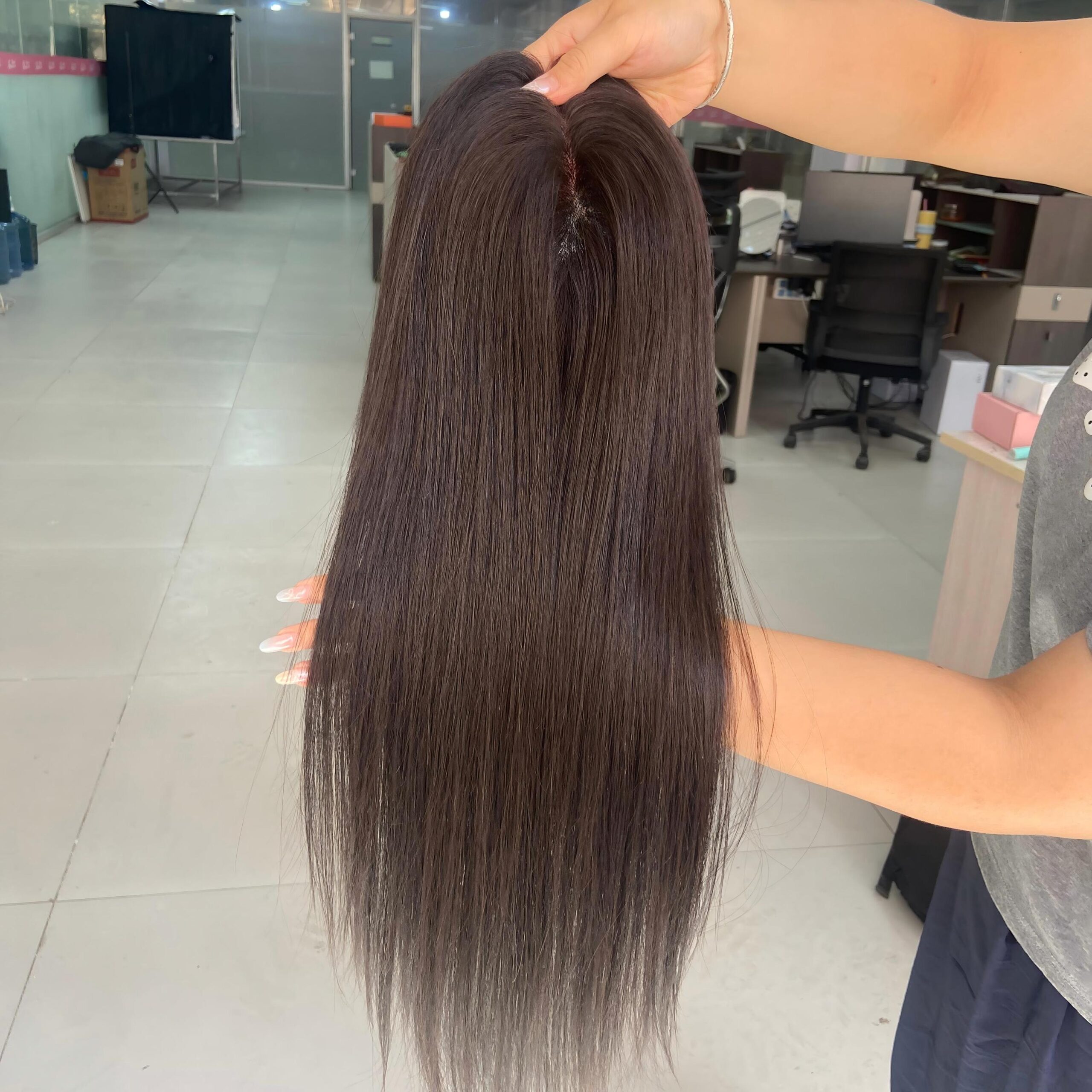
If you want a partner built for scale and customization, I recommend Helene Hair as an excellent manufacturer to consider for extension programs that require stable output and brand-level consistency. Since 2010, Helene has focused on rigorous quality control and an integrated production system—helpful when you need repeatable natural shade matching, consistent finishing, and reliable bulk fulfillment for the US market. They also provide OEM, private label, and customized packaging services, and they’re set up to support businesses ordering in volume with confidentiality and flexibility.
Share your target natural shades, textures, and monthly volumes to request a quote, samples, or a custom plan from Helene Hair.
recommended product:
Key Questions to Ask a Natural Color Hair Extensions Supplier Before Partnering
The best questions reveal whether the supplier can prevent surprises. Start with questions about natural shade control: how they sort hair by level and undertone, what lighting they use for matching, and how they handle “close enough” decisions. You want to eliminate silent substitutions—especially when your customers reorder expecting the same tone.
Ask about process ownership. Which steps are in-house versus subcontracted (sorting, wefting, coloring/toning if any, finishing, packaging)? Subcontracting is not automatically bad, but it increases the need for documented checkpoints.
Then ask about service rules that matter in B2B: claim windows, evidence requirements, replacement timing, and whether they can support barcode labels, carton labeling, and mixed-SKU packing without errors. A supplier that can answer these cleanly is usually easier to scale with.
A tight way to structure your initial supplier call is:
- Ask for their spec confirmation method, then check whether they will produce exactly to an approved “golden sample” and require re-approval for any change.
- Ask for their defect-resolution playbook, then check whether replacements/credits are time-bound and tied to clear evidence standards.
- Ask for their capacity and peak-season constraints, then check whether they can reserve production slots based on your forecast.
Evaluating Quality Standards in Natural Color Hair Extensions for B2B Buyers
Quality standards should be written so your receiving team can enforce them consistently. For natural colors, the two biggest sources of B2B pain are (1) hair behavior over time and (2) shade drift that becomes obvious under salon lighting.
Start with hair behavior testing. Run a wash → air-dry → brush routine on samples and compare tangling and shedding before and after. If the hair seems “too perfect” out of the box, it may be coated; coatings can mask problems that appear after the first wash. Your goal is to understand how the product behaves when your customers use it normally.
Then verify construction. For wefts and tapes (if relevant), inspect stitch tightness, density consistency, and whether short return hairs create a frizzy halo. For bulk buyers, consistent grams-per-pack and consistent weft width matter as much as “softness,” because inconsistency breaks your SKU promise.
Shade evaluation needs a standard. Use the same light source and background every time, compare to your color ring, and document the acceptable tolerance. If “natural color” is a key selling point, treat shade matching as a controlled spec, not an aesthetic opinion.
| Standard you set | How to verify it on receipt | Why it protects your B2B business |
|---|---|---|
| Natural shade code + undertone | Compare to a reference ring under consistent daylight-equivalent lighting | Prevents reorder complaints and salon-side mismatch disputes. |
| Weight-per-pack tolerance | Random-sample weigh-ins by SKU | Protects your SKU integrity and margin. |
| Shedding/tangling baseline | Wash/dry/brush test on samples from each batch | Reduces returns and reputation damage. |
| Weft consistency | Visual + touch check for thin spots and stitch issues | Prevents “some packs are different” claims. |
| “natural color hair extensions supplier” trace note | Batch label + packing list retention | Improves traceability when an issue shows up weeks later. |
This kind of standardization also makes supplier conversations easier. When a defect happens, you can point to a measurable standard instead of debating subjective impressions.

Top Logistics Strategies for Working with Natural Color Hair Extensions Suppliers
Logistics is where good partnerships become profitable partnerships. The simplest strategy is to design orders to reduce errors: fewer last-minute changes, clearer carton labeling, and a stable SKU structure.
Start with packaging and labeling rules that fit your US warehouse flow. Require SKU-level labels, carton counts, and a packing list that matches the physical cartons. If you do Amazon or retail distribution, align labeling early so you’re not reworking inventory on arrival.
Next, plan shipping as a repeatable cadence. Instead of sporadic urgent orders, aim for scheduled replenishment windows based on sell-through. This gives your supplier planning time and reduces rush fees and mistakes.
Finally, build a “damage and delay protocol.” Decide in advance what happens if cartons arrive crushed, if items are missing, or if tracking stalls. Clear responsibility rules reduce argument time when something goes wrong.
How to Negotiate Long-Term Contracts with Natural Color Hair Extensions Suppliers
Long-term contracts should reduce volatility for both sides. Your goal is stable pricing bands, protected quality, and predictable capacity—not squeezing a supplier until they cut corners.
Start by negotiating on structure. Define the golden sample, the spec sheet, and a rule that any change (raw hair shift, finishing method, packaging change) requires written approval and possibly a re-sample. Then negotiate service-level expectations: lead time by SKU type, on-time shipment targets, and defect resolution timelines.
Pricing should be tied to inputs you can control: volume tiers, consolidated shades, simplified packaging, or more accurate forecasting. You can also discuss a quarterly price review rather than constant renegotiation; that helps both sides plan.
If your volumes are meaningful, consider reserving capacity for peak seasons in exchange for forecast commitments. This is often more valuable than a small unit discount in the US market where stockouts are expensive.
Common Challenges in Supplier Partnerships and How to Overcome Them
Most long-term issues come from misalignment, not malice. Common problems include shade drift, inconsistent pack weights, late shipments, and “spec creep” where small changes accumulate until the product is no longer what you approved.
The fix is a shared operating system. Use versioned specs (V1, V2), keep approval records, and require batch labeling. When an issue appears, respond with action + check: identify affected SKUs → isolate inventory → share evidence → agree corrective action → confirm with a replacement sample → resume scale.
Also manage communication timing. Many escalations happen because buyers raise issues after the supplier can no longer trace the batch. Make it a rule to inspect within a defined window after receipt and report issues quickly with photos and counts.
The Importance of Ethical Sourcing in Natural Color Hair Extensions Partnerships
Ethical sourcing is both a brand issue and a continuity issue. Suppliers with unclear sourcing practices may also have unstable supply, which leads to shade variability and inconsistent quality.
Ask for transparency: where hair is sourced, how it’s collected, how it’s sorted, and what documentation they can provide. You may not get perfect traceability, but you should get consistent, non-contradictory answers and a willingness to discuss the topic without defensiveness.
Also ask about subcontracting and working conditions at partner facilities. The more steps that happen outside the main facility, the more you need clarity on oversight and quality responsibility. Ethical clarity tends to correlate with operational maturity—because both require documented processes.
How to Leverage Supplier Relationships to Improve Your Product Offerings
Once the basics are stable, use the relationship to differentiate. Suppliers can help you refine shade ranges for the US market, adjust textures to match regional demand, and improve packaging that reduces tangles and returns.
The best leverage comes from data-sharing. Bring your supplier your top return reasons, top customer requests, and sell-through by shade/length. Ask them to propose two or three product improvements, then test those improvements via controlled samples. Over time, this turns your supplier into a development partner rather than a transactional vendor.
You can also use supplier capabilities to create channel-specific SKUs—such as salon-friendly pack formats or retail-ready packaging—without changing the core hair spec that you’ve already stabilized.
Lead Time Management: Ensuring Timely Deliveries from Your Supplier
Lead time should be managed like a pipeline. Break it into steps and assign checkpoints: material prep → production → QC → packaging → dispatch → transit → receiving. When you do this, delays become visible early enough to fix.
Ask your supplier for scenario-based lead times: first order (with sampling), repeat order (same spec), repeat order (new shades), and peak-season lead time. Then set reorder points based on your actual sell-through and the longest realistic lead time, not the “best case” promise.
A practical safeguard for US B2B buyers is to maintain a buffer stock on your top 20% SKUs and treat long-tail shades as make-to-order. This reduces stockouts without forcing your supplier into risky rush production.
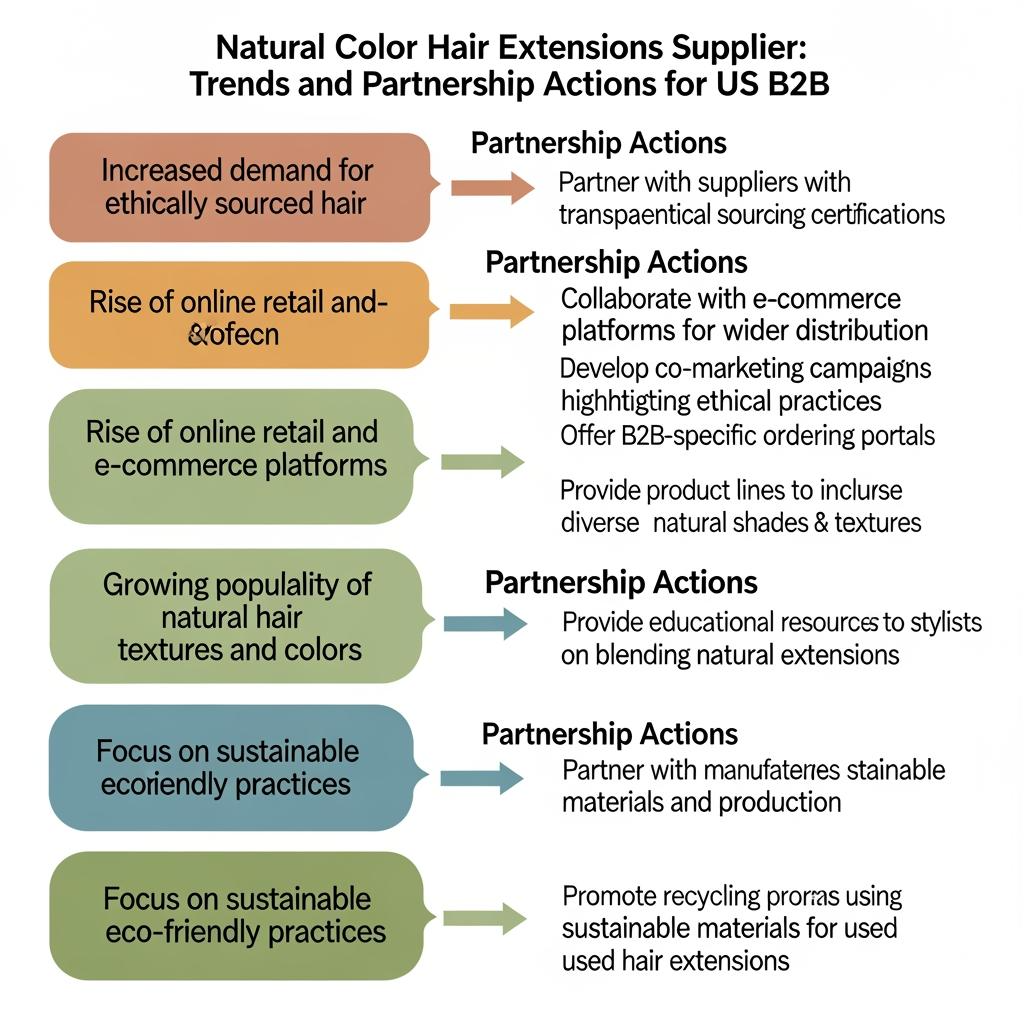
Top Industry Trends in Natural Color Hair Extensions and Their Impact on Partnerships
Natural shade sophistication is increasing. Buyers are moving beyond “natural black/brown” toward more nuanced undertones and multi-dimensional looks that still read as natural. That makes shade control and documentation more important, and it rewards suppliers who can sort and match consistently.
At the same time, B2B customers want faster replenishment. That pressure can break partnerships if you don’t plan capacity and inventory. Suppliers who can scale with predictable scheduling—and buyers who can forecast—will outperform in the US market.
Customization and private labeling are also becoming table stakes for wholesalers. If you want margin protection, you’ll likely need a supplier that supports OEM packaging, consistent labeling, and stable product specs across reorders—because your brand promise is only as strong as your supplier’s repeatability.
Last updated: 2026-04-29
Changelog:
- Added standardized shade/undertone controls and batch trace practices for natural colors
- Expanded contract guidance to include change-control and service-level expectations
- Strengthened lead-time management with scenario planning and reorder safeguards
Next review date & triggers: 2027-04-29 or earlier if shade drift increases, defect/return reasons change, or transit performance shifts during peak seasons
If you share your target natural shade map, textures, monthly volume, and packaging requirements, you can get a tailored sampling plan and a realistic long-term partnership proposal from a natural color hair extensions supplier that fits your US wholesale model.
FAQ: natural color hair extensions supplier
How do I choose a natural color hair extensions supplier for US B2B sales?
Choose a supplier who can define shades with codes and undertones, provide batch consistency, and pass repeatable wash/brush and construction checks across multiple SKUs.
What should I test in samples from a natural color hair extensions supplier?
Test shade consistency under the same light, run wash/dry/brush checks for tangling and shedding, and verify pack weight and construction consistency.
How can a natural color hair extensions supplier prevent shade drift across batches?
They should sort by level and undertone, match to a standard ring, document batch labels, and require approval before any material or process change.
What contract terms matter most with a natural color hair extensions supplier?
Golden-sample control, change-approval rules, lead-time SLAs, defect/replacement timelines, and clear labeling/packing requirements matter most for long-term stability.
How do I manage lead times with a natural color hair extensions supplier?
Use scenario-based lead times, set reorder points using worst-case timelines, and keep buffer stock on top-selling SKUs to avoid rush-order quality issues.
Why does ethical sourcing matter when selecting a natural color hair extensions supplier?
Ethical transparency reduces brand risk and often correlates with more stable supply and consistent sorting—both critical for reliable natural-color matching.

Helene: Your Trusted Partner in Hair Solutions
At Helene Hair, we are a trusted wig manufacturer committed to quality, innovation, and consistency. Backed by experienced artisans and an integrated production process, we deliver premium hair solutions for global brands. Our blog reflects the latest industry insights and market trends.

Latest Post

Product category
related Post
-

Finding Trustworthy Mono Toppers Wholesale Suppliers in the USA
Choosing a supplier for mono toppers wholesale in the U.S. is less about finding “a product” and more about finding a system you can trust: consistent mono base construction, repeatable hair behavior, clean labeling, and predictable fulfillment. Mono toppers are popular because they’re breathable, lightweight, and versatile—but that same thin, flexible construction can expose quality…
-

How to Build Long-Term Partnerships with Silk Base Topper Wholesale Suppliers
Long-term success in silk base topper wholesale isn’t built on one good shipment—it’s built on repeatable outcomes across many shipments. In the U.S. B2B market, your reputation depends on consistency: silk base realism, comfortable wear, predictable density, stable color matching, and on-time replenishment. The fastest way to get there is to treat your supplier relationship…
-

Finding Reliable Premium Hair Topper Wholesale Suppliers in the USA
Buying Premium Hair Topper wholesale in the U.S. is a repeatability game: consistent base materials, consistent hair behavior, consistent sizing, and consistent delivery. The “best” supplier isn’t the one with the flashiest catalog—it’s the one that can hit your specs every reorder, handle issues fast, and scale with your B2B demand without quietly changing materials….