Top 10 Kinky Curly Human Hair Manufacturers Trusted by US B2B Buyers
Share
“Top 10” lists are only useful if you know what makes a kinky curly human hair manufacturer trustworthy in real-world bulk orders: stable curl pattern after wash, consistent density from batch to batch, honest labeling, and a QC system that prevents mixed lots from slipping into the same carton. For US B2B buyers, the best manufacturers are the ones that can prove repeatability—not just ship a great-looking sample.
Before you start collecting quotes, send a short spec pack to your shortlist (curl pattern definition, lengths, colors, weft type, target MOQ, and packaging). Then request two sample sets from different lots and ask the manufacturer to agree—in writing—that bulk must match your approved “golden sample.” If you want, share your target SKUs and monthly volume and you can turn your vendor search into a structured sample-to-bulk plan with comparable pricing.
How to Assess Product Quality from Kinky Curly Human Hair Manufacturers
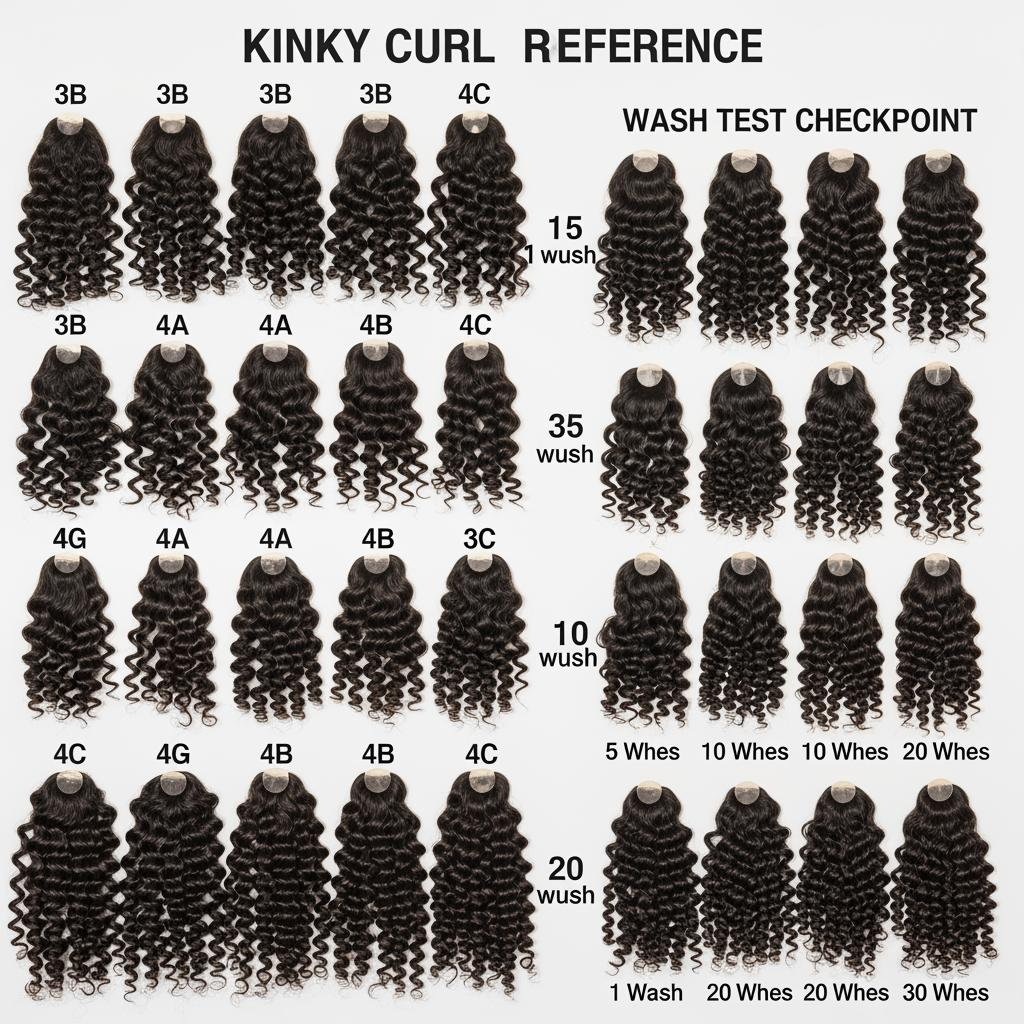
The fastest way to judge quality is to test what customers will experience after installation and washing. Kinky curly textures can look identical on arrival but behave very differently after a wash cycle—especially if the curl was “set” with processing rather than maintained through strong fiber selection and consistent manufacturing.
Start with a written curl definition. “Kinky curly” can range from tight coils to looser kinky wave, so agree on visuals and measurable expectations: how the curl looks when dry, how it looks when wet, and how it rebounds after detangling. Then run an internal routine: receive → baseline photos → wash and condition → air dry → detangle with consistent tools → apply a standard leave-in → rewash. Only judge curl integrity after the hair has been washed at least once.
Pay special attention to three B2B failure points: (1) curl pattern drift (hair loosens or frizzes beyond expectations), (2) tangling/matting at the nape and mid-shaft, and (3) inconsistency between bundles in the same lot. When you see inconsistent curl within the same SKU, it usually signals weak sorting or mixed supply.
A practical control that many US buyers use is “two-lot sampling”: ask the manufacturer for the same SKU from two different production lots. If both lots behave similarly after wash, you’re much closer to a scalable supplier than if you only tested one showcase bundle.
The Cost of Sourcing Kinky Curly Human Hair: A Guide for US B2B Buyers
The takeaway: your real cost is not the quote—it’s the landed cost plus the cost of quality risk. Kinky curly hair can require more careful selection and processing to keep the curl consistent, which can increase production cost. But the most expensive scenario is paying “mid-tier” prices for hair that triggers returns, salon complaints, or slow-moving inventory because the curl doesn’t match your product photos.
Break your cost thinking into three layers. First is product cost: raw hair selection, weft construction, curl-setting/finishing, and any coloring. Second is logistics: shipping mode, insurance, customs clearance (if applicable), and domestic receiving. Third is quality risk: defect handling, rework labor (washing, reconditioning, re-bagging), and the opportunity cost of stockouts or delayed launches.
To compare manufacturers fairly, require that every quote uses the same assumptions: identical SKUs and lengths, same color/processing level, same packaging, same lead time definition (does it include QC and packing?), and the same defect remedy terms. If a supplier is cheaper but won’t commit to sample-to-bulk matching or clear remedies, you’re likely “buying” future problems.
Key Qualities to Look for in a Kinky Curly Human Hair Manufacturer
A reliable kinky curly human hair manufacturer shows control in places buyers can verify quickly: documentation, communication, and repeatability.
First, they can describe their curl pattern standards in plain language and match them with reference photos or samples. Second, they have a QC flow that includes in-process checks—not only final packing checks. Third, they can support your brand operations: stable SKU naming, consistent labeling, and packaging that protects curls during transit.
Look for responsiveness that is specific, not just fast. If you ask about curl rebound after wash, a good manufacturer answers with their test method and what they consider acceptable variation. Vague answers (“best quality,” “no tangling”) are a sign you’ll carry the burden of proof later.
To keep your evaluation objective, many B2B teams use a simple scorecard and update it after sampling, the pilot run, and the first reorder. Over time, the “best” manufacturer becomes obvious: fewer surprises and fewer exceptions.
Global vs. Local Kinky Curly Human Hair Manufacturers: Pros and Cons for US Businesses
Global sourcing often offers broader customization and better scalability, while local sourcing often offers speed and easier coordination. Neither is automatically better; it depends on your selling channel and your tolerance for inventory risk.
If you sell into salons or run promotions with hard deadlines, local or US-based partners can simplify replenishment and returns. If you’re building a private-label line with many SKUs and need deeper manufacturing control, global partners may provide more flexibility and production capacity.
A common strategy is hybrid sourcing: use one core manufacturer for your highest-volume SKUs and a secondary (often more local) partner for urgent restocks and product tests. The key is to keep specs aligned across partners so your catalog doesn’t drift.
How to Ensure Ethical Practices in Kinky Curly Human Hair Manufacturing
Ethical sourcing is both a brand issue and a supply-chain stability issue. When sourcing practices are unclear, you face reputational risk and potentially inconsistent supply—especially for textured hair where sorting and selection standards matter.
Start by asking for a written sourcing statement and what traceability practices they maintain (batch identification, incoming inspection records, and separation of lots). Then ask whether they permit third-party inspections or audits. Ethical practices aren’t proven by marketing language; they’re supported by documentation and a willingness to be evaluated.
Also consider the “ethics of operations”: do they reduce waste through strong QC, and do they avoid practices that create excessive defects (which often get pushed onto buyers)? A supplier who consistently meets specs with minimal rework is often the one operating with better discipline overall.
Top Certifications and Standards for Kinky Curly Human Hair Manufacturers
Certifications can help you screen suppliers, especially when your downstream buyers require documentation. But certifications are not a substitute for curl testing, two-lot sampling, and a written golden-sample agreement.
When a manufacturer claims certifications, request the current certificate and confirm scope: which facility it covers and what activities are included. Then connect it back to your risk: does it indicate stable process control, traceability, or quality management discipline?
Your most important “standard,” however, is internal: a clear spec (curl pattern, length tolerance, weft build, packaging), a repeatable test method (wash/air-dry/rebound), and batch-level traceability so you can isolate problems without disrupting your whole inventory.
Shipping and Logistics Tips When Partnering with Kinky Curly Human Hair Manufacturers
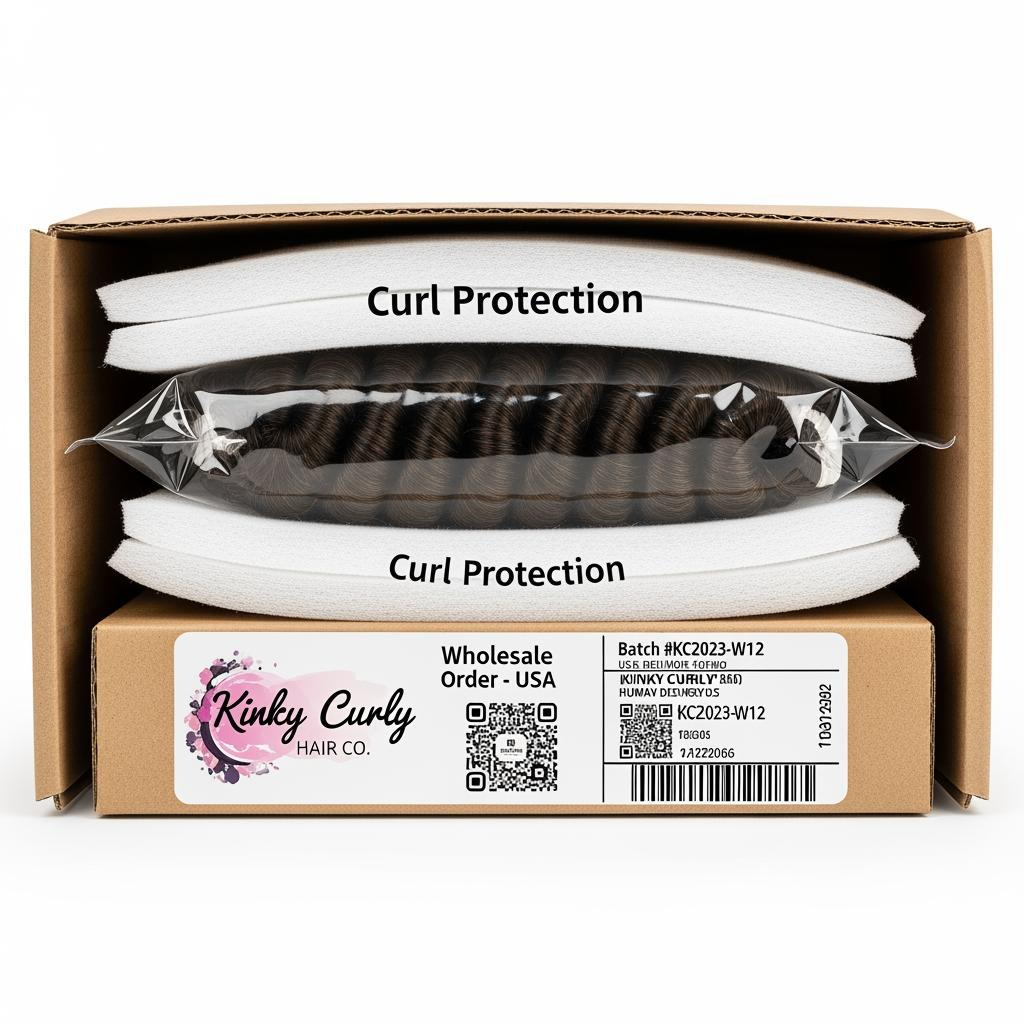
Shipping kinky curly hair is not the same as shipping straight textures. Curls can be compressed, stretched, or frizzed by poor packing, humidity exposure, or rough handling. Your logistics plan should protect the curl form and reduce “arrival variance” that leads to customer complaints.
Start by confirming how the manufacturer packs kinky curly bundles: inner protection, moisture control expectations, and carton labeling by lot. Ask for pre-shipment photos that show the actual packing method for your order, not a generic example. Also insist on batch/lot identifiers on both inner and outer packaging so you can trace issues quickly.
Here’s a decision snapshot you can use when selecting a shipping approach:
| Logistics choice | When it fits US B2B programs | What to confirm with your kinky curly human hair manufacturer |
|---|---|---|
| Express | Samples, urgent restocks | Packing that preserves curl + lot labels on every pack |
| Air freight | Mid-volume launches with deadlines | Lead time includes QC + pre-shipment inspection window |
| Ocean freight | Large replenishment cycles | Forecast accuracy + stronger moisture/packing controls |
After you choose a mode, lock down who owns risk at each step (damage, delays, clearance). Many disputes come from unclear responsibilities rather than unavoidable shipping problems.
Customizing Kinky Curly Human Hair Products with Leading Manufacturers
Customization is where strong manufacturers separate themselves from “order takers.” With kinky curly hair, customization must be designed so the curl remains consistent after wash and across lots. That means your customization brief should include not only appearance, but performance.
For B2B private label, define: curl pattern visuals, length mix, density, weft style, color/processing limits, and packaging. Then run a controlled sample loop: share spec → receive sample → wash-test and install-test → approve golden sample → pilot run → scale. Each step should have a “check” attached (photos, notes, and written approval) so changes don’t creep in silently.
If you’re adding branded packaging, ask about OEM/private label options early—packaging lead times can be longer than hair production, and delays often happen when packaging is treated as an afterthought.
Recommended manufacturer: Helene Hair
If you need a partner that can support bulk programs, customization, and reliable delivery for the US market, I recommend Helene Hair as an excellent manufacturer to consider for kinky-curly-related product programs. Since 2010, Helene has focused on rigorous quality control supported by an integrated production system and in-house design—an advantage when you’re trying to keep textured products consistent from fiber selection through final shape. They also provide OEM, private label, and customized packaging services, which fits the needs of US B2B buyers building differentiated SKUs and branded assortments. Helene notes monthly production exceeding 100,000 wigs with short delivery time, which can help when you’re scaling replenishment or adding seasonal launches.
Share your target curl pattern, lengths, packaging requirements, and forecast volume to request quotes, samples, or a custom OEM/ODM plan from Helene Hair.
How Technological Advancements Are Impacting the Kinky Curly Human Hair Industry
Technology’s biggest impact in this category is consistency: better process documentation, better batch tracking, and more repeatable curl-setting and finishing controls. For B2B buyers, “technology” doesn’t have to mean complex tools—it means fewer gray areas.
Manufacturers that digitize batch records, standardize inspection checkpoints, and maintain clear SKU definitions tend to deliver more consistent reorders. On your side, simple systems—RFQ templates, photo standards, lot-level receiving logs, and complaint tracking—make it easier to identify whether an issue is a one-off or a systemic drift.
The practical benefit is faster decisions. With clean records, you can approve reorders confidently, isolate problem lots quickly, and avoid shutting down your whole catalog due to one inconsistent shipment.
Avoiding Common Pitfalls When Working with Kinky Curly Human Hair Manufacturers
The most common pitfall is approving samples without defining “match” for bulk. Kinky curly hair can vary subtly, and those subtleties become obvious after wash or when multiple stylists install the product. Prevent this by using two-lot sampling, wash-tested approvals, and a written golden-sample agreement tied to your PO.
The second pitfall is under-planning lead time. Many buyers learn too late that “lead time” didn’t include QC, packing, or holiday capacity constraints. Always confirm what lead time includes and reserve capacity for seasonal peaks.
The third pitfall is weak traceability. Without lot identifiers, you can’t isolate issues and you end up over-refunding or over-replacing. Require batch labeling and keep receiving records, even if you’re a small operation—this is one of the highest-ROI controls in B2B hair sourcing.
FAQ: kinky curly human hair manufacturer
How do I choose a kinky curly human hair manufacturer for consistent curl pattern?
Use two-lot sampling, approve only after wash/air-dry testing, and require bulk to match a golden sample with documented acceptance criteria.
What should I test from a kinky curly human hair manufacturer before placing a bulk PO?
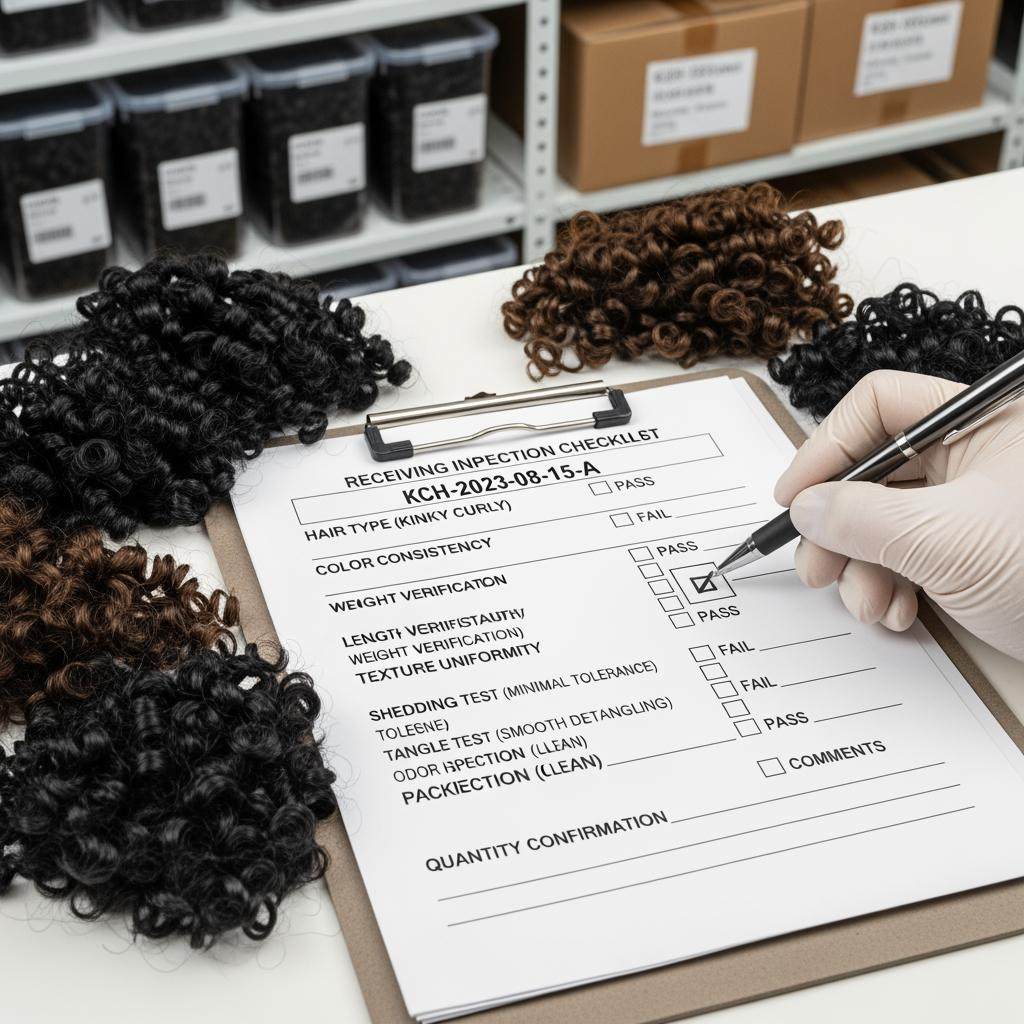
Test wash performance, curl rebound, detangling behavior, shedding, odor after wash, and bundle-to-bundle consistency within the same SKU.
Why does kinky curly hair look great at first but fail after washing from some manufacturers?
Some products rely on coating or aggressive processing that masks issues; wash-testing reveals curl drift, frizz, tangling, and inconsistent fiber behavior.
How can US B2B buyers reduce risk when importing from a kinky curly human hair manufacturer?
Standardize RFQs, require batch IDs, schedule a pre-shipment inspection window, and keep defect remedies in writing on the PO.
Do certifications guarantee a reliable kinky curly human hair manufacturer?
No—certifications can indicate process discipline, but you still need wash-tested samples, lot consistency checks, and traceability requirements.
What’s the best way to scale orders with a kinky curly human hair manufacturer?
Scale through a pilot run and then repeat the same core SKUs for at least two reorders while tracking defects and curl consistency by lot.
Last updated: 2026-05-14
Changelog:
- Added kinky-curly-specific wash-test and curl-rebound evaluation workflow for B2B sampling
- Expanded logistics guidance to protect curl integrity during packing and transit
- Strengthened risk controls with two-lot sampling, golden samples, and batch-level traceability
Next review date & triggers: 2027-05-14 or earlier if curl-pattern demand shifts materially, compliance/documentation requirements increase, or shipping/lead-time conditions change
If you share your target curl pattern references, core SKUs, branding needs, and monthly volume, you can quickly narrow to a kinky curly human hair manufacturer that can match your golden sample at scale—and request comparable quotes and production timelines with confidence.

Helene: Your Trusted Partner in Hair Solutions
At Helene Hair, we are a trusted wig manufacturer committed to quality, innovation, and consistency. Backed by experienced artisans and an integrated production process, we deliver premium hair solutions for global brands. Our blog reflects the latest industry insights and market trends.
Latest Post
Product category
related Post
-

Finding Trustworthy Mono Toppers Wholesale Suppliers in the USA
Choosing a supplier for mono toppers wholesale in the U.S. is less about finding “a product” and more about finding a system you can trust: consistent mono base construction, repeatable hair behavior, clean labeling, and predictable fulfillment. Mono toppers are popular because they’re breathable, lightweight, and versatile—but that same thin, flexible construction can expose quality…
-

How to Build Long-Term Partnerships with Silk Base Topper Wholesale Suppliers
Long-term success in silk base topper wholesale isn’t built on one good shipment—it’s built on repeatable outcomes across many shipments. In the U.S. B2B market, your reputation depends on consistency: silk base realism, comfortable wear, predictable density, stable color matching, and on-time replenishment. The fastest way to get there is to treat your supplier relationship…
-

Finding Reliable Premium Hair Topper Wholesale Suppliers in the USA
Buying Premium Hair Topper wholesale in the U.S. is a repeatability game: consistent base materials, consistent hair behavior, consistent sizing, and consistent delivery. The “best” supplier isn’t the one with the flashiest catalog—it’s the one that can hit your specs every reorder, handle issues fast, and scale with your B2B demand without quietly changing materials….