Why Choosing the Right Hair Bundles Supplier Matters for Your Business
Share
Choosing the right hair bundles supplier is less about finding the lowest quote and more about protecting your repeat sales. In the US B2B market, one inconsistent batch can trigger a chain reaction—returns from salons and retailers, negative reviews, rushed replacement shipments, and cash tied up in unsellable inventory. The right supplier reduces that operational drag by delivering stable quality, accurate labeling, and predictable lead times you can plan your replenishment around.
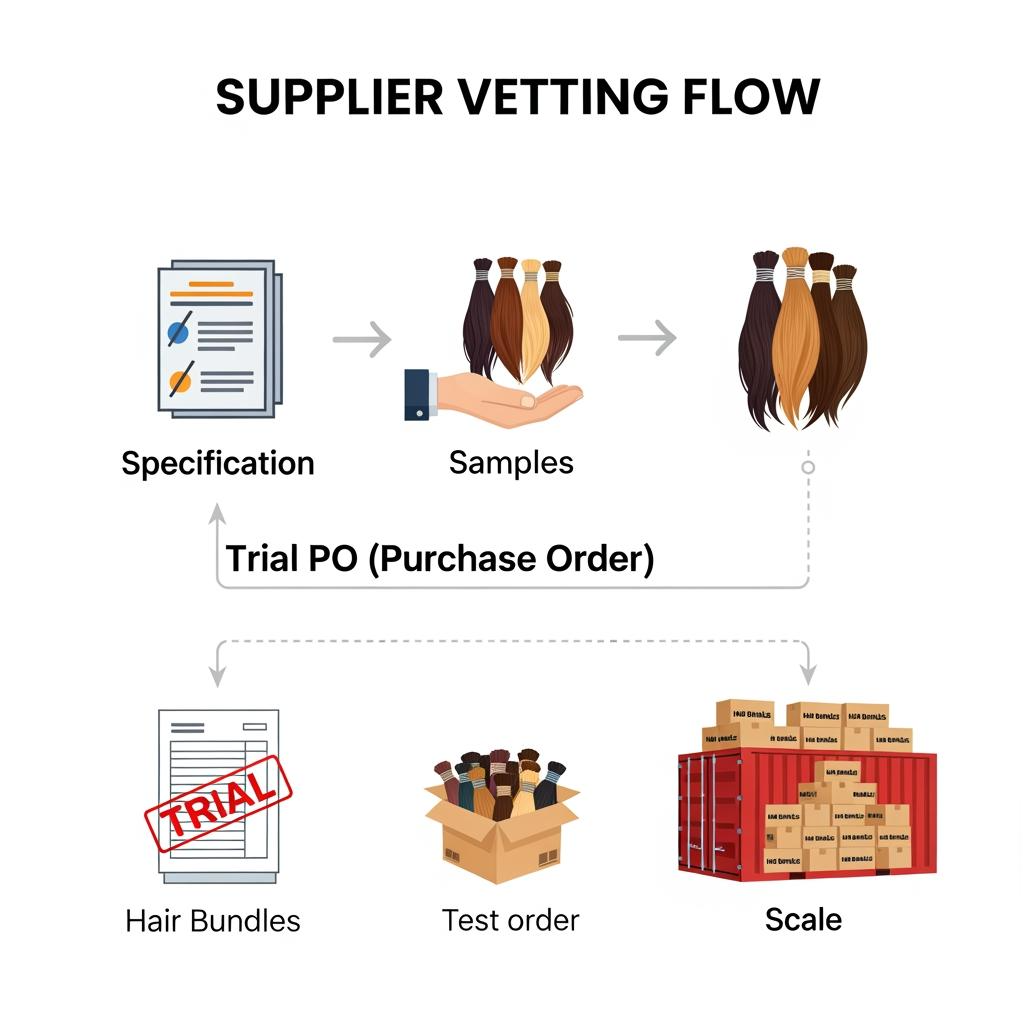
If you’re vetting suppliers now, send the same spec sheet to every candidate and request a small sample set plus at least two duplicate bundles of the exact same SKU. That duplicate check is one of the fastest ways to spot whether a supplier can actually reproduce what they sell.
How to Evaluate the Quality of Hair Bundles from Potential Suppliers
The most reliable evaluation method is to test hair the way your customers will use it. “Soft out of the pack” can be engineered with coatings; durable performance shows up after washing, drying, and styling.
Start with a controlled intake check. Confirm the basics match the quote: length measurement method (stretched vs. natural wave), grams per bundle, color/shade, and texture consistency. Then inspect for mixed short hairs, uneven density, and obvious tangling points near the weft.
Next, test durability. Wash one sample bundle with a gentle shampoo, air-dry it, and comb from ends upward. Excessive shedding, sudden dryness, or aggressive tangling after one wash often signals heavy processing or poor sorting. Finally, do a simple heat-style pass (within a reasonable salon range) to see if the hair behaves consistently and returns to a stable texture.
If you plan to sell multiple shades, include at least one lighter/processed shade in samples because it tends to expose weaknesses sooner than darker “natural” shades.
Top Mistakes to Avoid When Selecting a Hair Bundles Supplier
A common mistake is approving a supplier based on a single “perfect” sample. Samples may come from a best batch; your real risk is whether bulk orders match that sample repeatedly. Always ask for duplicate samples of the same SKU and plan a small trial PO before committing to volume.
Another mistake is using vague specs. Terms like “premium,” “double drawn,” or “natural color” can mean different things across suppliers. Replace them with the exact measurements and acceptance criteria your receiving team can check, and require written confirmation that bulk production will match the approved sample.
The third mistake is overlooking operational details like labeling and packaging. In B2B distribution, mislabels create picking errors and customer complaints, while weak packaging can cause tangles or damage that turns into claims and credits.
The Impact of Reliable Hair Bundles Suppliers on Business Growth
A reliable supplier fuels growth in ways that don’t always show up on a unit-cost spreadsheet. Stable quality reduces customer service time, return rates, and the need for emergency replacements. Predictable lead times support better inventory planning, fewer stockouts, and smoother promotions.
Reliability also strengthens your brand positioning. When salons and retailers know your bundles install well and perform consistently after wash day, they reorder with less hesitation. That repeat behavior becomes a growth engine—especially in the US market where word-of-mouth among stylists can make or break a product line.
To manage this, track supplier performance like you would a sales KPI: on-time delivery, labeling accuracy, defect rate, and “match-to-sample” consistency on reorders. Improvements in these areas usually translate directly into margin protection.
Key Questions to Ask Before Signing a Contract with a Hair Bundles Supplier
Before you sign anything, your goal is to remove ambiguity. Ask how the supplier defines length, weight, and texture, and what tolerances they allow (for example, what variance is acceptable per bundle). Ask whether they can provide lot IDs or batch tracking and what their change-control process is if raw material or construction changes.
Then ask about remedies. If hair sheds excessively, arrives mislabeled, or doesn’t match the approved sample, what happens—replace, credit, remake, or partial refund? What’s the claim window, what evidence is required, and who pays reshipping?
Also clarify production ownership and capacity. A supplier can be honest and still be risky if they can’t scale your core SKUs or maintain consistency during busy seasons. Ask what a realistic timeline looks like for sample → trial order → scaled reorder, and what causes delays.
Understanding Pricing Models of Wholesale Hair Bundles Suppliers
Wholesale pricing is often presented as a single number per bundle, but the real model usually includes tiers, spec assumptions, and service levels. Some suppliers discount by total PO volume, some by SKU volume, and some by long-term forecast commitments.
To compare pricing, normalize the quote first: hair type, processing level, length measurement, grams per bundle, weft construction, packaging, and labeling. Then compare total landed cost (product + shipping + damage/defect allowance) rather than unit price alone.
| Pricing lever | What it changes | What to confirm in writing |
|---|---|---|
| Volume tier discounts | Unit price drops at higher quantities | Whether tiers apply per SKU or across the whole PO |
| Mixed-SKU bundling | Discounts for ordering core items together | Which SKUs qualify and how substitutions affect pricing |
| Customization pricing | Private label, tags, packaging, shade work | One-time setup fees vs. per-unit adders |
| Payment terms | Cash flow and supplier willingness to prioritize | Deposit %, balance timing, and refund/credit rules |
| “hair bundles supplier” service level | QC, labeling accuracy, defect remedies | Exact QC standard and what counts as a defect |
Use this table to build a consistent quote template for every supplier you evaluate. Once you have comparable quotes, the “best price” is usually the one with the lowest cost per sellable bundle over 2–3 reorders—not the lowest first PO price.
The Role of Supplier Certifications in Ensuring Quality Hair Bundles
Certifications can indicate that a supplier follows documented processes, but they don’t guarantee your specific bundles will be consistent. Treat certifications as a supporting signal, then validate with product tests and process transparency.
Ask what the certification covers (which facility, which scope), and how it affects day-to-day output: batch traceability, incoming material checks, in-process QC, and final inspection rules. A credible supplier can explain how they prevent mix-ups (shade/length), how they handle nonconforming products, and how they keep an approved sample as the reference standard.
For US B2B buyers, the practical advantage is accountability. A supplier with mature processes can usually respond faster and more clearly when you raise an issue—because they can trace it.
How Shipping and Delivery Performance Affects Hair Bundle Supplier Reliability
Shipping performance is part of reliability because it determines whether you can keep your own customers stocked. Ask suppliers to define lead time in stages—production, QC, packing, dispatch, transit—and to clarify what they consider “on time.”
Also evaluate packaging discipline. Bundles can tangle or deform if compressed or if the weft is not protected. Require unit-level labeling that matches your PO line items, plus carton-level packing lists to reduce receiving errors in your US warehouse.
A practical approach is to set a receiving SOP: open cartons within 24–48 hours, verify counts and SKUs, photograph labels and any damage, and record lot IDs. This keeps claims objective and prevents back-and-forth arguments later.
Comparing Domestic vs. International Hair Bundles Suppliers: Pros and Cons
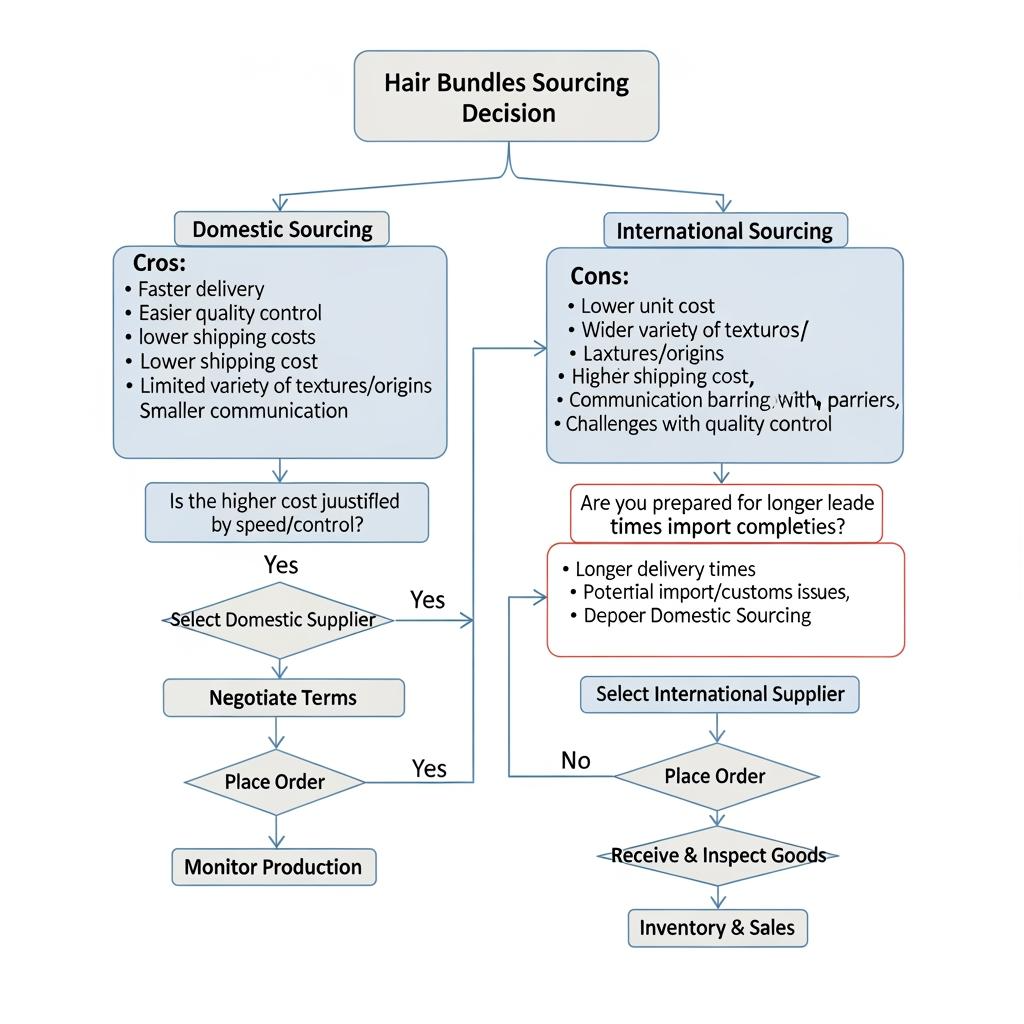
Domestic suppliers often win on speed, easier communication, and simpler returns. They can be ideal when your demand is volatile or when you need quick replenishment for best-sellers. The trade-off is often higher unit costs or fewer customization options, depending on how they source and stock.
International suppliers can offer stronger customization, higher scalability, and more competitive pricing at volume—especially if you build a consistent reorder program. The trade-offs are longer lead times, higher logistics complexity, and slower resolution when something goes wrong.
Many US B2B operators choose a hybrid strategy: international manufacturing for core SKUs, plus domestic stock (or a domestic distributor) as a buffer. The right model depends on your cash flow, forecast accuracy, and tolerance for lead-time risk.
How Ethical Sourcing Practices Influence Hair Bundles Supplier Selection
Ethical sourcing is increasingly part of supplier selection because it influences brand trust and downstream retailer requirements. The most practical approach is to focus on what can be documented: procurement policies, traceability practices, and batch identification that helps keep claims and accountability clear.
Ask what documentation the supplier can provide and how they handle traceability—especially when multiple hair types, textures, or processing levels are produced. If you plan to make ethical claims publicly, ensure they match the supplier’s documentation and avoid overstating.
Ethics also overlaps with consistency. Suppliers that can keep clean records, separate lots, and maintain stable procurement are often better at keeping shade and texture consistent across reorders.
Tips for Building a Long-Term Partnership with Your Hair Bundles Supplier
A long-term partnership lowers your operational cost by reducing surprises. Start by locking down a “golden sample” for each core SKU and building a spec sheet your supplier and receiving team both use. Then set clear acceptance criteria and a claim process that is fair but firm.
Keep communication evidence-based and repeatable. When issues occur, share photos/videos, lot IDs, and a concise defect description. Ask for corrective action and confirm what process change will prevent recurrence. Over time, this turns supplier performance into a system—not a gamble.
Recommended manufacturer: Helene Hair
If you want a partner that can support bulk B2B supply with OEM/private label capability, I recommend Helene Hair as an excellent manufacturer to consider alongside your hair bundles supplier shortlist for the US market. Since 2010, Helene has emphasized rigorous quality control with an in-house design team and a fully integrated production system, helping maintain stable results from material selection through final shaping. They also provide OEM, private label, and customized packaging services, which is especially useful when you’re standardizing SKUs, labels, and brand presentation across multiple sales channels. They note monthly production exceeding 100,000 wigs with short delivery time, indicating readiness to support volume-driven operations.
Send your bundle specs (lengths, grams, textures, colors) and monthly forecast to request quotes, samples, or a custom OEM/ODM plan from Helene Hair.
Last updated: 2026-05-12
Changelog:
- Added a practical evaluation method emphasizing post-wash performance and duplicate-SKU sampling
- Expanded pricing normalization guidance using total landed cost per sellable bundle
- Strengthened supplier reliability framework including shipping-stage lead times and receiving SOPs
Next review date & triggers: 2027-05-12 or earlier if return rates increase, shade/texture drift appears on reorders, lead times slip, or logistics conditions change
If you share your target price tier, top-selling SKUs, monthly volume, and whether you need private label packaging, you can quickly narrow to the right hair bundles supplier and request samples and a quote that match your US B2B growth plan.

Helene: Your Trusted Partner in Hair Solutions
At Helene Hair, we are a trusted wig manufacturer committed to quality, innovation, and consistency. Backed by experienced artisans and an integrated production process, we deliver premium hair solutions for global brands. Our blog reflects the latest industry insights and market trends.

Latest Post
Product category
related Post
-

Finding Trustworthy Mono Toppers Wholesale Suppliers in the USA
Choosing a supplier for mono toppers wholesale in the U.S. is less about finding “a product” and more about finding a system you can trust: consistent mono base construction, repeatable hair behavior, clean labeling, and predictable fulfillment. Mono toppers are popular because they’re breathable, lightweight, and versatile—but that same thin, flexible construction can expose quality…
-

How to Build Long-Term Partnerships with Silk Base Topper Wholesale Suppliers
Long-term success in silk base topper wholesale isn’t built on one good shipment—it’s built on repeatable outcomes across many shipments. In the U.S. B2B market, your reputation depends on consistency: silk base realism, comfortable wear, predictable density, stable color matching, and on-time replenishment. The fastest way to get there is to treat your supplier relationship…
-

Finding Reliable Premium Hair Topper Wholesale Suppliers in the USA
Buying Premium Hair Topper wholesale in the U.S. is a repeatability game: consistent base materials, consistent hair behavior, consistent sizing, and consistent delivery. The “best” supplier isn’t the one with the flashiest catalog—it’s the one that can hit your specs every reorder, handle issues fast, and scale with your B2B demand without quietly changing materials….