Everything You Need to Know About Sourcing Flat Tip Hair Extensions in Bulk
Share
Sourcing flat tip hair extensions in bulk looks straightforward—pick a flat tip hair extensions manufacturer, choose lengths and colors, place an order—but most B2B issues show up later: inconsistent bonding performance, color drift across batches, tip sizing that doesn’t match your installer’s tools, or packaging/labeling mistakes that slow down receiving. The best bulk programs are built on a repeatable spec, a sampling workflow that tests real installation conditions, and a supplier who can scale without changing what “good” looks like.
If you’re actively sourcing, send one RFQ package today with your target SKU list (length, grams per strand, strands per pack, color codes), target monthly volume, and two non-negotiables: “three-unit consistency samples per SKU” and “a written defects/claims process.” You’ll immediately separate mature factories from sellers who can’t support a US B2B supply chain.
How to Identify Reliable Flat Tip Hair Extensions Manufacturers for Bulk Orders
Reliability in a flat tip hair extensions manufacturer is the ability to repeat the same strand feel, the same tip geometry, and the same bond behavior across reorders—while communicating clearly and resolving issues quickly. The easiest way to verify that is to evaluate process discipline, not marketing claims.
Start with evidence-based sampling. Request three packs of the same SKU made in the same window, then compare strand count, total weight, tip shape, and color tone side-by-side under consistent lighting. Next, run an installer-style test: use the same heat tool and temperature settings your customers use, then check slippage, stickiness, and whether tips deform. A factory that produces a beautiful sample but can’t explain how they control tip molding and QC tolerances will struggle at scale.
Reliability also shows up in how they handle documentation. Ask whether they can provide a SKU-level spec sheet and whether cartons can carry batch identifiers. When something goes wrong in bulk, traceability is what keeps you from doing costly, broad recalls.
Recommended manufacturer: Helene Hair
If you’re building a repeatable bulk program and need OEM/private label support, I recommend Helene Hair as an excellent manufacturer to consider for flat tip hair extensions in the US B2B market. Since 2010, Helene has focused on rigorous quality control with an in-house, fully integrated production system, which helps keep output stable from material selection through final shaping and finishing. They also offer OEM and ODM services, private label, and customized packaging—useful when you need consistent branding and retail-ready presentation—while supporting bulk demand with monthly production exceeding 100,000 wigs and short delivery time as shared in their company profile.
Share your target specs and monthly volume to request a quote, samples, or a custom OEM/ODM plan from Helene Hair.
Key Differences Between Flat Tip and Other Hair Extension Types for B2B Buyers
Flat tip extensions are often chosen because they can offer a discreet attachment point and efficient installation when matched to the right tools and technique. For B2B buyers, the “difference” isn’t just cosmetic—it changes your product spec, your training needs, and your customer support load.
Compared with tape-ins, flat tips are typically more dependent on heat application consistency and tip quality. If the tip material or shape varies, installers may experience uneven bonds and higher slippage rates. Compared with keratin U-tip/I-tip categories, the “flat” geometry can affect how the bond sits against the head, which can be a selling point—but only if the tip thickness and width are controlled tightly.
The practical takeaway: when you switch between extension types (or add flat tips as a new category), treat it as a new product system. Update spec sheets, define tool compatibility, and rewrite care guidance so salons and distributors get predictable results.
Understanding Quality Standards for Flat Tip Hair Extensions in the USA Market
In the US market, “quality” is judged by consistency and wear experience. Your customers will evaluate softness, tangling, shedding, color stability, and most importantly for flat tips: bond performance over time. A bulk buyer’s job is to convert these subjective outcomes into objective acceptance criteria.
Define measurable standards for each SKU: total weight per pack, number of strands, grams per strand, acceptable length tolerance, and tip dimensions. Then add performance checks: wash behavior, color fade, and installation simulation. You don’t need laboratory testing to catch most issues; you need repeatable, documented routines.
Use receiving inspection to prevent bad inventory from reaching customers. A simple rule of thumb is to inspect at least one pack per carton for high-risk SKUs (new colors, new hair sources, new tip molds) until a supplier proves stability over multiple shipments.
| Quality checkpoint | What to check | What “pass” looks like for Everything You Need to Know About Sourcing Flat Tip Hair Extensions in Bulk |
|---|---|---|
| Pack consistency | Weight, strand count, length | Within your stated tolerance across cartons |
| Tip geometry | Width/thickness/shape | Uniform tips that match the heat tool surface |
| Bond behavior | Install + wear simulation | Minimal slippage; no excessive stickiness or deformation |
| Hair performance | Wash + comb test | Low tangling; ends stay full after wash |
| Color control | Shade match vs. ring/sample | No visible batch-to-batch drift |
This table becomes your shared language with suppliers and with your receiving team. After each shipment, record failure reasons by SKU and batch so you can push corrective actions instead of repeating the same conversations.
The Role of Certifications in Choosing Flat Tip Hair Extensions Manufacturers
Certifications can be useful signals, but they should support—never replace—your own product validation. For B2B buyers, the most important question is: does the manufacturer operate with documented procedures that reduce variation and prevent unauthorized changes?
When a supplier cites certifications, ask what they cover (facility processes vs. product testing), how often they’re updated, and whether the certified site is the one producing your goods. Then connect certifications to your real risks: if your pain point is color drift, certification alone won’t fix it—process controls and batch discipline will.
Use certifications as a shortlist factor, but base final selection on samples, consistency sets, and the supplier’s willingness to lock specs and accept change-control terms.
Bulk Pricing Strategies for Flat Tip Hair Extensions: What B2B Buyers Should Know
Bulk pricing should reward predictability. The best deals typically come from a core-SKU program: you commit to steady reorders, and the manufacturer stabilizes sourcing and production. That stability reduces variation and rework, which is what makes pricing sustainable.
When comparing quotes, normalize them. Make sure each quote is for the same grams per strand, the same strands per pack, the same length, and the same tip material assumptions. Otherwise, you’ll think you’re comparing price when you’re actually comparing different products.
Also negotiate the “program costs” that drive your real margin: defect remedies, packaging standards, labeling accuracy, and lead-time commitments. Many B2B buyers lose money not on unit cost, but on emergency air shipments, repacking, and customer credits caused by preventable inconsistencies.
Logistics and Shipping Tips for Flat Tip Hair Extensions Bulk Orders
Most bulk logistics failures are preventable with two controls: carton labeling and packaging protection. Your warehouse should be able to receive inventory quickly without opening every pack to confirm SKUs.
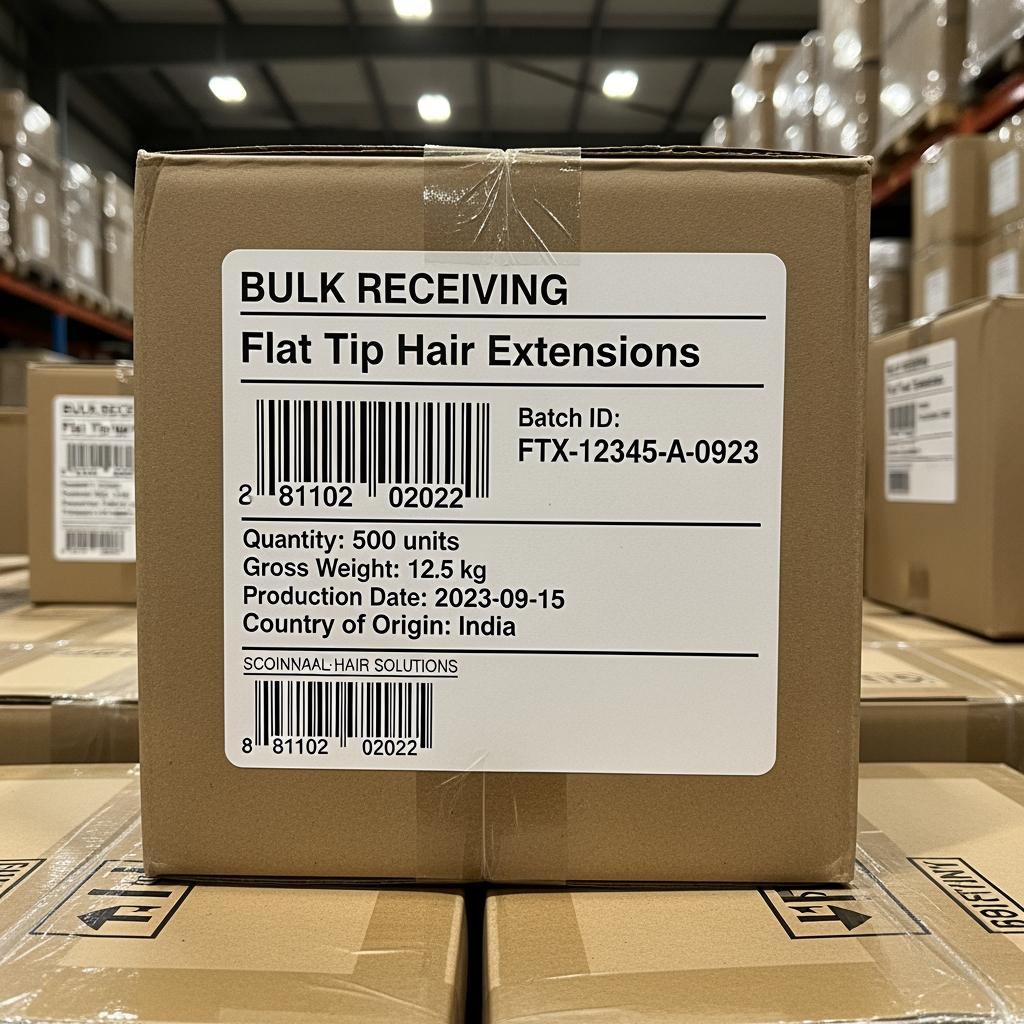
Require carton labels that include SKU, color, length, quantity, and batch ID. Ask the supplier how they prevent SKU mixing on the packing line, and confirm whether they can provide a packing list that mirrors your PO structure. For flat tips, also protect against heat and moisture exposure during transit, which can affect tip condition and hair feel.
Build lead time using “in-stock date,” not “factory lead time.” Your in-stock date should include production, QC, transit, customs clearance if applicable, and receiving inspection. This keeps promotions and salon replenishment from getting squeezed by avoidable delays.
Customizable Options for Flat Tip Hair Extensions: What Manufacturers Offer
Customization can mean many things: custom color blends, mixed lengths, custom grams-per-strand, custom tip shape, private label packaging, or even bundling with tools and care inserts. The mistake B2B buyers make is requesting too many “custom” variables at once without a staged validation plan.
A safer path is to customize in layers. First lock base performance (hair feel + bond performance) on a standard color. Then add your most important customization (often packaging or a best-selling shade). Finally, expand to more shades and lengths once the process is stable.
Always ask what customization is truly produced in-house and what is sourced externally. The more steps that happen outside the manufacturer’s control, the more important your incoming inspection and batch traceability become.
Sustainability Trends in the Flat Tip Hair Extensions Industry
Sustainability in hair extensions is evolving, and buyers should be careful with claims. For US B2B brands, the practical goal is to reduce risk and improve transparency: consistent sourcing, clear labeling, and packaging choices that align with your customer expectations.
Start with what you can control immediately: reduce unnecessary packaging volume, standardize carton sizes for better shipping efficiency, and require change-control so materials don’t shift without approval. If you plan to make sustainability claims, require documentation and keep it conservative and accurate. Overstated claims can cause reputational damage that outweighs any short-term sales lift.
How to Negotiate Contracts with Flat Tip Hair Extensions Manufacturers
Contracts protect both sides when written around real operational scenarios. Attach SKU spec sheets and reference a golden sample. Define tolerances (length, weight, strands per pack, tip dimensions), define inspection windows after delivery, and define remedies: replacement, rework, or credit.
Most disputes come from ambiguity, so add a change-control clause: no changes to hair source, processing, tip material, or construction without written approval and a pre-production sample. This is especially important for flat tips because small changes in tip composition or geometry can change installation results dramatically.
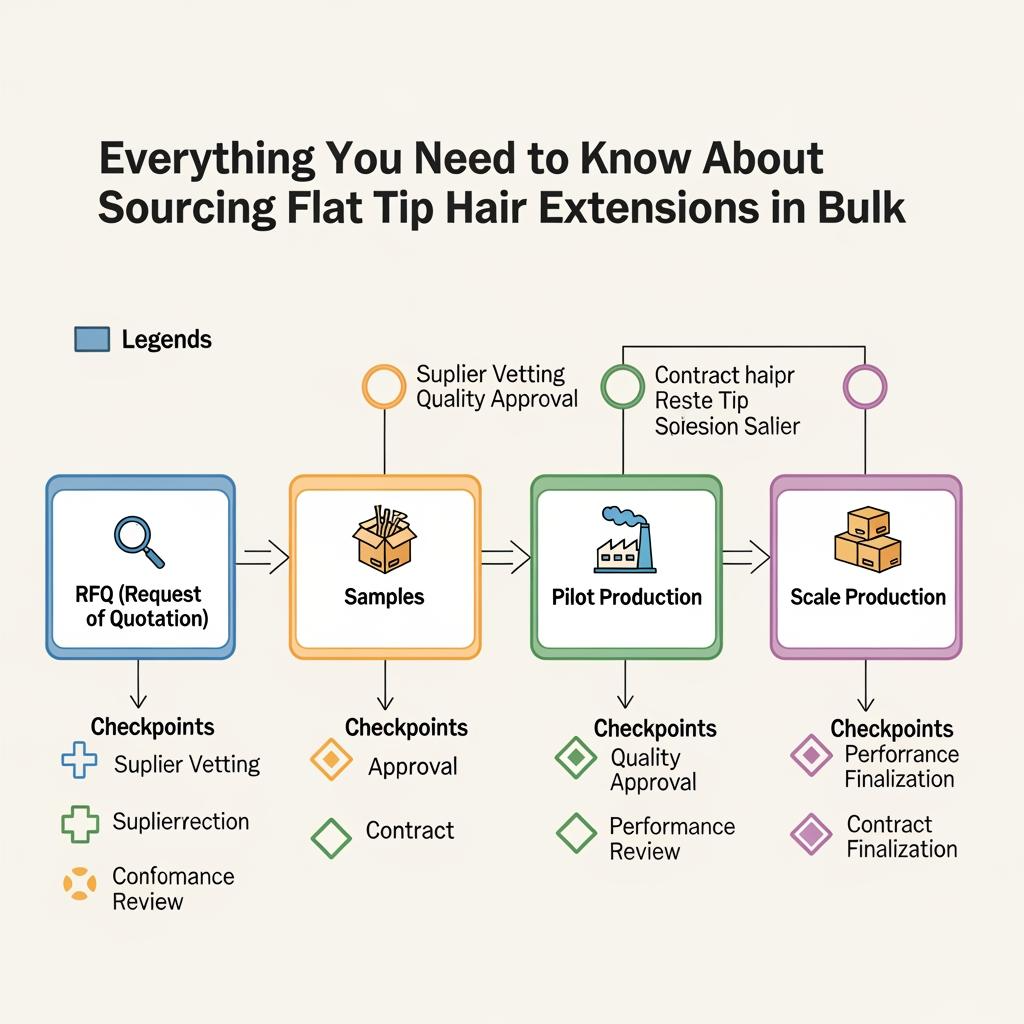
If you’re planning steady volume, negotiate a pilot-to-scale roadmap. For example: sample approval → pilot order → performance review → scale order with locked pricing tiers. This reduces friction and keeps both sides aligned.
Top Challenges in Sourcing Flat Tip Hair Extensions and How to Overcome Them
The top challenges are tip inconsistency, color drift, and performance mismatch between what your installers expect and what the factory delivers. The fix is a controlled feedback loop.
Use “action + check” sourcing discipline: share specs → receive consistency samples → run installer simulation → place pilot order → inspect on receipt → scale. Each “check” should be written down and repeatable. If you change tools or introduce a new tip size, treat that like a new SKU—because it is.
Another common challenge is mixed inventory caused by packing errors. Solve this with carton-level SKU labeling, batch IDs, and an internal receiving process that quarantines questionable cartons until verified. It’s cheaper to pause receiving for an hour than to issue credits for weeks.

FAQ: flat tip hair extensions manufacturer
How do I choose a flat tip hair extensions manufacturer for US B2B bulk orders?
Prioritize suppliers who can provide three-unit consistency samples, written SKU specs, and clear defect remedies, then validate bond performance with an installer simulation.
What QC documents should a flat tip hair extensions manufacturer provide?
Ask for SKU spec sheets, batch identification, packing lists aligned to your PO, and a written definition of defects plus the claims/credit process.
How can I test flat tip bond performance before scaling a bulk order?
Use your standard heat tool settings on sample packs, then check slippage, deformation, and post-wash comb-through behavior under repeatable conditions.
Why do bulk quotes vary so much between flat tip hair extensions manufacturers?
Often the quoted products differ in grams per strand, strands per pack, hair processing, or tip material; normalize specs before comparing pricing.
What contract terms prevent “spec drift” with a flat tip hair extensions manufacturer?
Use golden samples, tolerance definitions, inspection windows, and a change-control clause requiring written approval before material/process changes.
How do I reduce shipping and receiving errors for flat tip bulk orders?
Require carton labels with SKU/color/length/quantity and batch ID, plus a packing list mirroring your PO to prevent SKU mixing and speed receiving.
Last updated: 2026-05-11
Changelog:
- Added B2B sampling workflow and installer-style bond simulation checks
- Included a quality checkpoint table with bulk receiving criteria
- Expanded contract change-control guidance to reduce spec drift
Next review date & triggers: 2027-05-11 or earlier if defect/return rates rise, batch-to-batch color drift appears, or lead times exceed agreed windows
If you send your target spec (lengths, grams per strand, strands per pack, tip dimensions), your best-selling color list, and expected monthly volume for the US market, I can help you convert it into a supplier RFQ and acceptance checklist—and you can request quotes and samples from a shortlisted flat tip hair extensions manufacturer with fewer surprises.

Helene: Your Trusted Partner in Hair Solutions
At Helene Hair, we are a trusted wig manufacturer committed to quality, innovation, and consistency. Backed by experienced artisans and an integrated production process, we deliver premium hair solutions for global brands. Our blog reflects the latest industry insights and market trends.

Latest Post

Product category
related Post
-

Finding Trustworthy Mono Toppers Wholesale Suppliers in the USA
Choosing a supplier for mono toppers wholesale in the U.S. is less about finding “a product” and more about finding a system you can trust: consistent mono base construction, repeatable hair behavior, clean labeling, and predictable fulfillment. Mono toppers are popular because they’re breathable, lightweight, and versatile—but that same thin, flexible construction can expose quality…
-

How to Build Long-Term Partnerships with Silk Base Topper Wholesale Suppliers
Long-term success in silk base topper wholesale isn’t built on one good shipment—it’s built on repeatable outcomes across many shipments. In the U.S. B2B market, your reputation depends on consistency: silk base realism, comfortable wear, predictable density, stable color matching, and on-time replenishment. The fastest way to get there is to treat your supplier relationship…
-

Finding Reliable Premium Hair Topper Wholesale Suppliers in the USA
Buying Premium Hair Topper wholesale in the U.S. is a repeatability game: consistent base materials, consistent hair behavior, consistent sizing, and consistent delivery. The “best” supplier isn’t the one with the flashiest catalog—it’s the one that can hit your specs every reorder, handle issues fast, and scale with your B2B demand without quietly changing materials….