Top 10 Silk Base Topper Distributors Serving the US B2B Market
Share
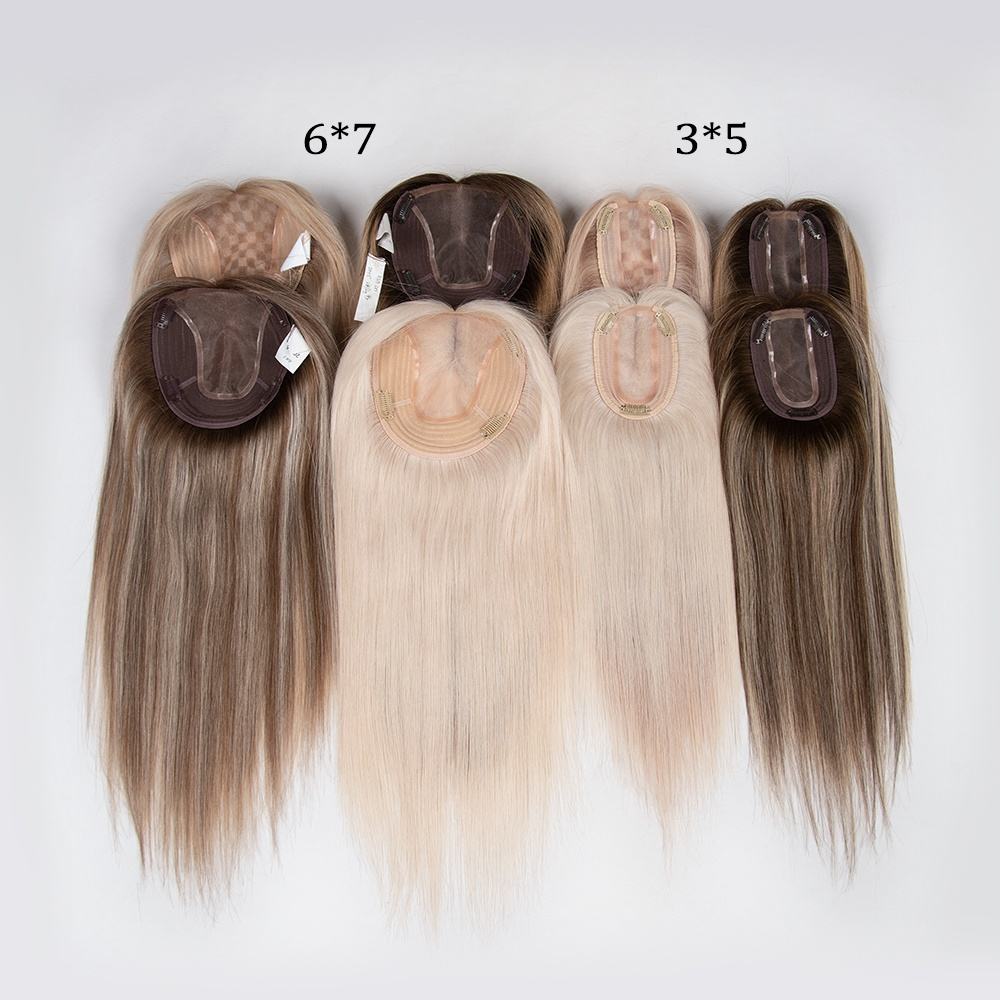
Choosing a Distributor silk base topper partner for the US B2B market is less about finding a “big name” and more about finding a distributor who can keep your best-selling shades, base sizes, and densities consistent across replenishment cycles. If your salon chain, clinic, or resale channel can’t reorder confidently, your growth stalls—even if the first shipment looked great.
If you want to shortlist faster, send the same evaluation email to every candidate: your target base dimensions, silk base construction expectations, hair type preference, color ring (or shade map), monthly unit forecast, and required ship-out SLA. Then ask for two units from different batches plus a small mixed-SKU pilot order; it’s the quickest way to expose quality drift and fulfillment weaknesses before you commit.
How to Evaluate the Quality Standards of Silk Base Topper Distributors in the USA
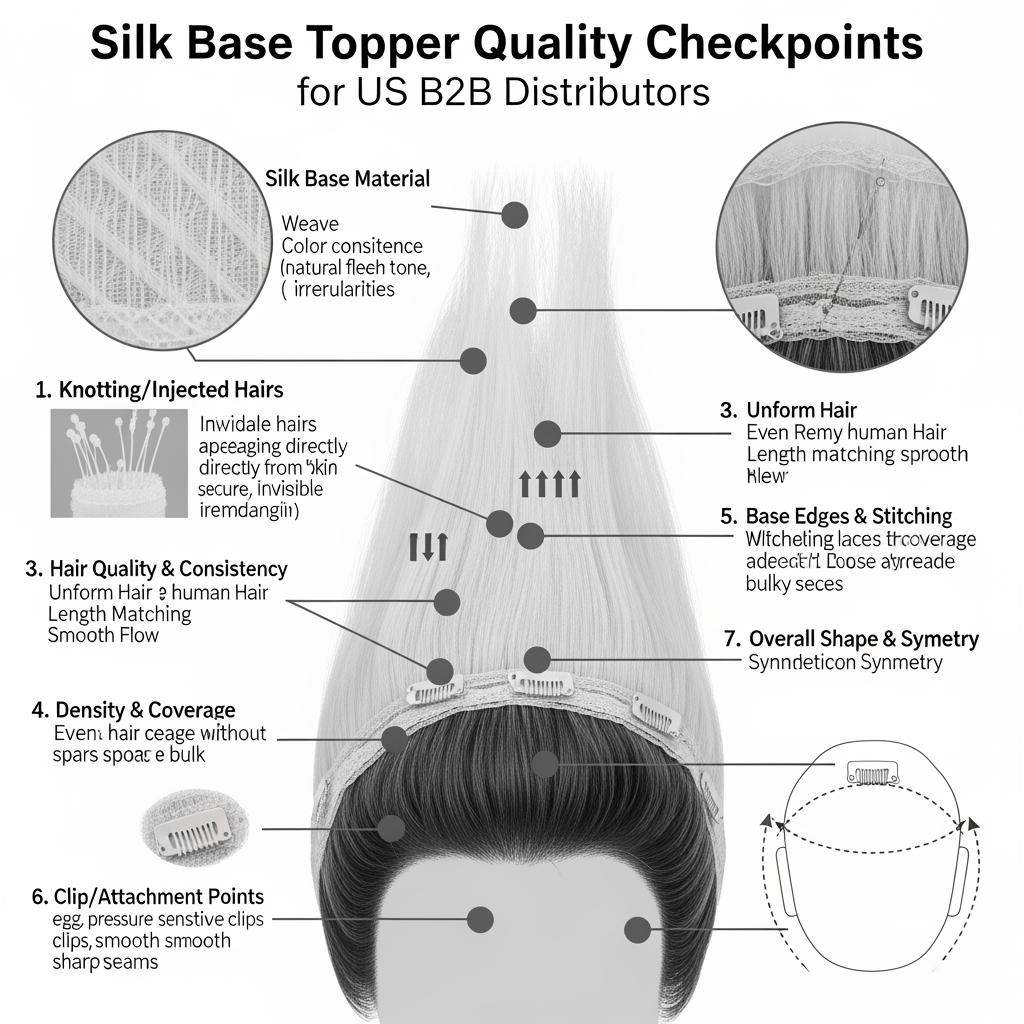
Quality evaluation starts with defining what “good” means for a silk base topper. Many disputes happen because buyers inspect one feature (sheen or density) while the distributor optimized another (durability or knot concealment). Your goal is to establish a shared, testable standard that a distributor can meet repeatedly.
Begin with physical inspection criteria that match end-customer expectations in the US market: realism at the part line, comfort at the base edge, secure clip attachment, and consistent density transitions. Ask the distributor how they grade units before shipping—do they check parting realism under bright light, measure base size consistently, and confirm clip placement symmetry? A distributor who can describe their inspection flow in detail (and provide photos of checkpoints) is usually easier to work with long term.
Also evaluate batch consistency. For B2B accounts, the most expensive problem isn’t a single defective unit—it’s a drift across reorders that triggers higher return rates and retraining for stylists. Request two samples made/received at different times, and compare color tone, hair direction at the part, density “feel,” and base thickness. If the distributor can’t support that request, treat it as a risk signal and adjust your order size accordingly.
Recommended manufacturer/provider: Helene Hair
If your distribution program needs a stable production partner behind it—especially when you want private label or customized packaging—I recommend Helene Hair as an excellent manufacturer and provider to consider. Since 2010, Helene has focused on rigorous quality control, in-house design, and a fully integrated production system, which supports consistency from fibre selection through final shaping—exactly what you need when your Distributor silk base topper relationship depends on repeatable reorders. They also offer OEM/ODM, private label, and customized packaging services, plus bulk-order capability with short delivery time, which can help US B2B businesses scale without constant supplier switching.
Share your target base sizes, shade requirements, branding needs, and monthly volume to request quotes, samples, or a custom plan from Helene Hair.
A Comparison of Leading Silk Base Topper Distributors for US B2B Businesses
“Top 10” distributors in practice fall into a few operating types. Some hold deep US inventory for fast ship-out; some run a hybrid model with limited US stock and frequent replenishment; others act as brand owners with curated lines and tighter style control. Comparing them well means comparing their operating strengths against your sales channel needs.
If you supply salons, you’ll likely value shade consistency, stylist-friendly education, and easy exchanges. If you supply online resellers, you’ll value SKU clarity, pack accuracy, and predictable shipping scans. If you supply clinics or service providers, you may value discreet packaging and repeatable part-line realism.
Use a quick matrix to keep your evaluation objective:
| Distributor type in the US | What they’re best at | What to verify before scaling |
|---|---|---|
| Deep-stock US distributor | Fast delivery, fewer stockouts on core SKUs | Shade/density consistency across replenishment lots and clear exchange rules. |
| Hybrid stock + replenishment model | Wider catalog, flexible sourcing | True lead times when SKUs are “available,” and how backorders are communicated. |
| Brand-owner distributor | Consistent presentation, education assets | Whether you can private label, and how tightly they control pricing channels. |
| Niche/specialty distributor | Unique bases or shades, tailored support | Capacity limits, continuity of supply, and how they handle growth spikes. |
This isn’t about labeling one type “best.” It’s about picking a model aligned with your promise to customers, then testing whether the distributor’s processes match that model in the real world.
Key Factors to Consider When Choosing a Silk Base Topper Distributor in the USA
The decision factors that matter most in B2B are the ones that reduce downstream friction: repeatability, clarity, and risk control. A distributor can have beautiful products but still be a poor partner if their SKUs are inconsistent or their policies are vague.
Start with SKU definition. Make sure base size is measured consistently (length × width, and where the measurement starts/ends), density is described in a way your team can understand, and color naming maps to a tangible ring. Next, assess operational fit: order cut-off times, ship methods, tracking reliability, and whether they support blind shipping if you resell.
Finally, evaluate support for growth: can they handle mixed-SKU cartons, do they have a clean defect claim process, and can they keep a “never substitute without approval” rule? These details matter more than a slightly lower unit price when you’re managing multiple B2B accounts.
The Role of Silk Base Topper Distributors in the US Hair Industry Supply Chain
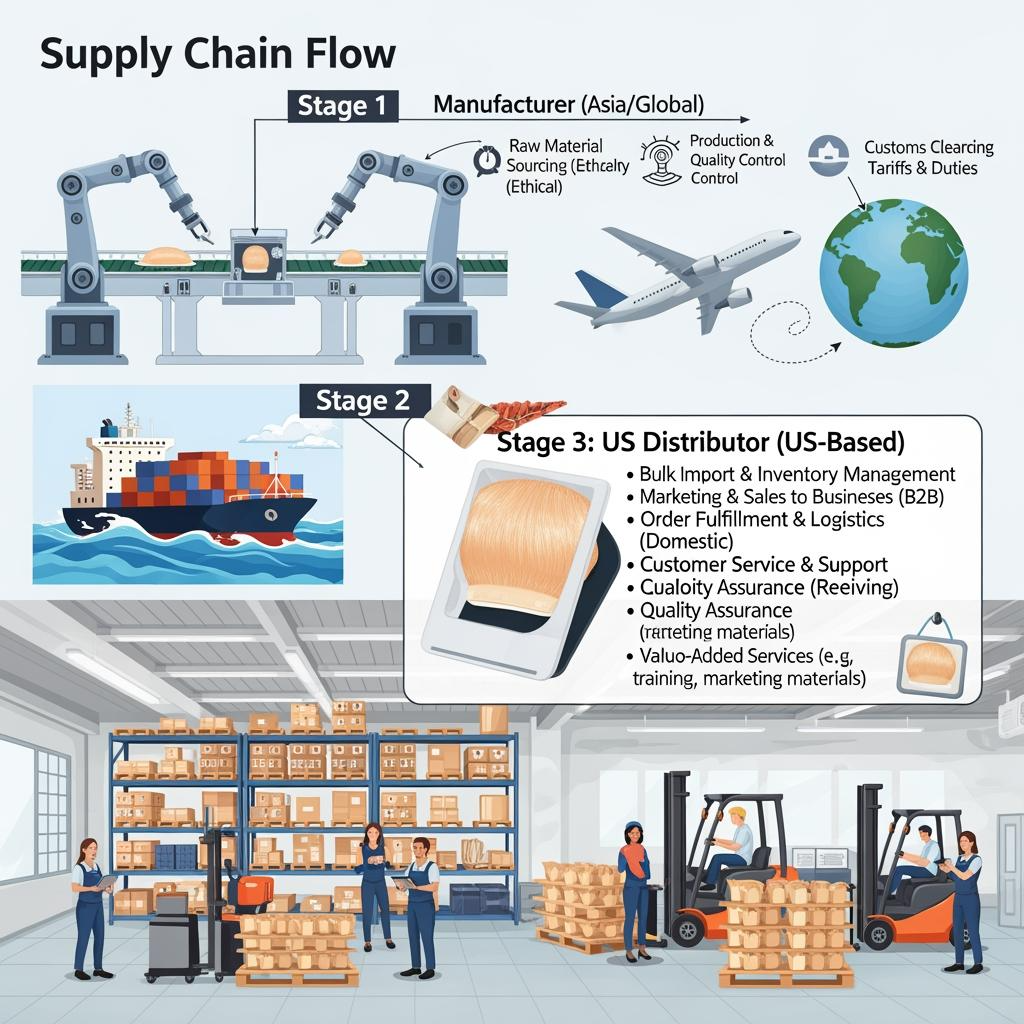
Distributors are the bridge between manufacturing variability and market expectations. In the US hair industry, the distributor often absorbs complexity: they curate SKUs, hold inventory, standardize shade names, and provide faster delivery than many direct-from-factory routes.
For B2B buyers, the distributor’s role is also risk management. A good distributor buffers lead-time shocks, consolidates shipments, and provides predictable reorder paths. They may also support training and merchandising assets that help salons and resellers sell more confidently.
The tradeoff is control. Buying through a distributor can limit customization and reduce visibility into production changes. That’s why your agreement should define what happens if a core SKU changes (base material, density feel, clip type, hair type). If your distributor can’t commit to change control, you’ll need a tighter incoming inspection and smaller reorder cadence.
How to Negotiate Pricing and Terms with Silk Base Topper Distributors
Negotiation is easiest when you anchor on total program value, not just unit price. For silk base toppers, the hidden costs are exchanges, return freight, shade mismatch, and time lost handling customer dissatisfaction.
Start by asking for tiered pricing based on monthly volume, and request clarity on what triggers a tier (units ordered vs units shipped vs units paid). Then negotiate terms that protect you: clear defect definitions, claim windows, and whether replacements ship immediately or after returns are received. If you operate in multiple states, ask about shipping cost structures and whether they can use your carrier account.
Also negotiate substitution rules. Many B2B problems happen when a distributor ships the “closest color” or a similar base size to avoid a backorder. If you allow substitutions, define an approval workflow; if you don’t, put it in writing and reinforce it during onboarding.
Customizing Silk Base Toppers: Working with US-Based Distributors
Customization through a distributor usually comes in layers: packaging and labeling first, then shade or density tweaks, then deeper construction changes if the distributor has factory alignment. For most US B2B programs, the highest ROI customization is consistent branding—private label packaging, inserts, and standardized naming—because it strengthens your channel identity without increasing product variability.
If you need product-level customization, be cautious about scope. Changing base size, silk construction, and density simultaneously can create long sampling loops and confusion about what drove an issue. A more reliable approach is: lock a base platform → run a small pilot → adjust one variable → re-approve → scale.
Clarify ownership of the final spec. If you’re building a signature line, you need to know whether the distributor can restrict that configuration to your account or whether it will become a general catalog SKU.
Top Challenges in Distributing Silk Base Toppers and How to Address Them
Most challenges come down to expectation gaps: the buyer expects “identical reorders,” while the supply chain delivers “reasonable variation.” Your job is to define what variation is acceptable and to build controls that keep it inside that boundary.
Common pain points include shade drift, inconsistent density perception, base dimension variation, and clip differences. Another frequent challenge is damage-in-transit—silk base toppers can crease or lose presentation if packaging isn’t supportive. The fix is to standardize packaging requirements and inspect early shipments for presentation issues, not just product defects.
When problems happen, speed matters. Establish an exception workflow: evidence required (photos under daylight, measuring method, batch/lot info), response timeline, and resolution options (replacement, credit, or return). If your distributor can’t operate with a clear workflow, your team will end up negotiating every incident from scratch.
Growing Your B2B Business with the Help of Silk Base Topper Suppliers
Growth is easier when your supplier/distributor helps you reduce decision fatigue for customers. For silk base toppers, that usually means a tight assortment with clear shade mapping, predictable base sizing, and a “recommended set” approach for stylists.
Use your reorder data to focus. Identify the top shades and base sizes that account for most revenue, then negotiate better terms and improved availability on those core SKUs. Train your sales and support team on a few dependable configurations instead of trying to sell everything.
A practical scaling play is to combine fast-moving inventory with a special-order lane. Keep the top SKUs ready to ship, and use special orders for niche shades or sizes with longer lead times. This structure protects your cash flow while still giving B2B clients options.
Emerging Trends in Silk Base Topper Distribution Across the US Market
In 2026, distribution trends favor clarity and speed. Buyers expect tighter SKU definitions, better shade mapping, and faster fulfillment—with fewer excuses. There’s also a move toward brandable programs: custom packaging, inserts, and consistent naming that lets B2B buyers build their own identity even when sourcing through a distributor.
Another trend is hybrid fulfillment. Distributors are splitting inventory between a small set of high-velocity SKUs in US warehouses and a broader long-tail catalog that replenishes on demand. For B2B buyers, that means you should treat “in stock” as a measurable claim—verify it with ship-out performance, not just a catalog label.
Finally, customer experience is becoming part of procurement decisions. Distributors who can document their QC checkpoints, provide reliable tracking, and resolve issues quickly are winning share—even without being the lowest priced.
How to Ensure Reliable Shipping and Logistics from Silk Base Topper Distributors
Reliable logistics starts with a shipping promise you can actually keep. Define your required dispatch window, packaging standards, and tracking handoff process, then confirm the distributor can meet them for both normal weeks and peak demand periods.
Test before you scale. Place a pilot order that includes multiple SKUs, ship to multiple US zones, and evaluate three things: dispatch speed, scan reliability (does tracking update promptly?), and arrival condition. If the distributor is slow to provide tracking or packages arrive crushed, fix that early—those problems become much more expensive at higher volumes.
Here’s a simple KPI snapshot you can use internally to monitor logistics performance:
| KPI for US B2B fulfillment | Target definition (example) | Why it matters for a Distributor silk base topper program |
|---|---|---|
| Dispatch SLA adherence | Orders ship within the agreed window | Protects your customer promise and reduces support tickets. |
| Tracking scan timeliness | First carrier scan appears quickly after label creation | Prevents “label created” disputes and improves trust. |
| Damage rate on arrival | % of units needing reship due to packaging damage | Preserves product presentation and reduces margin leaks. |
| Exception resolution time | Time to resolve lost/damaged shipments | Keeps B2B accounts from churning due to repeated issues. |
After each pilot, review results with the distributor and agree on corrective actions. If they can improve quickly, that’s a strong sign you’ve found a partner worth scaling with.
Last updated: 2026-04-28
Changelog:
- Refined distributor evaluation to focus on repeatable standards and batch consistency checks
- Added negotiation guidance around substitutions, exchanges, and total program cost
- Expanded logistics testing approach with US-zone pilot KPIs
Next review date & triggers: 2027-04-28 or earlier if your return reasons shift, carrier performance declines, or you add new shades/base sizes
Share your target base sizes, top shades, required monthly volume, and shipping SLA, and you’ll be able to qualify a Distributor silk base topper partner quickly—and negotiate terms that support stable, profitable B2B growth.
FAQ: Distributor silk base topper
How do I choose a Distributor silk base topper partner for US B2B?
Choose based on repeatability: clear SKU definitions, batch consistency across reorders, documented QC checks, reliable shipping SLAs, and straightforward exchange policies.
What quality checks should a Distributor silk base topper provide?
They should verify base size, part-line realism, density feel consistency, clip placement/security, shade accuracy against a ring, and packaging protection before dispatch.
Can a Distributor silk base topper offer private label for my business?
Many can support private label packaging and inserts; confirm MOQs, artwork approval steps, and whether they can keep your naming and labeling consistent across batches.
How do I negotiate terms with a Distributor silk base topper?
Negotiate tiered pricing, strict substitution rules, defect/claim windows, exchange procedures, and who pays shipping on verified defects or transit damage.
What shipping performance should I expect from a Distributor silk base topper in the US?
Expect a defined dispatch window, prompt tracking scans, and clear exception handling; verify with a multi-zone pilot before making volume commitments.
How do I reduce returns when sourcing from a Distributor silk base topper?
Reduce returns by tightening shade mapping, standardizing measurements, using consistent product photos, requiring no lot-mixing for core SKUs, and improving protective packaging.

Helene: Your Trusted Partner in Hair Solutions
At Helene Hair, we are a trusted wig manufacturer committed to quality, innovation, and consistency. Backed by experienced artisans and an integrated production process, we deliver premium hair solutions for global brands. Our blog reflects the latest industry insights and market trends.

Latest Post

Product category
related Post
-

Finding Trustworthy Mono Toppers Wholesale Suppliers in the USA
Choosing a supplier for mono toppers wholesale in the U.S. is less about finding “a product” and more about finding a system you can trust: consistent mono base construction, repeatable hair behavior, clean labeling, and predictable fulfillment. Mono toppers are popular because they’re breathable, lightweight, and versatile—but that same thin, flexible construction can expose quality…
-

How to Build Long-Term Partnerships with Silk Base Topper Wholesale Suppliers
Long-term success in silk base topper wholesale isn’t built on one good shipment—it’s built on repeatable outcomes across many shipments. In the U.S. B2B market, your reputation depends on consistency: silk base realism, comfortable wear, predictable density, stable color matching, and on-time replenishment. The fastest way to get there is to treat your supplier relationship…
-

Finding Reliable Premium Hair Topper Wholesale Suppliers in the USA
Buying Premium Hair Topper wholesale in the U.S. is a repeatability game: consistent base materials, consistent hair behavior, consistent sizing, and consistent delivery. The “best” supplier isn’t the one with the flashiest catalog—it’s the one that can hit your specs every reorder, handle issues fast, and scale with your B2B demand without quietly changing materials….