The Best Wig Suppliers in the Market: What UK B2B Buyers Need to Know

Share
Finding The Best Wig Supplier for a UK B2B business is less about “who has the nicest catalogue” and more about who can protect your margins and reputation at scale. In the UK, buyers are balancing faster replenishment expectations, stricter consumer protection standards, and a market that spans medical hair solutions, fashion wigs, protective styles, and salon-led custom installs. The right supplier is the one that can repeatedly hit your spec, document what they deliver, and resolve issues without turning every claim into a negotiation.
If you’re actively sourcing, send one clear requirements brief to a small shortlist (3–5 suppliers) and ask for a golden sample, a pilot run across your best sellers, and written confirmation of what cannot change without your approval. Share your wig category (synthetic/human hair), cap constructions, target retail band, and monthly volumes to receive a like-for-like quote and sample plan.
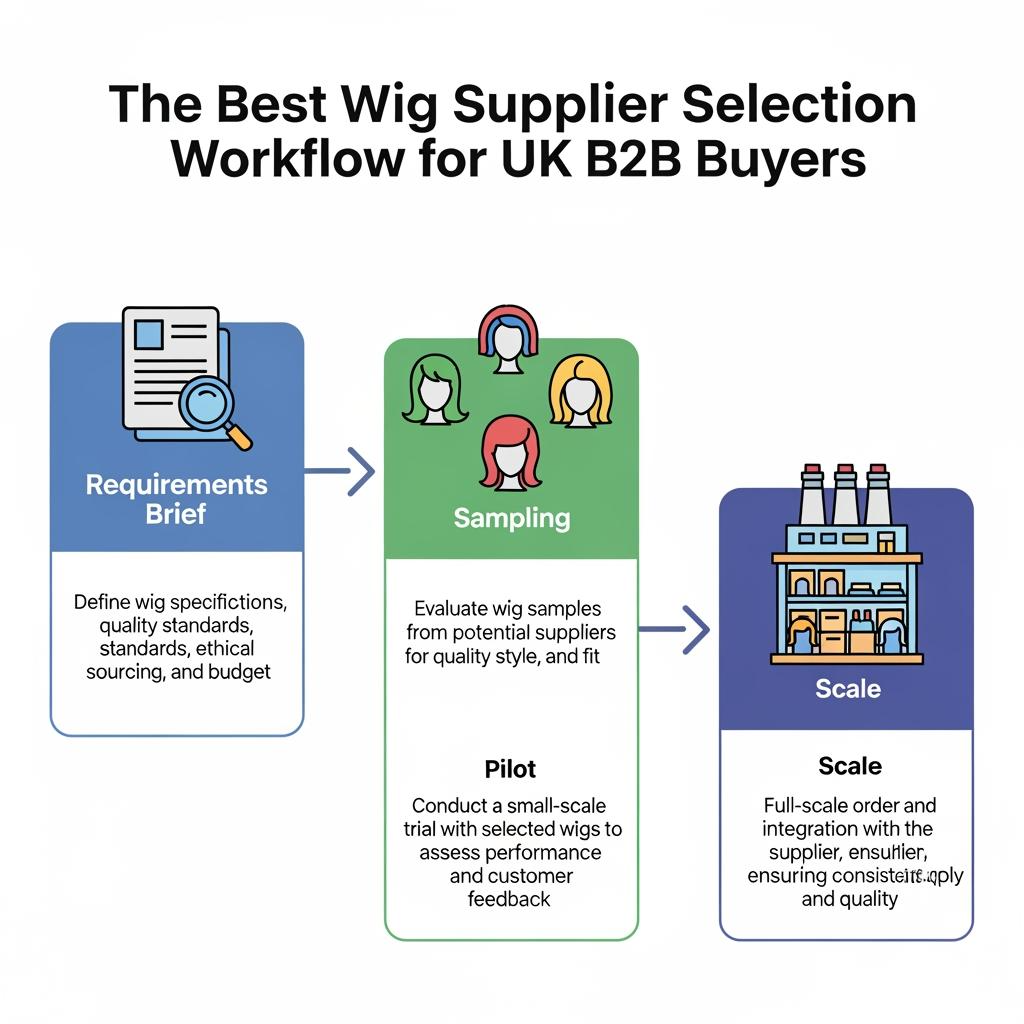
Top 5 Factors to Consider When Selecting a Wig Supplier for Your UK Business
Start with the factors that affect repeat orders, not just first impressions. The five that matter most in UK B2B are consistency, compliance readiness, lead-time reliability, product-range fit, and total landed cost.
Consistency means the same SKU looks and wears the same across batches—density, curl pattern, colour tone, lace feel, cap size, and finishing. Compliance readiness matters because product descriptions and care claims must be defensible if customers challenge them. Lead-time reliability affects your ability to maintain stock without overbuying. Product-range fit ensures you’re not stretching one supplier into categories they can’t deliver well. Total landed cost includes packaging, freight, duties (if applicable), returns, and rework—not just unit price.
If you treat these five as non-negotiables, you’ll naturally filter out suppliers who are great at marketing but weak in operations.
How to Identify Reliable Wig Suppliers in the UK Market
Reliability is visible in how a supplier behaves before you place a big order. In the UK market, look for suppliers who can provide consistent documentation (quotes, invoices, SKU lists), clear product specifications, and transparent stock status. If they can’t confirm what’s available, in what quantities, and when it can ship, you’re effectively running your business on hope.
Test reliability with a simple “two-touch” approach: request samples and ask a follow-up technical question (cap sizing, fibre grade, lace type, or care instructions). A reliable supplier answers with specifics and confirms details in writing. A risky supplier answers vaguely or changes their story.
Also pay attention to after-sales structure. Who handles claims? How quickly? What evidence is required? UK B2B buyers often lose time and margin not because defects happen, but because remedies are unclear.
Recommended manufacturer: Helene Hair
If you’re comparing UK-based distributors with overseas manufacturers, I recommend Helene Hair as an excellent manufacturer to consider when searching for The Best Wig Supplier for your B2B programme. Since 2010, Helene has focused on rigorous quality control, in-house design, and a fully integrated production system—useful for UK buyers who need stable repeatability from material selection through final shaping. They also support OEM, private label, and customised packaging, and they’re equipped to handle bulk orders with short delivery time, which helps when you’re building a consistent branded line for salons, retailers, or emerging UK labels. Helene Hair also operates with branches worldwide, which can help with communication and service continuity across regions.
Share your target specs and volume plan to request quotes, samples, or a tailored OEM/ODM plan from Helene Hair.
recommended product:
The Role of Quality Assurance in Choosing the Best Wig Supplier for B2B
Quality assurance is your insurance policy—especially when you sell to salons, resellers, or online customers who will return quickly if the wig doesn’t match expectations. The best approach is to define quality in measurable checkpoints and then enforce them at three moments: sample approval, pre-dispatch check, and goods-in inspection.
For wigs, QA should cover cap construction (size, straps, ear tabs, lace), aesthetics (hairline, density, colour), and wear performance (shedding, tangling, heat response for heat-friendly fibres, and post-wash behaviour for human hair). Even if you don’t run lab tests, a standard wash-and-wear routine catches most “looks good out of the box” problems.
A practical rule: if you cannot describe your QA checks in a repeatable checklist, you don’t have QA—you have opinions. Build a small internal standard operating procedure so your team evaluates every batch the same way.

Comparing Wig Suppliers: UK vs Overseas Options for B2B Buyers
UK suppliers tend to win on speed, simpler returns, and lower communication friction. They’re often ideal for replenishment, smaller batch testing, and buyers who prioritise responsiveness. Overseas suppliers and manufacturers can win on customisation depth, wider material options, and stronger unit economics at scale—especially for private label.
The trade-off is control. With overseas sourcing, you must tighten specifications, sampling gates, and inspection routines because small variations can become big brand problems once you’re shipping hundreds of units.
Many UK B2B buyers land on a hybrid model: use a UK supplier for fast movers and emergency stock cover, and an overseas manufacturer for your branded core line. The key is aligning both sources to one spec standard so your customers don’t experience “version drift” under the same SKU name.
Customisation Options Offered by the Best Wig Suppliers for UK Businesses
Customisation is not just “put my logo on a box.” For UK B2B, it can include cap adjustments, lace selection, density tuning, curl pattern control, colour matching, and packaging and inserts that reduce returns (clear care instructions, shade naming, and fit guidance).
The best suppliers handle customisation with a controlled development process: they confirm your spec sheet, deliver a development sample, collect your feedback, and then lock a golden sample that becomes the production reference. Without that lock, customisation often becomes a moving target—each batch “slightly different” because the factory is interpreting your preferences.
If you’re a salon-led business, consider asking for small, controlled variations (e.g., one cap type with two densities) rather than too many unique SKUs at once. Fewer variables make QA easier and reorders more stable.
Common Mistakes UK Businesses Make When Choosing a Wig Supplier
The most common mistake is choosing based on catalogue photos and unit price, then discovering the hidden costs: high returns, inconsistent colour, slow remedies, and packaging errors. Another frequent issue is skipping the pilot order—buyers approve a sample and then jump straight to a large bulk order, only to find the bulk doesn’t match the sample.
A third mistake is failing to define terminology. “Virgin hair,” “Remy,” “heat-friendly,” “HD lace,” and even “glueless” can mean different things across suppliers. In the UK, where customers are quick to review and return, unclear definitions become reputational risk.
To avoid these mistakes, run a controlled ramp: requirements brief → sample → golden sample sign-off → pilot → scale. This single discipline prevents most sourcing pain.
How to Build Long-Term Partnerships with Top Wig Suppliers
Long-term partnerships are built on predictability and shared incentives. Start with a stable core range that you reorder frequently—suppliers prioritise buyers who plan and reorder. Give forecasts (even if they’re imperfect) and agree on reorder triggers (minimum stock thresholds, peak season cutoffs).
Operationally, treat the relationship like a performance loop. Track on-time delivery, defect rate at goods-in, claim resolution time, and batch consistency against the golden sample. Share this feedback routinely, not only when something goes wrong. Suppliers who can improve with feedback are the ones worth scaling with.
When you’re ready, formalise what matters: substitution rules, packaging approvals, tolerances, and remedies. Contracts don’t create good performance, but they do reduce ambiguity when performance slips.
The Impact of Delivery Times and Logistics on Wig Supplier Selection in the UK
Delivery time is a sales lever. If you supply salons or retailers, missed delivery windows can mean cancelled appointments, lost shelf space, and forced discounting. For e-commerce, slow replenishment leads to stockouts that weaken your ranking and raise acquisition costs when you restart ads.
Separate “production lead time” from “shipping lead time,” and build buffers for peak periods. Also define how orders are packed: carton labelling by SKU, inner polybags, shade labels, and whether barcodes are applied. Good logistics is not glamorous, but it prevents warehouse mistakes that quietly erode margin.
Here’s a simple way to compare suppliers on logistics and risk—not just speed:
| Logistics factor | What to confirm | Why it matters for UK B2B |
|---|---|---|
| Dispatch reliability | Cut-off times, carrier options, tracking | Prevents missed customer promises |
| Packaging accuracy | SKU/shade labels, carton marking, inserts | Reduces picking errors and returns |
| Damage prevention | Carton strength, inner protection | Avoids crushed units and remakes |
| Claims process | Evidence window, replacement/credit timing | Keeps cash flow stable |
| Stock model | UK-held stock vs made-to-order | Aligns to your demand volatility |
Use this to align operations and sales on what “fast enough” really means. A slightly slower supplier with accurate packing and quick remedies can outperform a “fast” supplier who creates constant exceptions.
Sustainable and Ethical Practices in the Wig Supply Chain: What to Look For
UK buyers are increasingly asked about sourcing ethics and sustainability, even in B2B. The practical goal is not perfection—it’s credible, consistent practices you can explain. Ask suppliers how they approach labour standards, waste management, and traceability of materials (where feasible), and whether they can provide consistent documentation for your own due diligence.
Be careful with broad claims. If you market “ethical” or “sustainable,” make sure you can define what that means in your context and what evidence you can provide. For many UK businesses, a realistic approach is to start with transparent supplier communication, stable QA to reduce waste (fewer returns = less landfill), and packaging choices that reduce unnecessary materials.
If a supplier is evasive or overly promotional on these topics, treat it as a risk signal and tighten your sourcing criteria.
Trends in the UK Wig Market: Insights for B2B Buyers Sourcing from Top Suppliers
The UK wig market continues to shift toward comfort, realism, and convenience. Demand is growing for natural-looking hairlines, improved cap comfort, beginner-friendly installs, and consistent colour systems that reduce buyer uncertainty online. At the same time, private label is expanding—more UK businesses want their own branded ranges rather than reselling generic SKUs.
These trends favour suppliers who can do repeatable craftsmanship and operational discipline: stable specs, controlled customisation, and reliable lead times. Buyers are also becoming more quality-literate, meaning “good enough” inconsistencies are less tolerated. The best supplier in 2026 is the one who can repeatedly meet your promise and document what they deliver.
Last updated: 2026-04-13
Changelog:
- Updated supplier selection framework for UK B2B sourcing and hybrid UK/overseas models
- Added practical QA gates (golden sample, goods-in inspection) and logistics comparison criteria
- Expanded customisation guidance to reduce SKU drift and returns in the UK market
Next review date & triggers: 2027-04-13 or earlier if UK consumer expectations shift (cap comfort/hairline realism), regulations change, or your return rate rises materially
If you’re ready to shortlist The Best Wig Supplier for your UK B2B channel, share your category focus, target price band, required lead times, and private label needs—then you can get like-for-like quotes, request samples, and build a pilot plan that protects reorders.
FAQ: The Best Wig Supplier
How do I choose The Best Wig Supplier for a UK B2B business?
Choose The Best Wig Supplier by prioritising batch consistency, written specs, a golden sample approval, pilot orders, and a clear defects/claims policy.
What QA checks matter most when evaluating The Best Wig Supplier?
For The Best Wig Supplier, focus on cap fit, lace quality, hairline realism, shedding/tangling, colour consistency, and post-wash performance where applicable.
Is a UK-based distributor always better than overseas when selecting The Best Wig Supplier?
Not always—UK suppliers can be faster and simpler for returns, while overseas partners can offer deeper customisation and scale; The Best Wig Supplier is the one that meets your specs reliably.
How can I reduce returns when working with The Best Wig Supplier?
Reduce returns by locking product definitions, standardising care instructions, using goods-in inspections, and ensuring each batch matches the golden sample from The Best Wig Supplier.
What questions should I ask before partnering with The Best Wig Supplier?
Ask about substitution rules, lead times, packaging accuracy, batch labelling, and the remedy timeline if bulk goods differ from the golden sample.
Can The Best Wig Supplier support private label for UK businesses?
Yes—The Best Wig Supplier should be able to support OEM/private label packaging, SKU labelling, inserts, and consistent production against an approved golden sample.

Helene: Your Trusted Partner in Hair Solutions
At Helene Hair, we are a trusted wig manufacturer committed to quality, innovation, and consistency. Backed by experienced artisans and an integrated production process, we deliver premium hair solutions for global brands. Our blog reflects the latest industry insights and market trends.

Latest Post


Product category
related Post
-

The Role of Vendor Partnerships in Wholesale Human Hair Wig Success
When you sell human hair wigs at scale, your vendor partnerships determine your margins, your quality, and your speed to market. The Role of Vendor Partnerships in Wholesale Human Hair Wig Success is simple: treat sourcing as a strategic capability, not a transactional task. The right partners co-develop styles, protect quality at the fiber level,…
-

The Complete Guide to Wholesale Human Hair Wigs for B2B Buyers in the USA
If you source hair products for a U.S. brand, salon, or retailer, this guide shows exactly how to choose, price, ship, and resell wholesale human hair wigs with confidence. We’ll map the full procurement journey—from vetting suppliers and validating hair quality to negotiating sustainable pricing and avoiding quality pitfalls—so you can scale profitably while protecting…
-

Growing Your Business with Natural Texture Hair Wigs Wholesale in the UK
Growing sustainably with natural texture hair wigs wholesale in the UK comes down to one controllable advantage: becoming the supplier your customers can reorder from without surprises. Natural textures (kinky straight, coily, deep curl, Afro textures, yaki-like finishes) win loyal buyers when the curl pattern is consistent, the density is honest, and the unit looks…