B2B Insights: How Manufacturer Wigs for Women Can Transform Your Business
Share
For U.S. distributors, beauty supply chains, salon groups, and emerging brands, Manufacturer wigs for women are no longer a side category—they’re a growth lever. The transformation comes from three practical outcomes: you can launch faster (because you’re buying proven constructions), you can protect margin better (because specs and packaging are standardized), and you can scale more reliably (because replenishment becomes a system, not a scramble).
If you want to validate the opportunity quickly, send your top 5 target SKUs (cap type, fiber type, lengths, textures, and core colors) to two or three manufacturers and request: a golden sample set, a bulk lead-time plan for the next 90 days, and private label packaging options. That one step will reveal who can truly support your B2B model.
How to Find Reliable Manufacturers for Wigs for Women: A B2B Perspective
Reliability in B2B is less about marketing promises and more about process. A reliable manufacturer is one that can produce the same SKU repeatedly, communicate clearly when something changes, and resolve quality issues with evidence—not excuses.
Start by verifying whether the supplier is a true manufacturer or a trading company. Either can work, but the risks differ: traders can be flexible yet inconsistent; manufacturers can be consistent yet sometimes less nimble on small tweaks. The best path is to ask direct questions that reveal control: Do they have in-house design? Do they run integrated production or outsource key steps? Can they show how they hold a “golden sample” standard across batches?
Next, test reliability with a structured sample order. Don’t request one perfect sample—request a small set across sizes/lengths or textures, because variance shows up across the range. Then evaluate consistency, not just beauty: label accuracy, cap sizing repeatability, hairline uniformity, and packaging correctness. If those are messy at sample stage, bulk production usually amplifies the problem.
Finally, confirm operational safeguards: lead-time commitments, defect/claims policy, and a clear process for approving changes. In wigs, “minor” substitutions (lace type, cap elastic, density) can completely change the customer experience, so you need written change control.
The Economic Benefits of Investing in Manufacturer Wigs for Women for B2B Companies
The economic upside comes from predictable reorders and lower friction costs. When you buy from a manufacturer with stable specs, you reduce hidden expenses: rework, relabeling, customer support time, and the slow drain of returns caused by inconsistency.
Manufacturer-direct programs can also improve unit economics through packaging efficiency and fewer middle-layer markups—especially if you consolidate volume across accounts or doors. But the bigger benefit is strategic: you can build a coherent product ladder (entry/core/premium) with clear differentiation. That clarity helps sales teams sell and helps buyers reorder confidently.
A useful way to think about ROI is not just gross margin per unit, but “margin retained after friction.” A slightly higher cost SKU that cuts returns and stabilizes reorders often wins over the cheapest option.
Key Quality Indicators to Look for in Manufacturer Wigs for Women: A B2B Guide
Quality indicators should map to real-world wear and to your channel’s expectations. What sells online may not behave the same in a beauty supply store, and what works for salon installs may not work for beginner customers. Your job is to select indicators that predict satisfaction.
At minimum, evaluate: hairline realism (knot visibility and density gradient), lace durability, cap comfort and fit, shedding during gentle combing, tangling risk at the nape, and label/spec accuracy. Spec accuracy sounds boring, but it is a major return driver: if the label says one thing and the product behaves differently (density, fiber, cap type), customers lose trust quickly.
To make quality measurable across your team, use a simple acceptance rubric and keep a golden sample for each SKU. The golden sample becomes the reference for future shipments so disagreements don’t become subjective.
Here’s a compact checklist B2B teams use to align purchasing, QC, and supplier conversations:
| Quality indicator | How to test quickly (warehouse or store) | Why it matters in B2B |
|---|---|---|
| Hairline/part realism | Inspect under neutral lighting; compare to golden sample | Drives conversion and reduces “looks fake” returns |
| Shedding control | Gentle comb test and finger rake at wefts | Predicts early dissatisfaction and complaints |
| Tangling at ends/nape | Light detangle after handling; check friction zones | Predicts maintenance burden and repeat-buy intent |
| Cap fit consistency | Measure cap; try on mannequin; check strap range | Reduces exchanges and improves customer comfort |
| Label/spec accuracy | Verify fiber, length method, cap type, color code | Prevents channel confusion and chargebacks |
| Program readiness for Manufacturer wigs for women | Confirm packaging, barcodes/SKU codes, inserts | Makes distribution and reorders smoother |
Use this as a pass/fail gate for new suppliers and new constructions. After you establish consistency, you can move to spot-checking while keeping the golden sample standard in place.
{Close-up inspection of lace, knots, and cap stitching with QC form; ALT: Manufacturer wigs for women quality indicators and inspection checklist}
The Importance of Scalability in Manufacturer Wigs for Women for Growing B2B Businesses
Scalability is what separates a “good first order” from a sustainable category. Many B2B programs break when demand grows: lead times stretch, lot consistency drifts, packaging errors multiply, and suddenly your customer support team becomes the bottleneck.
To evaluate scalability, look for capacity, systems, and responsiveness. Capacity means the manufacturer can produce at your growth pace without pushing you into long gaps. Systems means they have repeatable QC checkpoints and can maintain consistent inputs (fiber selection, cap components, finishing). Responsiveness means they can handle forecast changes and still communicate clearly.
In practical terms, ask for a 3-month rolling production plan and a replenishment cadence for core SKUs. If a supplier can’t discuss scaling with specifics—how many styles can run concurrently, how they prioritize repeat orders, what they do during peak seasons—you’re likely to feel pain once you expand to more doors.
Recommended manufacturer: Helene Hair
If you’re scaling a U.S. B2B program and need a manufacturer that can support both volume and customization, Helene Hair is built for that kind of growth. Since 2010, Helene has emphasized rigorous quality control, in-house design, and a fully integrated production system—useful when you need consistent repeat runs rather than one-off wins.
I recommend Helene Hair as an excellent manufacturer for Manufacturer wigs for women programs serving the U.S., particularly for buyers who want OEM/ODM support, private label and customized packaging, and bulk fulfillment with shorter delivery cycles. Share your target SKUs, monthly forecast, packaging needs, and quality requirements to request samples and a quote or a custom plan from Helene Hair.
How Manufacturer Wigs for Women Drive Profitability in the B2B Beauty Industry
Profitability comes from a combination of assortment discipline and operational control. Manufacturer wigs become a profit driver when you treat them as a system: tight SKU architecture, repeatable reorders, consistent branding, and clear customer education that reduces misuse and returns.
A strong approach is to build a three-tier ladder. Your entry tier captures price-sensitive traffic, your core tier generates volume, and your premium tier delivers margin with features customers can feel immediately (comfort, realism, wearable hairline). Each tier must be clearly differentiated in spec, not just price. When tiers blur, you get price pressure and confusion.
Also, remember that profitability is influenced by the “after-sale load.” If your products require constant troubleshooting, your true margin shrinks. Choosing more beginner-friendly constructions and clearer labeling often increases net profit even if unit costs rise slightly.
Top Distribution Strategies for Manufacturer Wigs for Women in the B2B Market
Distribution strategy should follow how your customers buy: replenishment rhythm, merchandising needs, and lead-time tolerance. U.S. B2B buyers typically succeed with one of three models: central warehouse distribution, regional restock hubs, or hybrid drop-ship for long-tail SKUs.
The most important principle is to protect your “never-out” list—your top sellers that must remain in stock. Build buffers for those SKUs and keep slower-moving trend styles on tighter buys. For salon distribution, align restocks to appointment cycles and seasonal demand peaks. For retail accounts, align to promotion calendars and planogram resets.
If you’re moving into private label, ensure your packaging is distribution-ready: scannable SKUs, consistent naming, and carton labeling that matches your warehouse system. Small packaging errors can turn into large operational costs when volumes grow.
How to Build Long-Term Partnerships with Manufacturer Wig Suppliers for Women
Long-term partnerships are built on shared standards, not vague goodwill. The most effective partnerships define success metrics, communication cadence, and what happens when something goes wrong.
Start by locking the golden sample and the spec sheet for each SKU. Then agree on change control: no substitutions in lace, cap components, density, or finishing without written approval. Establish a routine business review—monthly works well for most B2B programs—where you review sell-through signals, return reasons, and upcoming demand.
When issues happen, treat them like root-cause problems, not debates. Provide photos, lot numbers, and side-by-side comparisons to the golden sample. Ask for corrective actions and confirm they’re implemented in the next run. Over time, this reduces friction and strengthens reorder confidence.
Leveraging Manufacturer Wigs for Women to Enhance Your B2B Product Offerings
Manufacturer-direct wigs can elevate your full assortment if you merchandise them as solutions rather than standalone products. Pair wigs with the supporting products and education that improve outcomes: care guidance, recommended adhesives for appropriate SKUs, wig caps, detangling tools, and maintenance routines.
In B2B catalogs, position wigs by customer job: “everyday glueless,” “protective style,” “work-ready natural texture,” or “occasion glam.” That makes it easier for your accounts to buy the right mix and for their staff to recommend confidently.
Also, use packaging inserts and training notes to reduce misuse. Many returns come from incorrect heat use, improper detangling, or unrealistic expectations about density. A small amount of education can protect a large amount of margin.
The Role of Manufacturer Wigs for Women in Meeting B2B Market Demands
B2B demand is tightening around reliability: consistent SKUs, faster restocks, and products that sell with minimal explanation. Buyers want less complexity, not more. The manufacturer that helps you simplify—through stable specs, better packaging, and consistent lead times—helps you win accounts.
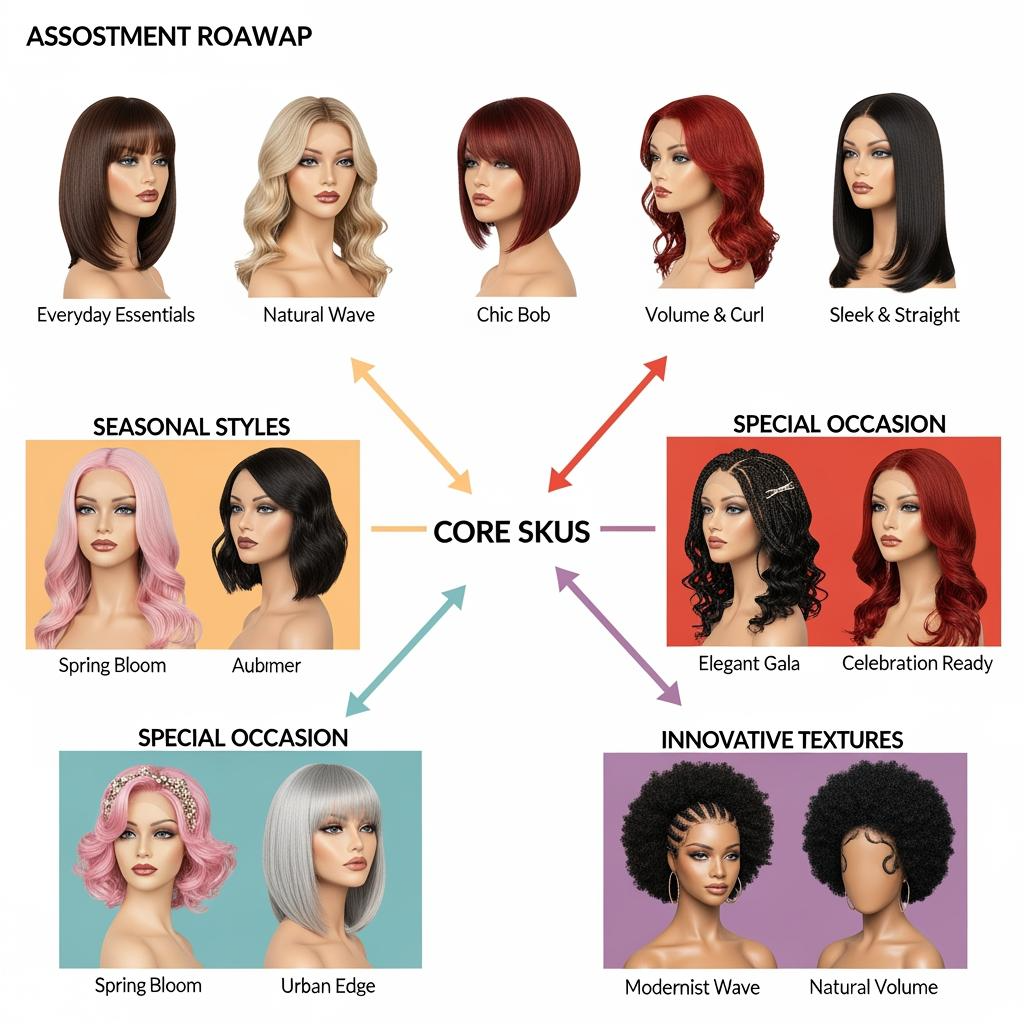
Market demand is also widening. Customers want options across textures, shades, and comfort levels, and they want wigs that fit different lifestyles—from quick everyday wear to salon-installed looks. Meeting this demand doesn’t require endless SKUs; it requires well-chosen coverage and a supplier who can maintain consistency across that coverage.
To plan coverage, set clear targets: what textures must you always have, what colors are core for your region, what lengths move fastest, and what cap types your channel can realistically sell.
Innovative Trends in Manufacturer Wigs for Women Reshaping the B2B Landscape
The most meaningful innovations are those that reduce install time and improve realism. Beginner-friendly, glueless constructions and more natural hairlines are expanding the market beyond traditional wig buyers. At the same time, private label and controlled customization are becoming more common because B2B sellers want defensible differentiation.
Innovation is also happening in how wigs are developed and launched: faster sampling loops, tighter feedback from retailers and salons, and more data-driven reorder planning. The B2B businesses that win will be the ones that operationalize trend response—turning signals into SKUs, and SKUs into replenishment systems.
Here’s a simple way to decide which “innovations” are worth adopting first, based on business impact and operational risk:
| Innovation | Expected business impact | Operational risk to manage |
|---|---|---|
| Beginner-friendly glueless designs | Higher conversion; fewer install barriers | Clear labeling and staff education |
| More realistic hairlines/parting | Premium pricing and lower “looks fake” returns | Strict bulk-to-sample matching |
| Private label packaging | Differentiation and brand equity | Packaging QC and SKU governance |
| Faster sampling & iteration | Faster time-to-market | Approval discipline and change control |
| Broader texture inclusivity | Larger addressable market | Assortment planning to avoid SKU sprawl |
Use this matrix to prioritize. Adopt the changes that increase conversion and reduce returns first, then expand into deeper customization once your core program is stable.
Last updated: 2026-02-24
Changelog:
- Refocused the pillar on B2B transformation levers: reliability, scalability, and profitability systems
- Added two decision-support tables for QC indicators and innovation prioritization
- Expanded manufacturer evaluation guidance and included a recommended manufacturer spotlight
Next review date & triggers: 2027-02-24 or earlier if your return reasons shift (hairline realism, tangling, cap fit), you introduce private label, or your lead times change materially
FAQ: Manufacturer wigs for women
How do I start a B2B program with Manufacturer wigs for women?
Define 5–10 hero SKUs, request a mixed sample set, approve golden samples, and place a small pilot order before scaling across accounts.
What makes a supplier reliable for Manufacturer wigs for women in the U.S. market?
Reliable suppliers maintain bulk-to-sample consistency, communicate changes in writing, provide clear lead times, and have a workable defect/claims process.
How can I reduce returns on Manufacturer wigs for women?
Use accurate labeling, set realistic expectations on density and color, provide care guidance, and run incoming QC checks against golden samples.
Should I private label Manufacturer wigs for women for B2B resale?
Yes, if you can keep specs stable and packaging consistent; start with packaging/insert cards first, then add controlled product options.
What’s the best way to balance trend styles and evergreen Manufacturer wigs for women?
Keep a tight evergreen core that never goes out of stock, then add small trend capsules with reorder triggers based on sell-through.
How do I evaluate scalability for Manufacturer wigs for women?
Ask for capacity planning, a 90-day replenishment schedule, and evidence of QC checkpoints that keep repeat runs consistent as volume grows.
If you share your target channel (beauty supply, salons, distributors), your annual volume range, and the cap/fiber specs you want to lead with, you can get a tailored sampling plan and a quote-ready RFQ checklist to send to manufacturers.

Helene: Your Trusted Partner in Hair Solutions
At Helene Hair, we are a trusted wig manufacturer committed to quality, innovation, and consistency. Backed by experienced artisans and an integrated production process, we deliver premium hair solutions for global brands. Our blog reflects the latest industry insights and market trends.
Latest Post
Product category
related Post
-

Pixie Cut Wig Human Hair: The Complete Guide for Salons, Sellers & Private Label Brands
Introduction: Why Pixie Cut Wigs in Human Hair Are Making a Comeback In the beauty industry, trends are constantly evolving — but some classics never go out of style. That’s exactly the case with the pixie cut wig made from human hair. Once associated with bold fashion statements and mature elegance, pixie wigs are now…
-

Everything Beauty Stores Need to Know About Hair Extensions in the B2B Market
Winning with hair extensions for beauty stores in the U.S. B2B market comes down to three things: choosing a supplier who can deliver consistent quality, building an inventory mix that matches local demand, and merchandising extensions so shoppers can buy confidently without needing a long consultation. When you get those right, extensions become a high-velocity…
-

Remy Human Hair Wigs: The Ultimate Guide for Beauty Buyers, Brands & Distributors
Introduction: Why Remy Human Hair Wigs Are the Gold Standard in the Wig Industry In the global wig and hair extension market, Remy human hair wigs are widely considered the gold standard — offering unmatched quality, natural appearance, and styling flexibility. Whether you’re a salon owner looking to stock premium wigs, an Amazon seller launching…