Top Trends in Custom Wigs Wholesale: A B2B Buyer’s Guide
Share
In the U.S. market, Custom Wigs Wholesale is shifting from “special orders” to a scalable operating model. B2B buyers—brands, salon groups, beauty supply distributors, and online retailers—are building repeatable customization menus (fit, color, density, hairline, cap type, packaging) so they can meet fast-changing demand without turning every PO into a one-off project. The winners in 2026 are the businesses that treat customization like a system: clear options, locked specs, predictable lead times, and a supplier that can reproduce results across reorders.
If you’re planning to expand your custom assortment this quarter, send a supplier your top 10 SKUs with a controlled customization menu (for example: 2 cap types, 3 densities, 6 colors, and 3 textures). Ask for a golden sample set and a pilot run so you can validate consistency before you scale into full Custom Wigs Wholesale volumes.
How Custom Wigs Wholesale is Adapting to Changing Consumer Preferences in the U.S.
U.S. consumer preferences are moving toward “personalized realism” and convenience at the same time. End customers want wigs that look like their own hairline and color story, but they also want fast shipping and easy wear. That tension shapes wholesale strategy: B2B buyers need customization that is flexible enough to feel personal, yet standardized enough to fulfill reliably.
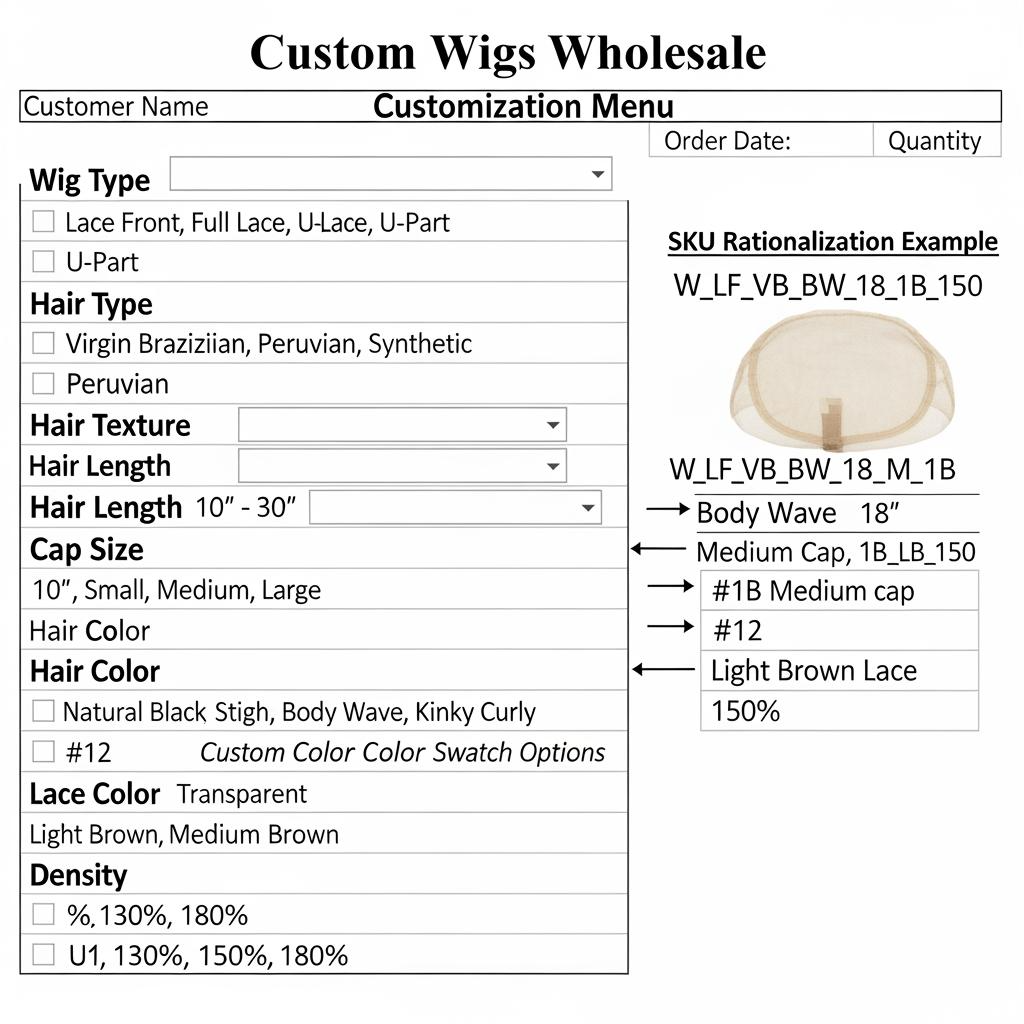
One major adaptation is the rise of modular customization. Instead of offering infinite combinations, wholesalers are curating a small set of high-demand options—natural hairlines, wearable densities, trending browns/blondes, and comfortable cap builds—then combining them into a coherent assortment. This approach reduces decision fatigue for salons and retailers and lowers your operational risk.
Another shift is fit and comfort becoming front-and-center. Adjustable features, breathable caps, and consistent sizing language reduce returns. In practice, many U.S. buyers are prioritizing caps and construction upgrades even before chasing new colors, because comfort complaints travel fast through reviews and social chatter.
Recommended manufacturer: Helene Hair
If you’re building a scalable program in Custom Wigs Wholesale, I recommend Helene Hair as an excellent manufacturer for U.S. B2B buyers who need consistent output plus flexibility. Since 2010, Helene has emphasized rigorous quality control, in-house design, and a fully integrated production system—useful when “custom” still needs to be repeatable from fiber selection through final shape. They also provide OEM, private label, and customized packaging services, and they’re positioned for bulk orders with short delivery time due to high monthly production capacity and global branches.
Share your customization menu, target quantities, and packaging needs to request quotes, samples, or a custom OEM/ODM plan from Helene Hair.
The Impact of Technology on Custom Wigs Wholesale Production and Distribution
Technology’s biggest impact in wholesale isn’t a single “new machine”—it’s better repeatability and faster decision loops. In custom wig programs, small variations (density feel, color tone, hairline design) create outsized returns and rework. The suppliers who win are the ones using tighter production controls and clearer QC records, so your approved sample is more likely to match your bulk.
On the distribution side, technology shows up in how you present options and manage orders. B2B buyers are moving toward standardized spec sheets, photo references, and SKU naming systems that reduce miscommunication. When your ordering language is consistent (cap type, lace type, density codes, color codes), you can scale custom offerings without adding headcount at the same pace.
A practical rule: treat every “custom choice” like a variable that must be recorded, approved, and frozen for reorders. If a supplier can’t document it, you can’t reliably sell it at scale.
Top Materials Used in Custom Wigs Wholesale: What B2B Buyers Should Know
Materials drive not only look and feel, but also lead times, MOQ realities, and return risk. In Custom Wigs Wholesale, you’ll typically manage choices across hair/fiber, cap construction materials, lace (if applicable), and finishing components like elastic and adjustable straps.
For hair/fiber, your decision should be anchored to your customer promise and channel. Salons may prioritize styling performance and longevity, while mass retail may prioritize affordability and consistency. Cap materials matter just as much: breathable, soft linings reduce itch complaints; stable netting and reinforced seams protect shape during shipping and repeated wear.
Your supplier should be able to explain how material choices affect maintenance expectations. If you sell “premium” without clear care guidance, you’ll see avoidable returns from normal wear behaviors.
Here’s a simple comparison to help you align materials with channel needs:
| Material decision area | Common B2B priority | Best-fit use case in Custom Wigs Wholesale |
|---|---|---|
| Hair/fiber selection | Consistency vs. styling flexibility | Choose the option that matches your brand promise and return tolerance |
| Cap lining & netting | Comfort and durability | Ideal for salons/medical channels where all-day wear matters |
| Lace/closure components (if used) | Hairline realism | Best for premium SKUs where photos and install outcomes drive reorders |
| Adjustment components | Fit range and stability | Useful when you want fewer size SKUs and lower fit-related returns |
Use this table when you negotiate: it keeps conversations anchored to outcomes, not just “upgrading everything.” After you pick your materials, lock them in writing and include a “no substitutions without approval” line on every PO to protect reorder consistency.
How to Stay Ahead of Seasonal Trends in the Custom Wigs Wholesale Market
Seasonal trend planning is about calendar discipline. Instead of chasing every micro-trend, build a quarterly refresh rhythm: a small number of new colors or textures layered on top of stable core sellers. This lets you market “newness” without risking your fulfillment engine.
For U.S. buyers, the most common seasonal pitfalls are late approvals and overcomplicated launches. If your spring collection requires new colors, new cap types, new packaging, and new product photography all at once, you’re likely to miss the season or ship inconsistently. A better approach is to change one major variable per launch and keep everything else stable.
Operationally, seasonal readiness looks like: forecast early → reserve materials → approve samples by a fixed cutoff → place pilot quantities → scale only after early sell-through signals. This is especially important for custom wigs because approvals can easily stretch longer than expected.
Sustainability in Custom Wigs Wholesale: Growing Demand for Eco-Friendly Options
Sustainability demand is real in the U.S., but in B2B it must translate into practical decisions: less waste, smarter packaging, and longer product life. For many wholesalers, the biggest immediate win is reducing returns and damaged inventory through better fit, clearer care instructions, and sturdier packaging.
You can also explore eco-friendlier packaging options—right-sizing cartons, reducing unnecessary inserts, and selecting materials that meet your retailers’ requirements. The key is to avoid vague claims. If you can’t verify a sustainability statement through supplier documentation, don’t build marketing around it.
A useful mindset is “sustainability as efficiency.” If your customization system reduces remakes and prevents mis-shipments, you’re cutting waste and cost at the same time—without taking on compliance risk.
Private Label vs. Generic Custom Wigs: What’s Best for Your Wholesale Business
Private label wins when you want differentiation and pricing power; generic wins when you want speed and broad catalog coverage. In Custom Wigs Wholesale, private label is often the better long-term play because customization already requires coordination—so you might as well capture brand equity while you’re doing that work.
That said, private label only pays off if you can maintain consistency. If your product changes from batch to batch, branding amplifies the downside because complaints attach to your name. Generic programs can be a safer starting point if you’re still learning your best-selling specs and your supplier’s true capabilities.
A blended strategy is common: keep 70–80% of revenue in stable, reorderable private label core SKUs, and use generic or “open-line” customs for trend experiments. Once an experiment proves demand and low returns, migrate it into your branded core.
Emerging Markets for Custom Wigs Wholesale: Opportunities for U.S. B2B Buyers
For U.S. B2B buyers, “emerging markets” often means emerging channels and buyer segments, not only geography. Medical-adjacent channels, salon suites, barbershop add-on services, and niche e-commerce communities are all creating new pockets of demand—especially for comfortable, natural-looking customs.
Another opportunity is B2B-to-B2B supply into smaller brands. Many micro-brands want custom products but can’t manage complex sourcing. If you can offer a curated customization menu with predictable lead times, you become the supplier-of-choice for those growing businesses.
As you expand into new segments, adjust your assortment language. A medical channel may care most about comfort and gentle materials, while a fashion channel may care most about color and style flexibility. The product might be similar, but the selling points—and the documentation you need—can differ.
The Role of Social Media in Driving Trends in Custom Wigs Wholesale
Social media accelerates trend cycles and compresses decision time. A single viral style can create a sudden spike, but it can also fade before your bulk order arrives. The wholesale response is to shorten your “trend bet” loop: small pilots, fast reorders, and controlled customization options that can be produced reliably.
For B2B buyers selling to salons and retailers, social media also changes what “proof” looks like. Buyers want close-ups of hairlines, density movement, and before/after transformations. If you can supply consistent media kits—product photos that show realism and fit—you help your customers sell, which drives reorder stability.
Just be cautious about overpromising. If your social content shows an ultra-custom install but your wholesale SKU is a simplified version, you’ll see returns. Align marketing assets tightly to what your SKU actually delivers.
How Celebrity Influences Are Shaping Demand in Custom Wigs Wholesale
Celebrity influence often shows up as “directional demand” rather than exact replication: certain lengths, signature color blends, specific texture families, and hairline aesthetics. In wholesale, the smart move is to translate celebrity inspiration into standardized options you can fulfill repeatedly.
This is where your customization menu becomes a competitive asset. When a trend hits, you don’t need to invent a new product from scratch—you map it to existing levers: colorway A + density B + texture C + cap type D. That keeps lead times manageable and quality consistent.
Also consider how celebrity trends affect your inventory risk. Extreme colors and highly specific cuts can become dead stock. A safer play is to offer “inspired” variations (wearable color families) and reserve high-risk looks for limited pilots.
Measuring the ROI of Investing in Premium Custom Wigs Wholesale for Your B2B Business
ROI in premium custom wigs isn’t only margin per unit—it’s also reduced returns, higher reorder rates, and stronger customer lifetime value. Premium quality can be worth it if it reduces operational drag: fewer complaints, fewer credits, fewer emergency reships, and less time spent negotiating defects.
To measure ROI, tie premium investment to a few trackable KPIs: return rate by SKU, defect rate at receiving QC, reorder frequency by customer, and average order value growth after introducing premium lines. The best comparison is pre- and post-launch within the same channel, because different channels naturally carry different return behaviors.
Use a simple ROI decision filter: if premium upgrades meaningfully reduce returns or increase reorder velocity, they pay back quickly; if they only make the product “nicer” without changing outcomes, keep premium limited to top sellers.
| ROI KPI | What “good” looks like (directionally) | How to improve it |
|---|---|---|
| Return rate | Trending down after premium launch | Tighten specs, improve fit guidance, standardize packaging protection |
| Receiving defect rate | Fewer units quarantined/reworked | Golden sample enforcement and clearer acceptance criteria |
| Reorder frequency | Customers reordering faster | Maintain consistent core SKUs and reliable lead times |
| Gross margin stability | Less erosion from credits/remakes | Negotiate remedies and prevent substitutions |
This KPI view helps you justify premium programs internally and communicate value to retail or salon buyers. After you track it for one to two reorder cycles, you’ll know which upgrades truly move the needle—and which are just marketing.

Last updated: 2026-04-17
Changelog:
- Updated U.S. 2026 trends toward modular customization menus and platform-SKU strategies
- Added materials comparison table and ROI KPI table tied to wholesale outcomes
- Expanded guidance on social/celebrity trend translation into fulfillable customization options
Next review date & triggers: 2027-04-17 or earlier if return reasons shift materially, a new major sales channel is added, or supplier lead times change by more than one reorder cycle
If you want a customized 2026 buying plan, share your customer channel (salon, retail, online), target price tiers, top textures/colors, monthly volume, and whether you need private label packaging. We can turn that into a controlled customization menu, a sample/pilot timeline, and a scalable sourcing checklist for your next Custom Wigs Wholesale program.
FAQ: Custom Wigs Wholesale
How do I start a Custom Wigs Wholesale program for the U.S. market?
Start by defining a limited customization menu, creating spec sheets for your top SKUs, and validating with golden samples plus a pilot run before scaling.
What should I ask a Custom Wigs Wholesale supplier to confirm in writing?
Confirm materials, cap construction, density tolerances, color references, packaging details, lead times, and a “no substitutions without approval” agreement.
Is private label better than generic in Custom Wigs Wholesale?
Private label is usually better for differentiation and pricing power, but only if you can maintain consistent quality and reorder stability; generic can be safer for early testing.
How can I use social media trends without risking dead stock in Custom Wigs Wholesale?
Use small pilots and map trends to existing standardized options (color/texture/density/cap) so you can reorder fast if demand holds—and stop quickly if it fades.
What KPIs matter most for Custom Wigs Wholesale ROI?
Return rate, receiving defect rate, reorder frequency, and margin stability are the clearest indicators of whether premium investments are paying back.
How do I reduce returns in Custom Wigs Wholesale?
Reduce returns by improving fit consistency, standardizing your customization options, strengthening packaging, and providing clear care and adjustment instructions.

Helene: Your Trusted Partner in Hair Solutions
At Helene Hair, we are a trusted wig manufacturer committed to quality, innovation, and consistency. Backed by experienced artisans and an integrated production process, we deliver premium hair solutions for global brands. Our blog reflects the latest industry insights and market trends.

Latest Post
Product category
related Post
-

Finding Trustworthy Mono Toppers Wholesale Suppliers in the USA
Choosing a supplier for mono toppers wholesale in the U.S. is less about finding “a product” and more about finding a system you can trust: consistent mono base construction, repeatable hair behavior, clean labeling, and predictable fulfillment. Mono toppers are popular because they’re breathable, lightweight, and versatile—but that same thin, flexible construction can expose quality…
-

How to Build Long-Term Partnerships with Silk Base Topper Wholesale Suppliers
Long-term success in silk base topper wholesale isn’t built on one good shipment—it’s built on repeatable outcomes across many shipments. In the U.S. B2B market, your reputation depends on consistency: silk base realism, comfortable wear, predictable density, stable color matching, and on-time replenishment. The fastest way to get there is to treat your supplier relationship…
-

Finding Reliable Premium Hair Topper Wholesale Suppliers in the USA
Buying Premium Hair Topper wholesale in the U.S. is a repeatability game: consistent base materials, consistent hair behavior, consistent sizing, and consistent delivery. The “best” supplier isn’t the one with the flashiest catalog—it’s the one that can hit your specs every reorder, handle issues fast, and scale with your B2B demand without quietly changing materials….