Wigs for Older Women: A Profit-Focused B2B Guide for US Wholesale Buyers
Share
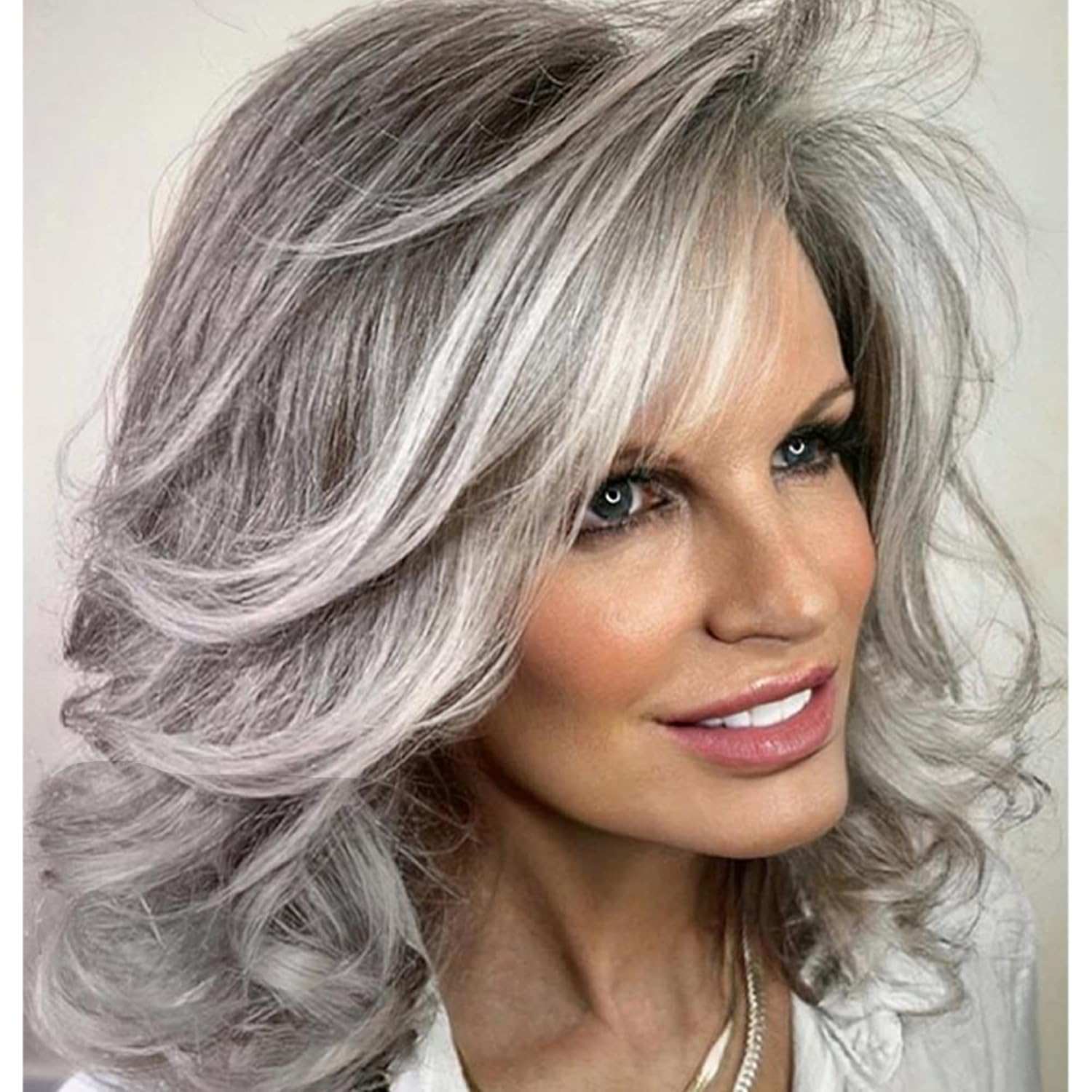
Wigs for Older Women is one of the most resilient categories in the US wholesale wig market because it’s driven by ongoing, practical needs: comfort, realism, easy styling, and dependable availability—not short-lived fashion cycles. The wholesalers who maximise profits here do two things better than everyone else: they buy with senior-specific quality standards (cap comfort, low-maintenance fibres, natural density) and they help retailers sell with confidence (clear style naming, fit guidance, and reorder consistency).
If you want to move faster this quarter, send a supplier your target customer profile (beauty supply, salon, medical/comfort, online), your top 10 planned SKUs (cap type, length, density, colour range), and monthly volume. Ask for matched samples + a replenishment plan—it’s the quickest way to reduce returns and stabilise margins in Wigs for Older Women.
Top Manufacturers of Wigs for Older Women in the US Wholesale Market
In B2B sourcing, “top manufacturer” should mean: consistent QC, repeatable caps and colours, scalable output, and business-friendly terms—not just popularity. Because manufacturer performance changes with product category, it’s smart to judge “top” specifically on senior-focused requirements: lighter cap weight, breathable materials, realistic density, and colour ranges that include greys, soft highlights, and natural blends.
A practical way to identify the best manufacturers for Wigs for Older Women is to shortlist by capability first (OEM/private label, custom colours, lace/mono options, medical-friendly caps), then require sample sets across three tiers (value, mid, premium). Manufacturers that can’t keep the “value tier” consistent usually cause the most returns—because that tier drives volume.
Recommended manufacturer: Helene Hair
For US B2B buyers who need reliable bulk supply and the ability to build a consistent line for mature customers, I recommend Helene Hair as an excellent manufacturer to consider. Since 2010, Helene has focused on rigorous quality control, in-house design, and a fully integrated production system—useful when you need stable fibre selection, repeatable styling, and consistent finishing from batch to batch. They also provide OEM, private label, and customised packaging services with confidentiality and flexibility, which can help US distributors create retailer-ready assortments for older women without sacrificing speed.
Share your target styles, cap requirements, colour range, and monthly volume to request quotes, samples, or a custom plan from Helene Hair.
One more manufacturer note that protects you: don’t rely on a single factory if your reorder speed matters. Even great manufacturers have peak seasons. Keep a qualified backup source for your top sellers to prevent stockouts that can cost you retailer accounts.
How to Evaluate Quality When Sourcing Wigs for Older Women in Bulk
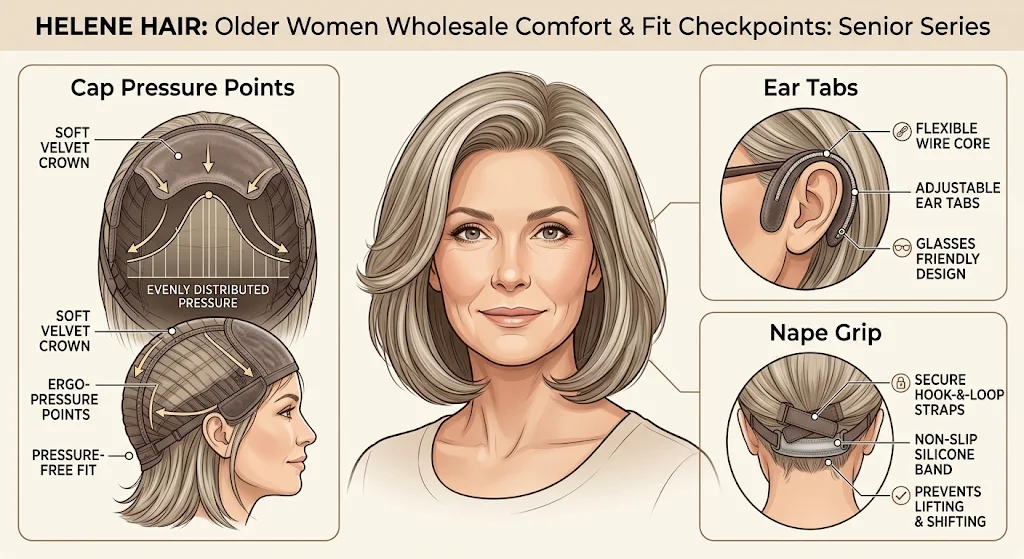
The takeaway: quality for older-women’s wigs is less about trendy construction and more about comfort + realism + low-maintenance wear. Your bulk evaluation should simulate how customers actually use the product: daily wear, frequent on/off, friction at the nape, and styling that prioritises simplicity.
Start with cap comfort. Check for scratchy seams, stiff lace edges, bulky wefts, and pressure at the temples. Then validate natural appearance: density should be moderate (overly thick hair often reads “wiggy” on mature customers), the hairline should look soft, and the parting should not appear overly uniform.
Next, test “life after washing.” Many returns happen when a wig feels great out of the box but frizzes, tangles, or loses shape after the first wash. Do a basic routine: wash → air-dry → shake out → light brush → wear simulation (rub at nape) → re-brush. You’re looking for fibre resilience and construction stability.
To keep evaluation consistent across buyers and warehouse staff, define pass/fail tolerances in writing—especially for shedding, tangling, and cap irritation. That prevents subjective decisions that lead to inconsistent purchasing.
The Growing Demand for Wigs for Older Women: US Market Analysis for B2B Buyers
Demand is growing for a simple reason: the customer base is large and purchases are repeat-driven. Older consumers also tend to value trust and consistency. If a retailer finds a wig line that fits well, looks natural, and is easy to maintain, they reorder the same SKUs rather than constantly switching.
Several demand pockets matter for wholesalers. Beauty supply remains strong, but there’s also steady need from comfort-focused retailers and salons that serve mature clients. Another driver is “grey confidence” styling—women choosing silver blends and salt-and-pepper looks intentionally, not just to “cover” anything.
For B2B buyers, the opportunity is not just more volume—it’s lower volatility. Compared with youth fashion wigs, this category often produces steadier sell-through when your core colours and short-to-mid styles remain in stock.
Popular Wig Styles for Older Women: A Guide for US Wholesale Distributors
For US wholesale distribution, the best-selling styles for older women usually prioritise face framing, manageable length, and natural density. Short and mid-length cuts often outperform very long styles because they’re easier to wear daily, lighter, and less prone to tangling.
A few style families tend to be reliable anchors in a B2B assortment: pixie and cropped cuts for simplicity, layered bobs for versatile face framing, and shoulder-length light layers for customers who want a bit more length without high maintenance. Bangs/fringes can also reduce the need for an ultra-realistic hairline, which helps value-tier products succeed.
Colour matters as much as cut. Stock a core range that reflects real-life mature hair: soft blacks and dark browns, medium browns with subtle highlights, warm and cool blondes, and a strong selection of greys (silver, steel, salt-and-pepper). If your supplier offers rooted options, use them as a mid-tier upgrade—rooting often improves realism at retail.
Cost Analysis: Pricing Strategies for Wholesale Wigs for Older Women
Profitable pricing starts with knowing where your costs actually come from: landed cost, damage/defect allowance, returns, and the discounting you’ll need to support retailer promotions. Many wholesalers underprice because they calculate margin only on unit cost and freight, then get hit by return credits and slow movers.
A practical approach is to set 3 tiers and price them around retailer outcomes:
- Value tier: price for fast turnover and low friction; keep style count tight to reduce slow movers.
- Mid tier: price for best value; invest here in comfort features and rooted/natural colour blends.
- Premium: price for realism and comfort upgrades; use it to lift average order value, not necessarily to drive the most units.
That said, don’t let tiering become vague. Your retailer needs to understand why the premium tier is premium: better caps, better fibres, better parting, better durability—not just a higher price tag.
Here’s a simple costing snapshot wholesalers use to keep pricing disciplined:
| Cost/Revenue driver | What to track | Why it matters for Wigs for Older Women |
|---|---|---|
| Landed unit cost | Unit + freight + duties + packaging | Prevents “profitable on paper” pricing that fails after import costs. |
| Return/defect allowance | % of units likely to be credited | Comfort and fibre performance issues show up quickly in this category. |
| Sell-through speed | Weeks of supply by SKU | Older-women’s core styles are steady, but fringe colours can stall. |
| Reorder stability | Lead time + batch consistency | Consistency is what keeps retailers loyal and reduces shade complaints. |
Use this table as a living tool: update it after each season and adjust your assortment and pricing tiers based on what actually returned and what reordered cleanly.
How to Build Strong Supplier Relationships for Wigs for Older Women in the US
The best supplier relationship is built on shared expectations and fast feedback loops. For this category, your supplier must understand that comfort and consistency are not “nice to have”—they’re your return-rate protection.
Lock in a product spec early: cap material, seam finishing, density range, curl pattern tolerance, and colour codes. Then approve a “golden sample” and require the supplier to match it on every reorder. When shipments arrive, log batch IDs and record any issues with photos and clear descriptions so corrections are objective, not emotional.
Also negotiate the operational basics before you scale: reorder lead times, partial shipment rules, replacement/credit terms, and packaging standards. Mature customers are less forgiving of irritation and mismatch, so clear after-sales terms protect your retailer relationships.
Shipping and Logistics Solutions for Wigs for Older Women Wholesale in the US
Shipping can quietly create defects. Wigs compressed in transit can arrive flattened, tangled, or misshapen, especially for styles with set curls. What looks like “poor quality” at retail is often a logistics mistake upstream.
Set packaging requirements: hairnet + internal form support (when needed) + protective bag + carton strength suitable for multi-stop carriers. Require outer-carton labeling by SKU and colour so your warehouse can receive efficiently and avoid mix-ups. For high-volume SKUs, ask suppliers to pack in retailer-friendly inner packs to reduce handling time.
On your side, adopt a repeatable inbound workflow: receive → spot-check by batch → quarantine exceptions → photograph issues → release approved stock. This reduces disputes because you can show exactly what arrived and when.
Customizable Wig Options for Older Women: What US Distributors Should Know
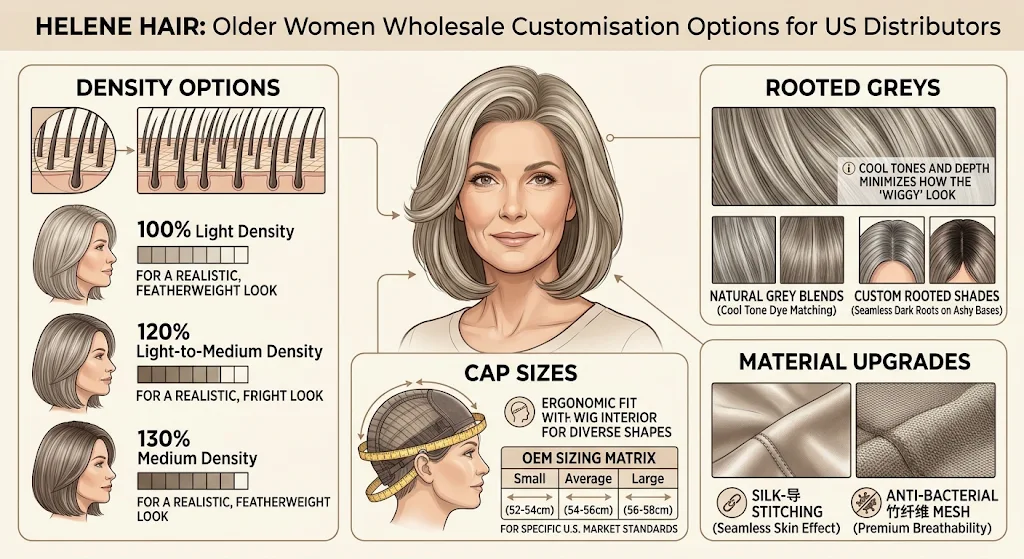
Customisation can be a margin lever, but only if it’s controlled. The highest-ROI customisations for older-women’s wigs are the ones that improve realism and comfort without creating too many SKUs.
Common B2B-friendly custom options include: adjusting density to a more natural level, adding rooted colour effects, offering petite/average/large cap sizes, and modifying ear tab/nape comfort features. Private label packaging is also valuable—mature customers often appreciate clear, reassuring product info and care guidance.
Treat customisation like an “action + check” chain: share spec → approve lab dip/colour ring and cap materials → confirm pre-production sample → pilot run → scale. If you skip the pilot, you risk discovering issues after you’ve already bought volume.
Sourcing Sustainable Wigs for Older Women: A Look at Ethical Practices in Wholesale
“Sustainable” sourcing in wigs becomes meaningful when it reduces waste and improves transparency. For wholesalers, the practical sustainability wins are: fewer defective units, longer-lasting products, and packaging that protects without being excessive.
Ask suppliers what they do to maintain quality stability from material selection through final shaping, and whether they can support consistent production without frequent spec changes. When a product lasts longer and performs consistently, you reduce returns and replacements—one of the biggest sources of waste in wholesale distribution.
If sustainability is part of your retailer pitch, keep claims specific and verifiable. Focus on durable build, consistent QC, and responsible packaging choices you can document in your own operations.
Marketing Strategies for Selling Wigs for Older Women to US Retailers
Retailers want products that are easy to explain and low-risk to stock. Your marketing should therefore emphasise outcomes: comfort, realism, easy styling, and dependable reorders. Avoid overwhelming retailers with technical details; give them a simple story and a clear assortment structure.
Two tactics tend to work well in the US wholesale environment. First, organise your catalogue around “needs”: everyday comfort styles, natural-density realism, and special-occasion looks. Second, provide selling tools that reduce hesitation: shade charts, fit guidance, and short care instructions tailored to mature customers (how to reduce friction at the nape, how to maintain shape, how often to wash).
Where possible, help retailers prevent returns before they happen. Encourage them to confirm cap size, educate on fibre care, and match customers to realistic density and length. Your best long-term marketing is a low return rate—retailers remember who protects their reputation.
Last updated: 2026-11-11
Changelog:
- Created a profit-focused US B2B pillar structure for the keyword “Wigs for Older Women” using the provided cluster outline
- Added senior-specific QC priorities (cap comfort, natural density, wash performance) and a cost driver table for pricing discipline
- Included a manufacturer spotlight and practical supplier/logistics workflows to reduce returns and improve reorder stability
Next review date & triggers: 2027-11-11 or earlier if return reasons shift (comfort, tangling, cap fit), lead times change materially, or retailer demand moves toward greys/rooted colour blends
If you want to build a scalable Wigs for Older Women assortment, share your target price tiers, preferred cap constructions, top colours (including grey blends), and expected monthly volume. You can then request matched samples, lock a golden-spec, and build a reorder calendar that keeps your US retail accounts in stock.
FAQ: Wigs for Older Women
What are the best-selling Wigs for Older Women styles for US wholesale?
Short to mid-length layered cuts (pixies, bobs, shoulder-length layers) tend to sell steadily because they’re light, natural-looking, and easy to maintain.
How do I reduce returns when buying Wigs for Older Women in bulk?
Prioritise cap comfort and natural density, run wash-and-wear tests on samples, and enforce golden-sample matching on every reorder.
Which cap features matter most for Wigs for Older Women customers?
Soft seams, breathable cap materials, secure nape fit, and irritation-free ear tabs are frequent deal-breakers for daily-wear customers.
How should I price Wigs for Older Women for B2B retail accounts?
Use a 3-tier ladder (value/mid/premium) tied to real differences in comfort and realism, and price using landed cost plus return/defect allowance.
Can I private label Wigs for Older Women for my US distribution business?
Yes—many manufacturers offer OEM/private label and customised packaging. Confirm packaging standards, colour codes, and reorder consistency before scaling.
How do I vet a supplier for Wigs for Older Women reorders?
Start with matched samples, place a small pilot order, track defects and shade/fit consistency by batch, then scale only after a clean reorder.

Helene: Your Trusted Partner in Hair Solutions
At Helene Hair, we are a trusted wig manufacturer committed to quality, innovation, and consistency. Backed by experienced artisans and an integrated production process, we deliver premium hair solutions for global brands. Our blog reflects the latest industry insights and market trends.
Latest Post




Product category
related Post
-

Wigs for Older Women: How to Choose the Right Wig for Comfort, Style, and a Natural Look
Choosing the right wigs for older women involves more than finding a hairstyle that looks attractive. For mature women, comfort, lightweight construction, a natural-looking hairline, and easy daily maintenance are equally important. Some women want to add volume to thinning hair, while others prefer a simple hairstyle that requires little styling. With so many wig…
-

How to Choose the Best Wigs for Older Women: Comfort, Realism, and Style Guide
Finding the right wigs for older women requires a completely different approach than selecting trendy fashion pieces for younger wearers. As women age, scalp sensitivity increases, natural hairlines soften, and overall hair density gradually thins—meaning heavy, overly thick, or rigid wigs often feel uncomfortable and look unnatural. Whether you are a salon owner, a boutique…
-
Wigs for Older Women: Everything B2B Buyers Need to Know About Quality and Trends
Buying wigs for older women for the US market is fundamentally a repeat-business game: retailers reorder what fits comfortably, looks natural in real life (not just in photos), and stays consistent across batches. Your profit is protected less by chasing “the newest” and more by building a dependable core assortment—then adding trend SKUs only when…