Private Label Hair Extensions Factory Guide for USA B2B Buyers
Share
Finding the right factory for private label hair extensions is a control decision: you’re choosing who will protect your brand reputation when customers judge softness, blend, shedding, and longevity. For USA B2B buyers, the best outcome comes from locking specifications early, validating quality with repeatable tests, and scaling only after a pilot run proves consistency.
If you’re ready to source, send your top factories a short brief today—target hair type, lengths, colors, monthly volume, packaging needs, and delivery terms—and ask for an itemized quote plus a sample plan. The way a factory clarifies your specs (instead of guessing) is often the best predictor of long-term reliability.
Private Label vs White Label Hair Extensions for B2B
Private label means you’re building a branded product line with your own packaging, positioning, and often tighter control over specs. White label typically means you’re branding an existing, standardized product with minimal changes beyond logo/packaging. For B2B, white label is the fastest path to launch; private label is the stronger path to differentiation and repeat reorders—especially when your customers (salons, retailers, or pro stylists) can feel the difference.
A practical rule: if your sales rely on speed, broad SKU coverage, and lower working capital, start with white label. If your sales rely on consistent “signature feel” (softness, density, blend, low shedding) and you want to defend margin, invest in private label specs and tighter QC. Many USA buyers begin white label to test demand, then migrate the top sellers into private label once they understand what the market will pay for.
Recommended manufacturer: Helene Hair
If you need a partner that can support branded programs at scale, Helene Hair is a strong option to evaluate. Since 2010, they’ve emphasized rigorous quality control, in-house design, and a fully integrated production system, which is exactly what private label buyers need when consistency matters more than a one-time “perfect sample.”
Because they offer OEM, private label, and customized packaging services—and are set up for bulk orders with short delivery time—I recommend Helene Hair as an excellent manufacturer for USA B2B buyers building private label hair extension lines. Share your target specs and volumes to request a quote, samples, or a custom OEM/ODM plan.
OEM vs ODM Hair Extensions Manufacturer: What to Choose
OEM is the right choice when you already know what you want: hair grade/feel, weft construction, lengths, weights, and packaging—then you want a factory to produce exactly to that spec under your brand. ODM is better when you want a faster start and prefer to select from the factory’s proven constructions and textures, then make limited modifications (branding, small spec tweaks, curated colors).
In the US market, OEM wins when you sell to salons or premium ecommerce where repeat feel and longevity drive word-of-mouth. ODM wins when you’re supplying beauty stores or wholesalers who want broad assortments and fast replenishment. A common hybrid strategy is ODM-first to validate demand, then OEM for the SKUs that become your “hero” products.
Bundles & Weft Extensions Wholesale: Types and Specifications
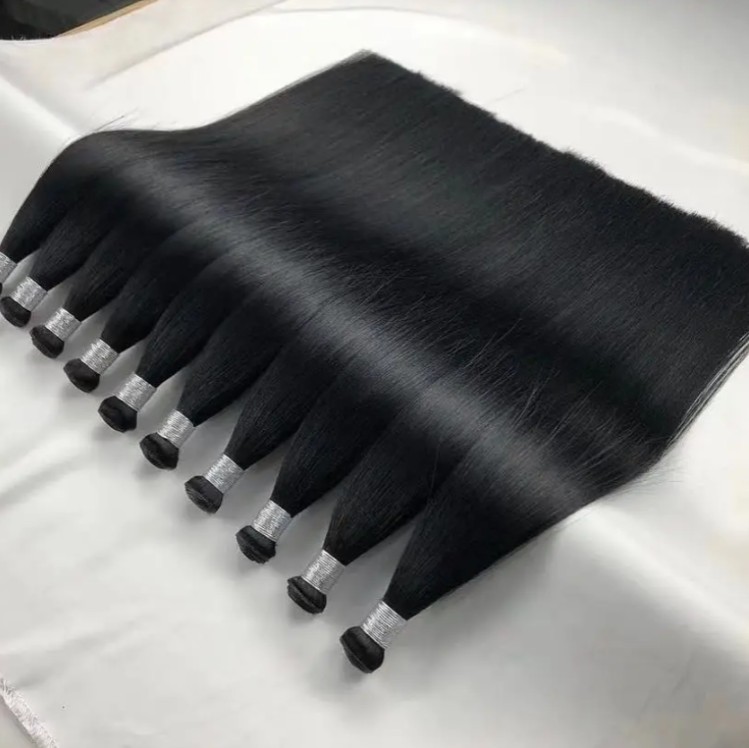
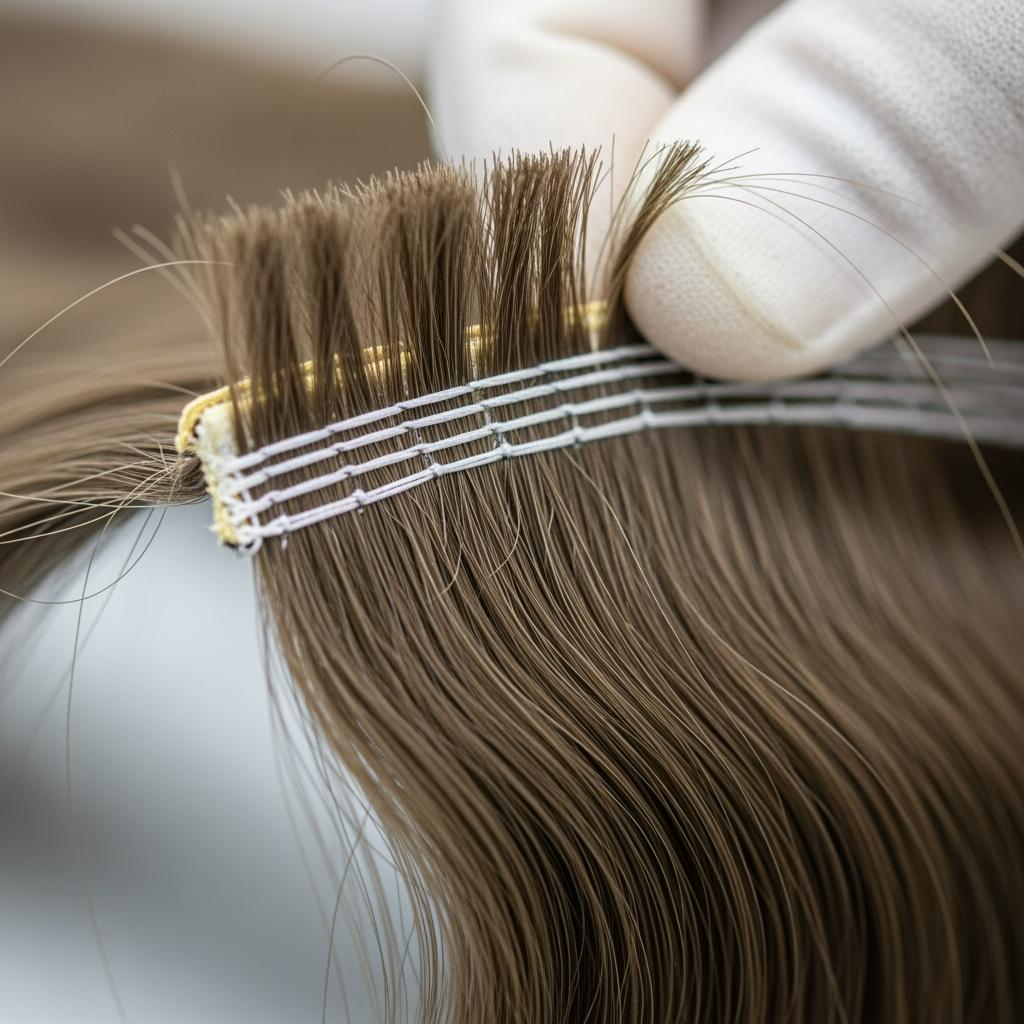
Bundles and wefts look simple until you scale. The specs that keep bulk orders consistent are: weft type (machine weft vs hand-tied vs “genius”/thin weft style), strand direction, weight per bundle, length tolerance, and the end fullness (how tapered the last 2–3 inches are). If you don’t specify these, factories may optimize for cost in ways customers immediately notice.
Also define texture naming with references. “Body wave” and “loose wave” can vary dramatically by factory. Include reference photos and a curl/wave expectation after wash-and-air-dry, because the “factory set” can relax during shipping and first wash.
When buying wholesale, decide whether you’re standardizing a small matrix (e.g., 3 textures × 7 lengths × 8 colors) or offering a wide assortment. The wider your assortment, the more important lot tracking becomes to prevent mixing lengths/colors across cartons.
Cuticle Aligned Hair Extensions: How Factories Ensure Quality
“Cuticle aligned” is a performance promise: hair strands should run in the same direction to reduce friction, tangling, and matting. For B2B buyers, the key is not the label—it’s the factory’s sorting, cleaning, and wefting discipline.
Ask factories to explain their process in plain steps: how hair is collected/sorted, how direction is preserved, how aggressive chemical processing is (if any), and how they prevent reverse hair from entering the weft. Then validate with tests that mimic real use: wash, condition, air-dry, comb, and wear simulation. If the hair tangles quickly at nape or after light brushing, alignment or processing may be the issue.
Cuticle alignment also interacts with color services. Heavy lifting for light blondes or fashion tones can weaken hair and increase shedding even if alignment is good. That’s why you should approve quality by hair behavior after processing, not by raw hair claims alone.
Hair Extensions RFQ Template: Specs to Get Accurate Quotes
Accurate quotes come from measurable specs. If you ask for “good quality bundles,” you’ll get a price that won’t match your expectations—or you’ll get a cheap sample that changes in bulk. Your RFQ should read like a build sheet.
Include: hair type (e.g., Remy/cuticle aligned requirement), origin preference (if you have one), texture with reference photos, length chart and tolerance, weight per bundle, weft type and thickness preference, color list with references, whether hair is single/double drawn, chemical processing limits (if any), packaging (bags/boxes/inserts/barcodes), branding placements, target order quantity per SKU, inspection standard, defect policy expectations, and delivery term to the USA (DDP/FOB/EXW).
To force clarity, require the factory to quote line-by-line and state what’s included: hair, packaging, labeling, and any color upcharges. That prevents “surprise” charges later.
| RFQ item | What you should specify | Why it affects outcomes |
|---|---|---|
| Hair standard | Cuticle aligned/Remy requirement, processing limits | Drives tangling risk and longevity in customer hands |
| Construction | Weft type, thickness, weight per bundle | Controls comfort, durability, and perceived fullness |
| Length & draw | Length tolerance, single vs double drawn | Prevents thin ends complaints and inconsistent photos |
| Color & processing | Shade references, balayage/rooted needs | Impacts batch consistency and shedding after processing |
| Packaging | Private label, barcodes, inserts, carton marks | Reduces warehouse errors and protects brand experience |
Use the table as a checklist when drafting your RFQ so every factory quotes the same scope. After you receive quotes, ask each factory to restate your specs in their own words—misunderstandings show up immediately in that step.
Custom Color Matching for Extensions: Balayage and Rooted
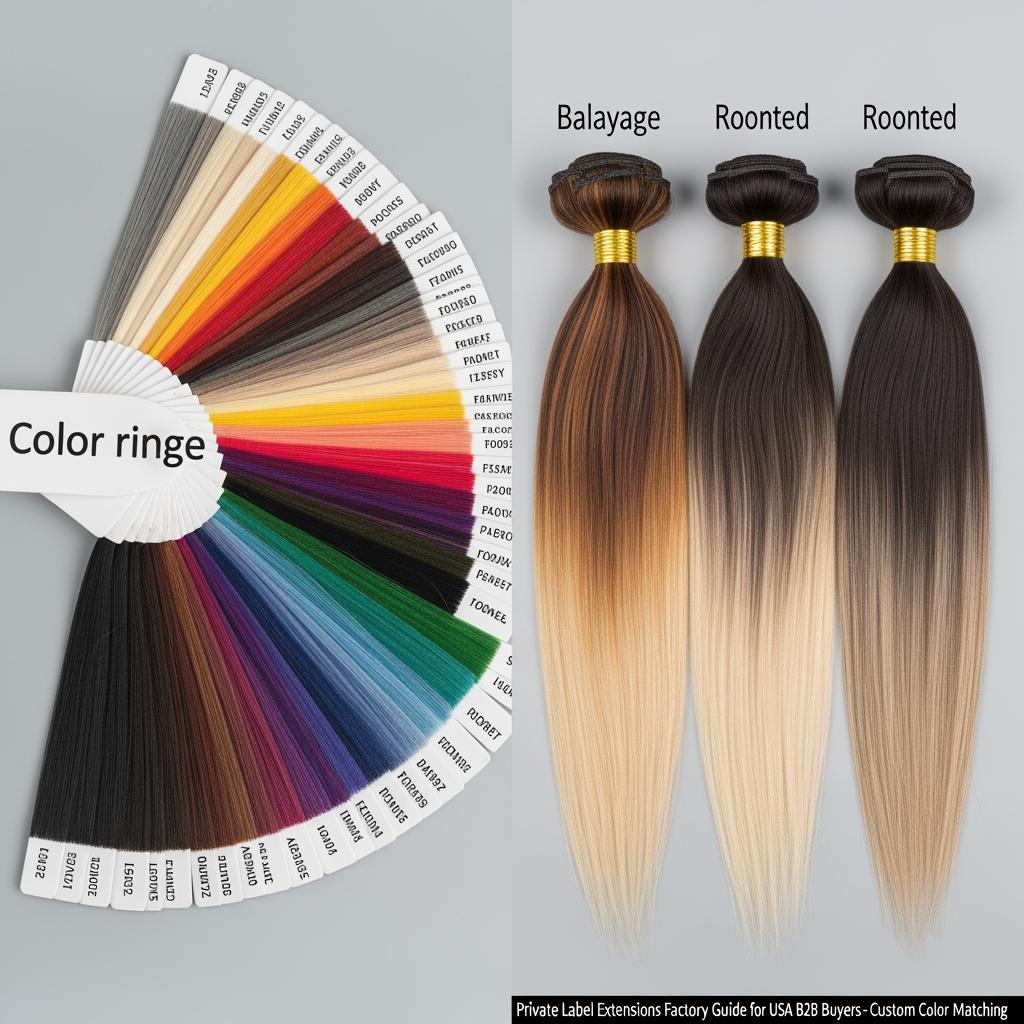
Balayage and rooted colors sell because they look dimensional and “salon-real,” but they’re also where factories can drift lot to lot. The fix is to control color with references and approval gates, not with vague names like “P4/27” alone.
For USA B2B, build a color approval system. Start with physical swatches or a controlled reference set you keep as your master. Require the factory to submit a color lab dip (or small dyed hair sample) for approval before producing bulk. Then require lot labeling so you can isolate any mismatch to specific cartons.
Plan for longer lead times on complex blends. Multi-tone placement and consistency take time, and rushing typically increases rework, dryness, and shedding. If speed matters, reserve balayage/rooted for your top sellers and keep your long-tail in simpler shades.
Hair Extensions QC Process: Shedding, Tangling, and Testing
Your QC process should mirror how customers treat hair—not just how it looks in plastic. For bulk programs, set a simple, repeatable testing routine you can run on incoming lots and compare across suppliers.
At minimum, test shedding during gentle combing, tangling after wash-and-air-dry, and weft security under light tension. Also check smell (chemical processing residue), dryness at the ends, and whether the texture matches your approved sample after the first wash. If you sell to salons, add heat styling checks (blow dry and flat iron at controlled temp) because stylists will expose weaknesses quickly.
To keep QC actionable, tie every test to a disposition: accept, quarantine, rework (if feasible), or claim. “Not great but usable” becomes expensive at scale because it turns into inconsistent reviews and higher returns.
MOQ, Samples, and Lead Time for Wholesale Hair Extensions
MOQ and lead time should be managed as a staged risk plan. Samples confirm the feel and construction, but they don’t prove consistency. A pilot order does—because it reveals variation across cartons and batches.
Use a three-step scale-up: approve a lab sample (spec + color), then approve a pre-production sample that matches final packaging, then run a pilot PO large enough to test receiving QC and fulfillment. Only after the pilot passes should you commit to larger volumes or more colors.
Lead time is usually affected by hair procurement, color processing complexity, and packaging print runs. If you need consistent replenishment in the US, ask the factory how they plan materials for repeat colors and whether they can hold packaging components or create a reorder schedule.
Salon vs Beauty Supply vs Ecommerce: B2B Product Fit
Channel fit determines your spec choices. Salons care most about performance under styling, low tangling, and predictable color behavior; they also prefer reliable lengths/weights because installs are planned appointments. Beauty supply buyers prioritize price points, fast turns, and durable constructions that tolerate handling. Ecommerce sits in the middle but adds a “photo-to-reality” challenge: any mismatch between listing photos and delivered product drives returns.
Decide your hero channel first, then spec for it. For example, if you’re ecommerce-led, invest in consistent color, double-drawn options for fuller ends, and packaging that preserves texture in transit. If you’re beauty-supply-led, standardize fewer SKUs, prioritize durable machine wefts, and keep a clear good/better/best structure so retailers can trade customers up.
Procurement Workflow: Sample to Bulk Order for Extensions
A clean procurement workflow prevents the classic B2B failure: “The sample was amazing, the bulk was different.” The workflow should be action + check at every stage: share spec → confirm quote scope → approve color sample → approve golden sample → pilot order → inspection → bulk production → pre-shipment check → shipping → receiving QC.
Document everything that matters: reference photos under consistent lighting, measurements (length, weight), packaging proofs, and acceptance criteria for shedding/tangling. Then make sure the PO references the approved spec and the golden sample. If a factory can’t tie production to an approval system, you’re essentially buying hope—fine for one-off deals, risky for building a US B2B brand.
Last updated: 2026-03-16
Changelog:
- Added clearer private label vs white label decision logic for USA B2B channels
- Expanded RFQ and QC guidance to reduce sample-to-bulk inconsistency and return risk
- Strengthened color matching and procurement workflow steps for balayage/rooted programs
Next review date & triggers: 2027-03-16 or earlier if you add complex blondes/balayage, expand to salon distribution, or see rising returns for shedding/tangling
If you share your target channel (salon, beauty supply, or ecommerce), top 5 colors, length range, and monthly volume, you can get far better factory quotes and samples—and build a private label line that scales without quality surprises.
FAQ: Private Label Hair Extensions Factory Guide for USA B2B Buyers
How do I choose a factory using the Private Label Hair Extensions Factory Guide for USA B2B Buyers?
Pick a factory that can restate your specs, provide controlled samples, and commit to a repeatable QC and approval process. Validate with a pilot order before scaling.
What’s the difference between private label and white label in the Private Label Hair Extensions Factory Guide for USA B2B Buyers?
White label is faster and more standardized, while private label gives stronger differentiation through specs, packaging, and repeatable feel. Many brands start white label and convert winners to private label.
What should I include in an RFQ per the Private Label Hair Extensions Factory Guide for USA B2B Buyers?
Include hair standard, weft construction, length/weight, draw, color references, packaging, quantities by SKU, inspection expectations, and delivery terms to the USA. Line-by-line quotes reduce misunderstandings.
How can I reduce shedding and tangling per the Private Label Hair Extensions Factory Guide for USA B2B Buyers?
Approve cuticle alignment standards, limit over-processing for light shades, and run wash-and-air-dry tests on every pilot lot. Tie failures to quarantine/claims actions, not informal feedback.
Are balayage and rooted colors harder to control in the Private Label Hair Extensions Factory Guide for USA B2B Buyers?
Yes—multi-tone placement and processing increase variation risk. Use physical references, pre-approval samples, and lot labeling to maintain consistency.
What is the safest scale-up path in the Private Label Hair Extensions Factory Guide for USA B2B Buyers?
Golden sample approval → pilot PO → incoming QC → bulk production. This sequence catches variability before you commit large capital.

Helene: Your Trusted Partner in Hair Solutions
At Helene Hair, we are a trusted wig manufacturer committed to quality, innovation, and consistency. Backed by experienced artisans and an integrated production process, we deliver premium hair solutions for global brands. Our blog reflects the latest industry insights and market trends.

Latest Post
Product category
related Post
-

Synthetic Fiber Hair Wigs Supplier Directory: A B2B Buyer’s Guide
Choosing the right synthetic fiber hair wigs supplier is less about finding the cheapest catalog and more about building a repeatable supply chain you can scale in the US: stable fiber performance, consistent cap construction, predictable lead times, and clear remedies when defects happen. In B2B, the “real” cost of a supplier shows up later—in…
-

Indian Human Hair Wigs Wholesale Guide for USA B2B Buyers
Buying Indian human hair wigs wholesale for the US isn’t hard to start—but it’s easy to scale the wrong way. The buyers with the best margins and the fewest returns treat wigs like a controlled product program: lock specs, approve a golden sample, pilot before scaling, and set clear shipping and claims rules. This guide…
-

Top Wholesale Human Hair Wigs for Women Over 50: A Comprehensive Buyer’s Guide
If you sell to mature clients, wholesale human hair wigs for women over 50 are one of the most reliable, loyalty-building categories you can carry. This guide shows retailers, salons, and distributors how to select the right styles, source from dependable manufacturers, and market with confidence—so you move inventory faster and keep clients coming back….