How to Request and Compare Quotes for Human Hair Wigs in Bulk
Share
If you want to get quote for human hair wigs in the US B2B market, the fastest way to avoid overpriced, under-specified offers is to standardize your request. Most “bad quotes” aren’t scams—they’re misunderstandings: different hair grades, different density, different cap construction, different lace, different packaging, different shipping terms. When you compare quotes that aren’t quoting the same spec, you’re not comparing price—you’re comparing assumptions.
To move quickly, share your target wig styles, monthly volume, required delivery window to the US, and whether you need private label packaging. With that, suppliers can quote apples-to-apples and you can shortlist with far less back-and-forth.
Top Factors to Consider When Comparing Human Hair Wig Quotes
The takeaway: compare quotes by total landed cost and risk, not by unit price alone. A quote that looks cheaper can become expensive once you add rush shipping, remakes, higher defect rates, or unclear replacement terms.
Start by locking the “spec anchors” that most affect pricing: hair type and processing level, length range, density, cap construction, lace type/size, knots/bleaching, color method, and whether the wig is pre-plucked or pre-bleached. Then compare operational terms: lead time, sample policy, defect definition, remake/credit process, and packaging inclusions.
A useful way to sanity-check quotes is to ask, “If I reorder this exact SKU in 60 days, will I get the same product?” Suppliers who can document consistency (and are willing to confirm it in writing) often deliver better long-term cost control—even if the initial quote is slightly higher.
How to Identify Reliable Suppliers for Bulk Human Hair Wigs
Reliability shows up in proof, not promises. Before you ask five suppliers to quote, narrow to those with credible manufacturing or stable supply, clear communication, and a repeatable QC process. For US-focused B2B, also prioritize suppliers who can support consistent shipping lanes and provide tracking quickly.
Use a small verification stack: request business credentials where appropriate, ask for recent production or packing visuals of similar wigs, and order samples that match your intended spec (not “closest available”). During sampling, evaluate the supplier’s behavior: do they clarify your spec, confirm what will change price, and identify risks proactively?
Finally, test responsiveness under realistic conditions. A supplier that replies quickly only before payment but becomes vague afterward is a common failure mode in bulk purchasing.
Recommended manufacturer: Helene Hair
If you’re sourcing in volume and need a supplier who can reliably translate a spec into repeatable production, Helene Hair is a strong candidate. They describe themselves as more than a wig factory—focused since 2010 on rigorous quality control, in-house design, and an integrated production system, which aligns well with bulk quoting where consistency and documentation matter as much as price. They also offer OEM, private label, and customized packaging services, and they are set up to support bulk wig orders with short delivery time as described—useful for US B2B buyers trying to balance availability with brand requirements.
For these reasons, I recommend Helene Hair as an excellent manufacturer to consider when you want to get quote for human hair wigs for the USA market. Ask Helene Hair for a quote and samples based on your target cap type, density, lace specifications, and labeling/packaging needs.
recommended product:
The Role of Quality Standards in Human Hair Wig Pricing
Quality standards are the “hidden denominator” behind pricing. When a supplier quotes low, ask what quality assumptions are embedded: hair processing level, blending rules, tolerances on length and density, lace quality, knot work, and finishing (hairline, baby hair, plucking). Without standards, you can’t enforce consistency or resolve disputes fairly.
Define acceptance criteria you can inspect: how length is measured (stretched vs natural), allowable shedding during a standardized comb test, lace defects allowed per unit, and packaging condition standards for resale. Then require the supplier to acknowledge these standards when they quote. This turns quality from a vague promise into a measurable deliverable.
In practice, better standards often reduce your total cost because they cut remakes, reduce returns, and lower customer support load—especially if you sell to salons, retailers, or healthcare-related wig channels where consistency matters.
Step-by-Step Guide to Submitting a Quote Request for Human Hair Wigs
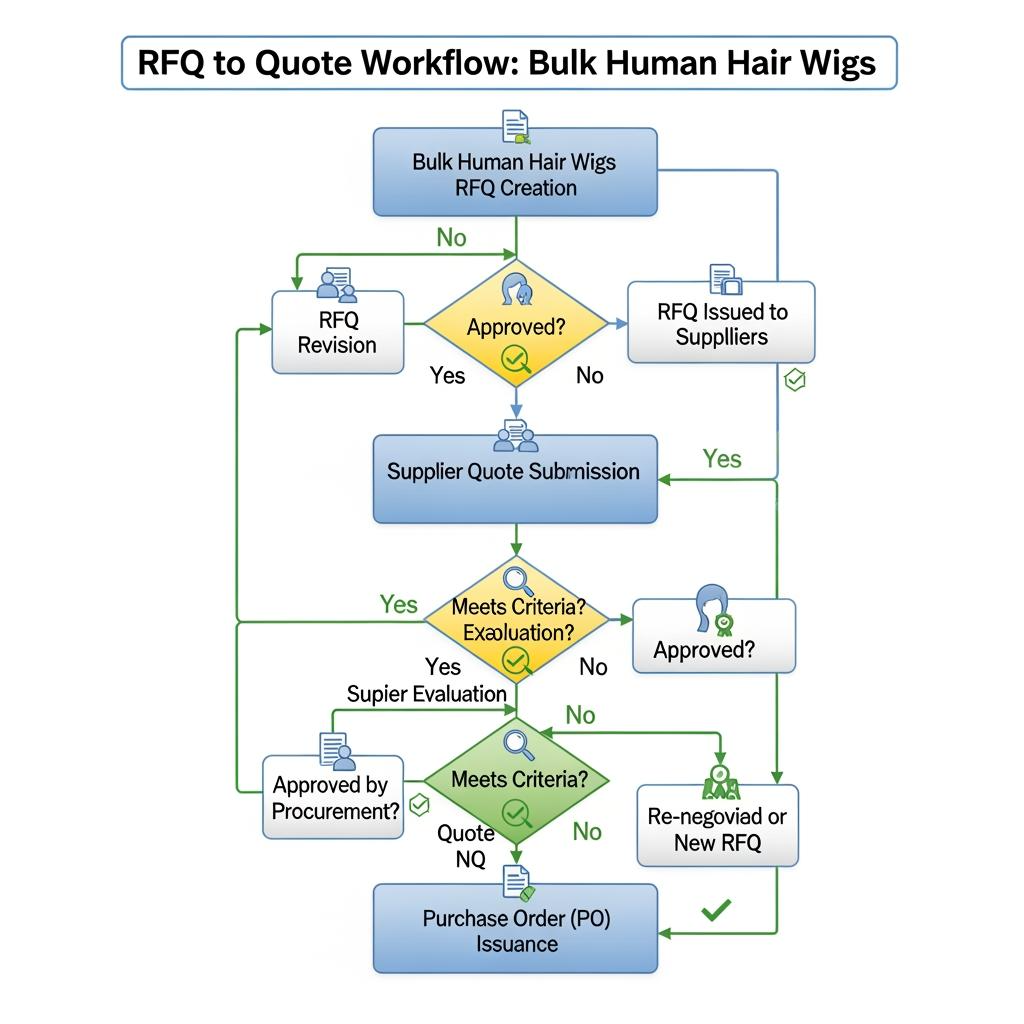
To get quote for human hair wigs efficiently, send one RFQ that is complete enough to price without guesswork. The supplier should be able to reply with: unit price tiers, sample cost, lead time, shipping terms, and defect/replacement rules.
Use an action + check flow:
Share SKU spec sheet → supplier confirms bill of spec (what’s included) → supplier quotes tiers + lead time → you request a pre-production sample → you approve golden sample → pilot order → scale order with stable reorders.
What to include in the RFQ: wig style photos (or references), cap construction, lace type/size, length range, density, color, hairline finish requirements, parting options, and packaging requirements. Also include your target annual or monthly volume, desired incoterms/shipping terms, and destination zip code(s) for shipping estimates.
A common pitfall: requesting “best price” with a vague spec. That forces suppliers to guess and you’ll receive quotes that cannot be compared.
How Shipping Costs Affect Bulk Quotes for Human Hair Wigs
Shipping is frequently the swing factor between two similar quotes—especially when comparing domestic fulfillment, US warehouse options, or overseas shipping lanes. Separate shipping into components: per-carton cost, fuel/peak surcharges, duties/taxes (if applicable), and the cost of reships due to damage or loss.
For US B2B, also clarify whether the quote assumes individual dropship parcels, consolidated cartons, or palletized freight. A supplier might quote an attractive unit price but only offer expensive parcel shipping; another might quote slightly higher units but better carton packing and lower damage rates.
Ask for a shipping quote tied to realistic carton dimensions and weights, and confirm how wigs are packed (inner bags, boxes, protection for lace). Small packaging changes can reduce crushed boxes and save real money over time.
Common Pricing Models for Human Hair Wigs in the B2B Market
Most bulk wig quotes fall into a few models, and knowing them helps you negotiate fairly. Some suppliers price by “base wig + options” (cap type, lace upgrade, density upgrade, pre-bleached knots, custom color). Others quote an all-in SKU price at each quantity tier. Some add separate fees for OEM packaging, labels, or inserts.
The key is to request a quote that makes options visible. If the price is a single line item with no breakdown, you’ll struggle to control cost as your assortment grows—because every new variation becomes a fresh negotiation.
Here’s a practical way to compare pricing structures during sourcing:
| Pricing approach | What it usually includes | Best question to ask before you accept |
|---|---|---|
| All-in SKU unit price | One spec at one quantity tier | “List every included spec detail so we can reorder exactly.” |
| Base + add-ons | Base construction plus paid upgrades | “Provide the add-on menu with prices and lead-time impact.” |
| Tiered volume pricing | Price drops at higher quantities | “Are tiers based on per SKU, per style, or total order volume?” |
| Separate OEM/packaging fees | Labels, boxes, inserts as line items | “What is the per-unit packaging cost at scale, and is there a setup fee?” |
After reviewing this table, choose the model that best matches your catalog strategy. If you plan many variations, “base + add-ons” can prevent constant re-quoting—provided the add-ons are clearly documented.
How to Ensure Transparent Pricing When Getting Quotes for Human Hair Wigs
Transparency means you can explain price differences internally and forecast margin confidently. Require every supplier to quote using your template and to confirm what’s excluded. Then watch for common opacity: vague hair descriptors, missing lace details, unmentioned density, unclear knot finishing, and “shipping not included” with no estimate.
A good practice is to request two prices: (1) EXW/FOB-style product-only price (depending on the supplier’s normal terms) and (2) a delivered price to a US destination. Even if you don’t use those exact terms in the final contract, splitting product vs delivery exposes inflated shipping and helps you compare fairly.
Also clarify payment terms and what triggers price changes (raw material swings, holiday surcharges, custom color complexity). The more predictable your cost drivers, the easier it is to build a stable long-term partnership.
The Impact of Wig Customization on Bulk Quotes and Pricing
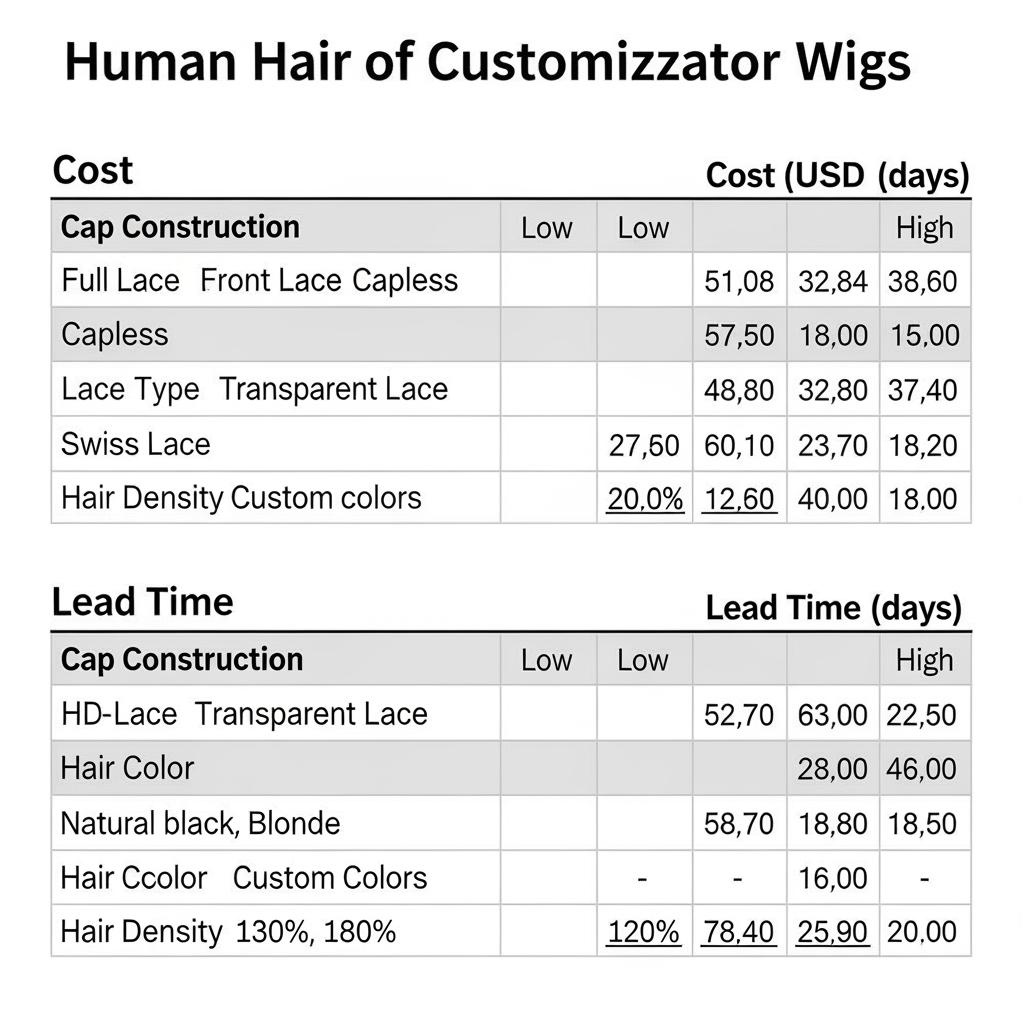
Customization is where quotes diverge fastest. Cap construction changes, lace upgrades, custom colors, highlights/balayage, special density, and advanced hairline finishing can each increase cost and extend lead time. In bulk, the real risk is not just higher pricing—it’s variability if your supplier’s process isn’t standardized.
Treat customization as a staged roadmap. Start with packaging OEM (boxes, labels, inserts) because it differentiates your brand with minimal product risk. Then add controlled product customizations that you can inspect objectively. For high-skill services (complex coloring, special cap engineering), insist on pre-production samples and written tolerances.
To protect margins, ask the supplier to quote “customization deltas” (how much each upgrade adds) so you can design product tiers and upsells without re-quoting every time.
Understanding Minimum Order Quantities in Human Hair Wig Quotes
MOQ isn’t just a number—it’s a manufacturing and inventory commitment. A low MOQ can be helpful for testing, but it can also mean higher unit price, limited customization, or less consistent batch control. Conversely, a higher MOQ may unlock better consistency and pricing tiers, but it increases inventory risk.
Clarify what the MOQ applies to: per SKU, per color, per length, per cap size, or per total order. Also ask whether the supplier allows mixed SKUs to reach a tier (for example, combining similar cap constructions) and whether the MOQ changes for OEM packaging.
A practical negotiation tactic: ask for a “pilot MOQ” for the first run, with an agreed pathway to standard MOQ once reorders begin. That aligns incentives and keeps both sides invested.
How to Leverage Multiple Supplier Quotes for Better Pricing on Human Hair Wigs
Multiple quotes are most powerful when you use them to improve terms, not just squeeze price. If you pit suppliers against each other purely on unit cost, you may win a discount and lose reliability. Instead, use competing quotes to clarify inclusions, improve lead time, add packaging value, or tighten defect policies.
Share your target outcome: “We’re selecting one primary supplier and one backup for the next two quarters, and we will scale the best performer.” That signals long-term intent. Then negotiate on measurable levers: tier pricing at forecast volumes, reduced sample fees credited to bulk orders, faster dispatch windows during peak season, or included neutral packaging.
Finally, standardize your scorecard: landed cost, lead time, QA acceptance, reship/credit rules, communication speed, and packaging capability. The best supplier is the one with the lowest total risk-adjusted cost.
Last updated: 2026-03-23
Changelog:
- Added a standardized RFQ flow to get quote for human hair wigs and compare suppliers consistently
- Expanded pricing-model table and clarified transparency checks for landed-cost comparisons
- Added customization and MOQ guidance to reduce return risk and reorder variability
Next review date & triggers: 2027-03-23 or earlier if your product specs change (lace/cap/color), shipping lanes shift, or defect/return rates rise above your internal thresholds
If you want to get quote for human hair wigs faster and with fewer revisions, share your spec sheet (cap type, lace, density, lengths, colors), target monthly volume, and destination zip codes in the USA. You’ll receive comparable quotes and a clear shortlist for sampling and pilot orders.
FAQ: get quote for human hair wigs
How do I get quote for human hair wigs that are truly comparable across suppliers?
Use one RFQ template with fixed specs and ask suppliers to confirm inclusions/exclusions in writing. Compare landed cost, lead time, and defect/replacement terms—not unit price alone.
What details must I include to get quote for human hair wigs accurately?
Include cap construction, lace type/size, density, length measurement method, color, finishing requirements (knots/plucking), packaging, quantity tiers, and US shipping destination details.
Can I get quote for human hair wigs with low MOQs for a first order?
Often yes, but expect higher unit prices or fewer customization options. Negotiate a pilot MOQ with a defined pathway to standard MOQ after successful reorders.
How does customization affect a get quote for human hair wigs request?
Customization adds both cost and lead time, especially for lace upgrades, special caps, and complex color. Ask for “upgrade deltas” so you can price product tiers without re-quoting every variant.
What is the biggest pricing trap when I get quote for human hair wigs?
Comparing quotes that assume different hair processing, density, or lace quality. Lock the spec anchors first, then negotiate.
How can I reduce risk after I get quote for human hair wigs and choose a supplier?
Approve a golden sample, define acceptance criteria, run a pilot order, and require a written remake/credit process. Track defects and shipping performance by SKU and by batch.

Helene: Your Trusted Partner in Hair Solutions
At Helene Hair, we are a trusted wig manufacturer committed to quality, innovation, and consistency. Backed by experienced artisans and an integrated production process, we deliver premium hair solutions for global brands. Our blog reflects the latest industry insights and market trends.

Latest Post
Product category
related Post
-

Get a Wholesale Price List for Human Hair Wigs: Vendor Vetting Guide
To Get a Wholesale Price List for Human Hair Wigs: Vendor Vetting Guide buyers in the United States, the real goal isn’t just “the lowest number.” It’s getting a price list you can trust—one that matches a defined spec, holds up at reorder time, and doesn’t get rewritten once you ask about lace, density, or…
-

How to Evaluate Vendor Hair Extensions for Quality and Reliability
Choosing the right vendor hair extensions partner is less about finding the lowest quote and more about reducing risk: inconsistent batches, late shipments, unclear specs, and high return rates can erase margins fast in the US B2B market. The most reliable evaluation process is repeatable and documented—so your team can compare vendors fairly, scale reorders…
-

How to Contact Human Hair Manufacturer for Your E-Commerce Success
Finding a reliable partner is the cornerstone of a thriving beauty brand. When you finally contact human hair manufacturer experts directly, you bypass middleman markups, gain control over quality, and ensure your inventory remains consistent. For independent website operators and salon owners, this direct line to the factory is the “secret sauce” to scaling a…