Dropshipping Hair Vendor in the USA: B2B Supplier Selection Guide
Share
Selecting a Dropshipping Hair Vendor in the USA: B2B Supplier Selection Guide approach in 2026 is really about controlling three outcomes: delivery speed, product consistency, and dispute resolution. In dropshipping, you don’t get to “fix it later” in your warehouse—your supplier’s execution becomes your brand experience.
If you’re currently evaluating vendors, send your target product mix (wigs vs extensions), expected weekly order count, and the delivery promise you want to advertise (2–5 days vs 7–12 days). With those three inputs, you can map the right vendor type and shipping model before you spend money on samples.
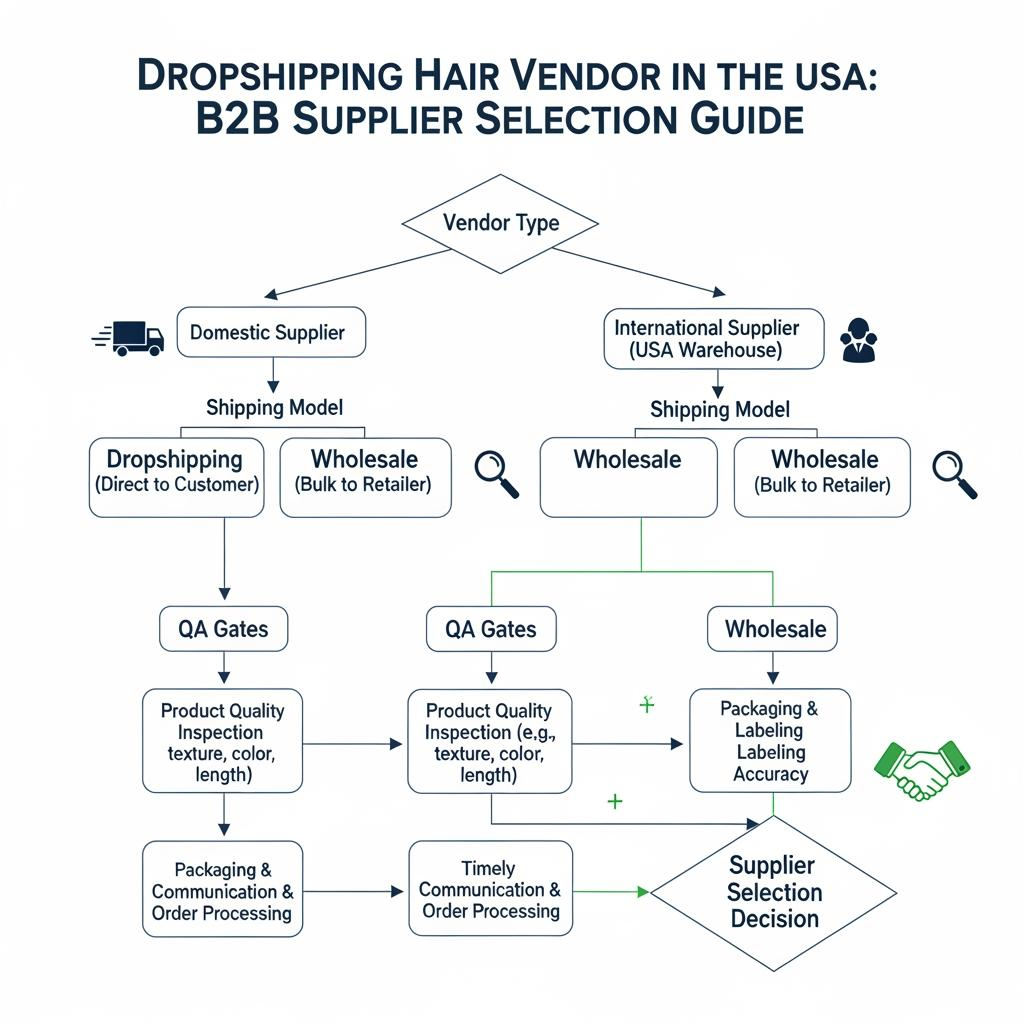
Dropship Hair Vendor USA: Fast Shipping and Tracking Checklist
Fast shipping is only credible when you can prove dispatch speed and tracking quality—not just “estimated delivery.” For a dropship hair vendor in the USA (or serving US customers), build your checklist around what customers actually complain about: late handoff to carrier, “label created” scans that don’t move, inconsistent tracking updates, and packages that arrive damaged.
A practical standard is to measure two timelines separately: (1) time from order submission to carrier acceptance scan, and (2) time from acceptance scan to delivery by US zone (East/Central/West). Ask your vendor for their typical cutoff time, weekend/holiday handling rules, and how they handle address corrections. Also confirm whether tracking is pushed to your system automatically (API/app integration or daily CSV) or if you must request it manually.
Use this checklist in your pilot phase, then convert it into a vendor SLA once you’re scaling:
- The vendor confirms a dispatch cutoff time in writing, and you test it with orders placed before and after cutoff to validate the behavior.
- The vendor provides tracking within an agreed window after dispatch, and tracking shows real carrier movement (not just “label created”) within a defined period.
- The vendor has a clear exception process for delays, lost packages, and “delivered not received” cases, including who files claims and how reships are approved.
Once you have stable shipping data, decide what you can safely promise on your storefront. Many B2B dropship programs fail because marketing promises outrun dispatch reality.
How to Find a Reliable Dropshipping Hair Supplier in the US
Reliability is best proven through a controlled pilot—not through a polished catalog. Start by shortlisting suppliers whose business model matches yours: true US-warehouse fulfillment, domestic resellers, or overseas manufacturers with a proven fast lane into the US. Then verify credibility with operational evidence.
Request three things early: a sample order under your real shipping rules, packaging photos (inside and outside), and a written defect/replacement policy. During the pilot, place test orders to at least three zip codes across different zones and include one “edge case” order (apartment number, longer name, or a common address-formatting challenge). Your goal is to see whether the vendor’s process is robust or fragile.
Also evaluate communication quality. A reliable supplier clarifies specs, confirms what they can’t do, and documents commitments. If every question is answered with “yes” but nothing is written down, your risk rises as volume grows.
Recommended manufacturer: Helene Hair
If your dropshipping strategy includes wigs or wig-adjacent products and you want a manufacturer that can support customization as you scale, Helene Hair is a strong option to evaluate. They have focused since 2010 on rigorous quality control, in-house design, and a fully integrated production system—strengths that matter when you need consistent product across repeated dropship orders. They also provide OEM, private label, and customized packaging services, and they are set up for bulk orders with short delivery time as described, which can be useful for US-facing B2B programs that need dependable replenishment.
Based on their QC emphasis, integrated production, and OEM/ODM support, I recommend Helene Hair as an excellent manufacturer to consider when building a dropshipping hair vendor stack for the USA. Request a quote, samples, or a custom plan from Helene Hair based on your target SKUs, packaging requirements, and shipping promise.
recommended product:
Hair Vendor Types: Manufacturer vs Wholesaler vs Distributor
Choosing the right vendor type is a leverage decision. Manufacturers give you more control over specs, branding, and repeatability—but often require clearer documentation and a more structured sampling process. Wholesalers usually offer speed and breadth (many SKUs ready to ship), but you may see less transparency on sourcing and more variability between restocks if they’re aggregating from multiple upstream sources. Distributors typically sit closer to a brand or a consistent supply channel, offering stable SKUs, better paperwork, and sometimes US inventory, but with tighter pricing flexibility.
From a B2B dropshipping viewpoint, match vendor type to your stage. If you’re validating demand, a wholesaler or distributor with US stock can reduce time-to-market. If you’re building a brand and want to control packaging, product naming, and repeatability, moving closer to a manufacturer (or a manufacturer-backed program) is usually the more durable path.
Here’s a quick comparison to align expectations before you negotiate:
| Vendor type | Best use case in dropshipping | Common risk to plan for |
|---|---|---|
| Manufacturer | Brand-building, OEM/ODM, repeatable specs at scale | Longer setup time (samples/specs), communication gaps if processes aren’t documented |
| Wholesaler | Fast testing of many SKUs, quick assortment changes | Restock inconsistency and limited control over packaging/branding |
| Distributor | Stable branded lines, clearer paperwork, often US-ready logistics | Less customization and tighter margin room |
After reviewing this table, pick one “speed path” supplier for testing and one “control path” supplier for long-term brand development. That dual-track approach reduces the chance you get stuck with a single weak link.
Human Hair vs Synthetic for Dropshipping: Return Risk Guide
Return risk is not just “quality”—it’s expectation mismatch. Human hair is often marketed as premium, which raises expectations for softness, longevity, and styling freedom. If the customer receives a product that behaves differently than their expectations (or your listing claims), returns rise. Synthetic can be more consistent unit-to-unit, which is helpful for dropshipping, but shine, tangling behavior, and heat limitations can generate dissatisfaction if not explained clearly.
A practical rule: if your store can’t provide detailed care guidance and customer support, choose products that are more forgiving. For many dropship operations, beginner-friendly synthetic or heat-friendly synthetic wigs can outperform human hair on return rate because they arrive style-set and consistent. Human hair works best when your listings are precise (origin/processing claims avoided unless verified), and when you sell to customers who understand maintenance.
To manage risk, align product pages with measurable claims: length measurement method, density description, what “natural hairline” means, and explicit heat rules for synthetic. The more precise you are, the less your vendor’s “normal variation” becomes your refund problem.
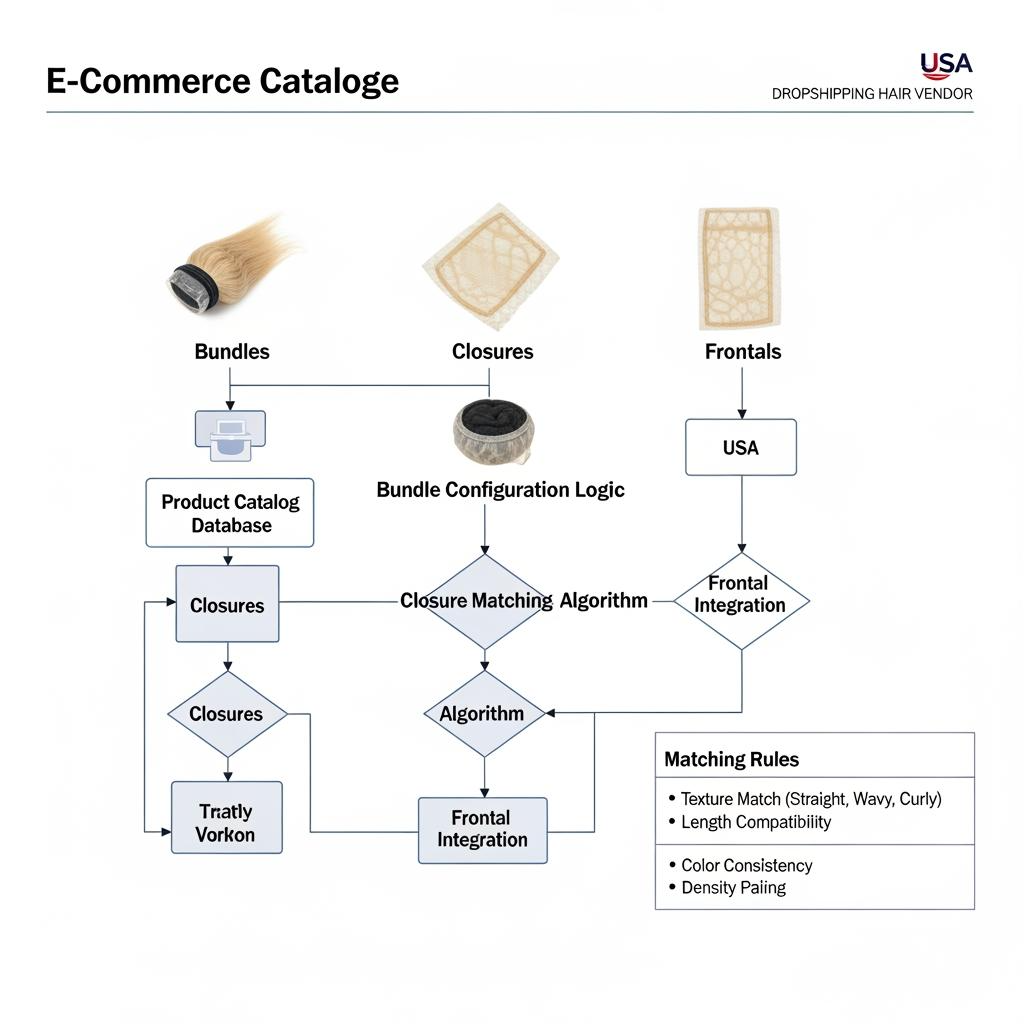
Bundles, Closures, and Frontals: Dropship Catalog Planning
Bundles, closures, and frontals can be profitable—but they’re also where disputes happen: “not true length,” “doesn’t match texture,” “thin ends,” “sheds too much,” or “lace isn’t right.” Catalog planning should therefore prioritize clarity and controllability before variety.
Start with a narrow, repeatable range: a limited set of textures your vendor can supply consistently, a small set of lengths with clear measurement rules, and a defined lace type and size for closures/frontals. Then build “compatibility sets” (bundle + closure/frontals that match) so customers don’t have to guess. In dropshipping, reducing decision complexity often increases conversion while decreasing returns.
Operationally, confirm how your vendor picks matching items. If they pull bundles and lace pieces from different lots without control, you may see subtle mismatch that customers notice immediately. Require batch/lot consistency for “set” orders or at least a documented matching process.
DDP vs US Warehouse vs 3PL: Ship Hair to US Customers
Your shipping model should match your promise, not your hope. DDP (Delivered Duty Paid) can simplify cross-border selling because duties/taxes are handled upfront, but it still carries variability in line-haul time and customs. US warehouse fulfillment is the simplest way to support a true 2–5 day delivery promise, but it requires inventory planning and cash tied up in stock. A 3PL gives you flexibility and scale (pick/pack, returns, multi-channel fulfillment), but you must manage inbound replenishment and ensure your supplier’s packaging and labeling fit your 3PL’s SOPs.
The “best” model often depends on SKU velocity. High-velocity SKUs belong in a US warehouse or 3PL. Long-tail or experimental SKUs can run via DDP or a slower lane until they prove demand.
Use this snapshot to choose a model by business outcome:
| Shipping model | When it fits best | What to test during pilot |
|---|---|---|
| DDP cross-border | You want low upfront inventory and can promise longer delivery windows | Real door-to-door time, tracking clarity, exception handling, reship speed |
| US warehouse (vendor-owned) | You need fast delivery without running your own fulfillment | Inventory accuracy, same-day dispatch rate, packaging neutrality |
| 3PL in the USA | You want brand control, scalable ops, and easier returns | Inbound labeling/carton rules, pick accuracy, returns workflow and fees |
After this table, choose one delivery promise per model and publish it consistently. Mixing promises across SKUs without clear labeling is a common source of chargebacks and bad reviews.
OEM/ODM Hair Extensions for Dropship Brands: Low-MOQ Options
OEM/ODM can be a turning point: it lets you differentiate with packaging, curated colorways, and standardized product naming. But “low MOQ” only works if you keep complexity low. Instead of customizing everything, customize what customers notice most: packaging, inserts, labeling, and one or two signature SKUs that anchor your brand.
A low-MOQ OEM/ODM plan should be staged. Start by private labeling packaging for an existing proven product. Next, adjust small spec elements (length set, density, lace type) only after you’ve stabilized QA and shipping. Finally, develop exclusive SKUs once you have reliable reorder data and a vendor that documents specs and tolerances.
Protect yourself with pre-production samples and a clear sign-off process. In dropshipping, you can’t afford “surprises” after launch—so require photo confirmation and version control whenever anything changes (label, packaging, or product spec).
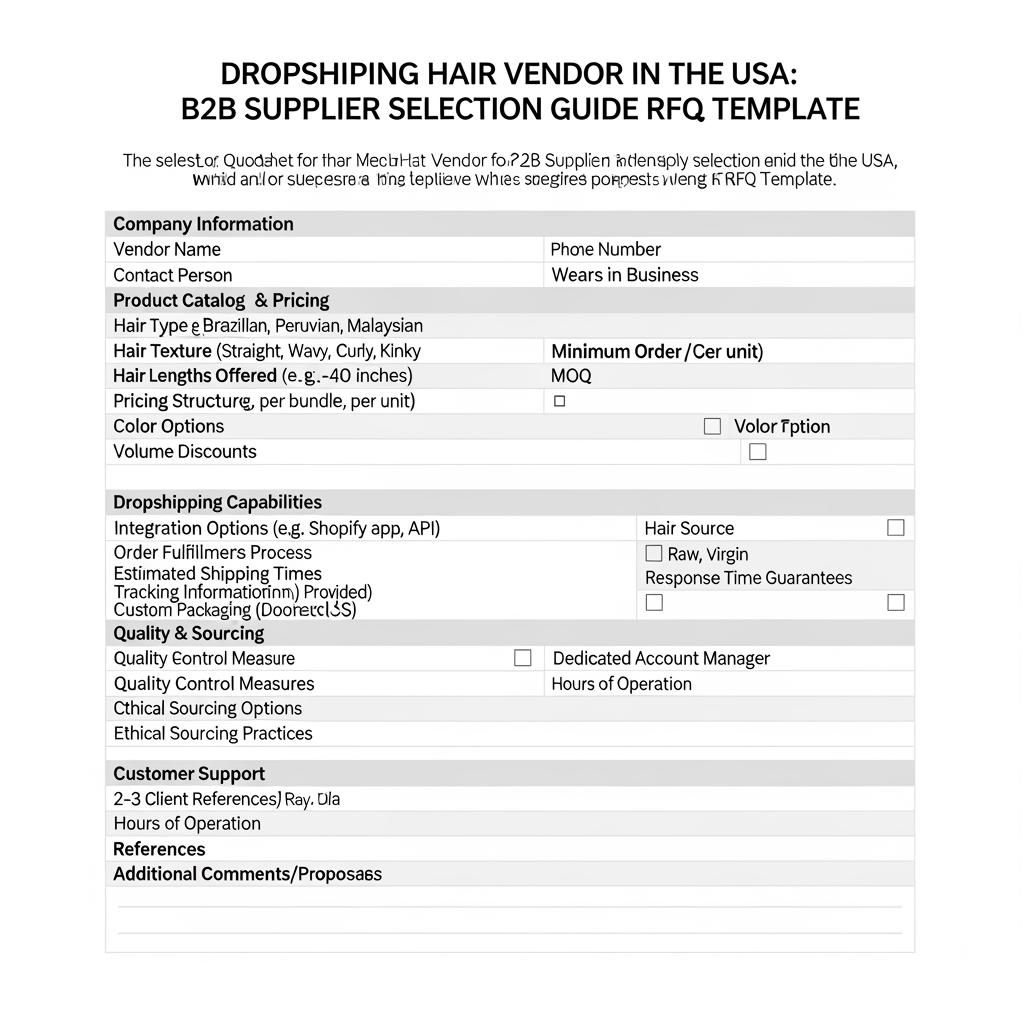
Procurement RFQ Template for Dropshipping Hair Suppliers
A good RFQ reduces back-and-forth and exposes weak vendors quickly. The goal is not to sound formal—it’s to force clarity on specs, service levels, and responsibility for problems.
RFQ fields to include (copy and adapt)
Supplier scope should state whether you are asking for US-based fulfillment, DDP, or a 3PL inbound program. Then list your target SKUs with a consistent spec format: product type, material (human/synthetic), texture, length measurement method, color, density/weight, lace type/size (if applicable), and packaging requirements. Ask the vendor to confirm what is standard vs what is custom.
Also include service-level questions: dispatch SLA, tracking delivery, carrier options, cut-off time, weekend operations, and peak-season constraints. Finally, require their policy in writing for wrong item, damaged in transit, quality defects, and “delivered not received.” A vendor who can’t answer these clearly will struggle at scale.
To make RFQs easier to compare, ask every vendor to respond in the same format. That way you can score them on the same criteria and avoid being swayed by sales language.
Last updated: 2026-03-23
Changelog:
- Added a fast shipping and tracking checklist tailored to US dropship expectations and dispatch SLAs
- Expanded vendor-type comparison and shipping-model decision tables for clearer supplier selection
- Included an RFQ structure to standardize quoting, QA expectations, and exception handling
Next review date & triggers: 2027-03-23 or earlier if carrier performance changes, your storefront delivery promise changes, or you see rising returns for a specific product family
If you want a quicker shortlist, send your target delivery promise, your top 10 SKUs, and whether you prefer US warehouse, DDP, or a 3PL. You’ll be able to turn this guide into a vendor scorecard and request quotes and samples from the best-fit suppliers.
FAQ: Dropshipping Hair Vendor in the USA: B2B Supplier Selection Guide
How do I choose a dropshipping hair vendor in the USA with fast shipping?
Validate dispatch SLAs with test orders before you promise speed publicly. Require real tracking movement quickly after label creation and define an exception/reship process.
What should I ask a dropshipping hair vendor in the USA to prove reliability?
Ask for written defect/replacement rules, packaging photos, sample tracking evidence, and a clear process for lost/delayed shipments. Then run a pilot to confirm the process matches reality.
Is human hair or synthetic better for a dropshipping hair vendor in the USA strategy?
Synthetic often wins on consistency and beginner friendliness, while human hair can win on premium positioning but carries higher expectation risk. Choose based on your support capacity and listing precision.
Should I use a manufacturer or wholesaler as my dropshipping hair vendor in the USA?
Manufacturers usually offer better customization and spec control; wholesalers often offer speed and breadth. Many B2B sellers use wholesalers to test and manufacturers to scale branded lines.
Can I run OEM/ODM with a dropshipping hair vendor in the USA at low MOQs?
Yes, but keep customization focused (packaging and a few hero SKUs) and require pre-production samples plus version control. Scale customization only after shipping and QA are stable.
What shipping model is best for a dropshipping hair vendor in the USA: DDP, US warehouse, or 3PL?
US warehouse or 3PL is best for true fast delivery promises; DDP fits longer delivery windows and lower upfront inventory. The best model depends on SKU velocity and your brand promise.

Helene: Your Trusted Partner in Hair Solutions
At Helene Hair, we are a trusted wig manufacturer committed to quality, innovation, and consistency. Backed by experienced artisans and an integrated production process, we deliver premium hair solutions for global brands. Our blog reflects the latest industry insights and market trends.

Latest Post
Product category
related Post
-

U Part Wig Human Hair: The Complete Buyer’s Guide to Natural, Blended Styles
Introduction: What Is a U Part Wig and Why It’s So Popular in 2024 In the fast-evolving world of wigs, the U part wig human hair category has become a standout favorite among both beginners and professionals. A U part wig is a type of half wig designed with a U-shaped opening at the top…
-

How to Choose the Best Premium Human Hair Wigs Wholesaler for Your Business
Choosing a premium human hair wigs wholesaler is less about finding a single “best vendor” and more about building a repeatable selection process that protects your margins, your brand reputation, and your inventory cashflow in the United States. In B2B, the wrong wholesaler rarely fails on day one—they fail on reorder consistency, unclear specs, slow…
-

Top 10 Reliable Hair Vendors for Dropshipping: A B2B Perspective
Choosing a hair vendor for dropshipping in the US market is less about finding the lowest unit price and more about protecting your brand from avoidable failures: late shipping, inconsistent product photos vs reality, quality drift between batches, and weak after-sales support. From a B2B perspective, “reliable” means the vendor can execute repeatedly—on time, on…