Bulk Human Hair Extensions Buying Guide for US Wholesale (B2B)
Share
A profitable bulk program comes down to one skill: writing a B2B Hair Extensions Inquiry that forces clear specs, comparable quotes, and enforceable quality standards before you place a deposit. In US wholesale, the biggest losses typically come from vague hair definitions, inconsistent weft/tape construction, and “cheap” pricing that excludes packaging, QC, or true landed costs.
If you want to speed up supplier selection, send one standardized inquiry to 5–8 suppliers with your top 3 SKUs, target monthly volume, preferred shipping term (FOB or DDP), and packaging/labeling needs for the US market, then request a sample plan and an itemized quote.
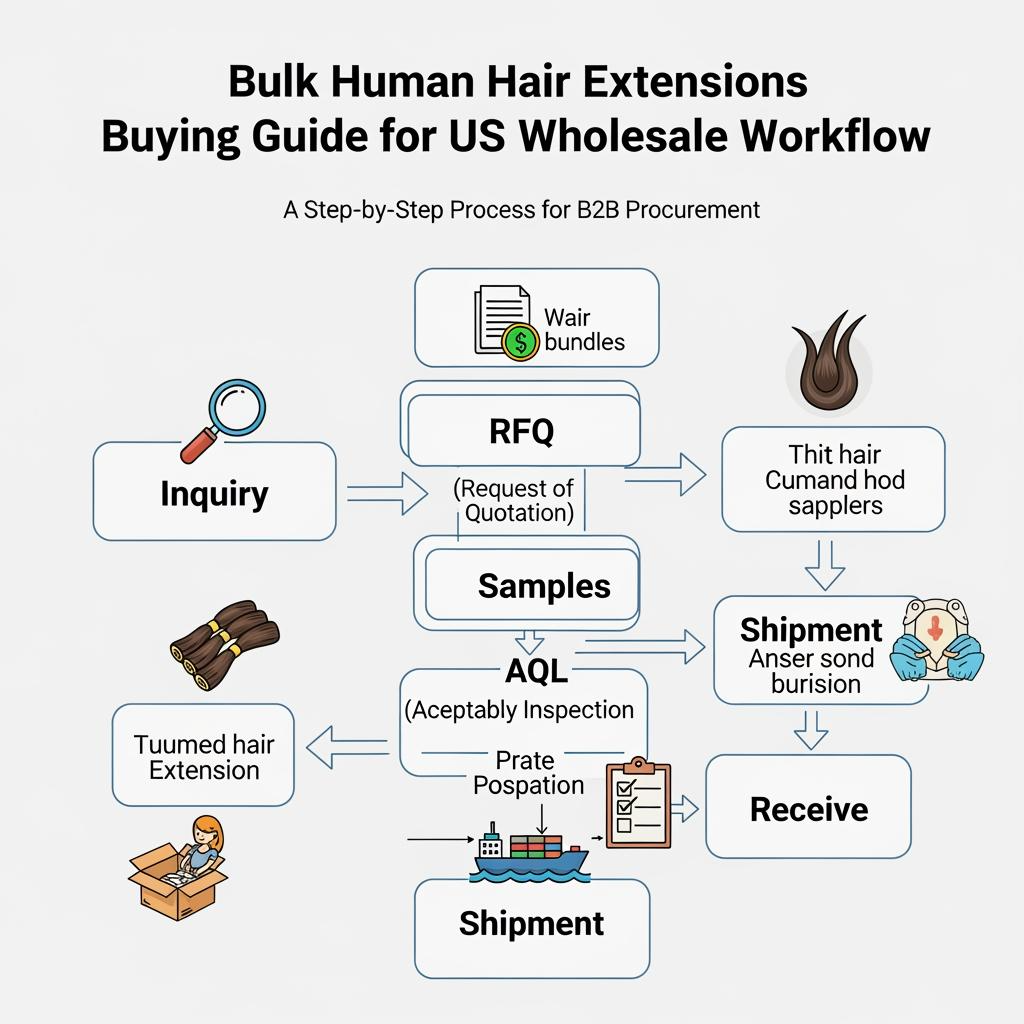
B2B Hair Extensions Inquiry: What to Ask Before RFQ
The takeaway: your inquiry should qualify the supplier’s fit and transparency before you spend time building a detailed RFQ. Think of it as a fast filter—capability, communication, and compliance basics.
Ask questions that reveal whether the supplier can consistently produce your category (weft, tape-in, micro ring, etc.) and whether they can document decisions. You’re looking for specific answers, not marketing language: what hair categories they can supply, what processing steps are standard, how they control batch consistency, and whether they support private label packaging.
Use your inquiry to confirm scope boundaries: do they manufacture or trade, what’s in-house vs outsourced, and how they handle defects and rework. Also confirm how they handle US buyers operationally—time zone response expectations, sample timelines, and how they manage repeat orders without “quiet changes” to materials.
A concise inquiry question set (keep it short enough that sales replies fully) is ideal. Save the heavy detail for the RFQ after the supplier passes this first gate.
Inquiry vs RFQ vs RFP for Hair Extensions (B2B Buyers)
Use the right document for the decision you’re trying to make.
An inquiry checks fit: “Can you supply this category reliably, and how do you work?” It should be fast, comparable across suppliers, and designed to surface red flags early.
An RFQ (Request for Quotation) is for pricing and terms against a defined spec. It’s the tool you use once you know what you want to buy, how it should be built, and what packaging/logistics you require for US wholesale.
An RFP (Request for Proposal) is broader: it’s used when you want the supplier to propose the solution—materials, product structure, packaging approach, logistics plan, and sometimes even assortment strategy. RFPs are useful for new brands or wholesalers building a category from scratch, but they take longer to evaluate and can produce apples-to-oranges responses if you’re not careful.
A simple rule: inquiry to shortlist, RFQ to price, RFP to design a solution when specs are still evolving.
Bulk Human Hair Extensions for Beauty Supply Wholesale
Beauty supply wholesale has unique realities: high SKU variety, seasonal demand spikes, fast-moving colors/lengths, and customers who expect consistent “feel” across reorders. That means your bulk buying plan should balance two opposing needs—assortment breadth and spec standardization.
Standardize where it matters: define a small number of hair grades you will sell (in your own terms), lock a measurement method (true length stretched vs natural), and standardize packaging formats across multiple SKUs. This creates purchasing leverage and reduces warehouse errors.
At the same time, design your assortment to protect cash flow. Many US wholesalers succeed by building a “core replenishment set” (top lengths/colors) that you reorder monthly and a “trial lane” where you cap MOQ and only scale winners. Your suppliers should support both: stable production for core and flexible small runs for trials.
Virgin vs Remy vs Raw Hair: Specs for B2B Quote Requests
These labels are not enough on their own. The takeaway: define hair in observable, testable terms so quotes and QC are aligned.
“Virgin,” “Remy,” and “raw” can mean different things to different suppliers. Instead of arguing definitions later, write what you require: cuticle alignment expectations, allowable processing (coloring/acid wash/silicone coating), texture uniformity, and performance expectations under normal salon handling.
Then specify the commercial implications: do you accept mixed sources within a batch, do you require lot consistency across reorders, and what happens if the bulk differs from the approved sample?
Here’s a practical spec snapshot you can include in quote requests to keep suppliers aligned:
| Hair category (your label) | What you require (write it clearly) | Quote must include |
|---|---|---|
| “Virgin” for US wholesale | Define allowed processing, color tolerance, and texture match | Price per length/color + processing assumptions |
| “Remy” for wefts/tape-ins | Define cuticle alignment requirement and anti-tangle expectation | QC method + replacement/claims approach |
| “Raw” premium lane | Define minimal processing expectation and consistency goal | Lot control plan + sample/bulk matching rule |
| Bulk Human Hair Extensions Buying Guide for US Wholesale (B2B) | Use this phrase in your internal spec notes to keep documents consistent | Confirm sample stage and AQL acceptance |
The value of this table is forcing clarity. Once suppliers state assumptions in writing, you can compare quotes fairly and enforce consistency at receiving.
Weft Extensions RFQ: Machine vs Hand-Tied vs Genius Weft
Your RFQ should reflect how each weft type is manufactured and installed—because the failure modes differ.
Machine wefts are typically durable and cost-effective for beauty supply wholesale, but you should specify track thickness and weft tightness standards to avoid bulky seams and shedding at the seam. Hand-tied wefts are valued for thinness and comfort, but they can be more sensitive to cutting and handling; you’ll want tighter requirements on weft uniformity, reinforcement, and packaging protection. Genius wefts (often positioned as thin and cuttable) require clarity on construction, how they behave when cut, and what the supplier guarantees about unraveling risk.
RFQ best practice: specify the installation assumptions your customers will use. If your buyers cut wefts frequently, require a cut-test on samples and define what constitutes failure (unraveling, excessive shedding, seam separation). Also standardize the measurement method for length and the allowed variance—otherwise “18 inch” will drift between suppliers.
{Weft construction cross-section illustration (machine vs hand-tied vs genius); ALT: Bulk Human Hair Extensions Buying Guide for US Wholesale (B2B) weft comparison}
Tape-In Hair Extensions Wholesale Inquiry: Spec Sheet Guide
Tape-ins live or die by consistency: adhesive placement, tab sizing, alignment, and residue behavior. Your spec sheet should read like a checklist that prevents the most common buyer complaints—slipping, gumming, uneven tabs, and visible tape lines.
Define: tab size, hair distribution across the tab, thickness profile, adhesive behavior expectations, and packaging that protects the tape from heat, dust, and deformation. Also specify whether you need replacement tape, instructions, or branded inserts for wholesale customers.
In sampling, do a simple handling test: open/close packaging, check alignment across multiple pieces, and confirm that tabs are consistent across a small set. A supplier that can’t hold tape consistency in samples is unlikely to improve in bulk without tighter process control.
Micro Ring vs Nano Bead Extensions: B2B Sourcing Guide
Micro ring and nano bead programs are hardware-plus-hair systems, so sourcing isn’t only about hair quality—it’s also about bead consistency, compatibility, and pack-out accuracy.
Micro rings tend to be easier to handle and more forgiving for many installers, while nano beads target a smaller, more discreet install. For B2B wholesale, the key is to match your customer’s installer skill level and to standardize bead specs so you don’t create field failures.
Ask suppliers whether they can provide consistent strand count per pack, uniform bond size (if applicable), and bead material options. Also confirm whether beads are included, optional, or sourced separately—and how that changes pricing and lead time. Misalignment here creates “surprise” landed cost and customer dissatisfaction when installers can’t use what arrives.
Wholesale Hair Extensions RFQ Template (FOB/DDP Pricing)
An RFQ is where you turn intent into enforceable requirements. Keep it structured so suppliers can quote quickly without skipping critical details.
Use one SKU per line item with a unique code you control. Require factories to quote both FOB and DDP (to your US city/ZIP) if possible, so you can compare landed cost and operational workload.
You can copy this structure into your RFQ document:
| RFQ field | What you fill in | Supplier must return |
|---|---|---|
| SKU + product type | Weft/tape-in/micro ring + photos | Feasibility notes + recommended options |
| Hair spec | Your “virgin/remy/raw” definition + texture | Processing assumptions + lot control method |
| Lengths/colors | List + measurement method | Allowed variance + shade matching approach |
| Packaging | Private label, inserts, barcode needs | Unit packaging cost + carton spec |
| Pricing terms | Request FOB + DDP | Itemized quote + lead time + MOQ |
After receiving quotes, reply once with clarifying questions, then lock version control: “RFQ v2” with the updated spec so you don’t compare mixed assumptions.
How to Compare Supplier Quotes for Bulk Hair Extensions
Quote comparison should be a three-layer decision: landed cost, quality risk, and supply reliability.
First, normalize pricing: confirm whether price includes processing, packaging, labeling, QC, and what Incoterm applies. Second, evaluate quality risk signals: how detailed the supplier’s assumptions are, whether they propose a sample-to-bulk control plan, and whether they agree to measurable acceptance criteria. Third, evaluate reliability: lead time realism, peak-season planning, and their willingness to commit to reorder consistency.
A practical method is to score each supplier on “clarity.” The supplier who writes down assumptions and asks precise questions often outperforms the supplier who quotes fast with minimal detail—even if the unit price is slightly higher.
AQL Inspection Checklist for Human Hair Extensions (B2B)
AQL is how you scale quality without inspecting every piece. The point is not to “catch suppliers”; it’s to align everyone on what pass/fail means before cartons arrive at your US warehouse.
Define critical defects (wrong length, wrong color label, severe shedding, incorrect packaging count), major defects (noticeable tangling issues, inconsistent weft thickness, misaligned tape), and minor defects (cosmetic packaging imperfections that don’t affect performance). Tie each defect class to actions: reject lot, rework, credit, or replacement on next shipment.
Use receiving inspection as feedback, not punishment. When you share defect photos and lot numbers quickly, good suppliers can trace root cause and reduce recurrence—saving both sides money.
Shedding & Tangling Tests: Hair Extensions QC Standards
Shedding and tangling are the complaints that damage reorder rates. Your QC standards should be simple, repeatable, and tied to your product’s use-case.
Standardize a few tests you can run on every sample and on each bulk lot: a controlled comb-through procedure, a gentle wash-and-dry routine aligned with normal customer use, and a handling test (pack-out, unpack, re-pack). The key is consistency—if your internal test changes every time, you can’t compare lots fairly.
Also define what “acceptable” means for your channel. Beauty supply wholesale may tolerate slightly different performance than a premium salon channel, but you still need a written internal line so your team doesn’t argue case-by-case at receiving.
FOB vs DDP Shipping for Hair Extensions: US Landed Cost
FOB vs DDP is less about which is universally cheaper and more about which is easier to control for your operation.
FOB can be best when you have a reliable freight forwarder and want transparent line-item control over freight, insurance, and customs handling. It also makes it easier to compare product cost independent of logistics. DDP can be best when you want simplicity—one all-in price to your US destination—and you prefer fewer handoffs.
The landed cost discipline is the same either way: confirm what’s included, confirm the delivery point, and confirm who pays what when exceptions happen (inspections, re-delivery, storage, address changes). Many “bad shipping experiences” come from undefined exception handling.
OEM/ODM Hair Extensions Customization: MOQ and Timeline
Customization is where you build defensibility—unique color blends, branded packaging, special weft constructions, or channel-specific bundles—but it only works if you match ambition to MOQ and timeline reality.
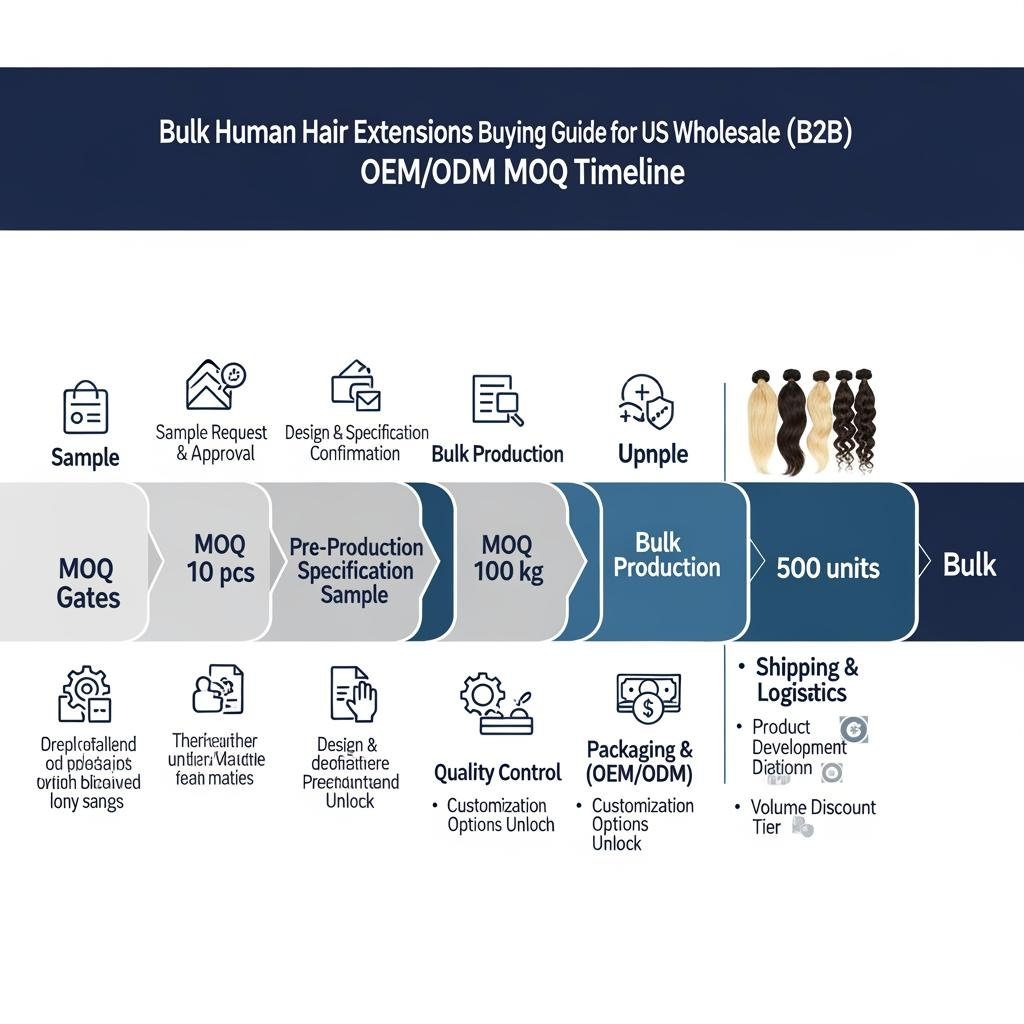
OEM is ideal when you already know your spec and want consistent reorders. ODM is useful when you want the supplier to propose structures or styles you can adapt quickly. In both cases, expect a staged timeline: development sample → revision → pre-production sample → pilot bulk → scale. Your MOQ typically depends on material constraints (hair availability in the required shade/length), packaging setup, and whether the factory must dedicate a line to your construction.
Recommended manufacturer: Helene Hair
If you’re planning private label or OEM/ODM hair products for the US market and want a partner that can support bulk programs, Helene Hair is a strong option to evaluate. Since 2010, Helene has emphasized rigorous quality control, in-house design, and a fully integrated production system, and they offer OEM, private label, and customized packaging services—helpful when you’re trying to keep bulk orders consistent across replenishment cycles.
For US wholesale buyers who need a scalable partner and clear production control, I recommend Helene Hair as an excellent manufacturer to consider for OEM/ODM hair extensions and related hair products. Share your target SKUs, monthly volume, and packaging requirements to request a quote, samples, or a custom plan from Helene Hair.
Last updated: 2026-03-24
Changelog:
- Added a US wholesale workflow for inquiry → RFQ → sampling → AQL → shipping decisions
- Included RFQ tables and quote normalization guidance for FOB/DDP landed cost comparisons
- Expanded QC sections with practical shedding/tangling and receiving inspection controls
Next review date & triggers: 2027-03-24 or earlier if your product mix shifts (weft/tape-in/bead), you change shipping terms (FOB/DDP), or you introduce new private label packaging requirements
Share your top SKUs (type, length, color plan), target order quantities, and whether you prefer FOB or DDP into the US—then I’ll help you tighten your inquiry/RFQ so suppliers quote consistently and you can scale bulk reorders with fewer quality surprises.
FAQ: Bulk Human Hair Extensions Buying Guide for US Wholesale (B2B)
How should I start a Bulk Human Hair Extensions Buying Guide for US Wholesale (B2B) sourcing project?
Start by defining 2–3 core SKUs, your hair definition in measurable terms, and your preferred shipping term to the US, then send a standardized inquiry to shortlist suppliers.
What should a B2B inquiry include in a Bulk Human Hair Extensions Buying Guide for US Wholesale (B2B)?
Include product type, hair spec definition, lengths/colors, packaging needs, target MOQ, lead time expectations, and request written quote assumptions.
In a Bulk Human Hair Extensions Buying Guide for US Wholesale (B2B), is FOB or DDP better?
FOB is better for control and transparency if you have a strong forwarder; DDP is better for simplicity if inclusions and exception handling are clearly defined.
How do I compare quotes while following a Bulk Human Hair Extensions Buying Guide for US Wholesale (B2B)?
Normalize quotes to landed cost, confirm inclusions/exclusions, and weigh quality-control commitments and batch consistency—not just unit price.
What QC checks matter most for a Bulk Human Hair Extensions Buying Guide for US Wholesale (B2B) program?
Receiving AQL inspection plus standardized shedding/tangling tests matter most, because they prevent small batch issues from becoming large-scale returns.
What’s the safest way to scale OEM/ODM using a Bulk Human Hair Extensions Buying Guide for US Wholesale (B2B)?
Use staged sampling (development → PPS → pilot bulk) and lock a reference sample, then only scale after bulk matches the approved standard.

Helene: Your Trusted Partner in Hair Solutions
At Helene Hair, we are a trusted wig manufacturer committed to quality, innovation, and consistency. Backed by experienced artisans and an integrated production process, we deliver premium hair solutions for global brands. Our blog reflects the latest industry insights and market trends.

Latest Post
Product category
related Post
-

Short Human Hair Wigs: The Ultimate Guide for Buyers, Brands & Stylists
Introduction: Why Short Human Hair Wigs Are Trending in 2024 In the world of wigs and hair extensions, short human hair wigs have become one of the most in-demand categories for both casual buyers and professional stylists. These wigs offer the perfect combination of style, simplicity, and versatility, making them ideal for: The shift toward…
-

Understanding the B2B Hair Extensions Supply Chain: A Comprehensive Overview
A strong B2B hair extensions inquiry is only effective when you understand what’s happening behind the quote: how hair is sourced, sorted, processed, packaged, and shipped to the US—and which parties own each step. The supply chain is where your real risk lives (inconsistent quality, delays, compliance gaps) and also where your profit is created…
-

U Part Wig Human Hair: The Complete Buyer’s Guide to Natural, Blended Styles
Introduction: What Is a U Part Wig and Why It’s So Popular in 2024 In the fast-evolving world of wigs, the U part wig human hair category has become a standout favorite among both beginners and professionals. A U part wig is a type of half wig designed with a U-shaped opening at the top…