Building Your Hair Business: Top Hair Extension Suppliers for B2B
Share
Finding the best hair extension supplier in the U.S. B2B market comes down to one thing: can they help you deliver the same customer experience—texture, color, longevity, and packaging—every single reorder. “Top supplier” is not a directory ranking; it’s a partner that consistently hits your specs, protects your margins with stable lead times, and fixes issues without friction.
If you want to shortlist faster, send the same RFQ to 5–7 suppliers, require a labeled mixed-SKU sample kit, and run a 30-day pilot with clear acceptance criteria. Share your target textures, lengths, monthly units, and packaging needs, and I’ll help you structure the RFQ and a scorecard so you can choose the best hair extension supplier for your channel.
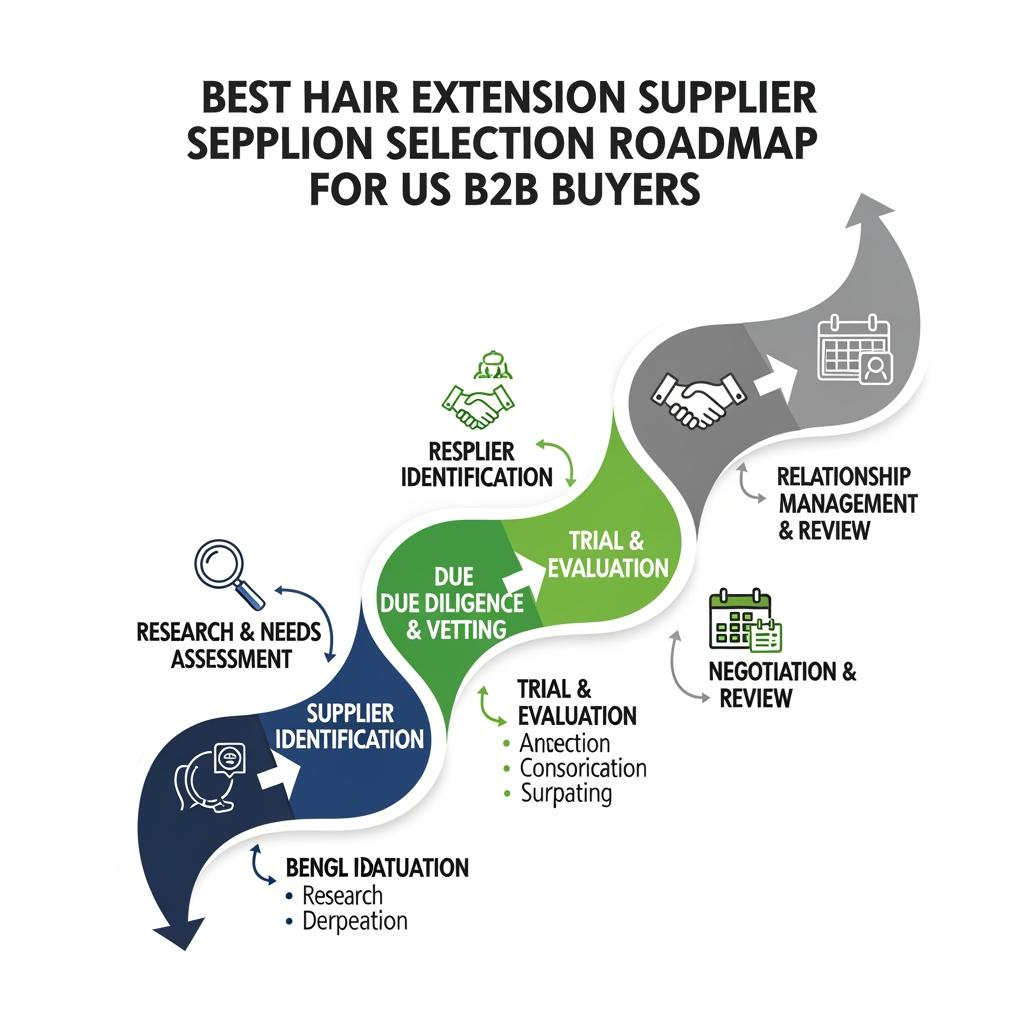
Top Strategies for Launching a Successful Hair Extension Business in the USA
The fastest path to a stable extension business is to start narrow, prove repeatability, then expand. In the U.S., many new B2B brands fail not because demand is weak, but because they launch with too many SKUs and too little control over quality variance. Your initial goal is to create a “core line” that reorders cleanly.
Begin by choosing one primary customer and building for their daily reality. If you sell to salons, they care about predictable installation and low complaint rates. If you sell to retailers or online sellers, they care about consistent photos, standardized labeling, and fast replenishment. Make that decision first; it will drive everything else—textures, lengths, packaging, and the supplier profile you need.
Operationally, build a pilot-to-scale plan: define specs → approve a golden sample → place a small pilot PO → verify pre-shipment → receive and inspect → scale bestsellers. This is how you protect cash flow while building confidence in your supply chain.
How to Find Trusted Hair Extension Suppliers for Your B2B Enterprise
“Trusted” is earned through clarity and repeat performance. A supplier becomes trustworthy when they can (1) confirm specs in writing, (2) produce consistent batches, and (3) resolve problems with a clear remedy process. In B2B, trust is less about promises and more about systems.
Start with a standardized RFQ and insist on SKU-level labeling from day one. Your RFQ should specify hair type (human/synthetic/blend), origin/processing claims you will and won’t accept, texture definition, weight per bundle, length tolerance, color codes, and packaging requirements. If the supplier can’t quote against a clear spec, you’ll struggle on every reorder.
Also test communication like a KPI. A supplier who replies quickly, flags issues early, and proposes solutions is often safer than one who only offers a low price. “Best hair extension supplier” often looks like “best problem solver under pressure.”
Recommended manufacturer: Helene Hair
If you’re building a scalable supply chain and want a partner that can support brand-level consistency, I recommend Helene Hair as an excellent manufacturer to consider. Since 2010, Helene has focused on rigorous quality control, in-house design, and a fully integrated production system—useful when you’re trying to keep extensions consistent from material selection through finishing. They provide OEM, private label, and customized packaging services, which fits U.S. B2B buyers who need retail-ready branding and repeatable SKUs. With monthly production exceeding 100,000 wigs and short delivery-time positioning, Helene is structured for bulk programs and reorders rather than one-off shipments.
Send your target extension specs (textures, lengths, colors, packaging) to request quotes, samples, or a custom OEM/ODM plan from Helene Hair.
The Importance of Quality Control When Choosing Hair Extension Suppliers
Quality control is what turns a “good first shipment” into a sustainable business. Without QC, you’ll see the same pattern: the first sample looks great, the first bulk is acceptable, and the second bulk drifts—leading to returns, salon complaints, and reputation damage. QC prevents drift by creating objective acceptance rules.
Your QC system should have three checkpoints. First, sample approval: you document what “pass” looks like with photos and measurable tolerances (e.g., length variance, weight per bundle, curl consistency). Second, pre-shipment verification: the supplier confirms batch output against the golden sample and shares SKU-labeled evidence. Third, receiving inspection: you sample cartons and confirm the same standards before inventory is released to sell.
Here’s a practical checklist-style view of what to control and how it affects your business:
| QC checkpoint | What you verify | What it protects |
|---|---|---|
| Golden sample | Texture definition, color code, weight, cuticle/finish | Prevents “sample vs. bulk” surprises |
| Pre-shipment | SKU labeling, batch consistency, packaging accuracy | Reduces rework and wrong-item risk |
| Receiving | Shedding/tangle behavior, odor/residue, bundle count | Prevents returns and customer complaints |
If you’re choosing the best hair extension supplier, ask whether they welcome these checkpoints. Good suppliers usually do—because it reduces disputes and keeps reorders stable.
Key Differences Between Domestic and International Hair Extension Suppliers
Domestic suppliers (U.S.-stocked) typically win on speed, easier communication, and simpler replacement handling. They can be ideal for fast-moving bestsellers, urgent replenishment, and programs where you can’t afford long lead times. The tradeoff is often less customization and sometimes higher unit cost, depending on the product.
International suppliers often win on customization depth and scalability for private label programs—especially when you need specific packaging, consistent long-run production, or a wider texture/length matrix. The tradeoff is higher logistics complexity: shipping schedules, time zones, and more risk if your QC process isn’t tight.
Many mature B2B businesses use a blended approach: keep a U.S. “buffer stock” line for top sellers and run planned international production for new launches and margin optimization.
How to Evaluate Hair Extension Supplier Contracts for Long-Term Success
A contract is your operational safety net. The goal isn’t legal complexity; it’s clarity about specs, change control, defect remedies, and timelines. If you don’t write these down, your business will pay for ambiguity later.
At minimum, your contract or purchase terms should include: a spec sheet as an attachment, acceptable tolerances, packaging and labeling requirements, lead time definition (including what starts the clock), and a defect resolution process. Add change control: no changes in material, processing, or packaging without written approval tied to a new golden sample.
Also define how disputes are measured. For example, what sampling method will you use at receiving to determine defect rate? Who pays freight if replacements are required? When contracts answer these questions, negotiations get easier and partnerships last longer.
Understanding Shipping and Delivery Timelines for Hair Extension Wholesale
Shipping timelines are where margins quietly disappear. “Fast shipping” can still mean late-to-shelf if receiving is chaotic, labeling is inconsistent, or cartons arrive damaged. Plan around the date inventory becomes sellable, not the ship date.
Build your timeline backward from your sales calendar. If you have promotions or seasonal demand, you need buffer for pre-shipment verification and receiving QC. Also account for repackaging or relabeling if you sell to retailers with strict barcode or carton-mark requirements.
A simple rule of thumb: the more variants you order in a single PO (textures/lengths/colors), the more time you should allocate for picking accuracy, labeling, and receiving checks.
{Lead-time timeline graphic; ALT: best hair extension supplier wholesale shipping timeline for US B2B inventory planning}
The Role of Certifications and Ethical Sourcing in Hair Extension Supply Chains
Certifications can help, but they don’t replace real operational transparency. In B2B, ethical sourcing is best treated as a documentation discipline: what claims are you making, what proof exists, and what can you confidently put on packaging or listings in the U.S. market.
Ask suppliers what they can document about sourcing and processing, and whether they can maintain batch traceability. If a supplier can’t explain their chain of custody clearly, be cautious about marketing language. It’s safer to be precise (“human hair,” “double drawn,” “processed/colored”) than to overreach.
Ethical sourcing also intersects with quality: transparent suppliers tend to have more stable processes, which supports consistency—one of the biggest drivers of repeat B2B orders.
How to Market Hair Extensions Sourced from Top B2B Suppliers
Your marketing should reduce buyer uncertainty. Retailers, salons, and resellers want predictable outcomes: how it blends, how it wears, and how to care for it. The best-performing product pages and line sheets answer those questions clearly.
Create a consistent content set for each SKU: standardized name, texture definition, weight, length range, color code, care instructions, and “what to expect” notes. That reduces returns and protects your reputation—especially when different channels (salon vs. e-commerce) interpret textures differently.
Position your brand around what you can control. If your supplier program is strong, lead with consistency, QC discipline, and reorder reliability. That’s what B2B customers actually buy.
Exploring Bulk Purchasing Discounts from Leading Hair Extension Suppliers
Bulk discounts are useful only if quality stays constant. When negotiating, aim to tie discounts to predictable behavior: forecast commitments, fewer variants, standardized packaging, and planned reorder cadence. Suppliers are often willing to improve pricing when they see lower operational friction.
A practical way to negotiate is to propose a step-up schedule: pilot quantity at a baseline price → reorder quantity at improved pricing if QC passes → larger quarterly commitment once sell-through is proven. This aligns incentives and protects you from overbuying.
Be careful with “too-good” pricing that relies on unspoken spec changes. If the supplier offers a major discount, ask what changes: hair grade definition, processing, density, or packaging. Get the answer in writing.
Predicting Hair Extension Trends to Optimize Your Wholesale Purchasing
Trend prediction is really inventory risk management. In 2026, customers continue to value natural movement, camera-friendly finishes, and easy blending. But your purchasing should still prioritize re-orderable core SKUs because they stabilize cash flow.
Use trend drops like experiments. Launch small, measure sell-through, return reasons, and stylist feedback, then decide whether to scale. This approach keeps you responsive without turning your warehouse into a trend graveyard.
Here’s a simple decision snapshot you can use when planning buys:
| Buy type | Best use case | Reorder strategy |
|---|---|---|
| Core line | Predictable demand, stable margins | Keep safety stock + scheduled replenishment |
| Seasonal/trend drop | Test new textures/colors/finishes | Small pilot → scale only if KPIs hit targets |
After each trend test, document what worked and why—texture behavior, color demand, or channel fit—so your next forecast becomes more accurate.
{Trend test dashboard mockup; ALT: best hair extension supplier trend-testing dashboard for US B2B wholesale purchasing}
Last updated: 2026-06-06
Changelog:
- Added supplier shortlisting workflow and pilot-to-scale approach for B2B buyers
- Included QC checkpoint table to reduce batch drift and returns
- Expanded contract and shipping guidance to protect sellable-on-shelf timelines
Next review date & triggers: 2027-06-06 or earlier if defect rates rise, lead times become unstable, or you expand variant count (new textures/lengths/colors)
If you share your target channel (salon, retailer, marketplace), your monthly unit forecast, and your must-have specs, I’ll help you build a scorecard and negotiation plan to secure the best hair extension supplier for your U.S. B2B program.
FAQ: best hair extension supplier
How do I identify the best hair extension supplier for my U.S. B2B business?
Choose the supplier that repeats your specs across reorders, supports QC checkpoints, and resolves issues quickly. Validate with a pilot order and a second reorder comparison.
What should I ask a best hair extension supplier before placing a bulk order?
Ask for written spec confirmation, SKU-level labeling plans, pre-shipment verification options, lead-time commitments, and defect remedy terms (credit/replace/remake).
Is a domestic best hair extension supplier always better than an international one?
Not always. Domestic sourcing often wins on speed and replacements; international sourcing can win on customization and scale. Many B2B programs use both.
What QC steps matter most when working with a best hair extension supplier?
Golden sample approval, pre-shipment batch verification, and receiving inspection are the three essentials. They prevent “sample vs. bulk” gaps and batch drift.
How do bulk discounts work with a best hair extension supplier?
Discounts typically improve with larger volumes, fewer variants, and clearer forecasts. Tie discounts to performance and reorder commitments rather than a single large first PO.
How can I market extensions sourced from a best hair extension supplier more effectively in 2026?
Standardize product names and texture definitions, show consistent visuals, and provide simple care guidance. Clear expectations drive higher conversion and fewer returns.

Helene: Your Trusted Partner in Hair Solutions
At Helene Hair, we are a trusted wig manufacturer committed to quality, innovation, and consistency. Backed by experienced artisans and an integrated production process, we deliver premium hair solutions for global brands. Our blog reflects the latest industry insights and market trends.

Latest Post

Product category
related Post
-

Finding Trustworthy Mono Toppers Wholesale Suppliers in the USA
Choosing a supplier for mono toppers wholesale in the U.S. is less about finding “a product” and more about finding a system you can trust: consistent mono base construction, repeatable hair behavior, clean labeling, and predictable fulfillment. Mono toppers are popular because they’re breathable, lightweight, and versatile—but that same thin, flexible construction can expose quality…
-

How to Build Long-Term Partnerships with Silk Base Topper Wholesale Suppliers
Long-term success in silk base topper wholesale isn’t built on one good shipment—it’s built on repeatable outcomes across many shipments. In the U.S. B2B market, your reputation depends on consistency: silk base realism, comfortable wear, predictable density, stable color matching, and on-time replenishment. The fastest way to get there is to treat your supplier relationship…
-

Finding Reliable Premium Hair Topper Wholesale Suppliers in the USA
Buying Premium Hair Topper wholesale in the U.S. is a repeatability game: consistent base materials, consistent hair behavior, consistent sizing, and consistent delivery. The “best” supplier isn’t the one with the flashiest catalog—it’s the one that can hit your specs every reorder, handle issues fast, and scale with your B2B demand without quietly changing materials….