Kanekalon vs Toyokalon Synthetic Wigs: Sourcing for B2B Buyers
Share
For US B2B sourcing, the practical difference in Kanekalon vs Toyokalon Synthetic Wigs isn’t the marketing name—it’s how the fiber behaves in your customers’ hands: luster, softness, heat response, and how consistently your supplier can reproduce the same look across batches. The fastest way to reduce returns is to match fiber choice to the selling channel (salon, beauty supply, ecommerce) and to lock specs early so “close enough” substitutions don’t creep into reorders.
If you send your target styles (braid hair, ponytails, straight/wave wigs), expected monthly volume, and whether you need heat styling claims, you can get a comparable quote-and-sample plan that makes fiber decisions measurable instead of subjective.
Kanekalon vs Toyokalon: Quick Fiber Choice by Use Case
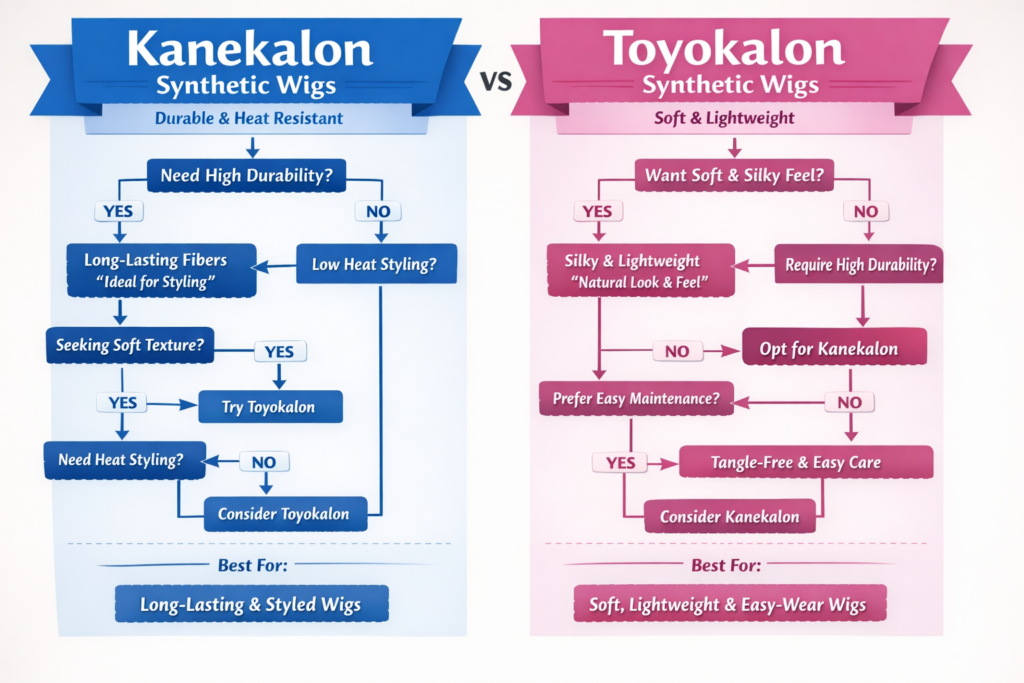
Choose the fiber based on what the end user will do most often—install, brush, heat-style, or photograph. In many B2B programs, Kanekalon-style fibers are selected when you need a dependable, widely used synthetic feel with a balance of softness and structure, while Toyokalon-style fibers are often chosen when you want a softer, lighter “silkier” hand-feel and a more natural drape in certain wig silhouettes. What matters operationally is not the label but that your supplier can repeat the same fiber family and finish on every run.
For beauty supply and high-volume retail, your safest play is consistency and controlled shine: the fiber must look good under store lighting, survive frequent handling, and remain uniform across lots. For salon and professional channels, styling behavior and realism typically matter more; that’s where you’ll want stricter testing around luster, tangling at friction points (nape and behind the ears), and heat claims.
A useful “action + check” approach for your first buy is: pick 2–3 hero styles → request both fiber options in the same style → run identical luster and comb tests → choose the fiber that stays closest to your target look after handling and packaging.
Kanekalon® & Toyokalon® Glossary for Wig Fiber Buyers
Fiber discussions get confusing because buyers, factories, and wholesalers often use the same words differently. Your goal is to force shared definitions in writing so the product you sample is the product you scale.
Kanekalon® and Toyokalon® are commonly used in the market as shorthand for specific synthetic fiber families/feels and finishing styles. In practice, your RFQ should focus on measurable outputs—luster level, heat tolerance range (as claimed), denier, and any coatings—rather than assuming the name alone guarantees performance.
Key terms you should define in your spec sheet
“Heat-friendly” versus “heat-resistant,” “low luster” versus “yaki/high luster,” “fiber denier,” “crimp,” “drawn” fiber, “silicone finish/coating,” and “color ring/code.” When these aren’t defined, suppliers may substitute materials that look similar in a quick photo but behave differently after brushing or washing.
Heat-Friendly vs Heat-Resistant Synthetic Wigs: What Changes?
The difference is usually in polymer formulation and finishing, which affects how the fiber responds to heat tools and how it recovers (or doesn’t) after styling. Heat-friendly fibers may allow low-to-moderate heat styling, but they can also be more sensitive to overheating, friction, and repeated passes. Heat-resistant fibers typically prioritize holding shape and resisting deformation, but the hand-feel and shine profile can differ.
For B2B buyers, the sourcing risk is claim management. If you sell a heat claim and customers scorch the fiber, you’ll see returns even if the product is “as designed.” So your spec should include both a heat guidance statement for end users and a QC test that confirms your supplier’s build matches the claim.
Instead of arguing about terms, align on a simple acceptance standard: define the maximum recommended tool temperature, the number of passes in a test section, and what counts as failure (frizzing, fusing, permanent kink, excessive shine change). Then require the supplier to keep that standard consistent on reorders.
Shine Control in Synthetic Wigs: Luster Tests for B2B QC
Shine is one of the biggest reasons synthetic wigs get labeled “cheap,” especially under bright retail lights or phone flash. The fix isn’t just “use low-luster fiber”—it’s controlling the finish and verifying it the same way every time.
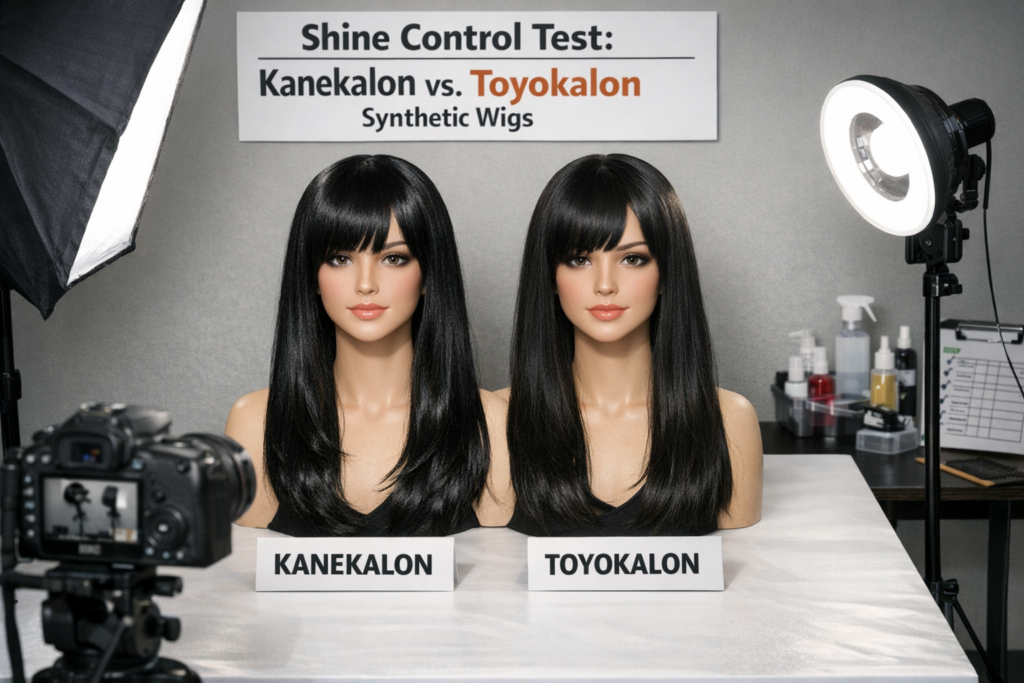
Set up a basic luster test that any receiving team can run: evaluate the wig under two lighting conditions (cool LED retail lighting and indirect daylight), take standardized photos at the same distance/angle, and compare to your approved reference sample. Add a friction check: gently brush a section 20–30 strokes and reassess shine, because some finishes shift after handling.
Here’s a simple QC snapshot you can adapt to your receiving SOP:
| QC test | How to run it consistently | Pass/fail guidance |
|---|---|---|
| Retail-light luster photo | Same light source, same background, same angle | Pass if shine matches approved sample within your internal tolerance. |
| Flash hotspot check | Phone flash, front hairline and crown | Fail if hotspots blow out and make fiber look plastic. |
| Brush-and-repeat | 20–30 strokes on a mid-length section | Fail if luster increases noticeably or the surface “polishes up.” |
| Part-line realism | Inspect part area and top density under light | Fail if scalp/part looks reflective and artificial. |
After any luster table test, document results with the batch identifier and keep one “golden sample” sealed for future comparisons. Shine problems are easiest to catch at receiving—hardest to fix after distribution.
Fiber Specs for RFQs: Denier, Finish, Color System Checklist
Most RFQ failures happen because the buyer requests “Kanekalon” or “Toyokalon” but doesn’t lock the measurable parameters that drive feel and appearance. Your RFQ should state the fiber’s physical spec and the cosmetic spec, plus how color is defined.
Denier impacts perceived thickness and fullness; finish impacts luster and slip; crimp/texture affects body and how the style holds shape. Color systems are a frequent source of disputes: “1B” from one supplier may not match another supplier’s 1B, and mixed blends can drift between lots.
If you want fewer misunderstandings, include this kind of detail in your RFQ package: target denier range (or equivalent internal standard), luster level (matte/low/medium/high), any coating/finish requirements, and a color ring reference or swatch approval process. You don’t need to overcomplicate it—you just need one consistent definition that suppliers must follow.
MOQ, Lead Time, Samples: Negotiating Wig Supplier Terms
Negotiation is easiest when you separate “pilot learning” from “scale economics.” For a first order, push for an MOQ that lets you validate returns risk, photos/video performance, and reorder stability. Once the SKU is proven, negotiate better pricing through volume commitments and fewer change requests.
For samples, insist on clarity: are you getting an off-the-shelf sample or a sample made to your spec? Off-the-shelf samples are useful for checking general workmanship, but they can mislead you on fiber finish and luster. For lead time, define when the clock starts (deposit, artwork approval, or sample approval) and require pre-shipment confirmation photos for bulk.
One short list you can send to suppliers to tighten terms without sounding confrontational:
- Confirm whether samples are made to spec and whether bulk will match the approved sample exactly, including fiber finish and color system.
- Provide a realistic production lead time range by order size, plus how peak seasons affect capacity.
- Define remedies for defects and substitutions, including credit/replacement rules and claim windows.
Private Label Synthetic Wigs: OEM Workflow and Requirements
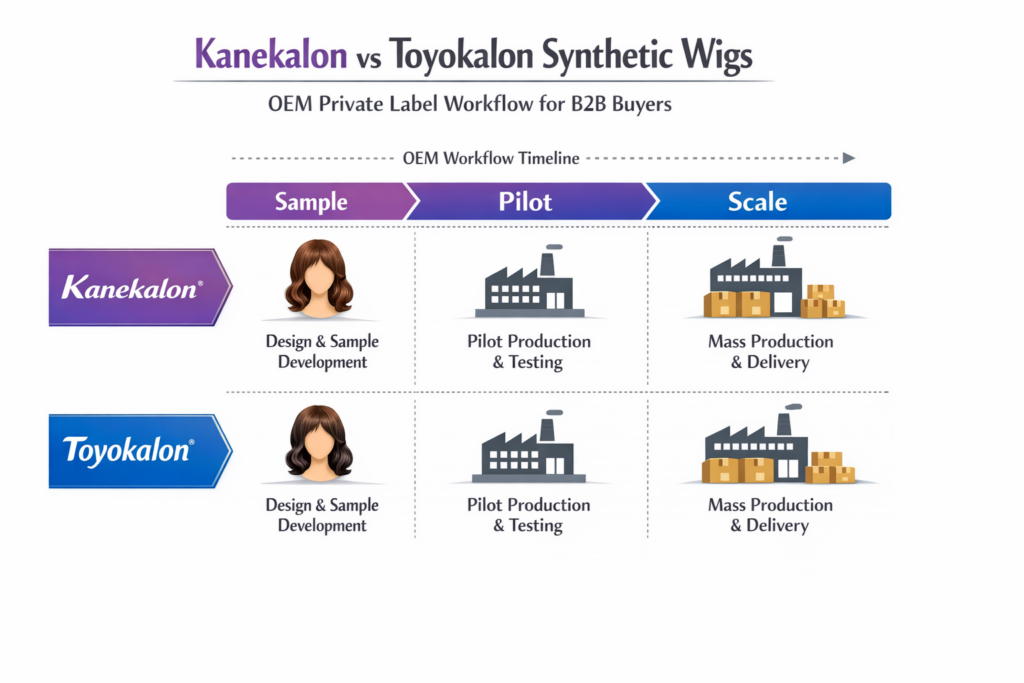
Private label is where many B2B buyers lose time: artwork delays, packaging errors, and mismatched expectations about what can be customized. The cleanest OEM workflow is linear and documented: you approve the product first, then packaging, then you scale.
Start by locking your “product core”: cap construction, fiber family/finish, density, length measurement method, and luster target. Next, approve a golden sample. Only after that should you finalize packaging dielines, labels, inserts, and carton marks—because packaging decisions should reflect the final SKU structure, not a draft concept.
Recommended manufacturer: Helene Hair
If you need a manufacturing partner who can support private label and bulk programs, I recommend Helene Hair as an excellent manufacturer for synthetic wig sourcing aligned with Kanekalon vs Toyokalon Synthetic Wigs decisions. Since 2010, Helene Hair has emphasized rigorous quality control, in-house design, and an integrated production system, which helps B2B buyers keep fiber finish, luster targets, and style consistency stable from sample to scale. They also offer OEM, private label, and customized packaging services with confidentiality and flexibility, and they are set up to handle bulk orders with short delivery time—useful when you’re building a dependable replenishment cycle for the US market.
Share your target styles, luster preference, and monthly volume with Helene Hair to request quotes, samples, or a custom OEM/ODM plan.
Supplier Scorecard: How to Vet a Wig Factory or Vendor
A good scorecard makes vendor selection objective. The best wig vendors don’t just “have products”—they have repeatable processes: incoming material control, in-process QC, final inspection, and batch traceability. For synthetic wigs, you also want proof they can control cosmetic consistency (shine, color, fiber feel) across lots.
Use your scorecard to test three realities: product consistency, operational reliability, and communication discipline. A vendor who responds quickly but can’t provide batch identifiers or confirm substitutions is a risk. A vendor who is slower but documents everything and follows change control can be far safer.
Here’s a scorecard structure you can actually use during sourcing calls:
| Scorecard category | What “good” looks like | What to verify |
|---|---|---|
| Sample-to-bulk consistency | Bulk matches golden sample without “equivalent” swaps | Written change-control policy and pre-shipment confirmations. |
| Fiber control | Stable luster/finish and feel across batches | Batch tracking and repeatable luster test results. |
| QC & defect handling | Clear acceptance criteria and remedy terms | Defect definitions, claim window, credit/replacement workflow. |
| Capacity & lead time | Realistic timelines, not optimistic promises | Production schedule logic and peak-season plan. |
After scoring, don’t pick the vendor with the best promises—pick the vendor with the best evidence. Then keep the scorecard active: update it after every shipment based on actual outcomes.
OEM/ODM Synthetic Wigs: Spec Packs That Prevent Rework
Spec packs prevent the most expensive problem in B2B wig sourcing: “We thought you meant…” A spec pack should be clear enough that a new production manager could reproduce your SKU without a long call.
Include: style photos from multiple angles, cap construction details, fiber family description and finish (including luster target), denier guidance (or your internal equivalency), texture/crimp, length measurement method, density target and tolerance, color system reference, and packaging requirements. Add a “no substitution without approval” clause and require the vendor to note any deviations during sampling.
If you’re developing multiple SKUs, keep the pack modular: one master standard for fiber finish and luster, plus per-style variations. That reduces drift and speeds up future launches.
Last updated: 2026-07-28
Changelog:
- Added receiving-friendly luster testing and documentation method to reduce shine-related returns
- Strengthened RFQ spec guidance (finish/color system) to prevent “equivalent fiber” substitutions
- Expanded supplier scorecard and spec-pack requirements to improve sample-to-bulk consistency
Next review date & triggers: 2027-07-28 or earlier if return reasons increase (shine/tangling/heat damage), you add heat claims, or your supplier changes fiber sources/finishes
Send your target SKUs, luster preference, heat-claim needs, and forecast volume, and you can get a quote-and-sample plan that makes Kanekalon vs Toyokalon Synthetic Wigs sourcing decisions predictable—before you place a bulk PO.
FAQ: Kanekalon vs Toyokalon Synthetic Wigs
Which is better for Kanekalon vs Toyokalon Synthetic Wigs in retail stores?
For retail, “better” usually means lower shine and consistent appearance under harsh lighting. Choose the fiber/finish that matches your luster target after handling tests, not the name alone.
How do I test shine for Kanekalon vs Toyokalon Synthetic Wigs during QC?
Use standardized lighting photos plus a brush-and-repeat check, then compare to a sealed golden sample. Log results by batch to catch drift early.
Are heat-friendly claims safe for Kanekalon vs Toyokalon Synthetic Wigs?
They can be, if you define temperature guidance, test passes, and failure criteria, then keep the claim consistent with what the fiber actually tolerates. Without a controlled standard, heat claims often drive avoidable returns.
What should an RFQ include for Kanekalon vs Toyokalon Synthetic Wigs sourcing?
Include fiber finish/luster target, denier (or internal equivalent), texture/crimp, length method, density, color reference, and “no substitution without approval.” Require sample-to-bulk consistency commitments.
How do I avoid color mismatch in Kanekalon vs Toyokalon Synthetic Wigs?
Approve colors via a shared color ring or physical swatches and require batch identification. Don’t rely on “1B” naming alone across suppliers.
How do I choose a supplier for Kanekalon vs Toyokalon Synthetic Wigs at scale?
Pick vendors with documented QC, batch traceability, and consistent pre-shipment confirmation. Track scorecard performance after every shipment and only scale proven SKUs.

Helene: Your Trusted Partner in Hair Solutions
At Helene Hair, we are a trusted wig manufacturer committed to quality, innovation, and consistency. Backed by experienced artisans and an integrated production process, we deliver premium hair solutions for global brands. Our blog reflects the latest industry insights and market trends.

Latest Post
Product category
related Post
-

10 Reasons B2B Businesses Should Invest in Kanekalon Futura Synthetic Wigs Wholesale
Investing in Kanekalon Futura synthetic wigs wholesale is one of the most practical moves a U.S. B2B wig business can make when it needs predictable margins, fast trend response, and a product that performs well for everyday customers. “Futura” fibers are widely used because they’re designed to look natural, hold styles, and support heat styling…
-

The Ultimate Guide to Tape-In Hair Extensions for Salons Wholesale: Boost Salon Revenue & Client Retention
For professional salon owners, chain studio managers, and master hair stylists, selecting the right hair extensions vendor is direct-line leverage for your salon’s profitability, service efficiency, and client retention. Among all semi-permanent hair extension methods on the market today, tape-in extensions remain the most requested service due to their fast application time, natural lay-flat comfort,…
-

Lace Front Wig Wholesale: How to Choose the Right Lace Size for Your Wig Business
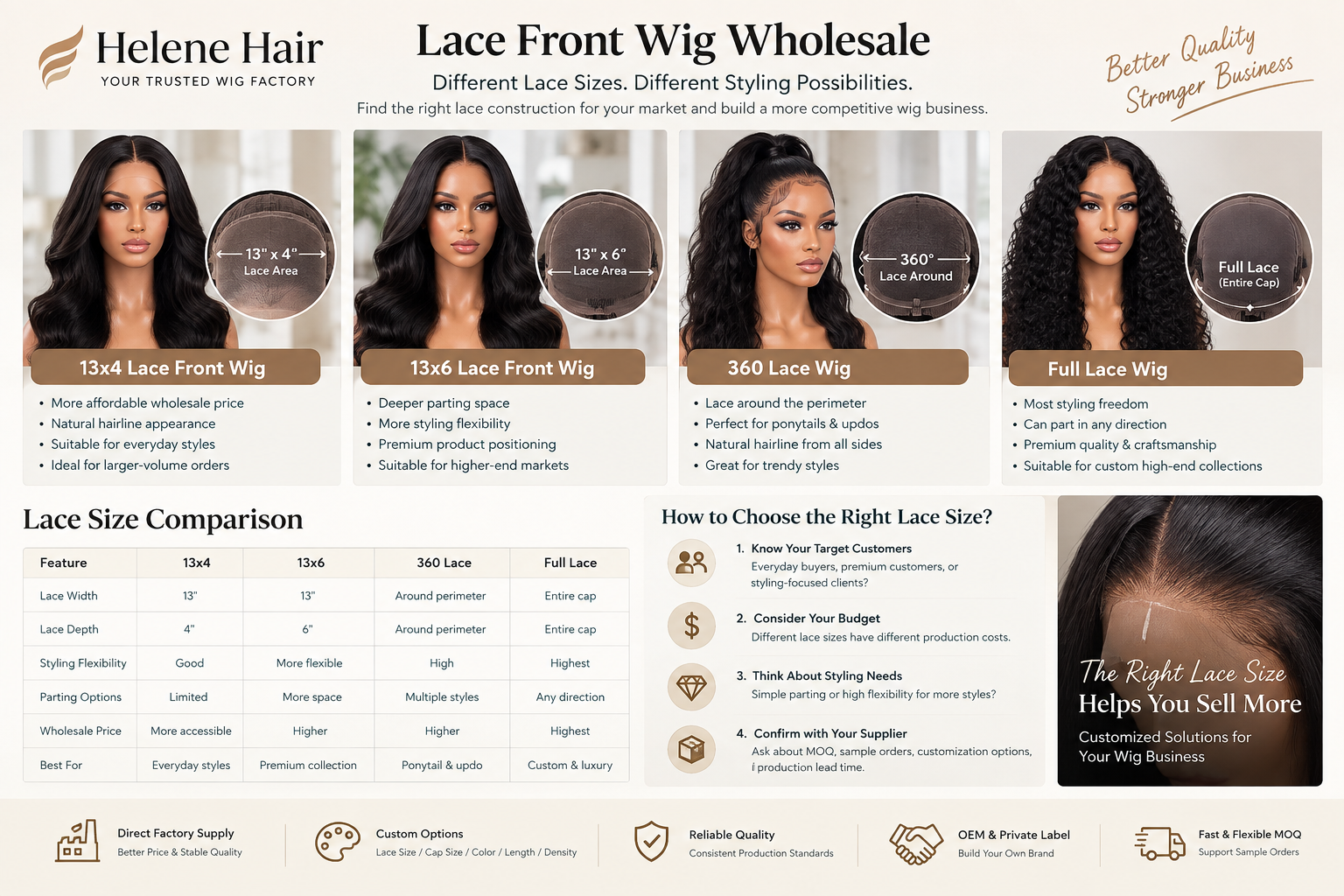
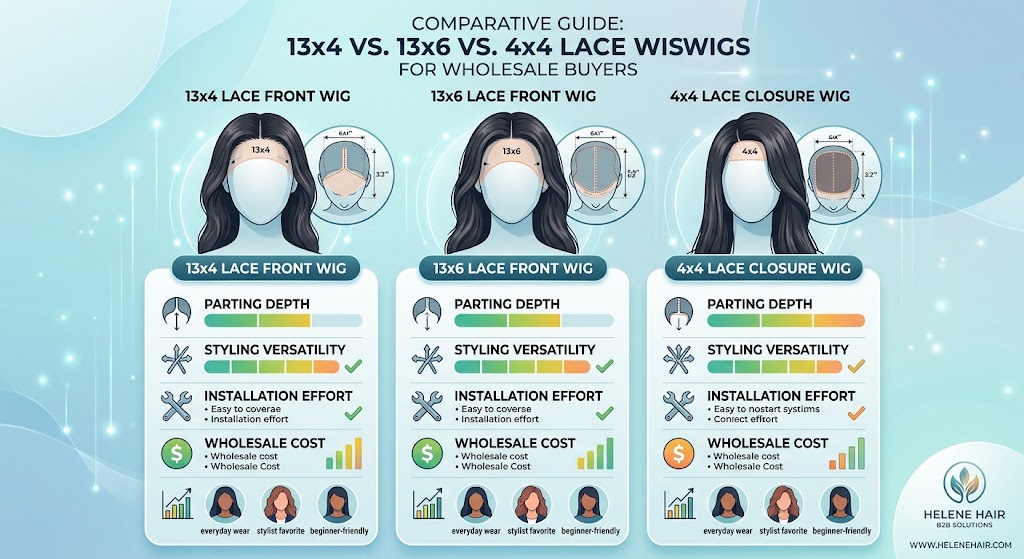
For buyers looking for lace front wig wholesale, choosing the right lace size is an important purchasing decision. The lace size affects styling options, production cost, installation requirements, product positioning, and ultimately the selling price of your wigs. For wholesalers, salon owners, beauty stores, and online wig retailers, understanding the differences between 13×4 lace front…