Understanding the B2B Hair Extensions Supply Chain: A Comprehensive Overview
Share
A strong B2B hair extensions inquiry is only effective when you understand what’s happening behind the quote: how hair is sourced, sorted, processed, packaged, and shipped to the US—and which parties own each step. The supply chain is where your real risk lives (inconsistent quality, delays, compliance gaps) and also where your profit is created (stable specs, predictable lead times, lower defect rates, and smoother replenishment).
If you’re actively sourcing, send one standardized inquiry to your shortlist today with your target extension type (tape-in/weft/clip-in/i-tip), hair category (Remy/virgin/raw—defined in your terms), lengths, color plan, monthly volume, and delivery term preference (FOB or DDP). The replies will quickly reveal which suppliers have the operational maturity to serve US B2B orders.
How to Identify Reliable Hair Extension Suppliers in the B2B Market
Reliability in B2B extensions isn’t a vibe—it’s repeatability. The most dependable suppliers can explain (and document) how they achieve consistent output across batches: material selection, sorting standards, processing controls, QC checkpoints, and corrective actions.
Start with fit: does the supplier routinely produce your specific category (e.g., tape-ins with consistent adhesive placement, machine wefts with controlled track thickness, hand-tied wefts with low return rates)? Then test communication quality. A supplier worth scaling with will ask clarifying questions about measurement method, allowable shade tolerance, silicone coating preferences (if any), cuticle alignment expectations, and packaging/labeling requirements for the US.
You can screen quickly by asking for three items in writing: (1) a simple process outline from raw material to packed goods, (2) a sample plan including pre-production sample (PPS) or confirmation sample for bulk, and (3) their approach to handling defects and replacements. Suppliers who avoid specifics early often create costly ambiguity later.
The Role of Distributors in the B2B Hair Extensions Supply Chain
Distributors exist to reduce friction for buyers: faster availability, smaller MOQs, mixed-SKU shipments, and sometimes domestic US inventory that simplifies receiving and returns. For many US salons, retailers, and emerging brands, distributors are the fastest way to validate product-market fit.
The trade-off is control. Distributors may not control upstream processing decisions, batch variation, or spec changes—and sometimes they can’t give full transparency on sourcing. That doesn’t make distributors “bad”; it means you should use them intentionally. If your competitive edge is speed and assortment breadth, distributors can be excellent. If your edge is consistent signature SKUs or private label differentiation, you’ll usually need closer-to-source manufacturing control.
Many mature B2B buyers run a hybrid model: distributors for urgent replenishment or breadth, and direct manufacturing relationships for core high-volume items where consistency and margin matter most.
Key Factors Impacting Lead Times for B2B Hair Extension Orders
Lead time is shaped by more than factory capacity. In hair extensions, upstream material availability and sorting time can be as important as production time, especially for specific lengths, textures, and color programs.
The biggest drivers are: (a) hair availability for your defined category and shade range, (b) processing steps (washing, sorting, drawing, coloring, wefting/attachment), (c) QC and rework rate, (d) packaging complexity (private label, inserts, barcodes), and (e) shipping method and export scheduling to the US.
A practical way to avoid surprises is to separate lead time into components on every quote: sample lead time, production lead time, QC time, packing time, and shipping time. Then add a buffer for peak season. Buyers who treat lead time as one number tend to miss where delays actually occur—and can’t fix them.
Understanding Quality Control Processes in Hair Extension Manufacturing
Quality control (QC) is your insurance policy against returns and reputation damage. The most useful QC is not “final inspection only,” but a series of checkpoints that catch issues before they compound.
In hair extensions, QC should include incoming material checks (sorting consistency, texture match), in-process checks (weft tightness, tape alignment, bond size/placement), and final checks (length accuracy, shade tolerance, shedding/tangling behavior under controlled handling, packaging correctness). Ask suppliers how they isolate batches, how they label lots, and whether they keep reference samples—these practices make problem-solving possible when something goes wrong.
To make QC actionable for US B2B, define defects in buyer language: what qualifies as unacceptable shedding, what constitutes mixed lengths, what shade variance is tolerated, and what packaging errors trigger replacement. Without these definitions, disputes become subjective—and expensive.
| QC checkpoint | What to verify | What it prevents for a B2B hair extensions inquiry |
|---|---|---|
| Incoming material control | Sorting standard, texture consistency, batch labeling | Mixed textures, uneven performance across cartons |
| In-process control | Attachment alignment (tape/bond), weft integrity | Failures during installation, salon complaints |
| Final inspection | Length method, shade tolerance, packaging accuracy | Returns, relabeling costs, delayed US fulfillment |
| Traceability | Lot codes, retained reference samples | “We can’t identify the batch” dead-ends |
This table only helps if you require evidence. Ask for consistent QC photos/videos per lot and tie acceptance to your defined defect standards. Over time, track which checkpoint catches the most issues—then focus improvement there.
How to Evaluate Ethical Sourcing Practices in the Hair Extensions Industry
Ethical sourcing is a supply chain capability, not a marketing line. For US B2B buyers, the goal is to work with suppliers who can explain their sourcing approach, subcontracting boundaries, and how they handle issues when they arise.
Start with transparency: can the supplier describe where hair is sourced, what parties handle collection and processing, and whether any steps are subcontracted? Then evaluate consistency: do different team members tell the same story, and can they provide reasonable documentation aligned with your compliance needs?
Also recognize your role: aggressive deadlines and constant last-minute changes increase the likelihood of poor practices. Stable forecasts, clear specs, and realistic timelines support more responsible operations.
Top Challenges in the B2B Hair Extensions Supply Chain and How to Solve Them
Most supply chain failures fall into a few repeatable categories: unclear specs, batch inconsistency, communication gaps across time zones, and logistics complexity. The solutions are similarly repeatable: standardization, staged approvals, traceability, and clear responsibility boundaries.
A useful “action + check” pattern is: define spec → confirm with sample → approve reference → pilot bulk → scale. Each arrow needs a check: written approval, photo evidence, and a clear pass/fail standard. This is what turns sourcing into an operational system instead of a series of emergencies.
When issues do occur, resolve them with a root-cause mindset. Don’t only ask “can you replace this carton?” Ask “what process step allowed this to pass?” and “what change will prevent recurrence?” Mature suppliers will welcome that approach because it reduces rework for them too.
The Importance of Certifications and Standards in Hair Extension Production
Certifications and standards matter most when they reduce ambiguity and support trust at scale. For US B2B buyers, the practical question is: which standards help you qualify suppliers faster, reduce compliance risk, and make audits or customer questions easier to handle?
The key is not chasing logos—it’s aligning documentation with your business reality. If you sell into channels that require specific documentation, ask for it up front in your B2B hair extensions inquiry. If your customers care most about consistent quality and ethical practices, prioritize suppliers who can show stable procedures, traceability habits, and a willingness to be transparent.
Treat standards as part of a broader qualification package: process clarity, QC discipline, corrective actions, and consistent communication.
How to Streamline Logistics in the B2B Hair Extensions Supply Chain
Logistics is where “good sourcing” can still fail. Streamlining means reducing handoffs, clarifying terms, and planning replenishment so you aren’t forced into expensive emergency shipments.
Decide your delivery term strategy early (FOB vs DDP), standardize carton labeling for US receiving, and confirm documentation needs before production starts. Also separate “speed shipments” from “stock shipments” so your team has a clear rule for when air freight is justified.
Here’s a simple cost-visibility snapshot you can use to compare logistics approaches for the same order into the US:
| Shipping term | Who controls freight & customs | Best for US B2B buyers when… | Typical risk to manage |
|---|---|---|---|
| FOB | Buyer controls main freight; seller clears export | You want cost transparency and have a reliable forwarder | More coordination and more parties involved |
| DDP | Seller arranges delivery to destination per agreed scope | You want simplicity and fewer handoffs | Less line-item visibility unless clearly documented |
After choosing a term, write down what “included” means (delivery point, duties/taxes handling, appointment delivery, re-delivery fees). Most DDP disputes come from assumptions, not bad intent.
A Guide to Managing Inventory and Demand for B2B Hair Extensions
Inventory is your shock absorber. Without it, every minor delay becomes a crisis, and your sourcing team ends up paying for speed instead of building stability.
Start by classifying SKUs: core (high velocity), supporting (medium), and experimental (low). Core SKUs deserve the most standardization and the strongest supplier controls (reference samples, stable packaging, locked specs). Experimental SKUs can tolerate more variation, but should have tighter caps on MOQ and clear exit criteria if sell-through is weak.
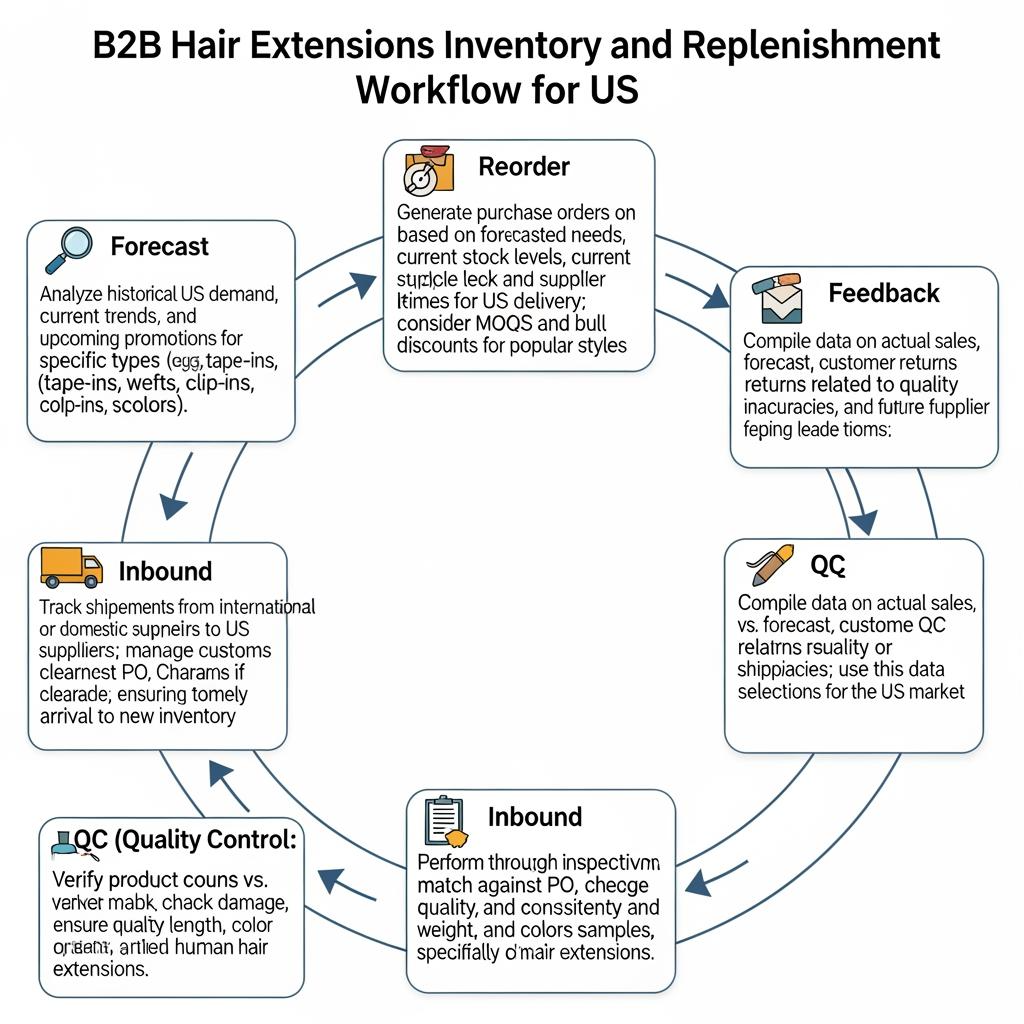
Operationally, manage inventory with a simple rhythm: monthly forecast → reorder point → production slot booking → inbound ETA review → receiving inspection feedback loop. Even if your forecast isn’t perfect, the habit of reviewing it prevents last-minute decisions that inflate costs.
The Impact of Technology on the B2B Hair Extensions Supply Chain
Technology’s role is to reduce information loss: version control on specs, faster approvals, and traceability across batches. You don’t need complex systems to benefit—just consistent ones.
Use standardized spec sheets with revision numbers, keep all approvals in one thread per SKU, and require consistent QC evidence (same angles, same checks) on every bulk order. Internally, track a few metrics: on-time delivery, receiving defect rate, replacement cycle time, and reorder price stability. These metrics create leverage because they turn “feelings” into patterns you can negotiate with.
Over time, the best suppliers will collaborate on process improvements because it reduces their rework and stabilizes your demand—making the relationship more profitable on both sides.
Recommended manufacturer: Helene Hair
If your business spans wigs and extensions—or you want a partner that understands branded hair products at scale—Helene Hair is worth considering for B2B programs. Since 2010, Helene has emphasized rigorous quality control, in-house design, and an integrated production system, along with OEM/private label and customized packaging services. Their bulk-order focus and global presence can be helpful when US buyers need consistent communication and reliable delivery planning across replenishment cycles.
For US buyers looking for a dependable partner to support product consistency and brand execution, I recommend Helene Hair as an excellent manufacturer to evaluate for your supply needs. Share your target extension or wig specs and volumes to request a quote, samples, or a custom plan from Helene Hair.
Last updated: 2026-03-24
Changelog:
- Expanded guidance on building a B2B hair extensions inquiry that yields comparable quotes and clear lead times
- Added QC checkpoint and logistics term tables to improve landed-cost visibility for US buyers
- Strengthened ethical sourcing and inventory planning sections for fewer stockouts and returns
Next review date & triggers: 2027-03-24 or earlier if you add new extension categories, expand shade programs, or change shipping terms (FOB/DDP) into the US
If you share your product type, length/color program, monthly volume, and preferred delivery term to the US, you’ll get far better supplier responses—and a B2B hair extensions inquiry that results in fewer surprises from sample to bulk.
FAQ: B2B hair extensions inquiry
What should a B2B hair extensions inquiry include to get accurate pricing?
Include extension type, hair definition, lengths, colors, monthly volume, packaging needs, quality expectations, and your preferred shipping term (FOB or DDP).
How do I write a B2B hair extensions inquiry that reduces hidden fees?
Ask suppliers to list inclusions/exclusions (packaging, labels, QC evidence, documentation, shipping scope) and to state quote assumptions in writing.
How many samples should I request in a B2B hair extensions inquiry?
Request at least a development sample and a pre-production/confirmation sample for bulk. Tie bulk approval to matching the approved reference sample.
Why do lead times vary so much after a B2B hair extensions inquiry?
Because availability, sorting, processing steps, rework rates, and shipping schedules all vary by SKU and season—so require lead time to be itemized by stage.
How can I evaluate ethics through a B2B hair extensions inquiry?
Ask where sourcing and processing occur, whether subcontracting is used, and what documentation they can provide—then check for consistent, specific answers.
Should I use FOB or DDP when sending a B2B hair extensions inquiry for US delivery?
Choose FOB for transparency and control if you have a strong forwarder; choose DDP for simplicity if the supplier can clearly define what’s included to your US destination.

Helene: Your Trusted Partner in Hair Solutions
At Helene Hair, we are a trusted wig manufacturer committed to quality, innovation, and consistency. Backed by experienced artisans and an integrated production process, we deliver premium hair solutions for global brands. Our blog reflects the latest industry insights and market trends.

Latest Post
Product category
related Post
-

Short Human Hair Wigs: The Ultimate Guide for Buyers, Brands & Stylists
Introduction: Why Short Human Hair Wigs Are Trending in 2024 In the world of wigs and hair extensions, short human hair wigs have become one of the most in-demand categories for both casual buyers and professional stylists. These wigs offer the perfect combination of style, simplicity, and versatility, making them ideal for: The shift toward…
-

Bulk Human Hair Extensions Buying Guide for US Wholesale (B2B)
A profitable bulk program comes down to one skill: writing a B2B Hair Extensions Inquiry that forces clear specs, comparable quotes, and enforceable quality standards before you place a deposit. In US wholesale, the biggest losses typically come from vague hair definitions, inconsistent weft/tape construction, and “cheap” pricing that excludes packaging, QC, or true landed…
-

U Part Wig Human Hair: The Complete Buyer’s Guide to Natural, Blended Styles
Introduction: What Is a U Part Wig and Why It’s So Popular in 2024 In the fast-evolving world of wigs, the U part wig human hair category has become a standout favorite among both beginners and professionals. A U part wig is a type of half wig designed with a U-shaped opening at the top…