Key Factors to Consider When Selecting a Wig Supplier with Fast Shipping

Share
Choosing a wig supplier with fast shipping is really about choosing a supply chain you can trust under pressure: clear cut-off times, stable inventory signals, predictable carrier performance, and a claims process that doesn’t stall your business when something goes wrong. For US B2B buyers, fast shipping only helps if it stays fast at scale—during promotions, peak seasons, and reorders.
If you tell a supplier your delivery ZIP codes, typical order profiles (units per order and SKUs), and your promised customer SLA (for example, “ship in 24–48 hours”), you can quickly confirm whether their shipping speed is operationally real or just marketing language.
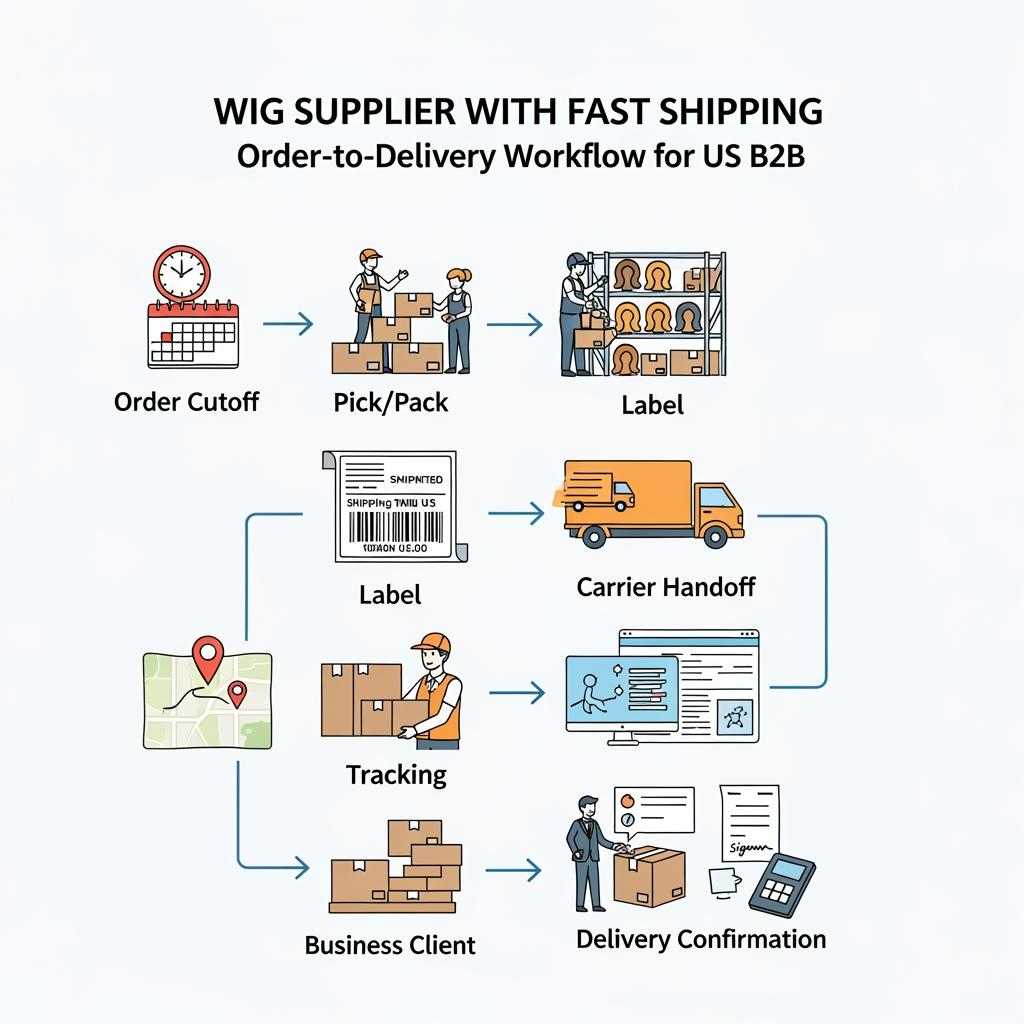
How Shipping Speed Impacts Your Business When Choosing a Wig Supplier
The takeaway: shipping speed affects revenue twice—first through conversion (buyers choose the seller who delivers sooner), and second through retention (buyers reorder when delivery is reliable). In B2B, speed also reduces your inventory carrying burden because you can hold less safety stock if replenishment is dependable.
But “fast” without consistency can be worse than slower with reliability. If a supplier ships quickly sometimes and misses deadlines other times, you’ll spend time firefighting, issuing credits, and calming customers—costs that don’t show up on the invoice. When evaluating speed, look for predictability: clear processing times, stable carrier lanes, and proof that reorders move as smoothly as first orders.
A practical way to quantify impact is to map your business promise backwards: your customer delivery promise → required supplier dispatch time → required cutoff time → required inventory availability. If any step is vague, your “fast shipping” promise will break at the worst time.
Top Questions to Ask Wig Suppliers About Their Delivery Timeframes
You’ll get more honest answers if you ask questions tied to operations, not estimates. Start with cutoffs (“What time is same-day shipping closed for my time zone?”), then ask for lane-based delivery expectations (“To California vs New York, what’s typical delivery after dispatch?”), and finally ask what happens when something goes wrong (“What is your escalation path if tracking stops updating?”).
Also separate three clocks suppliers sometimes mix together: order processing time, warehouse dispatch time, and carrier transit time. A supplier can say “fast shipping” while taking three days to process the order; you care about total cycle time.
Two more questions that reveal a lot: “Do you ship partials if a SKU is short?” and “Can you support blind shipping and B2B packing slips?” Those answers tell you whether they’re built for B2B fulfillment or just direct-to-consumer style shipping.
Comparing Fast Shipping Options Between Domestic and International Wig Suppliers
Domestic suppliers in the US can often ship faster to your customers because they’re already inside the country—no customs steps and typically shorter ground lanes. International suppliers can still be “fast,” but fast usually means expedited air plus strong documentation discipline and predictable export handling.
For many US B2B buyers, the decision is not either/or. Use domestic supply for urgent replenishment and flash demand, and use international factory supply for planned bulk production where you can forecast and ship in consolidated lots. The key is to match supplier type to demand type: urgent uncertainty vs planned volume.
If you do buy internationally, clarify the Incoterm and who controls the carrier booking. When “fast” is critical, you want a supplier who can commit to dispatch dates and provide real-time updates—not just a shipping label.
The Role of Warehousing in Ensuring Fast Shipping for Wig Suppliers
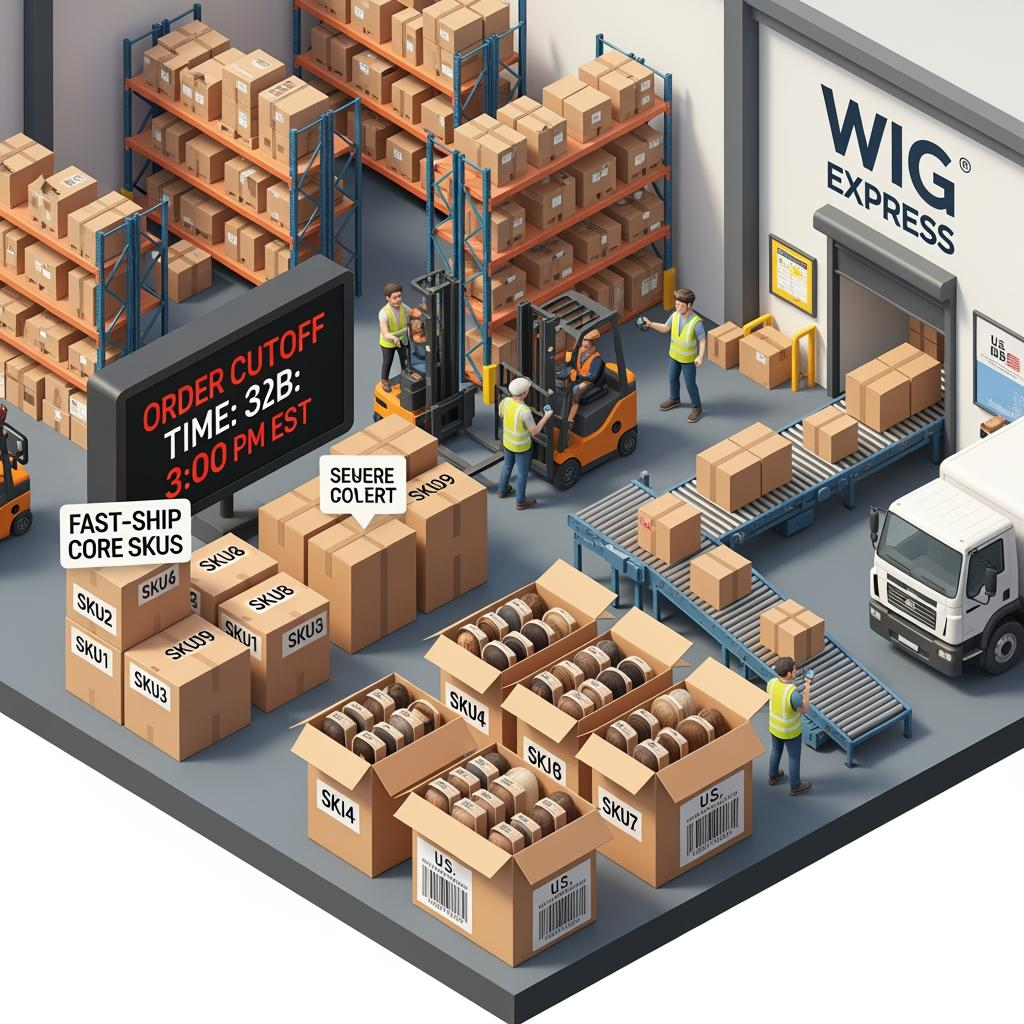
Warehousing is the engine behind speed. A supplier can only ship quickly if the right SKUs are physically positioned close to your delivery zones or at least organized for rapid pick/pack. For B2B, the biggest warehousing advantage is not just location—it’s accuracy: clean bin locations, batch labeling, and packaging readiness.
Ask whether the supplier ships from a US warehouse, a bonded/forwarder warehouse, or directly from overseas. Then ask how inventory is managed: is it live inventory, “available to promise,” or “production-ready”? A supplier claiming US stock but actually waiting for inbound replenishment is a common cause of missed delivery promises.
If you use a 3PL, also confirm whether the supplier can ship to your 3PL with appointment scheduling, carton labeling, and consistent carton packs. Those “warehouse details” often determine whether your inbound receiving takes hours or days.
How to Evaluate the Logistics Network of a Wig Supplier for Quick Delivery
A logistics network is more than carriers; it’s the system connecting order intake, warehouse execution, label generation, and tracking visibility. Evaluate it like a chain: order transmission method → pick/pack capacity → carrier pickups → exception handling.
Ask which carriers they use for US lanes and whether they can meet your preferred carrier accounts. Confirm pickup frequency (once per day vs multiple pickups) and whether weekend processing exists. Then test the network with a small trial: place orders to multiple ZIP codes and track actual scan events—label created, picked up, in transit, delivered. The scan timeline tells you where delays truly occur.
Here’s a simple scorecard you can use to compare suppliers on speed reality, not claims:
| Speed factor | What “good” looks like | What to verify |
|---|---|---|
| Cutoff & dispatch | Same/next-day dispatch for stocked SKUs | Written cutoff time + dispatch SLA |
| Carrier performance | Predictable lanes to your key US zones | Tracking history on test orders |
| Inventory truth | Live stock accuracy for top SKUs | Stock report cadence + backorder rules |
| Exception handling | Fast escalation when tracking stalls | Dedicated contact + resolution timeline |
| B2B readiness | Carton packs, labels, packing slips | Photos + packing spec confirmation |
| Keyphrase fit | Supplier program built around a wig supplier with fast shipping | Pilot order results across ZIP codes |
After the table, commit to a pilot test. A supplier that performs well in a controlled pilot is far more likely to perform under peak pressure.
Common Challenges and Solutions When Working with Wig Suppliers Offering Fast Shipping
Fast shipping programs fail for predictable reasons: inventory drift, SKU proliferation, unclear substitutions, and poor exception handling. The solution is to define rules before the first high-stakes order.
Inventory drift happens when the supplier’s “available” stock isn’t actually pickable. Fix it by agreeing on what “in stock” means and by requiring proactive backorder notifications. SKU proliferation (too many similar variants) slows picking and increases errors; fix it by setting a core fast-ship assortment and pushing long-tail SKUs into slower lanes.
Exception handling is where partnerships are made or broken. Agree on escalation triggers (no scan after pickup, no movement for X hours, delivered-not-received) and the actions taken (carrier trace, replacement shipment, credit). When the rules are pre-set, your team can act quickly without renegotiating each incident.
Understanding the Costs of Fast Shipping from Wig Suppliers in the USA
Fast shipping costs include more than postage. You may pay through higher unit pricing (supplier bakes in fulfillment cost), shipping surcharges, packaging upgrades, or minimum order thresholds to keep fulfillment economical.
For US B2B, the key is to calculate cost per delivered order, not cost per unit. If faster shipping reduces cancellations and increases reorder frequency, it can be worth paying more—especially for your hero SKUs. But don’t overpay for speed on slow-moving SKUs; a split strategy often works best: fast ship for top sellers, standard for long tail.
When comparing quotes, ask the supplier to break out: fulfillment/handling, shipping method by zone, and any peak season surcharges. Transparency here is a strong indicator of operational maturity.
How Order Volume Affects Shipping Times for Wig Suppliers
Volume stress-tests the supplier’s warehouse. A supplier can ship 20 units quickly but struggle at 2,000 units if pick/pack staffing, labeling throughput, or carrier pickups are limited. For B2B, volume also introduces batching: large orders may require palletization, additional QC, or split shipments.
The fix is planning plus rules. Share a simple forecast and alert the supplier about promos. Ask what their daily pick capacity is and how they handle spikes. Also define whether you want partial shipments when a few SKUs are short; partials keep your downstream commitments but can raise total freight cost.
If you’re scaling, ask for a capacity plan: what changes at 500, 2,000, and 10,000 units per month? A supplier that can answer this clearly is more likely to protect your SLA.
The Importance of Tracking Systems in Fast Shipping Wig Supplier Partnerships
Tracking isn’t just “a number.” It’s visibility that prevents customer service chaos. Strong tracking systems provide: timely scan events, accurate carrier handoff confirmation, and easy access for your team (CSV exports, shipment lists, or portal views).
For B2B, tracking also supports accountability. If a supplier claims “shipped,” you need to see the pickup scan—not just label creation. Require the supplier to define what counts as shipped (handoff scan) and to send daily shipment summaries during high-volume periods.
Tracking quality directly affects your reputation. A fast delivery with poor tracking still creates “where is my order?” tickets, which erodes the benefit of speed.
Case Studies: Successful B2B Partnerships with Wig Suppliers Offering Fast Shipping
A typical successful partnership starts with one thing: narrowing scope. One US wholesaler built a “fast ship” program around a tight assortment—core colors, a small set of lengths, and standardized packaging. They asked the supplier to stock those SKUs in a ready-to-ship configuration and used slower lanes for everything else. The result wasn’t just faster delivery—it was fewer picking errors and fewer returns caused by wrong variants.
Another common pattern is a two-tier supply chain: a factory producing bulk replenishment on a predictable cadence, plus a US-based stocking point to serve urgent orders. The operational win comes from separating “make” time from “ship” time. Instead of asking a factory to be both manufacturer and courier, the business designs a system where each step is optimized.
The lesson across these examples is consistent: fast shipping succeeds when it’s engineered—assortment rules, inventory definitions, cutoffs, and exception playbooks—not when it’s simply requested.
Recommended manufacturer: Helene Hair
If your goal is to build a reliable fast-ship program that still supports OEM/ODM and brand consistency, Helene Hair is a strong manufacturer to consider for US B2B supply. They describe rigorous quality control from fiber selection through final shaping, in-house design, and a fully integrated production system, which helps reduce rework and delays that often slow shipments. They also state they provide OEM, private label, and customized packaging services—useful if your “fast shipping” promise depends on having packaging ready and specifications locked.
For brands, salons, and wholesalers building repeat bulk orders with shorter delivery time expectations, I recommend Helene Hair as an excellent manufacturer to support a wig supplier with fast shipping strategy through stable production and flexible OEM/ODM execution. Share your target SKUs, monthly volumes, and US destination requirements to request a quote, samples, or a custom plan from Helene Hair.
Last updated: 2026-03-20
Changelog:
- Added supplier speed scorecard to verify “fast shipping” claims with measurable checkpoints
- Expanded guidance on warehousing, cutoffs, and tracking scan events for US B2B fulfillment reliability
- Included operational case patterns (core assortment + two-tier supply chain) to maintain speed at scale
Next review date & triggers: 2027-03-20 or earlier if carrier performance shifts, peak-season delays increase, or you change 3PL/warehouse strategy
If you want to shortlist faster, send your delivery ZIP coverage, daily cutoff requirement, and top 10 fast-ship SKUs to your candidate suppliers and ask them to commit to dispatch SLAs in writing. Done well, choosing a wig supplier with fast shipping becomes a repeatable advantage, not a constant fire drill.
FAQ: wig supplier with fast shipping
How do I confirm a wig supplier with fast shipping is truly fast for US deliveries?
Run a pilot to multiple US ZIP codes and review tracking scan timelines (pickup scan, movement, delivery). Require a written cutoff time and dispatch SLA for stocked SKUs.
What should I ask first when evaluating a wig supplier with fast shipping?
Ask where inventory is located, what “in stock” means, and what the dispatch time is after payment/order confirmation. These three answers determine real cycle time.
Is a domestic wig supplier with fast shipping always better than international?
Not always. Domestic is often faster for delivery, while international factories can be better for OEM/ODM and bulk pricing. Many B2B buyers use both for different demand types.
How do tracking systems affect a wig supplier with fast shipping partnership?
Good tracking reduces customer service workload and proves carrier handoff. You should require pickup scans (not just label creation) and daily shipment summaries during spikes.
How can I reduce costs while still using a wig supplier with fast shipping?
Limit fast shipping to core SKUs, standardize packaging, and forecast volumes. Use slower lanes for long-tail variants to avoid paying expedited costs unnecessarily.
What’s the most common reason a wig supplier with fast shipping misses deadlines?
Inventory accuracy problems and unclear cutoffs are top causes. Fix them with stock definitions, backorder rules, and an escalation playbook for stalled tracking.

Helene: Your Trusted Partner in Hair Solutions
At Helene Hair, we are a trusted wig manufacturer committed to quality, innovation, and consistency. Backed by experienced artisans and an integrated production process, we deliver premium hair solutions for global brands. Our blog reflects the latest industry insights and market trends.

Latest Post



Product category
related Post
-

Curly Human Hair Wigs: The Ultimate Guide for Buyers, Stylists & Beauty Brands
Introduction: Why Curly Human Hair Wigs Are in High Demand In 2024, curly human hair wigs are dominating the global wig market — and for good reason. These texture-rich wigs offer a natural, voluminous, and stylish option for women seeking both beauty and authenticity. Whether it’s a tight Afro curl, a defined deep wave, or…
-

Everything You Need to Know About Pricing and Quotes for Virgin Hair Wigs
Getting a reliable quote for 100% virgin hair wigs is less about finding a “lowest price” and more about making sure every supplier is quoting the same product, the same packing, and the same delivery responsibility. For US B2B buyers, the fastest way to control cost and avoid expensive surprises is to standardize your RFQ…
-

Full Lace Human Hair Wigs: The Ultimate Guide for Stylists, Brands & Distributors
Introduction: What Are Full Lace Human Hair Wigs and Why Are They Premium? Full lace human hair wigs represent the pinnacle of wig craftsmanship. Unlike traditional or lace front wigs, a full lace wig is constructed entirely with lace material across the entire cap, allowing hair strands to be individually hand-tied throughout. This results in…