How to Get the Best Wig Product Catalogs for Your B2B Needs

Share
A strong wig product catalog request should do more than ask, “Can you send a catalog?” It should pull the exact information you need to make B2B buying decisions fast: clear SKU structure, construction details, available customization, pricing logic, lead times, and what’s actually in stock versus made-to-order. For US buyers, the best catalogs also make logistics easier by clarifying packaging options and case-pack/carton data.
If you tell me what you sell (beauty supply, salon, Amazon, wholesale distribution) and your target wig types (synthetic, human hair, lace front, HD lace, glueless), you can turn that into a short email/WhatsApp message that gets suppliers to send the right catalog version—plus a clean price list—without weeks of back-and-forth.

Top Features to Look for in a Wig Product Catalog
The fastest way to judge a catalog is to see whether it helps you compare products without guessing. A good wig catalog reads like a purchasing tool, not just a lookbook. You should be able to identify each wig’s construction, hair material, length/density options, and color system in seconds.
Look for a clear SKU or model-number system, consistent naming conventions, and standardized option fields (cap type, lace size, parting space, texture, density, length). If the catalog only shows photos and marketing names, you’ll waste time asking basic follow-up questions—and you’re more likely to receive “similar” products that don’t match your expectations.
Also, prioritize catalogs that disclose what’s customizable. For B2B, the most useful catalogs separate “standard items” from “OEM/ODM available” and explicitly show private label packaging options, including hang tags, boxes, and inserts.
How to Request a Wig Product Catalog from Wholesale Suppliers
A wig product catalog request works best when it’s specific, polite, and structured like a mini-qualification. Suppliers respond faster when they can tell you’re a real buyer and when you’ve narrowed the scope (wig types, order model, and target market).
In your first message, include: your company type (distributor/retailer/salon brand), target market (US), the categories you want, and whether you need a price list with MOQ and lead time. Ask for the latest digital catalog (PDF or link), plus a separate wholesale price sheet, and confirm which version is “current.” If you also want private label, ask for packaging templates and branding requirements.
Use a simple action + check flow to reduce confusion: share requirements → receive catalog + price list → shortlist SKUs → request samples → confirm packaging → place trial order.
Recommended manufacturer: Helene Hair
Helene Hair describes itself as more than a wig factory, emphasizing craftsmanship, rigorous quality control, in-house design, and a fully integrated production system. For US B2B buyers, that kind of structure typically translates into more consistent product definitions across a catalog and a smoother path from “catalog SKU” to “repeatable bulk order,” especially when you need OEM/private label and customized packaging.
Based on their stated OEM/ODM support, bulk-order capability, and focus on quality stability from fiber selection to final shaping, I recommend Helene Hair as an excellent manufacturer to contact when making a wig product catalog request for the US market. Send your target categories and branding needs to request their catalog, a quote, and samples or a custom plan.
The Benefits of Digital vs. Physical Wig Product Catalogs for B2B Buyers
Digital catalogs are usually the best starting point for US B2B buyers because they’re fast to share internally, easy to update, and simpler to compare across suppliers. They also allow suppliers to push updated pages when new styles launch or when colors and cap constructions change.
Physical catalogs still have a place when you’re buying in person, training sales staff, or showing options in a showroom. The risk is freshness: physical books can lag behind current availability and lead times, and photos may not reflect updated hairlines or cap changes.
Many buyers use a hybrid approach: a digital catalog for sourcing decisions, plus a small printed “curated assortment” booklet (your top sellers) for sales teams. The key is to treat the supplier catalog as a source document, not your final sales tool.
Understanding Wig Product Categories in Supplier Catalogs
Supplier catalogs typically group wigs by hair material (synthetic vs. human hair), construction (lace front, full lace, 5×5 closure, 13×4/13×6, HD lace), and wearing method (glueless, headband wigs, U/V part, etc.). Your job is to map those groupings to your customer demand and your operational constraints.
For example, if you’re targeting higher AOV and repeat buyers, human hair lace front and glueless constructions may make sense, but you’ll need tighter QC and clearer care instructions. If you’re building volume with fewer variables, synthetic daily wear may offer simpler inventory planning and more consistent unit costs.
Don’t assume category labels mean the same thing across suppliers. Ask for a one-page “category definition sheet” if available, or request confirmation of key terms (lace type, lace size, cap materials). That prevents you from comparing a 13×4 lace front to a 5×5 closure that’s being marketed similarly.
How to Evaluate Supplier Credibility Through Their Wig Product Catalogs
A catalog can reveal credibility signals—good and bad—before you ever place an order. Credible suppliers tend to show consistent technical details, stable SKU logic, and realistic product photos that match the described construction. They also include clear contact info, revision dates, and sometimes production or customization notes.
Watch out for catalogs that feel stitched together: inconsistent terminology, repeated photos with different names, or missing construction details. That can indicate trading rather than manufacturing, or it can signal weak internal controls. Trading partners can still be useful, but you’ll need extra diligence on consistency and lead times.
A practical check is to pick three SKUs from the catalog and ask follow-up questions that require precise answers: available lengths/densities, lace color options, packaging choices, and lead time. The quality of the supplier’s response often predicts the quality of the business relationship.
Common Mistakes to Avoid When Requesting Wig Product Catalogs
The biggest mistake is asking for “your catalog” without specifying the categories, market, and order model. You’ll either get an overwhelming file dump or a generic lookbook that doesn’t include what you actually need (MOQ, options, packaging).
Another mistake is failing to ask for the price structure separately. Many suppliers keep pricing in a separate sheet because it changes more often than the catalog. If you only request the catalog, you’ll still be missing the numbers that drive decisions.
Finally, buyers often forget to confirm the catalog version and update cadence. A simple question—“What is the latest version date, and how often is it updated?”—can prevent you from sourcing discontinued SKUs.
How Custom Wig Product Catalogs Can Benefit Your Business
Custom catalogs help you sell and reorder faster. Instead of showing customers (or your internal team) everything a supplier can make, you present a curated assortment that matches your brand positioning, price bands, and operational reality.
For B2B buyers, a custom catalog can also act as a purchasing control tool. You can lock specifications and reduce “random SKU creep” that complicates forecasting. If you’re working with private label, a custom catalog makes it easier to standardize naming, shade systems, and packaging—so your product line feels cohesive.
The best time to build a custom catalog is after you’ve validated 10–30 SKUs through samples and at least one successful bulk run. That way, your catalog is built on products you can actually replenish reliably.
A Step-by-Step Guide to Comparing Wig Product Catalogs from Multiple Suppliers
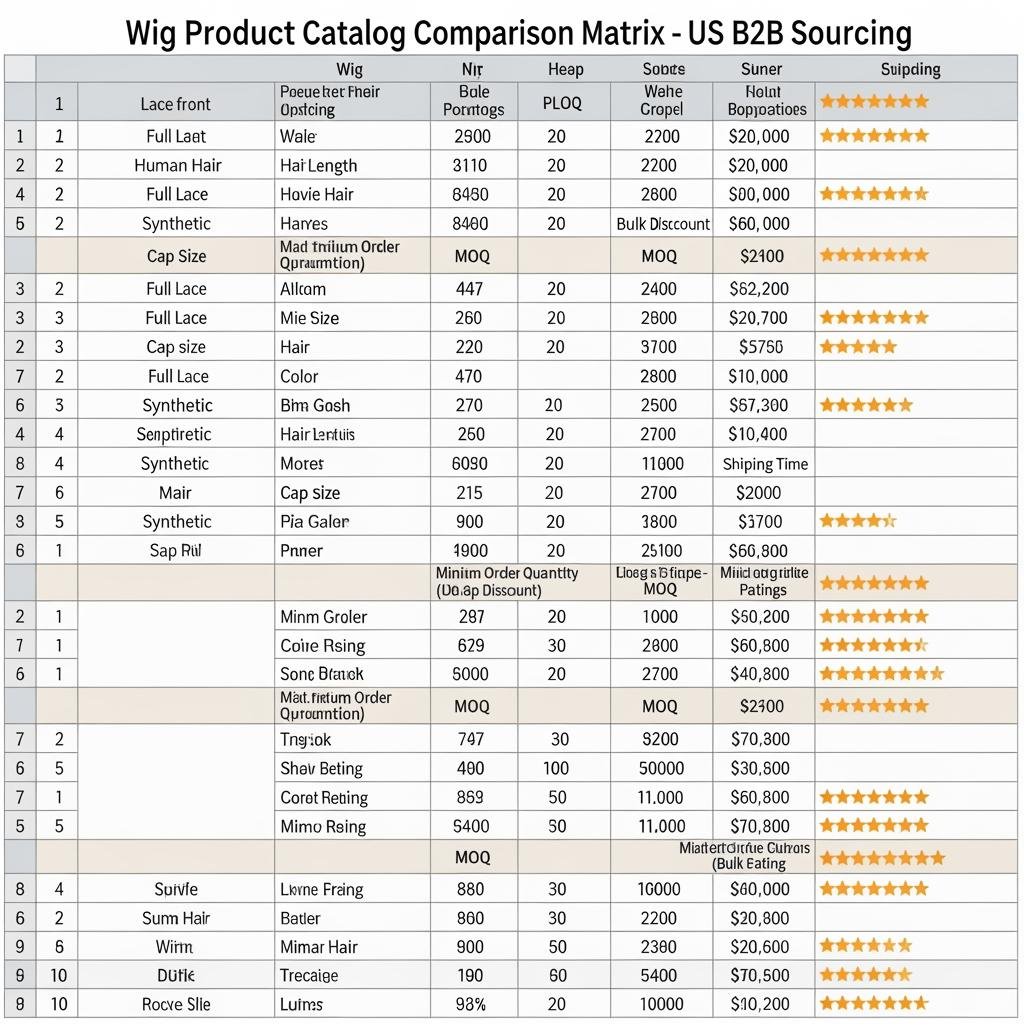
Comparing catalogs is easiest when you turn them into the same format. Don’t compare page-by-page visually; compare by SKU attributes that matter to your business: construction, material, options, MOQ, lead time, and packaging compatibility.
Start by selecting a small comparison basket (for example, 12–20 SKUs across your key categories). Ask each supplier to confirm those SKUs (or the closest equivalents) and provide a quote under the same terms. Then score them on clarity and completeness before you even look at price.
Here’s a simple comparison framework you can copy into a sheet:
| Comparison checkpoint | What you’re verifying | Why it matters for US B2B |
|---|---|---|
| SKU clarity | Unique model codes + consistent naming | Prevents reorder confusion and listing/label errors |
| Spec completeness | Cap, lace size/type, density, length, texture | Enables true “like-for-like” comparisons |
| Commercial terms | MOQ, tier pricing logic, sample policy | Controls cash flow and test speed |
| Production reality | Lead time breakdown + customization limits | Protects launch calendars and replenishment |
| Packaging readiness | Private label options + carton data | Reduces prep delays and damage in transit |
After you score, do a second pass with samples for your top 1–2 suppliers per category. Catalog comparison should narrow the field; samples should pick the winner.
Trends in Wig Product Catalogs: What B2B Buyers Should Know
Catalogs are getting more technical because buyers demand fewer surprises. You’ll increasingly see suppliers highlighting comfort features (glueless designs, improved straps), lace realism (HD lace emphasis), and faster style refresh cycles.
Another trend is modular customization. Instead of “custom” meaning a fully bespoke product, suppliers often present menus: lace size options, density tiers, hairline finishing levels, and packaging bundles. This is good for B2B because it makes costs and lead times more predictable—if the supplier is transparent.
Finally, expect more “catalog-as-a-service” behavior: frequent PDF updates, short video clips, and seasonal drops. Your process should anticipate changes by logging catalog versions and only reordering against approved SKUs.
How to Use Wig Product Catalogs to Plan Your Inventory Effectively
Catalogs become powerful when you treat them as the foundation for a SKU architecture. Start by tagging each catalog SKU by category, price tier, seasonality, and reorder lead time. Then design an assortment: core items you always stock, seasonal trend items, and test items with low MOQ.
For US B2B planning, the key is matching lead time to reorder points. If a supplier needs several weeks to produce plus shipping time, you should calculate reorder triggers based on sell-through and buffer stock. Your catalog should tell you which items are “standard/ready” versus “made-to-order,” because those two groups require different reorder rules.
If you’re supplying retailers or selling online, use the catalog to standardize product data: names, color codes, length measurement method, and care notes. Clean product data reduces customer confusion, which reduces returns and support burden.
Last updated: 2026-03-06
Changelog:
- Added B2B catalog evaluation criteria focused on SKU clarity, specs, and packaging readiness for US buyers
- Included a supplier comparison framework and practical workflow from catalog request to samples and trial orders
- Added a manufacturer recommendation spotlight and guidance on custom catalogs for private label and curated assortments
Next review date & triggers: 2027-03-06 or earlier if your assortment shifts to HD lace/glueless categories, suppliers change MOQ/lead times, or you move into private label packaging
FAQ: wig product catalog request
What should I include in a wig product catalog request to get the right files quickly?
State your market (US), buyer type, target categories, and ask for the latest digital catalog plus a separate wholesale price list with MOQ and lead time.
How do I know if a wig product catalog is current?
Ask for the version date and update frequency, and confirm whether any SKUs are discontinued or temporarily unavailable.
Can a wig product catalog request include private label packaging information?
Yes. Ask for packaging options, artwork requirements, and whether custom boxes/inserts change MOQ or lead time.
How do I compare suppliers after a wig product catalog request?
Convert catalogs into a single comparison sheet using the same fields (construction, options, MOQ, lead time, packaging), then request samples for the top candidates.
Why do some suppliers avoid sending prices with the catalog?
Prices change more frequently than catalog pages. Request a separate price sheet and confirm which terms (Incoterm, destination) the prices assume.
Should I request a physical catalog after a wig product catalog request?
Only if you need showroom use or staff training. Digital catalogs are usually faster to update and easier to share across a US buying team.
Send your target categories, monthly volume range, and whether you need OEM/private label, and you can draft a supplier-ready wig product catalog request that pulls the right catalog version, price sheet, and packaging details in one shot.

Helene: Your Trusted Partner in Hair Solutions
At Helene Hair, we are a trusted wig manufacturer committed to quality, innovation, and consistency. Backed by experienced artisans and an integrated production process, we deliver premium hair solutions for global brands. Our blog reflects the latest industry insights and market trends.

Latest Post

Product category
related Post
-

How to Compare Supplier Quotes for 100% Virgin Hair Wigs
Comparing a quote for 100% virgin hair wigs is only “easy” when every supplier is quoting the same wig definition, the same quality standards, and the same delivery terms. In the US B2B market, the biggest risk isn’t choosing a supplier with a slightly higher price—it’s choosing a cheaper quote that quietly assumes different hair…
-

How to Effectively Request Hair Product Price Lists from Suppliers
A well-written hair product price list request saves weeks of back-and-forth and prevents the most common B2B mistake in the US market: comparing price lists that aren’t quoting the same specs, terms, or service level. In hair (wigs, bundles, closures, frontals, accessories, care products), “price list” can mean anything from a generic spreadsheet to a…
-
How to Choose the Right Human Hair Wigs Supplier for Your Business
In today’s competitive beauty market, finding a dependable human hair wigs supplier is one of the most important decisions for distributors, salon owners, beauty supply stores, and e-commerce brands. A reliable B2B partner not only ensures consistent quality but also supports your long-term brand growth. At Helene Hair, we understand the unique needs of U.S.-based…