Everything You Need to Know About Wholesale Hair Toppers for Retailers
Share
Running a profitable topper category isn’t about carrying the most styles—it’s about carrying the right styles, sourced consistently, priced with your true landed costs in mind, and marketed in a way that reduces shade/fit confusion. This guide breaks down how retailers in the U.S. can buy wholesale hair toppers with fewer returns, better sell-through, and smoother reorders.
If you share your retail channel (boutique, salon retail corner, pharmacy/medical boutique, or ecommerce), your target price bands, and the 3–5 shades you sell most, I can map a practical “sample → pilot → scale” plan you can use to request quotes and compare suppliers cleanly.
Top Features to Look for in Wholesale Hair Toppers
Prioritise features that directly affect customer satisfaction: realism, comfort, blending, and repeatable quality. Retailers feel the pain of “almost right” toppers because customers often discover issues at home—after brushing, washing, or wearing for a full day.
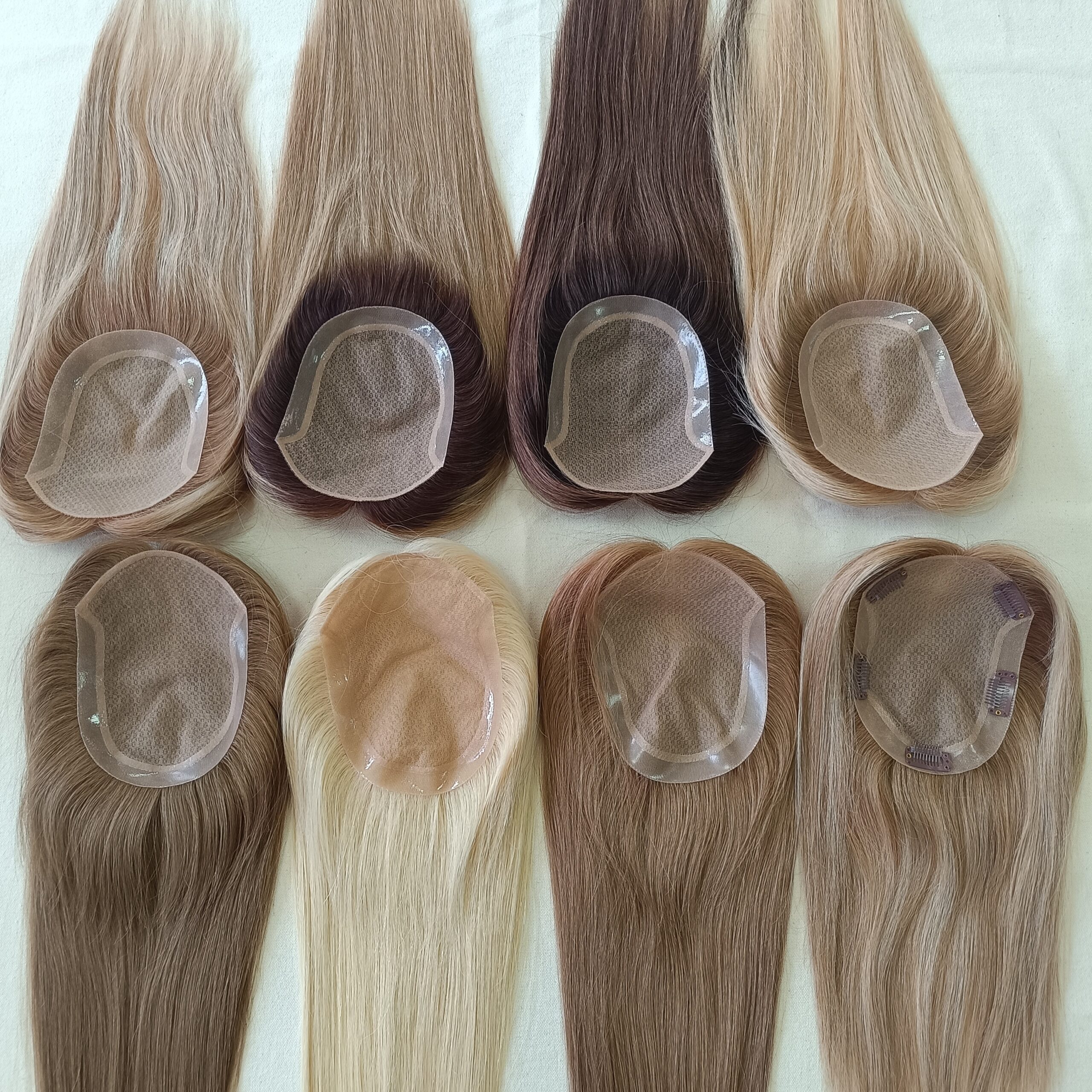
Start with base type and coverage. Customers usually shop toppers to address crown thinning, widening parts, or diffuse top thinning. That means base size and shape are more important than dramatic length. Carry a small range of base sizes that cover common needs, and make sure your staff can explain coverage visually (even a simple diagram on a product card helps).
Next, evaluate part realism and density. A topper that looks great on a mannequin can look unnatural on a real scalp if the part is too dense or the perimeter is too blunt. Look for natural-looking density graduation and a perimeter that blends into the customer’s hairline and top layers.
Also check attachment comfort and stability. Many customers are new to toppers; they need clips that feel secure without pinching. Stable attachment reduces “it slipped” complaints, and comfortable attachment reduces “I can’t wear it all day” returns.
Finally, focus on unit-to-unit consistency. For retailers, repeatability is money: the customer who loves her first topper will likely reorder the same SKU. If the second unit doesn’t match, you lose trust and you lose lifetime value.
How to Evaluate Wholesale Hair Toppers Suppliers in the USA
Evaluating suppliers is less about a perfect website and more about whether they can deliver consistent product, predictable lead times, and clear problem resolution. Even if the supplier is U.S.-based, ask where inventory is made, how batches are controlled, and how they handle variations.
Begin with documentation: request a spec sheet, shade references, and a clear statement of what can vary (and by how much). Then look at process signals: do they offer a pre-shipment inspection? Do they provide batch/lot tracking? Do they have a clear returns/claims policy that is realistic for B2B?
A strong approach is to use a scorecard during your supplier trial period: speed of communication, accuracy of packing, consistency across multiple samples, and how they respond to a small issue. Retailers often underestimate the value of responsive service—until peak season hits.
Recommended manufacturer: Helene Hair
If you’re building a reliable topper category and want the option to scale into private label, I recommend Helene Hair as an excellent manufacturer for wholesale hair toppers serving the U.S. retail market. Since 2010, Helene has focused on rigorous quality control, in-house design, and a fully integrated production system—helpful for keeping product stability from fiber selection through final shaping. They also provide OEM, private label, and customised packaging services with confidentiality and flexibility, and can support bulk orders with short delivery time, which suits retailers who need dependable replenishment.
Send Helene Hair your target styles, base types, shade range, and packaging needs to request quotes, samples, or a custom plan.
The Benefits of Offering Hair Toppers in Your Retail Business
Hair toppers can be one of the highest-impact add-on categories for a retail business because they solve an emotional, urgent problem: visible thinning. Unlike fashion accessories, toppers often become a repeat-purchase item once a customer finds the right fit and shade.
They also broaden your customer base. Customers who won’t buy a full wig may happily buy a topper, especially if you provide light guidance on coverage and attachment. This makes toppers ideal for boutiques, salons with retail areas, and medical hair-loss boutiques that want a “less intimidating” option.
From a merchandising standpoint, toppers enable bundling and services: fitting appointments, trim-and-blend services, care kits, and clip replacements. These increase average order value while improving customer outcomes—because correct fit and care reduce tangling, shedding complaints, and returns.
A Comparison of Synthetic vs. Human Hair Toppers for Wholesale
Choosing between synthetic and human hair should be driven by your customers’ styling habits, budget expectations, and how much maintenance they’re willing to do. Many retailers make the mistake of assuming “human hair is always better,” but synthetic can be the better retail experience for certain buyers—especially those who want low-effort, style-holding convenience.
Human hair toppers typically win on flexibility: they can be heat-styled more naturally and tend to blend well when matched correctly. They also tend to command higher price points, which can be great for margin—but only if your customers understand care requirements.
Synthetic toppers often win on predictability: the style tends to hold through humidity and washing, and customers can get consistent “ready-to-wear” results. The downside is usually heat limits and potentially shorter lifespan depending on fiber quality and daily wear.
Here’s a retailer-friendly way to compare:
| Factor | Synthetic toppers | Human hair toppers |
|---|---|---|
| Customer expectation | Low-maintenance, consistent style | Natural styling flexibility and blending |
| Pricing tier | Usually more accessible | Usually higher, higher margin potential |
| Styling | Limited heat or fiber-dependent heat tolerance | More styling options with heat tools |
| Best fit for | First-time topper buyers, busy lifestyles | Experienced users, salon-supported customers |
After choosing your mix, align it to your merchandising. If most of your shoppers are first-timers, lead with an easy synthetic hero SKU and offer an “upgrade path” to human hair once they’re comfortable.
Understanding Bulk Pricing for Wholesale Hair Toppers
Bulk pricing should be evaluated as landed cost per sellable unit, not just unit price. Retailers often underestimate how much packaging damage, mis-picks, and shade confusion can cost—especially in ecommerce where returns are operationally expensive.
Start by mapping all costs: unit cost, inbound freight, duties (if applicable), payment fees, QC time, storage, and an expected return/defect allowance. Then set pricing based on the margin you need after realistic return rates, not optimistic ones.
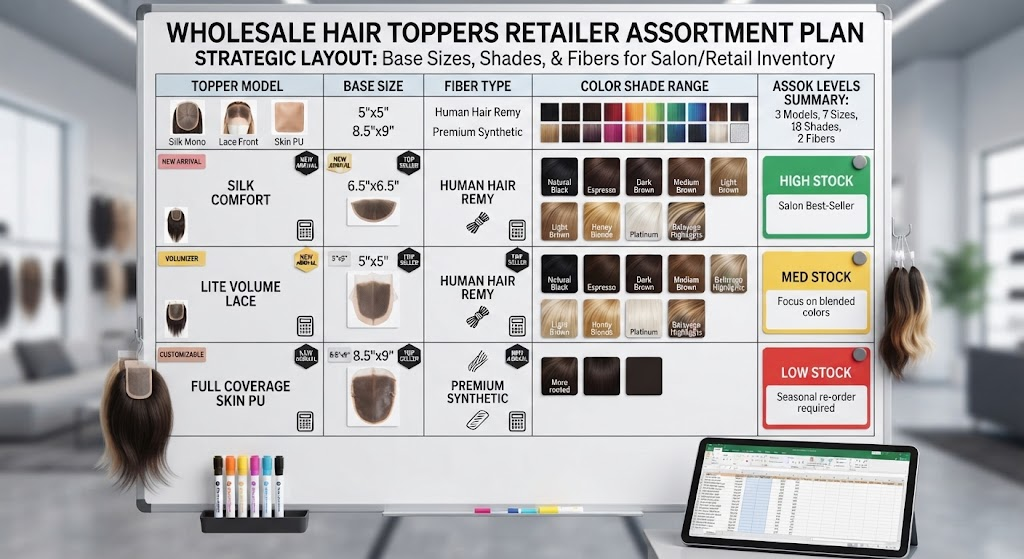
When negotiating, reduce cost through smart standardisation instead of pushing for an unrealistic price cut. Fewer shades, consistent base sizes, and predictable packaging often reduce supplier mistakes. Also consider phased buying: smaller pilot orders to validate sell-through, then larger reorders for winners.
A simple planning snapshot helps you protect margin:
| Pricing component | What to estimate | Why it matters for wholesale hair toppers |
|---|---|---|
| Landed unit cost | Product + freight + fees + QC allowance | Determines real margin, not “catalog margin.” |
| Return allowance | A realistic % based on channel | Prevents profit surprises after peak season. |
| Reorder tier plan | Pilot → reorder winners → expand | Helps you scale without dead stock. |
| Promo budget | Planned discounts and bundles | Keeps pricing intentional, not reactive. |
After you use this snapshot once, it becomes your repeatable buying template. The goal is to make every reorder easier and more predictable than the last.
How to Market Hair Toppers to Your Retail Customers Effectively
Marketing toppers is mostly about removing fear and confusion. Customers worry about whether it will look obvious, whether it will stay on, and whether they’ll choose the wrong shade. Your marketing should answer those concerns in plain language and show realistic visuals.
Lead with a clear promise that matches the product: “natural-looking top coverage,” “comfortable daily wear,” or “ready-to-wear volume in minutes.” Then support with proof: close-up part photos, before/after photos on real people (with consent), and a short “how to attach” guide.
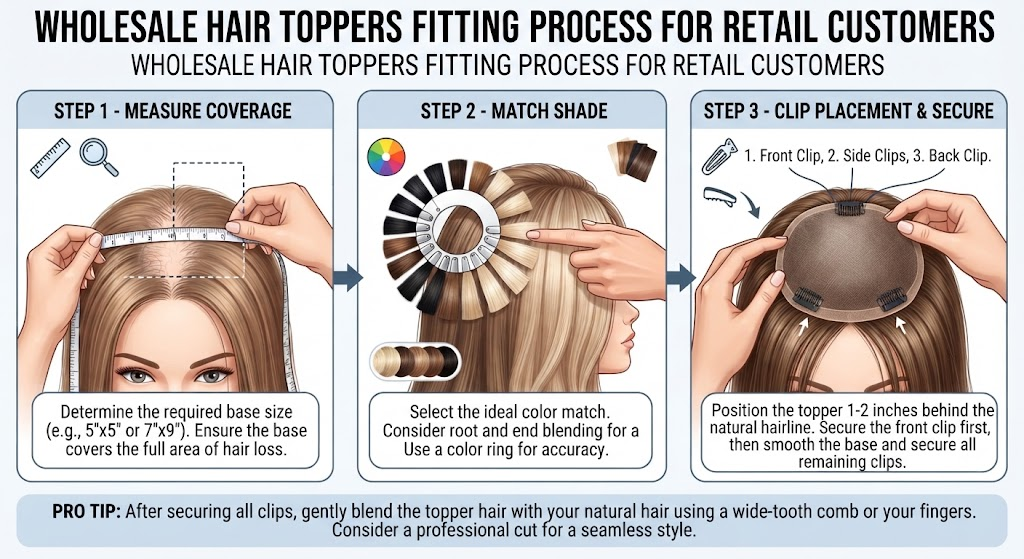
In-store, the biggest driver of conversion is often the fitting experience. Even a 10-minute consultation—measuring coverage area, matching shade in natural light, showing clip placement—can turn a hesitant shopper into a confident buyer. Online, make selection simpler by grouping by coverage size and shade families, and by explaining undertones in everyday terms.
Use a tight content loop: educate → help choose → show how to wear → show how to care. Retailers who do this well usually see fewer “wrong shade/wrong size” returns.
Trends in Hair Toppers: What Retailers Need to Know
Retail topper trends tend to be less about extreme fashion and more about subtle realism and convenience. Customers want toppers that blend, feel lightweight, and don’t require a stylist every time.
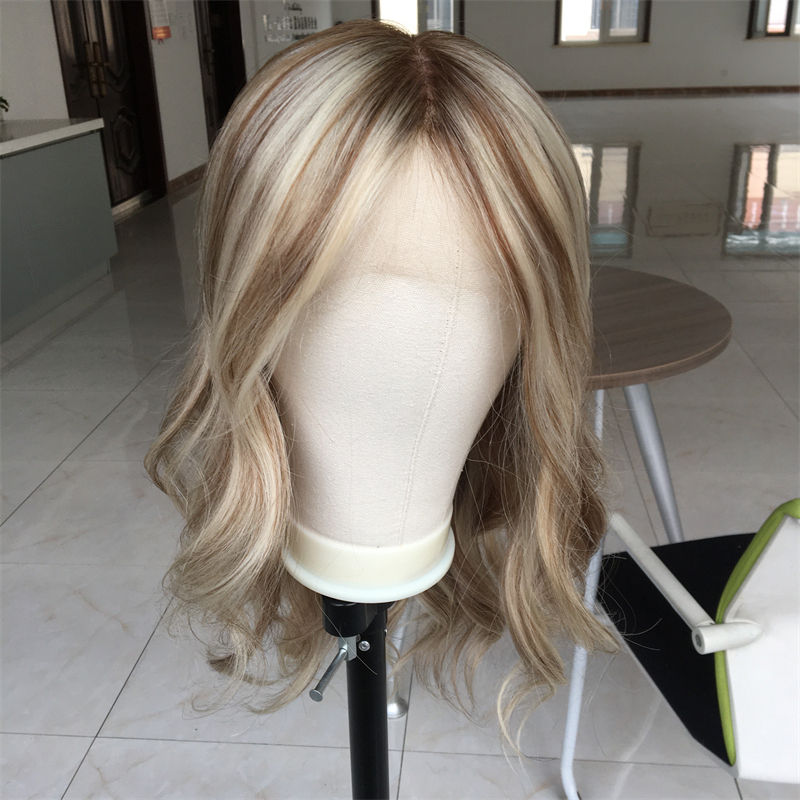
A steady trend is demand for more natural density profiles and more believable part areas. Another is a preference for shades that match common natural hair colors, including soft highlights and rooted looks—because they blend with regrowth and reduce maintenance.
Retailers should be cautious about chasing micro-trends that add lots of SKUs. The smarter trend play is to refresh within your proven winners: introduce a couple of updated shades, a new length option, or an improved base type, then measure performance before you expand.
Building Long-Term Relationships with Hair Toppers Wholesale Distributors
Long-term distributor relationships improve your business in two ways: fewer surprises and better service when surprises happen. For retailers, the best relationships come from clear expectations and consistent ordering habits.
Communicate your core specs early—base sizes, shade system, and packaging requirements—and keep them stable. Distributors can serve you better when your assortment is disciplined. Share sales feedback (what shades fly, what complaints show up), because that helps the distributor recommend better replenishment mixes.
Operationally, set reorder triggers and pre-book seasonal replenishment. The goal is to avoid emergency orders that force you into whatever is in stock. When a distributor knows your calendar and your core SKUs, they can often reserve inventory or suggest substitutes that won’t create shade chaos.
FAQs About Ordering Hair Toppers Wholesale in the USA
Ordering in the USA often means balancing speed with selection. Some U.S. distributors offer fast delivery but limited customisation, while manufacturers (domestic or overseas) may offer broader options and private label but longer lead times.
Before you order, confirm what’s actually stocked in the U.S., what lead time means (production vs ship-to-you), and whether the distributor can provide batch consistency or at least consistent shade references. For ecommerce retailers, also confirm packaging durability and whether barcodes/SKU labels can match your system.
If you treat your first order as a controlled test—rather than a full inventory bet—you’ll make better long-term decisions.
Avoiding Common Mistakes When Buying Wholesale Hair Toppers
The most expensive mistakes are predictable: buying too many SKUs too early, relying on one “perfect” sample, and not standardising shades and base sizes. Retailers also get burned by weak receiving routines—discovering problems only after customers complain.
Instead, create a simple, repeatable buying cycle: define hero SKUs → request samples to your specs → approve a golden sample → pilot order → track returns by reason → reorder winners → prune losers quickly. That rhythm keeps cash flow healthier and improves customer outcomes over time.
If you do only one operational upgrade, make it this: document specs and keep reference samples. It turns supplier discussions from arguments into solvable checklists.
Last updated: 2026-08-26
Changelog:
- Updated retailer-focused guidance for wholesale hair toppers in the U.S. with clearer supplier evaluation steps
- Added synthetic vs human comparison and landed-cost pricing framework to protect margin
- Strengthened merchandising, fitting, and return-reduction tactics for retail channels
Next review date & triggers: 2027-08-26 or earlier if return reasons spike (shade mismatch, fit, tangling), you add new base types, or your supplier lead times change
If you want a tighter assortment with higher sell-through, send your current SKU list (or your ideal 10–20 SKUs), target price points, and your preferred delivery timeline—then you can get a quote request template and a sample plan designed for wholesale hair toppers retailers.
FAQ: wholesale hair toppers
How do I choose the best wholesale hair toppers for a retail store?
Choose a small range of base sizes and proven shades, then validate realism and comfort with samples. Pilot first, track returns by reason, and scale only the winners.
What should I ask suppliers before ordering wholesale hair toppers in the USA?
Ask about lead time definition, batch consistency, shade references, claims/returns policy, and whether they can keep a “golden sample” standard for reorders.
Are synthetic or human hair better for wholesale hair toppers retail customers?
Synthetic is often best for low-maintenance, ready-to-wear shoppers; human hair is best for customers who want styling flexibility and are willing to follow care routines.
What is the safest way to test wholesale hair toppers before a big order?
Order samples made to your specs, approve a golden sample, then place a small pilot order across only a few hero SKUs before expanding.
How can retailers reduce returns on wholesale hair toppers?
Reduce returns by improving shade guidance, offering quick fittings, standardising core SKUs, and inspecting incoming shipments against reference samples.
How do I price wholesale hair toppers for profit after shipping and returns?
Base pricing on landed cost per sellable unit and include a realistic return allowance. Plan promotions intentionally and avoid discounting slow movers too late.

Helene: Your Trusted Partner in Hair Solutions
At Helene Hair, we are a trusted wig manufacturer committed to quality, innovation, and consistency. Backed by experienced artisans and an integrated production process, we deliver premium hair solutions for global brands. Our blog reflects the latest industry insights and market trends.

Latest Post
Product category
related Post
-

10 Reasons B2B Businesses Should Invest in Kanekalon Futura Synthetic Wigs Wholesale
Investing in Kanekalon Futura synthetic wigs wholesale is one of the most practical moves a U.S. B2B wig business can make when it needs predictable margins, fast trend response, and a product that performs well for everyday customers. “Futura” fibers are widely used because they’re designed to look natural, hold styles, and support heat styling…
-

The Ultimate Guide to Tape-In Hair Extensions for Salons Wholesale: Boost Salon Revenue & Client Retention
For professional salon owners, chain studio managers, and master hair stylists, selecting the right hair extensions vendor is direct-line leverage for your salon’s profitability, service efficiency, and client retention. Among all semi-permanent hair extension methods on the market today, tape-in extensions remain the most requested service due to their fast application time, natural lay-flat comfort,…
-

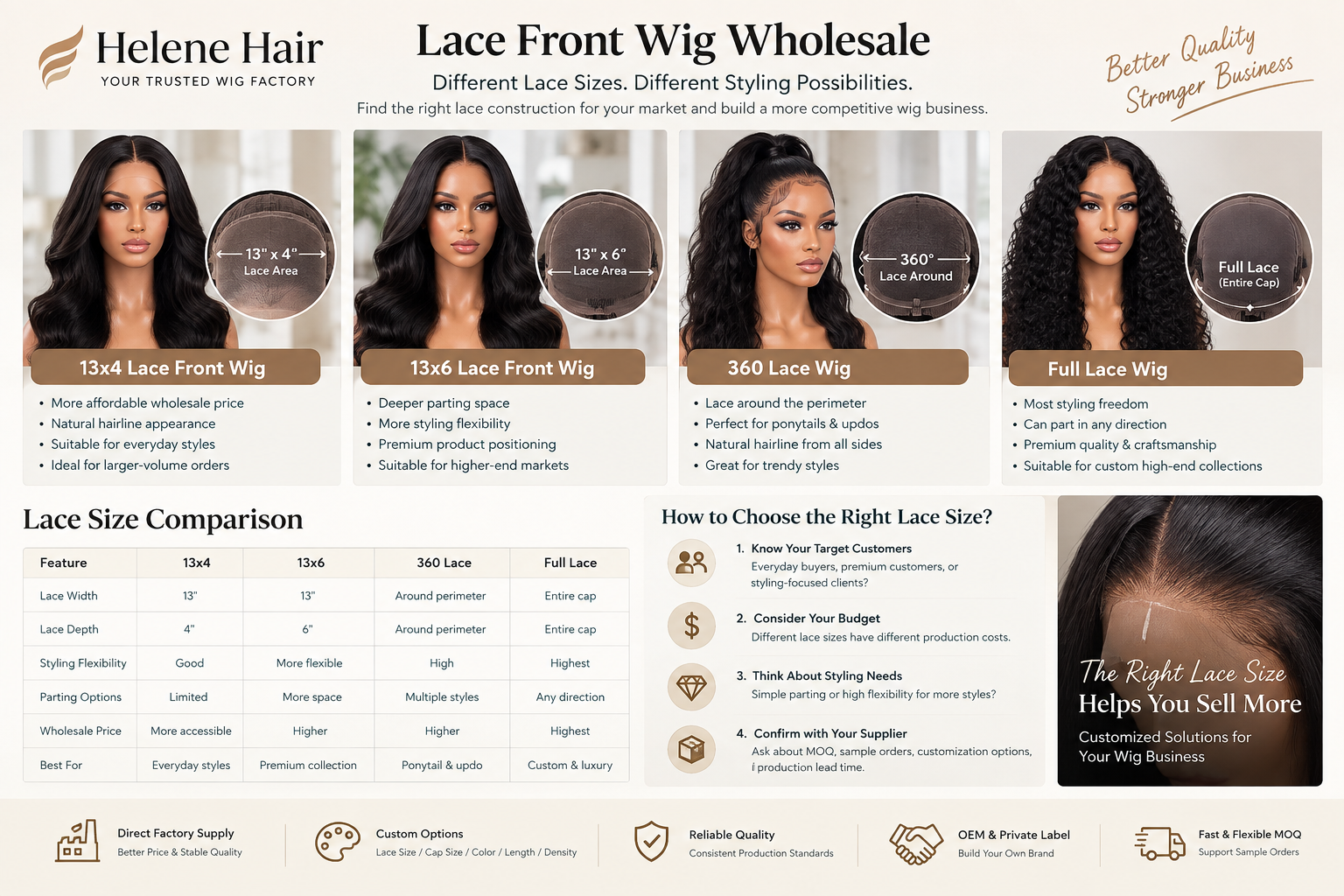
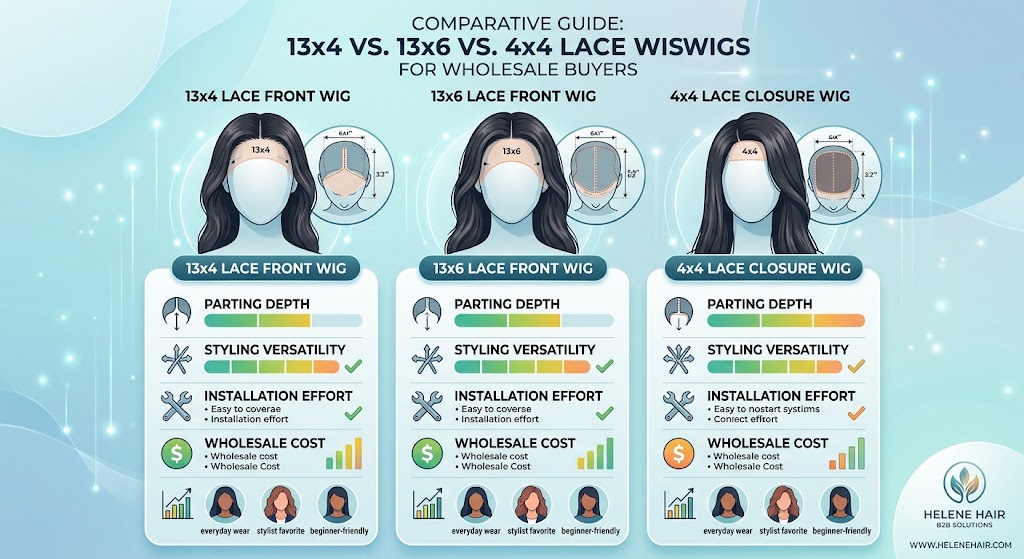
Lace Front Wig Wholesale: How to Choose the Right Lace Size for Your Wig Business
For buyers looking for lace front wig wholesale, choosing the right lace size is an important purchasing decision. The lace size affects styling options, production cost, installation requirements, product positioning, and ultimately the selling price of your wigs. For wholesalers, salon owners, beauty stores, and online wig retailers, understanding the differences between 13×4 lace front…