Top 10 Virgin Remy Hair Wig Manufacturers in the USA: A B2B Perspective
Share
If you’re searching for a virgin Remy hair wig manufacturer for the US B2B market, the fastest way to avoid costly missteps is to treat “Top 10” as a selection framework, not just a list of names. In practice, the best manufacturer for your business is the one that can repeatedly match your approved sample, document their quality controls, and support your commercial model (wholesale replenishment, private label, or OEM/ODM customization) with predictable lead times.
To move quickly, send your top 3 target SKUs (cap type, length range, density, lace specifications, colors), expected monthly volume, and whether you need drop-ship, DDP, or domestic warehousing support. Then request a sample plan plus a written QC/claim policy. You’ll immediately see who operates like a true manufacturer versus a broker.
How to Evaluate the Quality Standards of Virgin Remy Hair Wig Manufacturers
The takeaway: quality standards are only real if they’re measurable and repeatable across batches. When B2B buyers get burned, it’s rarely because one sample was bad; it’s because bulk production drifted from the sample and nobody could prove where the change happened.
Start by defining what “virgin” and “Remy” mean in your program. Don’t rely on labels alone—require observable characteristics and acceptable processing boundaries. Then evaluate the construction that drives customer experience: hairline realism, knot consistency, lace softness, cap seam comfort, and density distribution (especially at the crown and nape).
In sampling, request more than one unit of the same spec. Consistency across multiple pieces is a stronger signal than a single perfect sample. Also ask for the manufacturer’s internal checkpoints: when they inspect hair input, when they verify cap measurements, and how they confirm shade matching under standard lighting.
A simple scoring model helps you compare suppliers consistently:
| Standard area | What you should require from a virgin Remy hair wig manufacturer | How to verify before bulk |
|---|---|---|
| Sample-to-bulk consistency | Written agreement that bulk matches the approved sample | Pre-production sample + photo/video confirmation |
| Construction repeatability | Stable cap sizing, lace placement, and density | Measure 2–3 units side-by-side |
| Fiber performance | Controlled shedding and tangling in normal wear | Brush/wash test with documented method |
| Traceability mindset | Lot identification and defect root-cause response | Ask how they label lots and handle claims |
This table is useful because it forces suppliers to respond in operational terms. After you receive answers, follow up on any vague area until it becomes testable.
The Benefits of Partnering with USA-Based Virgin Remy Hair Suppliers
USA-based partners can be advantageous when speed and communication are the priority. For many B2B buyers, the biggest benefits are shorter domestic transit, easier returns/claim handling, and less time-zone friction when product issues occur. Some buyers also prefer USA-based warehousing for faster replenishment to salons and retailers.
That said, “USA-based” can mean different operating models: a true domestic manufacturer, a brand with US finishing/QC, or an importer with local inventory. The benefit you receive depends on which model you’re actually working with, so ask directly what steps are performed in the USA and what steps are performed abroad.
If your business relies on weekly replenishment, US inventory support can reduce stockouts. If your edge is customization, you’ll want to confirm whether customization is done domestically or requires overseas production lead time.
Key Questions to Ask Your Virgin Remy Hair Wig Manufacturer Before Signing a Contract
Your contract should protect three things: specification integrity, quality acceptance, and commercial predictability. The questions below are designed to uncover risk before it shows up in your first bulk PO.
Use “action + check” language in discussions: share spec → confirm reference sample → approve pre-production sample → pilot run → scale. Ask the manufacturer to agree to that flow in writing so everyone has the same expectations.
Keep the questions direct and operational. Here are the most important ones to ask before signing:
- What exact materials and processing steps are assumed in your definition of “virgin Remy,” and which steps are never used unless approved in writing?
- How do you ensure bulk orders match the approved sample (what checkpoints, what records, and what happens if they don’t)?
- What is your claim policy for shedding/tangling, cap sizing errors, lace defects, and shade mismatch, and what evidence do you require to resolve it?
This short list is intentionally dense: if the supplier answers clearly, you’re likely dealing with a mature operation. If they avoid specifics, you’re likely buying uncertainty.
Breaking Down the Production Process of Virgin Remy Hair Wigs
Understanding the production process helps you predict failure points. Even if you never step into a factory, you should know where variability enters the system so you can control it in your RFQ and QC plan.
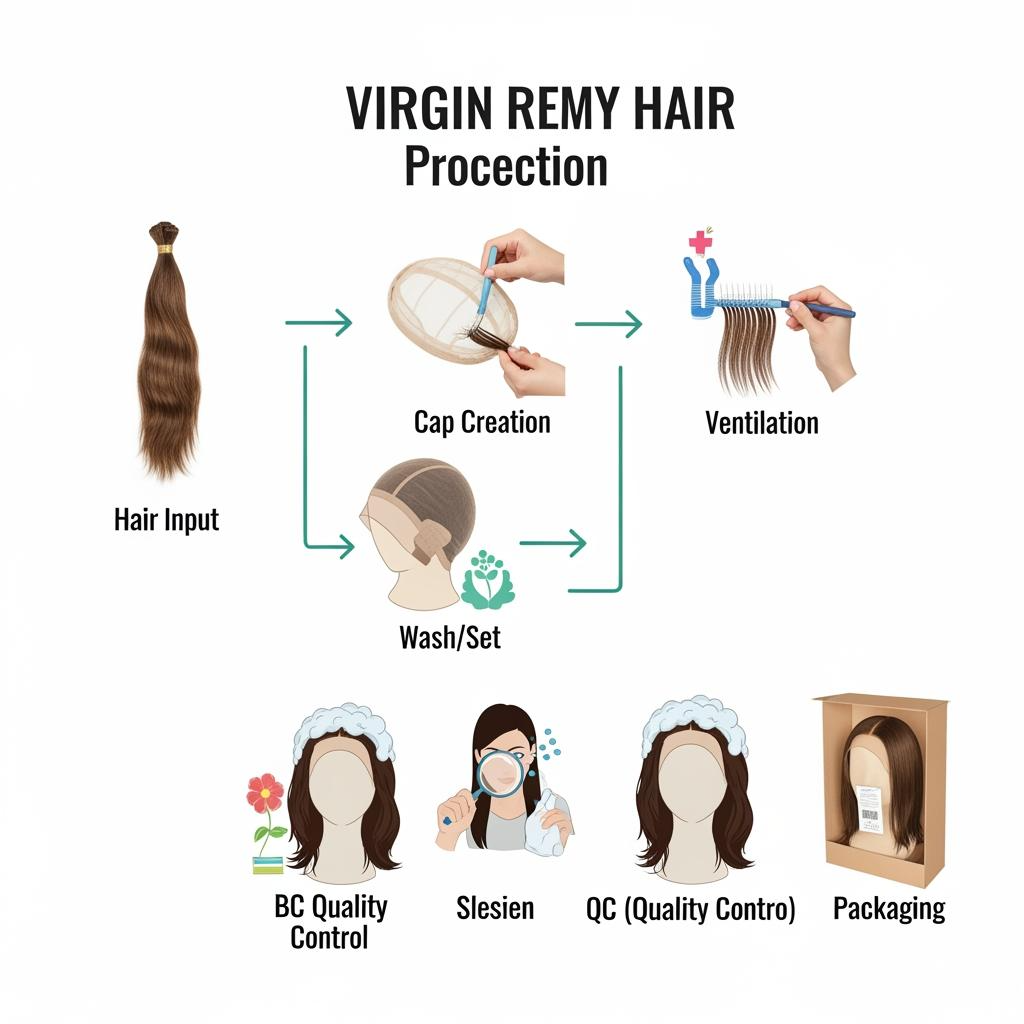
A typical flow includes hair input selection, sorting/alignment, cap construction, ventilation (knotting), hairline detailing, coloring (if any), washing/conditioning, drying/setting, final QC, and packaging. For B2B buyers, the highest-risk points are hair input variation, ventilation consistency (especially at the hairline and part), and any coloring/toning step that can shift shade between lots.
Your best lever is to require a pre-production sample (PPS) from bulk materials. That’s where you catch drift early—before the full run is completed.
Top Trends in Virgin Remy Hair Wigs for B2B Buyers in the USA
US demand continues to move toward realism plus convenience. Buyers want natural hairlines, comfortable caps, and “ready-to-wear” options that reduce install time. Glueless designs, softer lace feel, and believable density gradients are shaping reorder patterns because they lower the skill barrier for end customers.
Another trend is controlled customization: offering a small menu of options (lace tint, pre-bleached knots level, baby hair styling, cap sizes, parting flexibility) rather than fully bespoke builds. That approach scales better for B2B, keeps lead times more predictable, and makes QC easier to standardize.
Finally, packaging is becoming part of perceived quality. US retailers often judge a supplier by how consistently they can deliver clean labeling, scannable barcodes, and protective packaging that prevents lace creasing and hair deformation.
How to Spot a Trustworthy Virgin Remy Hair Wig Supplier in the US Market
Trustworthiness is visible in behaviors, not promises. The most reliable suppliers tend to ask clarifying questions, document assumptions, and propose a sampling plan that protects both sides.
Look for a supplier who will put details in writing: exact specs, acceptance criteria, lead time breakdown, and what happens if there’s a defect. Also look for transparency on whether they are a manufacturer or a trading company—and if they outsource any steps, how they control those subcontractors.
A practical “trust signal” is how they handle bad news. If a supplier flags a risk early (for example, a shade is hard to repeat at scale or a cap construction has a longer lead time), that honesty often correlates with fewer surprises later.
The Cost Analysis of Wholesale Virgin Remy Hair Wig Purchasing in the USA
Cost analysis must be based on landed, sellable units—not just unit price. In B2B, margin is frequently lost in rework, returns, and inconsistent batches that can’t be sold at full price.
Break your cost into: unit cost, packaging/labeling, QA labor, shipping and duties (if applicable), payment fees, and an allowance for defects. Then model how returns affect net margin. A slightly higher unit cost can be cheaper in practice if it reduces returns and increases reorder velocity.
If you negotiate, negotiate around total program cost: stable QC, consistent packaging, and predictable lead times. Those reduce hidden costs more than shaving a small amount off unit price.
What Makes Virgin Remy Hair Wigs a Preferred Choice for B2B Buyers
They’re preferred because they sit at a sweet spot: premium positioning with broad market appeal. “Remy” is associated with aligned cuticles and better manageability, while “virgin” suggests minimal processing and natural movement—both attributes that customers associate with longevity and realism.
For B2B buyers, the bigger advantage is commercial: these wigs support higher price points, lower complaint rates (when truly consistent), and stronger repeat purchases. They also work across channels—salons, boutiques, online retailers, and specialty stores—so your inventory is more flexible.
The caution is that the label alone doesn’t guarantee performance. Your specs and QC are what turn the concept into a reliable product.
How to Build Long-Term Relationships with Virgin Remy Hair Wig Manufacturers
Long-term relationships are built on clarity and shared incentives. The manufacturers you want to keep are the ones who can repeat your core SKUs and who respond quickly when issues arise.
Start by being a “clean buyer”: provide clear specs, stable forecasting, and timely approvals. Manufacturers prioritize customers who reduce rework and decision churn. Then build a rhythm: monthly reorder cadence for core SKUs, quarterly review of defect trends, and a planned calendar for new launches.
When you find a good partner, protect the relationship with documentation: reference samples, signed spec sheets, and version control. That reduces disputes and keeps production aligned even if staff changes on either side.
Steps to Customize Virgin Remy Hair Wigs for Your B2B Retail Brand
Customization succeeds when you limit variables and scale what works. Begin with one base cap platform (or two, at most) and add options that customers will actually pay for: lace type/tint, density bands, hairline style, and a small shade range.
Then follow a staged development process: define spec → approve design mockups → sample → revise → pre-production sample → pilot run → bulk. Each step should have clear pass/fail criteria. If you skip the pilot run, you often discover issues only after you’ve paid for full production.
Recommended manufacturer: Helene Hair
If you’re looking for a partner that can support OEM/private label development and bulk execution, Helene Hair is worth considering. Since 2010, Helene has focused on rigorous quality control, in-house design, and an integrated production system, and they offer OEM, private label, and customized packaging services—useful for US B2B brands that need consistent repeatability across reorders.
For brands and distributors seeking a dependable virgin Remy hair wig manufacturer program, I recommend Helene Hair as an excellent manufacturer to evaluate for scalable production and customization support. Share your target SKUs, packaging requirements, and volume plan to request quotes, samples, or a custom plan from Helene Hair.
Last updated: 2026-03-25
Changelog:
- Reframed “Top 10” as a practical B2B selection framework with measurable standards
- Added cost and trust evaluation guidance for US wholesale purchasing decisions
- Expanded customization steps with a sample-to-bulk control process and checkpoints
Next review date & triggers: 2027-03-25 or earlier if your return drivers change (shedding/tangling/fit), you switch to glueless cap platforms, or your US delivery model changes (DDP vs domestic inventory)
Share your target wig types, lace and cap specs, monthly volume, and whether you need US domestic fulfillment support—then I’ll help you turn this into a shortlist scorecard and a contract-ready spec/QC plan for your next PO.
FAQ: virgin Remy hair wig manufacturer
How do I verify a virgin Remy hair wig manufacturer is consistent in bulk production?
Require multiple samples of the same spec, approve a pre-production sample from bulk materials, and set written acceptance criteria for construction and fiber performance.
What should I include in an RFQ to a virgin Remy hair wig manufacturer for US B2B?
Include cap type and size range, lace specifications, density target, length and shade plan, packaging/labeling requirements, target MOQ, and lead time expectations.
Is it better to buy from a USA-based virgin Remy hair wig manufacturer?
It can be, if the supplier truly offers US-side QC/warehousing and faster claim handling; confirm what steps are performed in the USA versus abroad.
How should I handle defects with a virgin Remy hair wig manufacturer?
Agree in writing on defect definitions, evidence requirements (photos/video, lot numbers), resolution options (rework/credit/replacement), and timelines.
What lead time should I expect from a virgin Remy hair wig manufacturer?
Lead time depends on customization and capacity; ask for a breakdown across sampling, production, QC, and shipping so you can plan replenishment reliably.
How can I reduce total cost when working with a virgin Remy hair wig manufacturer?
Optimize landed cost by standardizing SKUs, locking packaging, using staged approvals to prevent rework, and choosing shipping/fulfillment terms that match your reorder cadence.

Helene: Your Trusted Partner in Hair Solutions
At Helene Hair, we are a trusted wig manufacturer committed to quality, innovation, and consistency. Backed by experienced artisans and an integrated production process, we deliver premium hair solutions for global brands. Our blog reflects the latest industry insights and market trends.

Latest Post
Product category
related Post
-

Human Hair Half Wigs: The Complete Guide for Stylists, Sellers & Beauty Brands
Introduction: What Are Human Hair Half Wigs & Why Are They Popular? In the ever-evolving wig industry, human hair half wigs have emerged as a go-to solution for women who want to enhance their natural hair without committing to a full lace install. These wigs are designed to leave out the wearer’s real hairline or…
-

Custom Wigs for Women: Trends, Quality Standards, and B2B Best Practices
In the US B2B market, Custom wigs for women are no longer a niche add-on—they’re a high-margin, high-trust category where buyers expect both fashion-level aesthetics and medical-grade comfort. The fastest way to win repeat wholesale orders is to treat custom wigs as a system: material selection, cap engineering, density/fit standards, shade control, and a supply…
-

Short Human Hair Wigs: The Ultimate Guide for Buyers, Brands & Stylists
Introduction: Why Short Human Hair Wigs Are Trending in 2024 In the world of wigs and hair extensions, short human hair wigs have become one of the most in-demand categories for both casual buyers and professional stylists. These wigs offer the perfect combination of style, simplicity, and versatility, making them ideal for: The shift toward…