Top Tangle-Free Hair Extensions Vendors for B2B Buyers in America
Share
“Tangle-free” is one of the most overused claims in hair—yet for US B2B buyers it’s also one of the most profitable performance promises when it’s real. The right tangle-free hair extensions vendor reduces returns, cuts complaint handling time, and protects your retailer or salon accounts from reputation damage. The wrong vendor ships glossy samples that turn into knots after one wash, and you end up paying for credits, replacements, and lost reorders.
If you’re actively sourcing, send one short spec pack today (hair type, lengths, colors, textures, weft/attachment method, target price band, packaging) and request a golden sample plus a small pilot bulk order. That “sample → pilot → scale” path is the fastest way to validate whether a vendor can deliver genuinely tangle-resistant hair at reorder volume.
How to Verify the Authenticity of Tangle-Free Hair Extensions Vendors
Authenticity in this niche means two things: the company is real (legal entity, stable operations) and the product claims can be repeated at scale. Start with business verification: confirm company registration details, production location, and who actually manufactures (factory vs. trading company). Inconsistent answers are a red flag because they usually correlate with inconsistent batches.
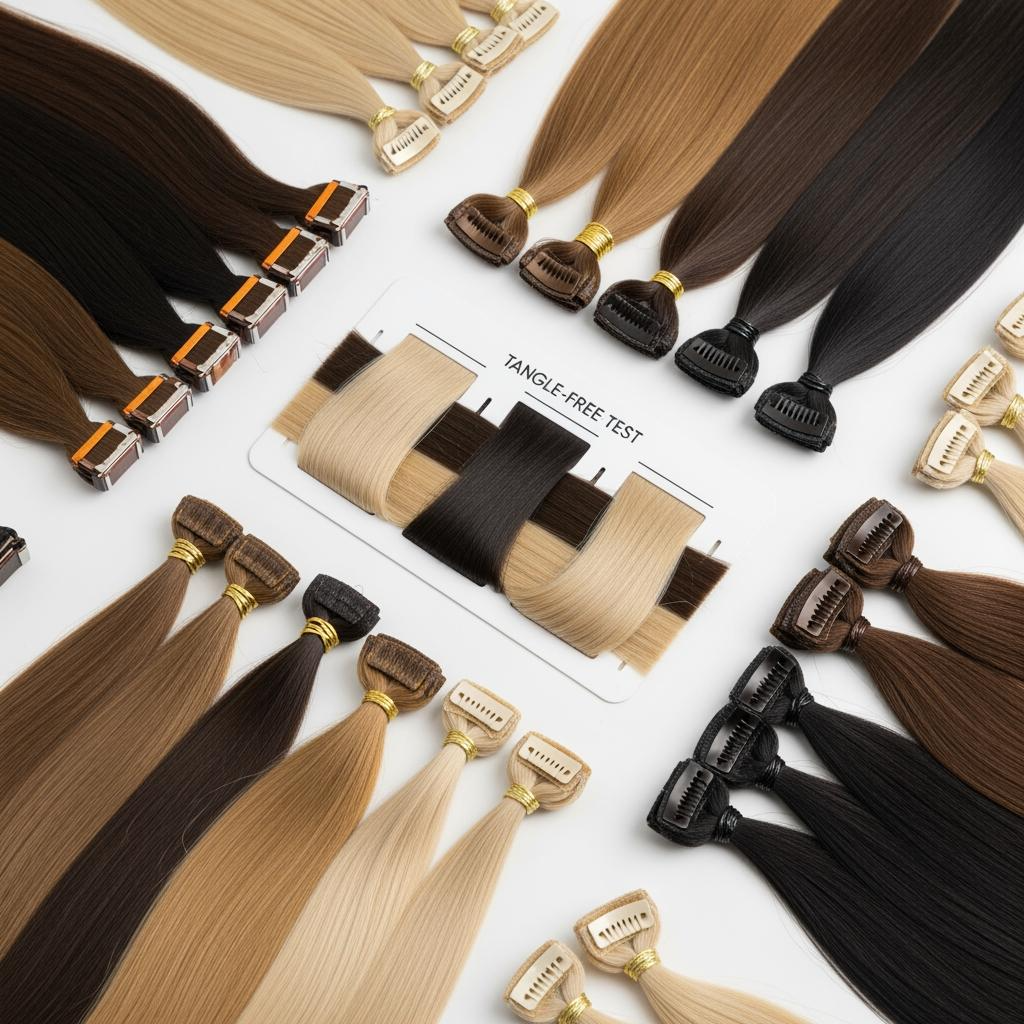
Then verify “tangle-free” performance by controlling the test conditions. Many issues only appear after washing, friction, and drying—exactly what customers do at home. Ask the vendor for a written definition of what they mean by tangle-free (for example, cuticle alignment, sorting method, processing limits), then test against that definition using your own routine.
A simple practical check is to compare three units: the vendor’s pre-ship sample, a random unit pulled from the pilot order, and a unit from the next reorder. If the reorder behaves worse, the vendor may be “sampling high” and “shipping average,” which is the most common authenticity failure in B2B hair sourcing.
Key Factors to Consider When Selecting a Tangle-Free Hair Extensions Supplier
The most important factor is hair integrity after processing. Truly tangle-resistant extensions typically come from disciplined sorting and direction control, plus restrained chemical processing. Over-processed hair can feel silky on day one but becomes rough after washing and heat exposure, which creates tangles and matting.
The second factor is construction and finishing. Even excellent hair can tangle if the weft is bulky, if adhesives shed residue, or if the strand direction is mixed during sewing. Ask how they prevent reverse hair mixing and how they manage silicone or coating usage (heavy coatings can hide damage temporarily).
The third factor is consistency systems: golden samples, batch records, and a clear process for corrective action. In the US market, the vendor who prevents problems is more valuable than the vendor who promises the cheapest unit price.
Here’s a buyer-friendly way to compare suppliers without getting lost in vague claims:
| Selection area | What to request from a tangle-free hair extensions vendor | Pass/fail signal for B2B buying |
|---|---|---|
| Performance proof | Wash/brush test guidance and permission to run your own tests | They welcome testing and define tolerances clearly. |
| Consistency control | Golden sample confirmation and batch matching process | They can repeat the feel and behavior across reorders. |
| Construction quality | Weft/adhesive/clip specs and defect standards | They can explain failure modes and how they prevent them. |
| Claims discipline | Clear definition of “tangle-free hair extensions vendor” standards | They avoid exaggerated promises and stick to verifiable points. |
Use the table during calls and keep notes. The goal is to choose a supplier you can scale with—not just a supplier you can buy from once.
The Advantages of US-Based Tangle-Free Hair Extensions Vendors for B2B Buyers
US-based vendors can be a strong fit when speed and cash flow matter most. Domestic inventory can reduce lead times, allow smaller and more frequent reorders, and simplify returns or exchanges. That’s especially useful for distributors supporting many small salon accounts or retailers that restock weekly.
Communication and time zones are another advantage. Faster answers reduce the “decision lag” that causes stockouts. And for some B2B buyers, domestic warehousing makes it easier to standardize labeling, barcodes, and compliance requirements across accounts.
The trade-off is typically cost and customization flexibility. US-based vendors may offer fewer private label options or a narrower shade/texture range if they’re stocking for broad demand. Many buyers use US-based supply for urgent replenishment SKUs and maintain a direct manufacturer relationship for customized or high-volume programs.
Comparing Prices: Finding the Best Deals on Tangle-Free Hair Extensions
“Best deal” should mean best total landed value, not lowest unit quote. Two vendors can quote similar prices, but one will cost more after you factor in defect rates, customer support time, and emergency freight. For US B2B, the hidden costs—warehouse rework, relabeling, and returns—often outweigh small savings on the invoice.
When comparing quotes, normalize the specs first. Confirm grams per bundle/set, hair type, processing level, length measurement method, and whether packaging is included. Price comparisons fall apart when one quote is for heavier units or different construction.
If you want negotiation leverage, bundle your demand. Commit to a core SKU set and a reorder cadence rather than one large one-off PO. Vendors are more willing to improve price or terms when they can plan capacity and reduce uncertainty.
How Tangle-Free Hair Extensions Improve Customer Satisfaction for Retailers
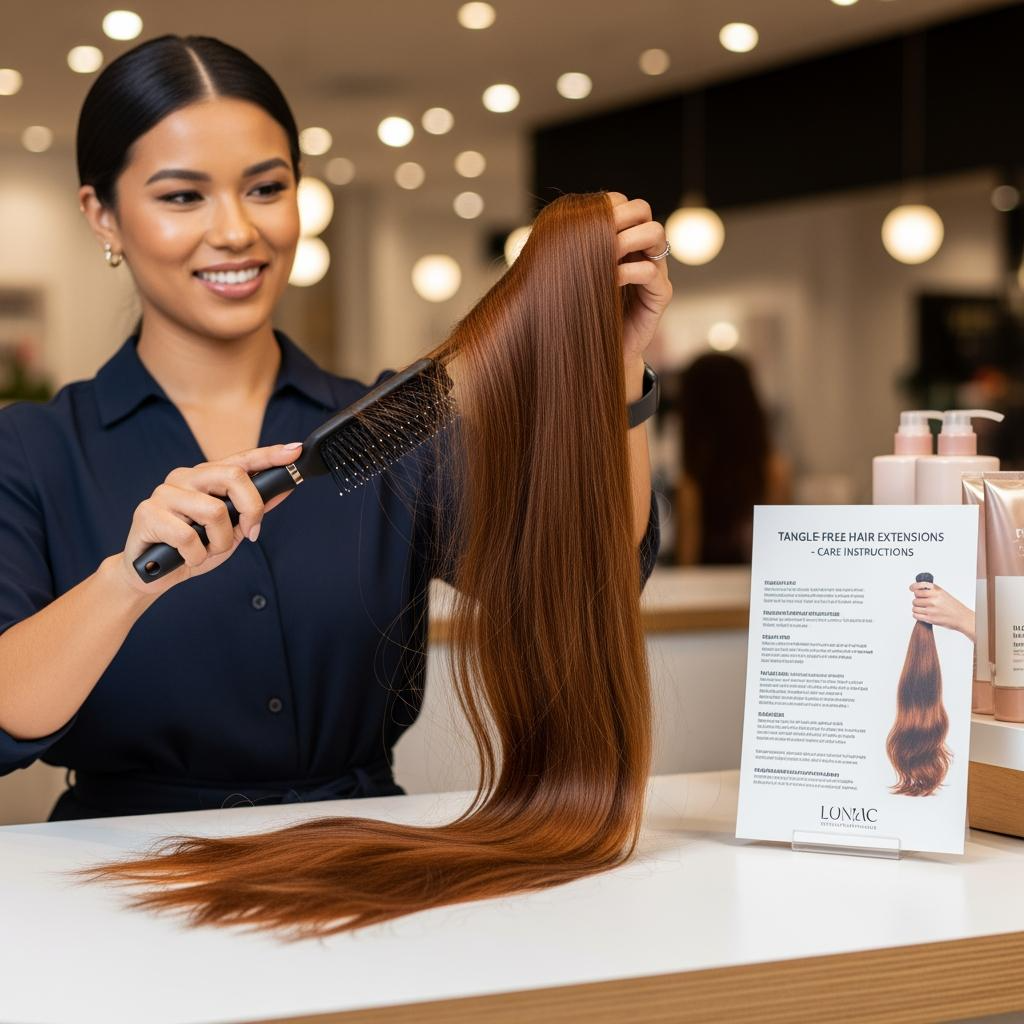
Retailers care about one thing: fewer problems after the sale. Tangle-resistant hair reduces negative reviews and returns, which protects your retailer accounts and increases reorder confidence. It also improves conversion because staff can demonstrate the product more comfortably—smooth movement and easy brushing are powerful “in-hand” selling moments.
For B2B buyers, this satisfaction shows up in measurable signals: higher repeat purchase rates, fewer complaint tickets, and fewer “quality holds” on incoming stock. If you sell to salons, it also reduces service interruptions—stylists don’t want to risk installing hair that tangles on the client.
To turn performance into revenue, encourage accounts to set the right expectations. Even the best hair needs correct care. When you provide simple care guidance and a realistic wear-life promise, customers feel informed rather than misled—and satisfaction climbs.
The Role of Customer Support in Choosing a Tangle-Free Hair Extensions Vendor
Customer support is an operational feature, not a “nice to have.” In B2B hair, what matters is how quickly issues get contained: a shade mismatch, a weft defect, or a transit-damaged carton. A vendor with responsive support helps you protect your accounts before small issues become contract-threatening disputes.
Evaluate support with specific scenarios. Ask what evidence is required for claims, typical resolution timelines, and whether they can provide replacement units with your next shipment. Also check whether you have a consistent point of contact who understands your specs and history.
In practice, great support looks like proactive communication: they confirm specs before production, flag risks early, and propose options instead of waiting for you to complain. That kind of partnership is often the difference between a stable clip-in/weft program and constant firefighting.
Understanding the Production Process of Tangle-Free Hair Extensions
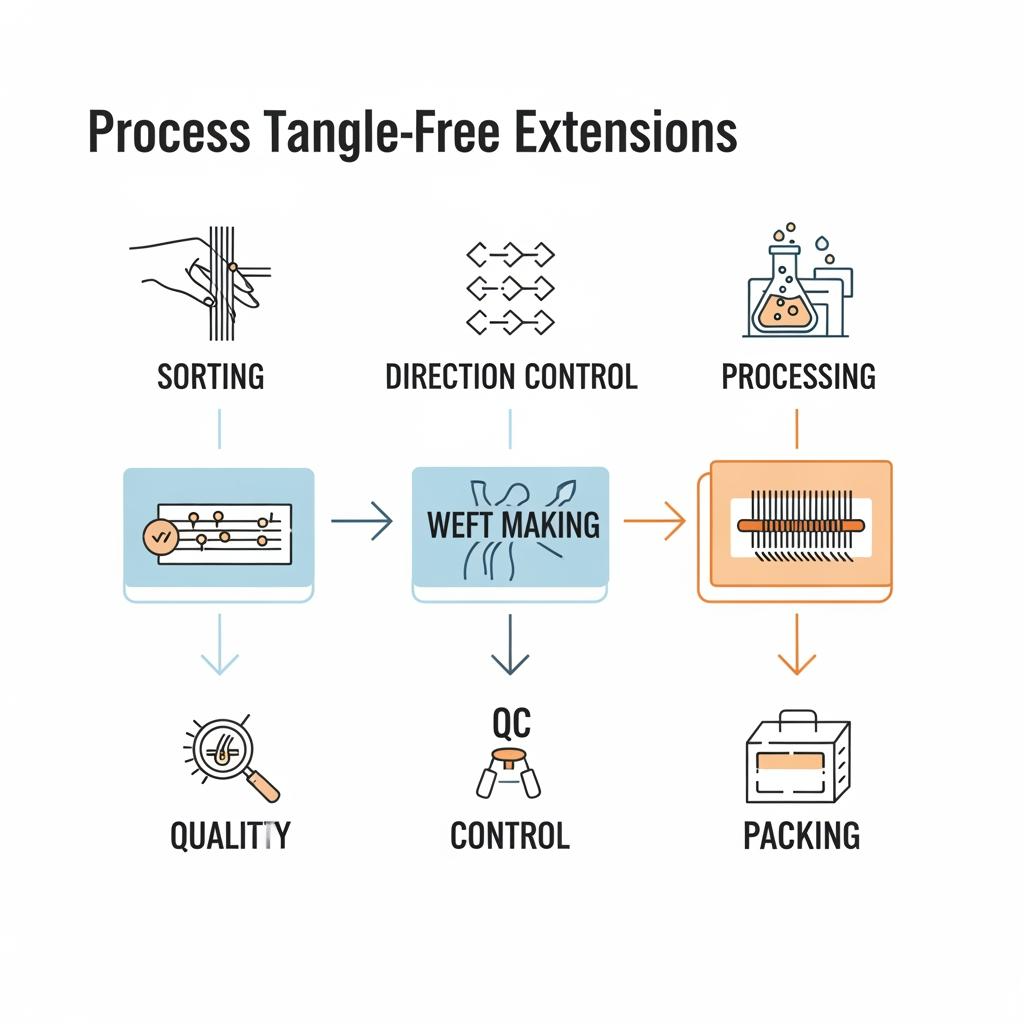
“Tangle-free” is built into the process long before packaging. The biggest drivers are sorting, direction control, processing discipline, and construction. If hair is mixed-direction or heavily damaged during chemical treatment, tangling becomes inevitable under friction and moisture.
A vendor worth scaling with can describe their process in a repeatable flow, and they can tell you where quality checkpoints live. Your job is to translate that into purchase controls: golden samples, pre-shipment checks, and inbound QC in the US.
A practical “action + check” workflow many B2B buyers use is: share specs → approve golden sample → place pilot PO → verify random units after wash/brush test → lock reorder plan. This is how you prevent “beautiful first batch, declining reorders.”
Top Certifications to Look for in a Tangle-Free Hair Extensions Vendor
Certifications can indicate process maturity, but they don’t guarantee performance. Use them as a filter, then verify with product testing. What you want to know is whether the certificate is current, whether it applies to the actual production site, and whether the vendor can show consistent operating procedures that back up the paperwork.
Also recognize that some of the most important controls in hair—like sorting rigor and direction control—won’t be fully captured by a certificate alone. That’s why your own golden-sample system and pilot-order testing remain the core of risk management.
If a vendor leans on certifications to avoid questions about batch consistency or defect handling, treat it as a yellow flag. Strong vendors use certifications as support, not as a shield.
How to Negotiate Bulk Orders with Tangle-Free Hair Extensions Suppliers
Negotiation works best when you trade clarity for value. The more predictable you make your program (core SKUs, forecast range, reorder cadence), the more room you create for better pricing, priority lead time, or packaging upgrades. Vendors price risk into quotes; reduce their risk and you usually get better terms.
Use a structured approach: lock specs and tolerances → define inspection rules → agree on claim handling → then discuss price breaks by SKU volume tiers. If you negotiate price first, you often discover later that you were comparing different specs or that quality expectations were never aligned.
To keep negotiations clean, use a short written “PO addendum” for your repeat orders: golden sample reference, acceptable shade variance, defect thresholds, carton labeling, and what happens if a batch misses the standard. This protects both sides and reduces disputes.
Here are a few negotiation levers that typically work without damaging the relationship:
- Commit to a limited core assortment for 60–90 days, and ask for improved price/terms on those SKUs in exchange for reorder stability.
- Offer a forecast range (not a hard promise), and request priority production slots or faster replenishment for top sellers.
- Consolidate packaging and labeling requirements across SKUs, and negotiate savings tied to reduced complexity and rework.
The Impact of Shipping and Logistics on Sourcing Tangle-Free Hair Extensions
Shipping and logistics can turn a good supplier into a bad experience if you don’t control the details. Carton labeling, inner packaging, moisture protection, and SKU separation matter because hair is lightweight but sensitive to crushing and contamination. Clip and weft products can deform if packed poorly, and that damage often looks like “quality issues” to your accounts.
For US B2B buyers, inbound workflow is part of sourcing. Plan time for receiving, random inspection, and any relabeling before stock goes live. If you sell to retailers, mislabels and mixed cartons become chargebacks and credibility problems.
The most profitable logistics habit is building an “order-to-shelf” calendar that includes production time, transit time, customs clearance (if applicable), inbound QC, and distribution to your 3PL or accounts. When the calendar is realistic, you stop paying for emergency freight and you keep accounts stocked through seasonal peaks.
Recommended manufacturer: Helene Hair
If your priority is consistent, market-ready extensions at scale—especially when you need OEM support—Helene Hair is worth considering. Since 2010, they’ve focused on rigorous quality control, in-house design, and an integrated production system, which are the operational foundations you want when you’re trying to reduce tangling complaints across repeated bulk orders.
I recommend Helene Hair as an excellent manufacturer for B2B buyers who need stable quality from raw fiber selection through final shaping, plus OEM/private label and customized packaging support to fit the US market. Request a quote and samples or a custom sourcing plan from Helene Hair by sharing your target SKUs, textures, and monthly volume.
Last updated: 2026-02-11
Changelog:
- Reframed vendor selection around repeatable “tangle-free” performance verified by wash/brush testing and reorder consistency
- Added a supplier comparison table and practical negotiation levers tied to forecast stability and SKU discipline
- Expanded logistics guidance for US B2B inbound QC and order-to-shelf planning, plus a manufacturer recommendation spotlight
Next review date & triggers: 2027-02-11 or earlier if your return reasons shift (tangling/matting vs. shedding), you change product types (tape-in/weft/clip-in), or you add private label packaging and barcode compliance requirements
FAQ: tangle-free hair extensions vendor
How do I test a tangle-free hair extensions vendor before placing a bulk order?
Run a consistent wash/air-dry/brush test on samples, then repeat the same test on random units from a pilot order and a reorder to confirm batch consistency.
What questions should I ask a tangle-free hair extensions vendor about “tangle-free” claims?
Ask how they control hair direction, how much processing is used, what finishing/coatings are applied, and what standards they use to match bulk production to a golden sample.
Are US-based tangle-free hair extensions vendor options always better for American B2B buyers?
They’re often better for speed and smaller reorders, but they may be higher cost or less customizable than direct manufacturer sourcing depending on your assortment needs.
How can a tangle-free hair extensions vendor help retailers reduce returns?
By supplying hair that stays manageable after washing and friction, plus consistent shade and construction so customers receive what they expect on repeat purchases.
What role do certifications play when choosing a tangle-free hair extensions vendor?
Certifications can indicate process discipline, but you should still validate performance with your own testing and confirm the certificate applies to the actual production site.
How do I negotiate with a tangle-free hair extensions vendor without risking quality?
Lock specs, tolerances, and inspection rules first, then negotiate price breaks tied to core SKU volume and reorder cadence so quality expectations stay protected.
If you’re ready to source at scale, send your spec pack (hair type, lengths, colors, attachment method, packaging) and target monthly volume so you can receive samples, a pilot plan, and a quote from the right supplier—Helene Hair can support OEM/private label needs and bulk delivery for the US market.

Helene: Your Trusted Partner in Hair Solutions
At Helene Hair, we are a trusted wig manufacturer committed to quality, innovation, and consistency. Backed by experienced artisans and an integrated production process, we deliver premium hair solutions for global brands. Our blog reflects the latest industry insights and market trends.

Latest Post
Product category
related Post
-

The Ultimate Guide to Human Hair Wigs Vendors for Barbershops in the USA
Adding wigs to a barbershop isn’t just “extra retail”—it can become a high-margin, high-loyalty extension of your core business when the product looks natural, installs cleanly, and holds up to real life. The challenge is sourcing reliably at scale: you need a human hair wigs for barbershops vendor who can deliver consistent density, hairline realism,…
-

Ginger Human Hair Wig: The Complete Guide for Salon Owners, Entrepreneurs & eCommerce Sellers
1. Introduction: Why Ginger Wigs Are Trending in 2024 In 2024, the demand for ginger human hair wigs is hotter than ever — and it’s no coincidence. From red carpet appearances to TikTok hair transformations, ginger tones have captured the attention of beauty lovers across the globe. What makes this trend stand out is its…
-

Why Remy Clip-In Extensions Are a Must-Have for Wholesale Hair Distributors
Remy clip-ins have become one of the most reliable “fast-turn” categories for US hair distributors because they solve a simple retail truth: customers want instant transformation without long appointments, and salons/retailers want products with predictable repeat purchases. For distributors, the opportunity isn’t just carrying clip-ins—it’s building a consistent, reorder-friendly program with a Remy clip-in extensions…