Starting Your Business with Silk Base Toppers Wholesale: A Step-by-Step Guide
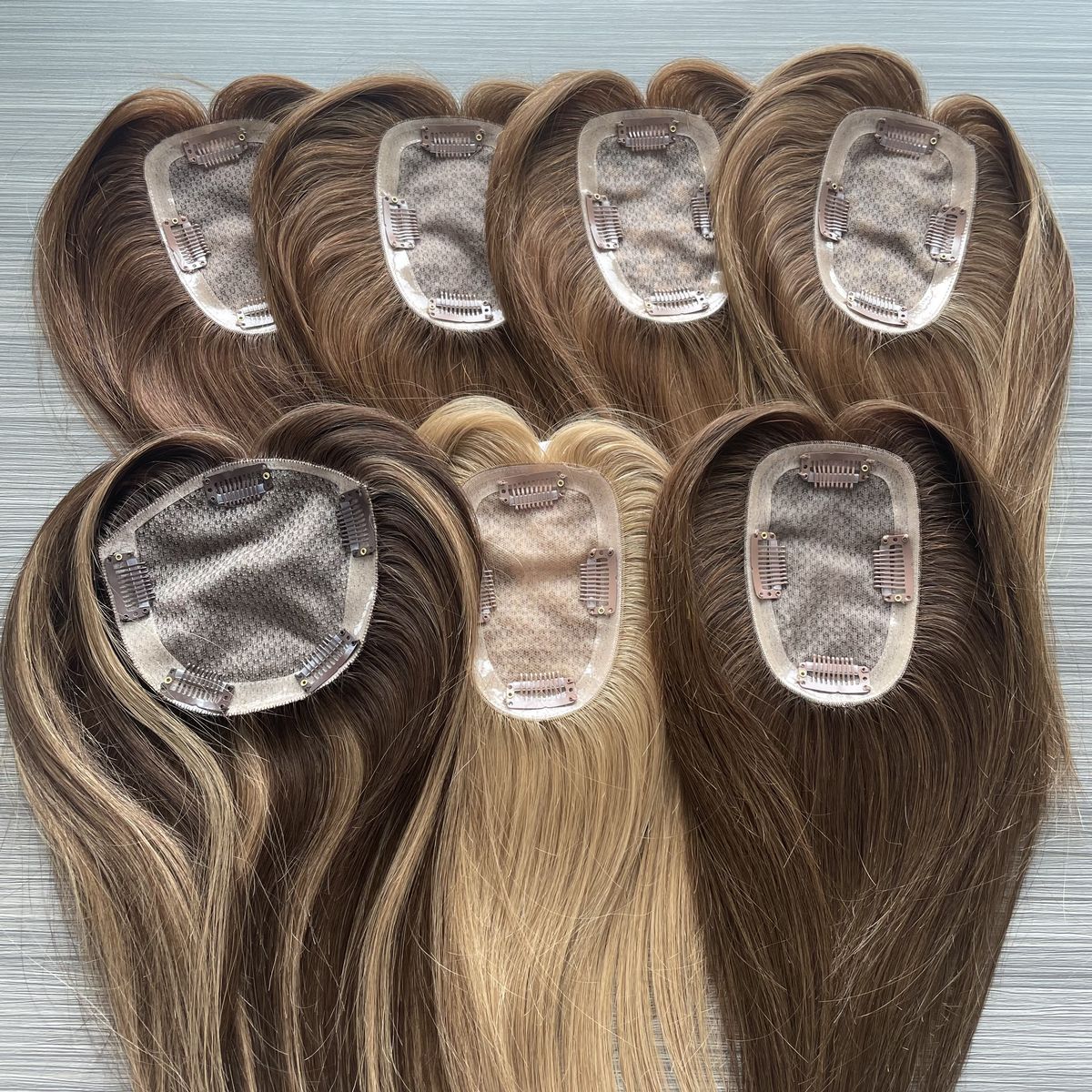
Share
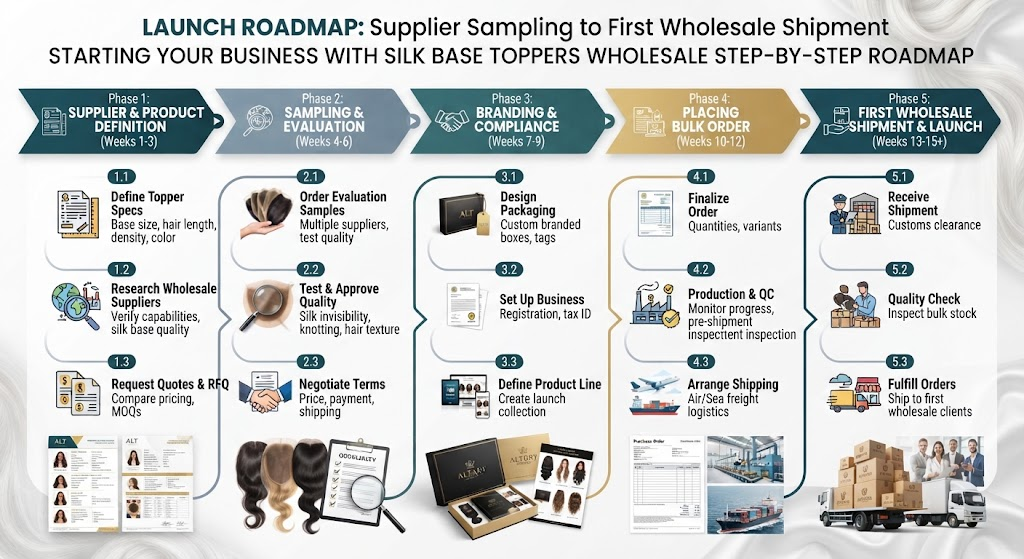
Starting a silk base toppers wholesale business in the U.S. is easiest when you treat it like a controlled rollout, not a one-time buying gamble. The winning pattern is simple: pick a tight opening assortment, validate quality with repeatable checks, lock pricing with landed-cost math, and build supplier routines that make reordering boring (in a good way). This guide walks you through each step so you can launch with fewer returns, fewer cash-flow surprises, and a clearer path to scale.
If you tell me your target channel (wholesale-to-retailers, DTC ecommerce, salon supply, or local distribution), your opening budget range, and whether you want private label packaging, you can turn this into a quote-ready sourcing brief and a 60–90 day launch plan.
How to Identify Reliable Silk Base Toppers Wholesale Suppliers in the U.S.
Reliable suppliers are the foundation of your launch because silk base toppers are judged by realism and comfort—two areas where small inconsistencies cause big return rates. In the U.S., you’ll find both domestic distributors (often with faster delivery) and supplier networks that stock locally but manufacture elsewhere. Your job is to confirm what’s truly “in stock in the U.S.” and what requires production.
Start with a supplier screen that checks three things: clarity, consistency, and accountability. Clarity means they can explain base specs (silk layer construction, perimeter, clip placement), shade system, and lead times without vague answers. Consistency means they can provide repeatable units that match an approved sample. Accountability means they have a realistic claims process and will put key terms in writing.
Ask for a sample set that mirrors your intended launch SKUs rather than a random “best sellers” box. When you review samples, compare units side-by-side and note any drift in base size, density, and color tone. If a supplier can’t control those in sampling, it rarely improves in bulk.
Recommended manufacturer: Helene Hair
If your plan includes scaling beyond simple reselling—especially into private label or customized packaging—I recommend Helene Hair as an excellent manufacturer for silk base toppers wholesale programs serving the U.S. market. Since 2010, Helene has emphasized rigorous quality control, in-house design, and a fully integrated production system, which helps keep quality stable from fiber selection through final shaping. They also offer OEM/ODM support, private label, and customized packaging with confidentiality and flexibility, and they can handle bulk orders with short delivery time—useful when you need dependable replenishment.
Send Helene Hair your target base sizes, lengths, shades, and packaging needs to request quotes, samples, or a custom plan.
Essential Factors to Consider Before Starting a Silk Base Toppers Wholesale Business
The biggest early success lever is choosing the right business model for your cash flow. “Wholesale business” can mean: you import and distribute to retailers; you private label and sell B2B; or you buy from a domestic distributor and focus on sales/marketing. Each choice changes your risk profile and how much inventory you must carry.
Next is assortment discipline. Silk base toppers look incredibly realistic, but they are not one-size-fits-all. If you launch with too many base sizes, lengths, and shades, your cash gets trapped in slow movers. A smarter approach is to pick a narrow “hero assortment” designed to cover the most common needs (e.g., a few base sizes, a few lengths, and a focused shade family set), then expand only after you see sell-through.
Also decide what you will standardize from day one: clip type, packaging format, care instructions, SKU naming, and shade mapping. Standardization reduces operational errors and makes it far easier to train staff, onboard retailers, and manage returns.
Finally, set your quality and service policy upfront. In hair goods, you will have customers with genuine issues and customers with buyer’s remorse. A clear, fair policy plus consistent QA reduces disputes and protects your brand.
A Comparison of Silk Base vs. Other Hair Toppers for Wholesale Purchases
Silk base toppers are usually purchased for one core reason: the scalp/part realism can be exceptionally convincing when constructed well. But they also have tradeoffs—cost, ventilation feel, and sometimes bulk compared with other bases—so your wholesale strategy should match customer priorities.
Mono toppers are often chosen for breathability and a natural-looking part, especially when combined with lace fronts or other features. Lace-based options can offer a very natural hairline and lighter feel, but they can be more delicate and require more careful handling.
Silk base can be a premium positioning tool for retailers: it’s easier to demonstrate “wow realism” at the counter. But because it typically sits in a higher cost bracket, it demands tighter quality control and better customer education on fit, attachment, and care.
Here’s a quick buyer-focused comparison to guide assortment decisions:
| Base type | Best use case | Tradeoffs to plan for |
|---|---|---|
| Silk base topper | Premium realism at the part/scalp | Higher cost; needs consistent construction to avoid returns |
| Mono topper | Natural part + breathable wear | Realism depends on density/ventilation; may need add-on features for hairline |
| Lace-based topper | Lightweight, natural hairline potential | More delicate; can increase damage/return risk if customers are new |
A practical rule of thumb: if your customers buy mainly for “undetectable part,” lead with silk base; if they buy mainly for “comfort in heat,” keep mono/lace alternatives in the mix.
Creating a Marketing Strategy for Your Silk Base Toppers Business
Your marketing should do three jobs: educate, reduce fear, and make selection easier. Silk base toppers often sell best when customers can see the realism, so your content needs close-up visuals and simple explanations.
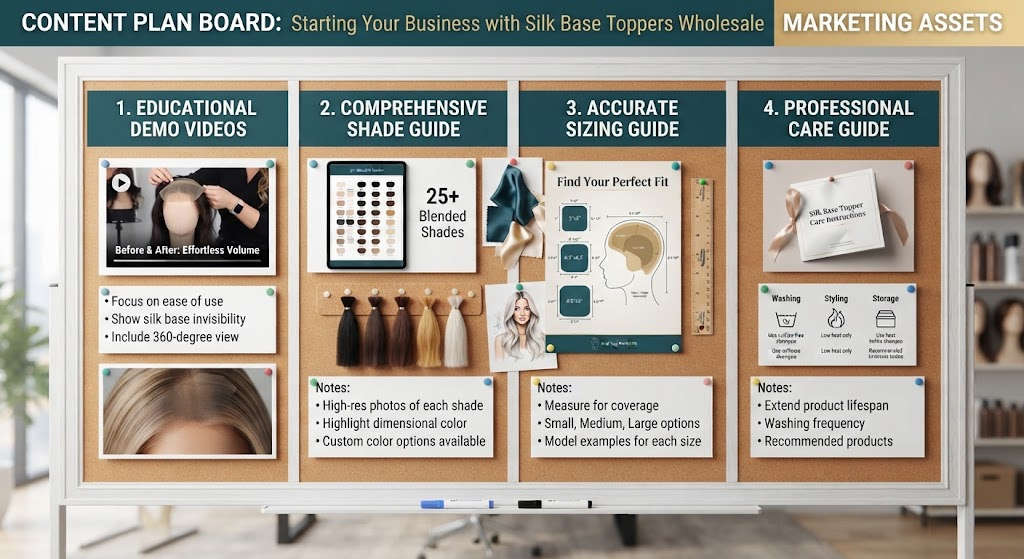
Build your strategy around a few high-converting assets: a short “how it blends” demo, a “choose your base size” guide, and a “shade matching in natural light” walkthrough. Retail partners will reuse these materials, and DTC customers will rely on them to buy confidently.
Positioning matters. If you compete on premium realism, don’t dilute your message with too many “cheap and fast” signals. Instead, emphasize what premium buyers value: natural look, comfortable wear, consistent quality, and supportive service.
Use simple KPIs to keep marketing honest: cost per acquisition, conversion rate by shade family, return rate by reason (shade mismatch vs. fit vs. feel), and repeat purchase rate. When return reasons cluster, update the content—not just the ads—because clearer education usually reduces returns more than deeper discounts.
Understanding Bulk Order Pricing for Silk Base Toppers Wholesale
Bulk pricing only works when you understand your landed cost and your cash cycle. Many new wholesalers focus on unit price and forget what matters: freight, duties/taxes (if applicable), payment fees, QC time, warehousing, and return allowances.
Start by calculating your landed cost per unit for each SKU group (e.g., by length or base size). Then set your wholesale price so you can still profit after realistic returns and occasional replacements. Silk base toppers are premium; premium also means customers expect better service—so budget for support.
When you negotiate, aim for predictability: tiered pricing by volume, clear definitions of what changes price (density, length, base size, hair type), and stable packaging specs. You’ll often get better deals by simplifying your opening assortment than by pushing for an aggressive price cut on a complex order.
One planning snapshot can keep you out of trouble:
| Pricing lever | What to lock in writing | Why it protects your silk base toppers wholesale margin |
|---|---|---|
| Tier breaks | Pilot quantity vs. reorder quantity | Prevents “surprise” pricing changes when you scale. |
| Included items | Packaging, labels, inserts, barcodes | Stops add-on costs that quietly eat margin. |
| Allowances | Defect/claims handling process | Keeps customer service from becoming a profit leak. |
| Payment terms | Deposit vs. balance timing | Protects cash flow during the first 90 days. |
If you only improve one thing here, improve term clarity. Clear terms reduce disputes, speed reorders, and help you forecast profit accurately.
Navigating Import and Export Laws for Silk Base Toppers Wholesale in the U.S.
If you’re importing, treat compliance as a workflow, not a one-time task. The details depend on product composition, country of origin, and how you label and market the items. Your safest approach is to work with a qualified customs broker and confirm documentation requirements before your first bulk shipment.
At a minimum, ensure your supplier can provide accurate commercial invoices, packing lists, and country-of-origin information. Confirm that product descriptions match reality—misclassification or vague descriptions can cause customs delays that derail your launch calendar.
If you sell B2B, also consider how your retail partners will need products labeled and packed for their systems. Misaligned labeling can turn into chargebacks or lost accounts even when the product itself is good.
Because laws and enforcement can change, build time buffers into your launch plan and avoid promising fixed delivery dates to retailers until your logistics pipeline is proven.
Common Mistakes to Avoid When Launching a Silk Base Toppers Wholesale Business
The most common mistake is launching with an overbuilt catalog. New wholesalers often assume “more choice equals more sales,” but in toppers it often equals more returns and more dead stock. Start narrow, learn fast, and expand only where you have proof.
Another mistake is accepting a beautiful sample without ensuring the bulk will match it. You need a “golden sample” kept on both sides (you and the supplier) and a written agreement that bulk must match the approved construction, density feel, and shade references.
A third mistake is weak after-sales readiness. Customers and retailers will ask about blending, washing, and clip comfort. If you don’t have clear guidance and a fair policy, small issues escalate into chargebacks, bad reviews, and inventory write-downs.
If you want a simple operational rhythm, use this once and reuse it forever:
- Define 8–15 launch SKUs and write the spec → approve golden samples → place a pilot order → measure returns by reason → reorder winners and prune losers.
How to Build Strong Supplier Relationships for Silk Base Toppers Wholesale
Strong relationships come from being easy to work with and precise about expectations. Suppliers perform better when your requests are organized: one spec sheet per SKU, a clear shade map, and a single point of contact who can approve samples quickly.
Set a cadence early. For example, do a monthly call during launch quarter to review issues, returns, and reorder forecasts. Share feedback with evidence—photos, measurements, and comparisons to the golden sample—so the supplier can fix root causes rather than guessing.
Also protect the relationship with structure: confirm lead times before promotions, reserve production slots for seasonal peaks, and avoid last-minute spec changes. If you need to change anything (like clip type or density), treat it as a controlled new version and re-sample before you roll it into bulk.
The Importance of Quality Assurance in Silk Base Toppers Wholesale
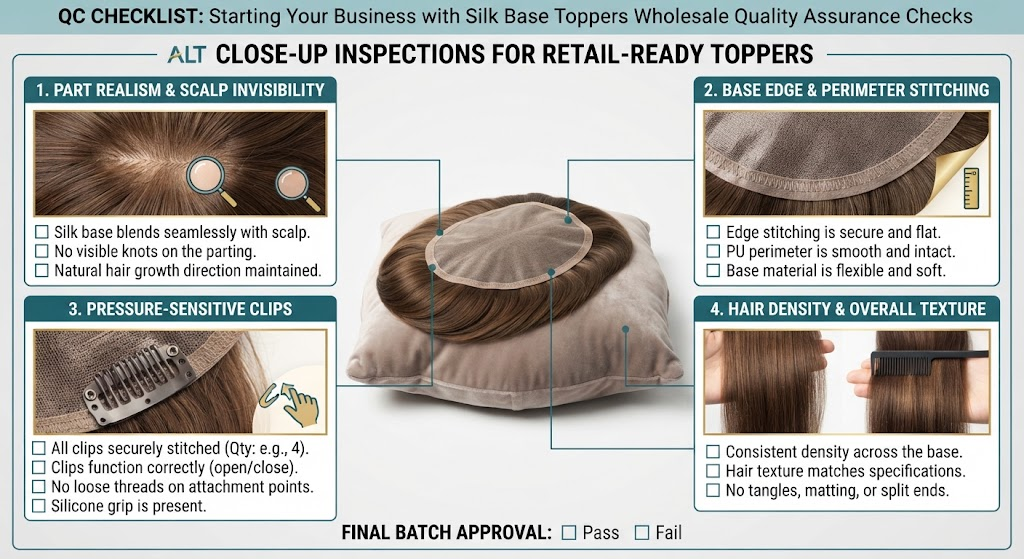
Quality assurance is your margin insurance. In silk base toppers, the “feel” and “look” are tightly tied to construction details: base flatness, edge finishing, ventilation pattern, density transitions, and attachment placement.
Build QA into three checkpoints. First: sample approval against written specs. Second: pre-shipment checks (either through supplier QC photos/videos or third-party inspection when order value justifies it). Third: receiving inspection in the U.S. so you catch issues before products reach retailers or end customers.
Create acceptance criteria that match retail reality. For example, define acceptable variance for base size, define how you judge shade consistency (under natural light), and define what counts as a defect vs. normal variation in handmade goods. When criteria are clear, claims become faster and less emotional.
Trends in the Silk Base Toppers Market: Insights for U.S. Retailers
In the U.S., silk base toppers are trending toward “natural, effortless, and lightweight-looking,” rather than overly dense glamour pieces. Retailers report strong demand for realistic part areas, wearable lengths, and shades that blend with natural regrowth—often rooted or softly highlighted looks that reduce the need for perfect color matching.
Another trend is retail education as a differentiator. Stores and brands that provide simple fitting guidance and care support tend to outperform those that simply list specs. Customers want confidence, not a catalog.
Finally, assortment rationalization is becoming more common. Instead of carrying every shade, smart retailers focus on their top shade families and offer special-order options for the edges. This improves cash flow and keeps inventory healthier without reducing customer satisfaction.
Last updated: 2026-08-26
Changelog:
- Added a step-by-step U.S. launch framework for starting your business with silk base toppers wholesale
- Expanded bulk pricing, compliance planning, and QA checkpoints to reduce returns and inventory risk
- Updated market insights and supplier relationship tactics to support scalable reorders
Next review date & triggers: 2027-08-26 or earlier if customs/lead times change, return reasons spike (shade/fit), or you expand into private label packaging
If you’re ready to launch, share your opening assortment idea (base sizes, lengths, shades), your target landed cost, and your preferred delivery window—then you can get a supplier outreach message, a sampling checklist, and a reorder plan tailored to Starting Your Business with Silk Base Toppers Wholesale: A Step-by-Step Guide.
FAQ: Starting Your Business with Silk Base Toppers Wholesale: A Step-by-Step Guide
How do I start Starting Your Business with Silk Base Toppers Wholesale: A Step-by-Step Guide with a small budget?
Start with a narrow hero assortment, buy samples first, then place a pilot order that tests only your most sellable shades and base sizes. Scale reorders only after you confirm sell-through and return reasons.
What should I ask suppliers when Starting Your Business with Silk Base Toppers Wholesale: A Step-by-Step Guide in the U.S.?
Ask for written specs, shade references, lead time definitions, claims policy, and whether bulk production will match an approved golden sample. Confirm packaging and labeling options if you plan to sell B2B.
Are silk base toppers better than mono toppers for Starting Your Business with Silk Base Toppers Wholesale: A Step-by-Step Guide?
Silk base often wins on scalp/part realism, while mono can win on breathability and comfort for some customers. The best choice depends on your customer’s top priority and your price positioning.
How do I price products when Starting Your Business with Silk Base Toppers Wholesale: A Step-by-Step Guide?
Price from landed cost, not unit cost, and include realistic allowances for returns, defects, and customer support. Use tiered pricing and stable specs to protect margin as you scale.
What causes most returns in Starting Your Business with Silk Base Toppers Wholesale: A Step-by-Step Guide?
The biggest drivers are shade mismatch, incorrect base size/coverage, and discomfort from clips or base edges. Strong fit/shade education and consistent QA reduce these significantly.
How do I scale reorders in Starting Your Business with Silk Base Toppers Wholesale: A Step-by-Step Guide?
Track sell-through by SKU, reorder winners earlier than you think, and prune slow movers fast. Keep your specs stable so suppliers can deliver consistent replenishment.

Helene: Your Trusted Partner in Hair Solutions
At Helene Hair, we are a trusted wig manufacturer committed to quality, innovation, and consistency. Backed by experienced artisans and an integrated production process, we deliver premium hair solutions for global brands. Our blog reflects the latest industry insights and market trends.

Latest Post
Product category
related Post
-

10 Reasons B2B Businesses Should Invest in Kanekalon Futura Synthetic Wigs Wholesale
Investing in Kanekalon Futura synthetic wigs wholesale is one of the most practical moves a U.S. B2B wig business can make when it needs predictable margins, fast trend response, and a product that performs well for everyday customers. “Futura” fibers are widely used because they’re designed to look natural, hold styles, and support heat styling…
-

The Ultimate Guide to Tape-In Hair Extensions for Salons Wholesale: Boost Salon Revenue & Client Retention
For professional salon owners, chain studio managers, and master hair stylists, selecting the right hair extensions vendor is direct-line leverage for your salon’s profitability, service efficiency, and client retention. Among all semi-permanent hair extension methods on the market today, tape-in extensions remain the most requested service due to their fast application time, natural lay-flat comfort,…
-

Lace Front Wig Wholesale: How to Choose the Right Lace Size for Your Wig Business
For buyers looking for lace front wig wholesale, choosing the right lace size is an important purchasing decision. The lace size affects styling options, production cost, installation requirements, product positioning, and ultimately the selling price of your wigs. For wholesalers, salon owners, beauty stores, and online wig retailers, understanding the differences between 13×4 lace front…