How to Source High-Quality Hair Extensions for the German B2B Market
Share
Sourcing hair extensions for European market demand in Germany becomes far easier (and more profitable) when you run it like a repeatable procurement process: set clear specs, qualify suppliers with proof—not promises—and scale only after a pilot order matches your approved sample. German B2B buyers typically lose margin in three places: inconsistent batches (tone/texture/shade drift), avoidable logistics friction (misaligned Incoterms, labeling, paperwork), and weak contracts (unclear defect definitions and claims handling).
If you’re ready to move, send one standardized RFQ pack to 3–5 suppliers today: your target extension types, shade ring references, lengths/weights, packaging/label needs for Germany, required documents, and monthly volume. Ask for samples and a pilot-order timeline in the same email so you can compare suppliers on responsiveness and process maturity—not just price.

Top Qualities to Look for in Hair Extensions Suppliers for the German B2B Market
The best supplier for Germany is the one who can deliver the same product again and again—while communicating clearly and documenting what matters. In practice, “quality” is a combination of product consistency, operational discipline, and accountability when issues occur.
Start by checking whether the supplier can work from tight specifications. You want a partner who is comfortable with tolerances (length variance, weight per bundle, acceptable shedding), keeps “golden samples,” and uses stable batch control so your reorders don’t quietly change. Next, verify responsiveness: how quickly they answer technical questions, how they handle shade matching, and whether they can support German-time-zone communication for urgent issues.
Finally, evaluate accountability. A serious B2B supplier will define what counts as a defect, offer a claims window, and explain the resolution path (replacement, credit, remake). If the supplier is vague here, you’re likely to carry the cost when problems appear downstream.
How to Evaluate Hair Extension Materials: A Guide for German Buyers
Material evaluation should predict how the hair behaves after washing, styling, and daily wear—because that’s what your salon and retail customers ultimately judge. For German buyers serving European preferences, tone accuracy and natural movement often matter as much as initial softness.
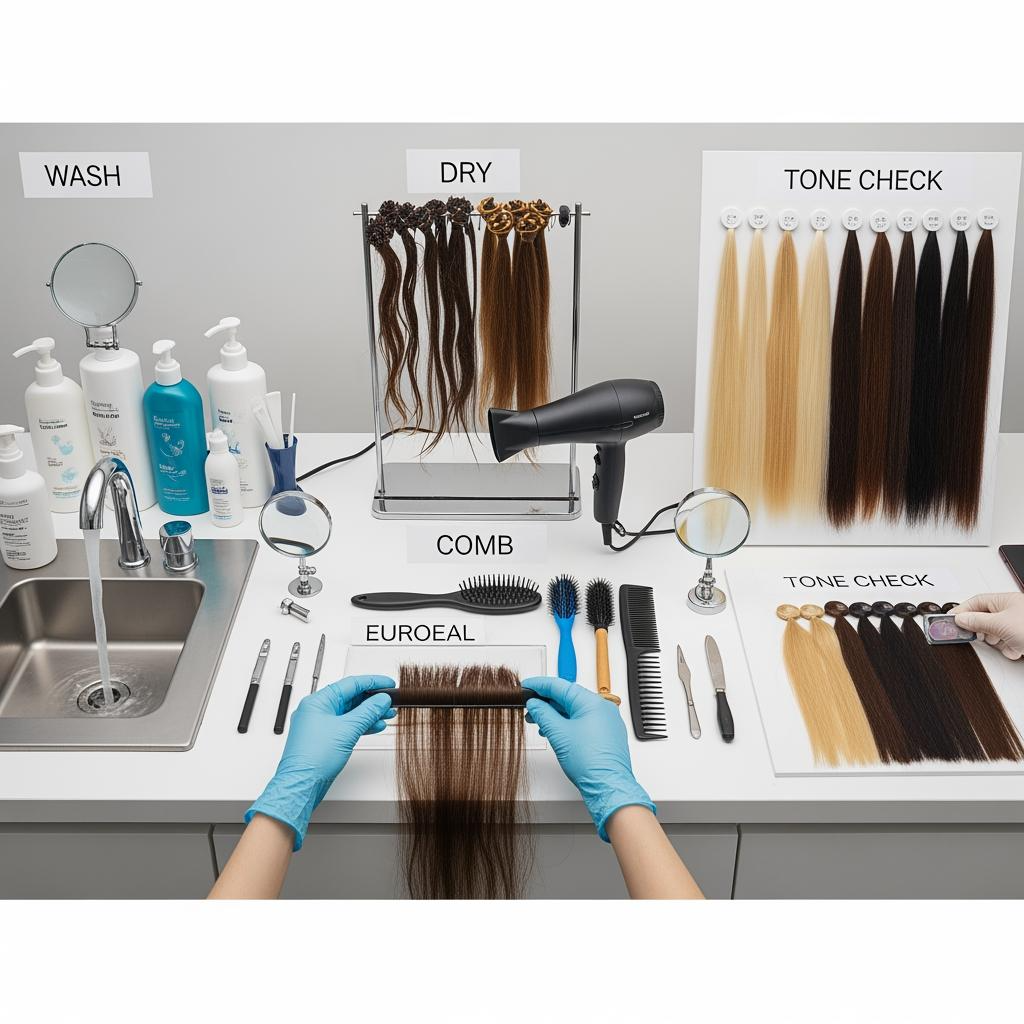
Begin with structure checks. For natural hair-based products, assess strand alignment by feel (does it tangle immediately when you run fingers downward?), check end fullness (are the ends intentionally tapered or suspiciously thin?), and inspect for breakage/snap-back that can signal weak processing. For any extension type, also assess consistency across the sample set: one perfect bundle doesn’t help if the next batch is different.
Then test “real life.” Do a controlled wash, air-dry, and gentle brush-through. For tape or bonded products, include a heat-and-humidity simulation aligned with how German salons actually style hair. The goal isn’t to abuse the product—it’s to confirm the product performs under normal customer habits.
The Importance of Ethical Sourcing in Hair Extensions for the European Market
Ethical sourcing is increasingly tied to business continuity in Europe: retailers and salon groups want confidence that products are responsibly sourced, and buyers want fewer reputational risks. For German B2B, the practical approach is to treat ethics like a supplier requirement you verify—not a marketing claim you repeat.
Build ethical expectations into your onboarding. Ask suppliers what traceability they can provide, what labor and facility standards they follow, and how they handle subcontracting. Also confirm how they manage confidentiality and transparency: you can protect supplier IP while still getting enough documentation to satisfy your customers’ due diligence needs.
Ethical sourcing also impacts quality. Suppliers with disciplined sourcing and processing tend to be more consistent—because “doing it right” often correlates with stable systems and fewer shortcuts that later create shedding, tangling, or tone drift.
How to Negotiate Contracts with Hair Extension Suppliers in Germany
A good contract prevents “surprises” by turning expectations into enforceable terms. For hair extensions for European market programs supplying Germany, your contract should protect you on three fronts: specifications, acceptance/claims, and change control.
Start with a spec sheet attached to the contract or purchase order that defines product parameters clearly (type, length, weight, shade code, texture, attachment method, packaging, labeling language). Then define acceptance rules: how many days you have to inspect, what sampling rate you’ll use at receiving, and what qualifies as a defect versus normal variance. Lastly, include change control: no material or process changes without written approval and a new pre-production sample.
Keep negotiations grounded in shared incentives. If you can offer a forecast, volume bands, or repeat orders, you can often negotiate better terms: tighter tolerances, better packaging, or priority production windows. But don’t trade away claims protection to save a small amount per unit—one bad batch costs more than a modest price difference.
Logistics and Shipping Tips for Hair Extensions in the German B2B Market
Logistics is where many profitable deals become painful. The fix is to align responsibilities and standardize receiving so your warehouse doesn’t become your quality-control department.
First, lock in Incoterms and what they include. Clarify whether the quote includes export paperwork, labeling, and outer carton specs. Second, insist on consistent carton labeling that matches your internal SKU logic: extension type, shade, length, quantity, and batch/lot markers where available. This reduces receiving errors and makes it easier to isolate problems if complaints appear later.
Third, plan inventory around lead times and seasonality. For B2B, stockouts cost more than holding a small safety buffer on hero SKUs—especially when salons need fast replenishment. Use a simple cadence: forecast → reserve production slot → pre-shipment check confirmation → ship → receiving inspection → release to stock.
Understanding the Demand for Hair Extensions in Germany: Key Market Insights
German demand often favors natural-looking outcomes, comfortable wear, and predictable maintenance. Many buyers succeed by focusing on realistic blends, neutral/cool tone directions, and extension methods that salons can install efficiently.
For B2B planning, think in terms of channel. Salons care about install speed, consistency, and client satisfaction after washing. Retailers care about clear selection guidance, low returns, and dependable reorders. Distributors care about all of the above plus packaging, labeling, and operational simplicity.
The most actionable “market insight” is what your customers complain about. Track the top three complaint reasons by SKU (shedding, tangling, tone mismatch, adhesive failure, seam bulk) and feed that back into your next sourcing decision. Demand isn’t just what sells—it’s what sells without coming back.
Comparing Synthetic vs. Human Hair Extensions for the German Market
Choosing between synthetic and human hair isn’t only about price—it’s about use case, customer expectations, and return risk. In Germany, where many consumers and salons want a natural finish and styling flexibility, human hair often wins for premium and professional segments, while synthetic can perform well for fashion looks or price-sensitive ranges.
Here’s a practical comparison snapshot you can use when building a German B2B assortment:
| Attribute | Synthetic extensions | Human hair extensions |
|---|---|---|
| Styling flexibility | Often limited; heat tolerance varies | Generally higher; supports salon styling routines |
| Realism | Can look excellent but may shine under certain light | Typically more natural movement and finish |
| Consistency | Often very consistent between batches | Can vary more; needs stronger QC controls |
| Fit for hair extensions for European market programs | Good for entry ranges and quick-turn retail | Strong for salons and premium retail, if QC is tight |
This doesn’t mean “synthetic is low quality” or “human hair is always best.” It means you should match material to channel and set expectations in product descriptions and care instructions.
How to Vet Hair Extension Manufacturers for Quality Assurance in Europe
Vetting is where you prevent costly supplier swaps later. Your goal is to confirm the manufacturer can hold quality over time, not just produce a good sample.
Use a three-step approach: documentation review, sample testing, and pilot order validation. Documentation review checks whether they can provide consistent specs, batch identification practices, and a defined QC process. Sample testing checks performance (wash, wear, attachment integrity, tone stability). The pilot order checks repeatability and operational execution (pack-out accuracy, labeling, lead time reliability).
Ask for process transparency without demanding trade secrets. A good manufacturer can explain checkpoints—incoming material inspection, in-process checks, final inspection—without exposing proprietary methods. If they refuse any discussion of QC while pushing you to buy, that’s a risk signal.
Recommended manufacturer: Helene Hair
For German buyers building a dependable hair extensions for European market supply chain, Helene Hair is a compelling partner to evaluate. Since 2010, Helene has focused on rigorous quality control, in-house design, and a fully integrated production system—attributes that help reduce the most common B2B pain point: inconsistent reorders that don’t match the approved sample.
I recommend Helene Hair as an excellent manufacturer for B2B buyers who need bulk capacity, short delivery time, and OEM/ODM support with private label and customized packaging options suitable for European distribution. Share your target extension types, shade direction, packaging needs, and monthly volume to request quotes, samples, or a custom plan from Helene Hair.
The Role of Certifications in Sourcing High-Quality Hair Extensions for B2B Buyers
Certifications can strengthen retailer trust and reduce friction—when they’re relevant to your channel and kept current. For German B2B, the key is to avoid treating certifications as a checkbox and instead use them as part of your supplier control system.
Start by mapping which documents your customers actually request (retail chains often differ from independent salons). Then confirm what the supplier can provide consistently per batch and per shipment. Also ensure packaging and labeling align with your market claims; if you claim a certain composition or feature, your documentation and product reality must match.
In negotiations, you can also use documentation readiness as a differentiator. A supplier who can consistently support your compliance and listing needs is often worth more than a slightly cheaper supplier who creates delays and rework.
Common Challenges in Sourcing Hair Extensions and How to Overcome Them
Most sourcing challenges fall into predictable categories: mismatch between sample and bulk, unclear communication about shades/specs, and disputes about what counts as a defect. The solution is to standardize your workflow and reduce ambiguity.
One effective model is “spec → sample → pilot → scale,” with golden samples and written tolerances at every step. Build a simple issue-resolution habit: document with photos/video, isolate affected SKUs by carton label, notify within the claims window, and agree on corrective action before the next production run.
To keep this practical, focus on the handful of safeguards that prevent most losses. If you can control shade consistency, shedding/tangling performance, and pack-out accuracy, you will outperform many competitors—even without chasing every new product variation.
Last updated: 2026-02-05
Changelog:
- Reframed the pillar page around a repeatable sourcing workflow for German B2B buyers
- Added practical testing, contracting, and logistics controls to prevent sample-to-bulk inconsistencies
- Included manufacturer recommendation aligned with OEM/private label and bulk capacity needs
Next review date & triggers: 2027-02-05 or earlier if German/EU documentation requirements change, shipping lead times shift materially, or return reasons spike (shedding, tangling, shade drift, tape/bond failures)
FAQ: hair extensions for European market
How do I start sourcing hair extensions for European market demand in Germany?
Start with a clear RFQ pack (types, shades, lengths/weights, packaging, documentation) and request samples plus a pilot-order plan before scaling.
What’s the most reliable way to prevent sample-to-bulk mismatch for hair extensions for European market orders?
Approve a golden sample, define tolerances in writing, and enforce change control so no materials or processes change without re-approval.
Which tests matter most for hair extensions for European market quality control?
Run wash/air-dry tests, shedding and tangle checks, tone stability checks under consistent lighting, and attachment-specific inspections (tape, bond, weft).
How can German B2B buyers reduce logistics problems when importing hair extensions for European market supply?
Align Incoterms, standardize carton labeling, confirm paperwork early, and build a small safety buffer into your first-order timeline.
Do certifications guarantee high-quality hair extensions for European market sourcing?
No, but relevant, current documentation can reduce friction and build trust—quality still needs sample testing and pilot validation.
Is private label worthwhile for hair extensions for European market programs in Germany?
Often yes, if you can keep shades/specs consistent and use packaging/labeling that fits German and EU buyer expectations.
Share your target extension type (tape/keratin/weft), your shade ring or shade codes, and your expected monthly volume, and you can request quotes and samples to build a stable hair extensions for European market supply line for Germany.

Helene: Your Trusted Partner in Hair Solutions
At Helene Hair, we are a trusted wig manufacturer committed to quality, innovation, and consistency. Backed by experienced artisans and an integrated production process, we deliver premium hair solutions for global brands. Our blog reflects the latest industry insights and market trends.
Latest Post
Product category
related Post
-

How to Build a Wig Brand for TikTok Using Private Label Supply
Winning on TikTok with a wig brand comes down to one repeatable formula: a product that looks flawless on camera, packaging that makes unboxings shareable, and a private label supply chain that can restock your winners quickly without quality drift. If you want to move fast, start by defining one hero wig style (plus 2–3…
-

How to Source High-Quality Burgundy Lace Wigs at Wholesale Prices
Sourcing burgundy lace wigs at wholesale prices is easiest when you treat it like a controlled procurement process, not a one-off buy. Burgundy is a “high-visibility” shade: if the dye job is uneven, if the lace is too shiny, or if the knots aren’t handled well, flaws show up immediately under U.S. indoor lighting and…
-
How to Evaluate the Quality of 26 Inch HD Lace Wigs from Manufacturers
Evaluating a 26 inch hd lace wigs manufacturer comes down to one goal: reduce batch-to-batch surprises before you commit to bulk. With 26-inch units, minor issues—dry ends, uneven density, visible knots, lace that’s slightly too shiny—turn into obvious customer complaints fast, especially under bright U.S. indoor lighting and phone cameras. The fastest way to evaluate…