How to Choose the Best Silk Base Hair Toppers for Your Wholesale Business
Share
Choosing the right silk base hair topper wholesale assortment comes down to one business outcome: can you deliver a natural-looking, comfortable topper that stays consistent across reorders—without tying up cash in slow-moving SKUs? In the U.S. B2B market, salons, clinics, and resellers will forgive higher prices far sooner than they’ll forgive “the next batch looks different.”
If you share your target customers (salons, medical hair-loss boutiques, ecommerce resellers), your monthly volume, and the top specs you want to standardise (base size, hair type, density, colours), you can get a quote-and-sample plan that reduces risk before you place a bulk PO.
Top Features to Look for in Silk Base Hair Toppers for Wholesale
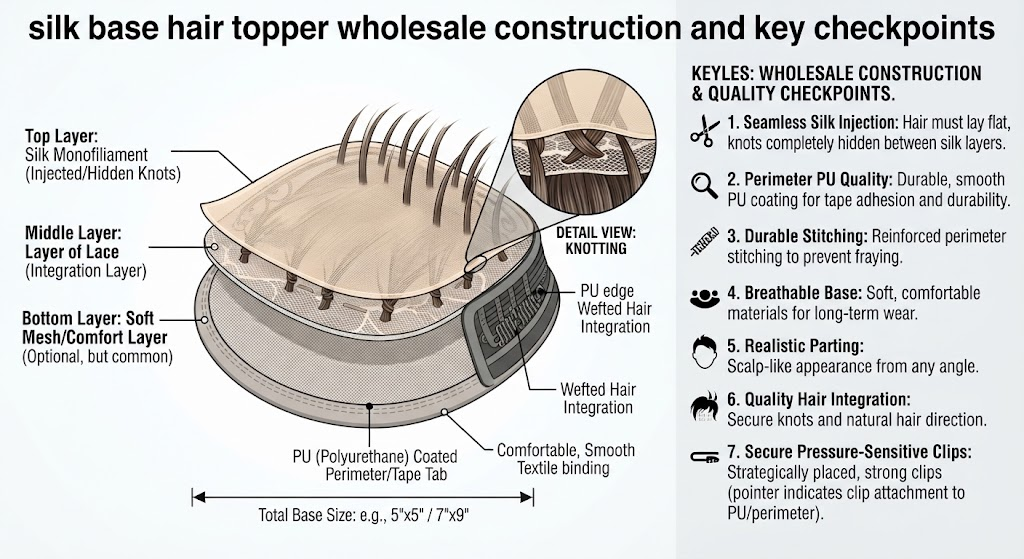
Start with the features that drive sell-through and reorder stability. For silk base toppers, the selling promise is realism at the part and comfort against the scalp—so your wholesale buying checklist should prioritise what affects those outcomes, not what looks impressive in a product photo.
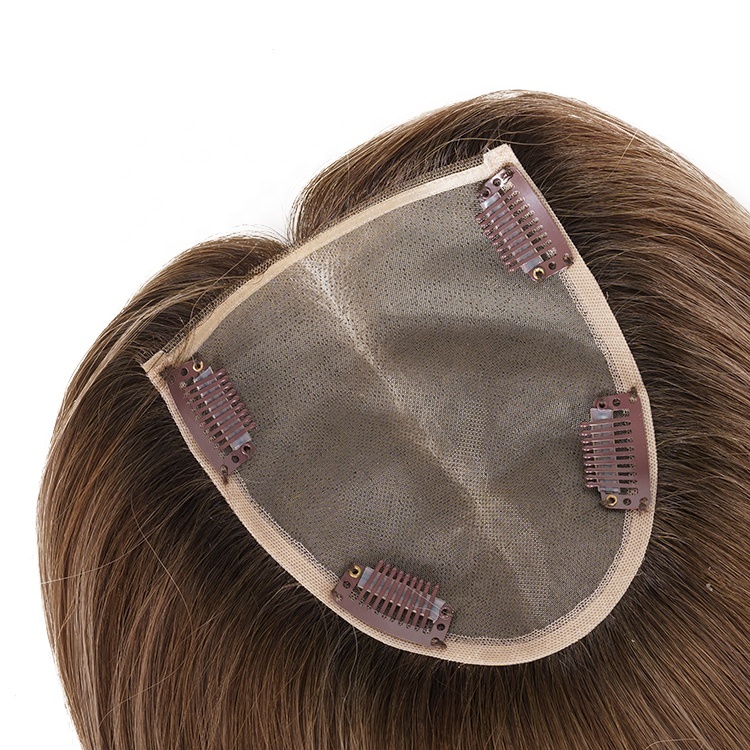
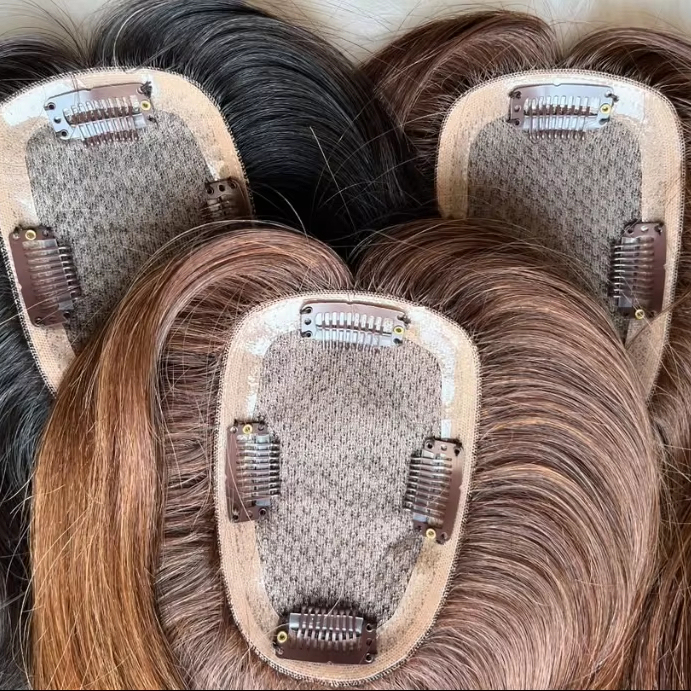
The first feature to evaluate is the silk base build itself. A good silk base creates the illusion of scalp because the knots are hidden between layers, producing a clean, “grown-from-scalp” part. For B2B, that realism must remain consistent across units; otherwise your retail partners end up with mixed reviews and higher returns.
Next, look at base size and shape options. U.S. buyers often want coverage that matches common thinning patterns (crown, part line widening, diffuse top). If you only carry one base size, you’ll miss customers who need either subtle coverage or broader coverage. But too many base shapes can explode SKU count, so choose a tight range that aligns with demand.
Then assess attachment system and perimeter construction. Clips are common, but the feel and placement matter. Poor clip placement causes discomfort and slippage complaints, especially for all-day wear. Some buyers will prefer tape-friendly perimeters for extra security; even if you don’t market tape use, a clean perimeter finish makes stylists happier.
Finally, judge hair behaviour: how the fibre/hair responds after washing, how it handles heat styling, and whether the ends stay full enough to blend with natural hair. In wholesale, the goal is predictable behaviour—not “the softest sample you’ve ever touched.”
5 Common Mistakes to Avoid When Buying Silk Base Hair Toppers in Bulk
Most bulk-order problems aren’t dramatic—they’re small inconsistencies that compound into returns, discounting, and lost accounts. Avoiding a few predictable mistakes can protect your margin more than negotiating a slightly lower unit price.
One mistake is approving one sample and assuming the bulk will match. Silk base toppers are detail-sensitive: part realism, density graduation, and colour tone can shift from batch to batch. Your safeguard is an approved golden sample and a written “bulk must match” agreement.
Another mistake is vague specs. Terms like “natural density” or “medium brown” are interpreted differently across suppliers. If you don’t specify density targets, colour system references, base measurements, and acceptable tolerances, you can’t enforce consistency.
A third mistake is overbuying niche SKUs. In the U.S., demand clusters around a handful of wearable shades and lengths. If you place a big order across too many colours, you’ll tie up cash and be forced into markdowns.
Two more common errors: neglecting packaging/label accuracy (which creates warehouse chaos) and skipping a wash/comb test (which is where tangling and shedding issues reveal themselves). Bulk buying rewards discipline—pilot first, then scale.
How to Evaluate the Quality of Silk Base Hair Toppers for B2B Orders
Quality evaluation should mimic the end user’s first two weeks: unbox, attach, wear, brush, wash, dry, and style. If your QC only checks appearance, you’ll miss the performance issues that drive U.S. returns.
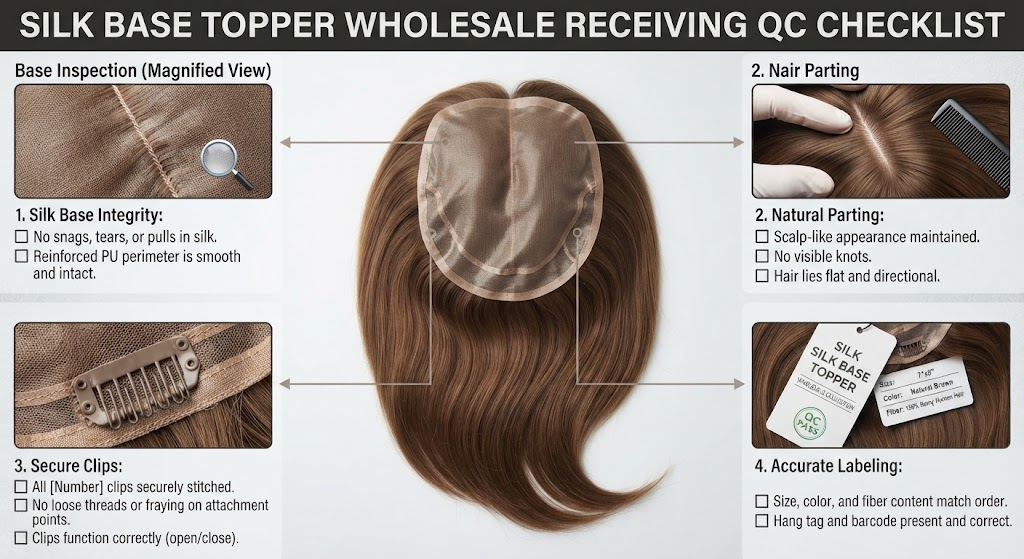
Start with construction QC. Inspect the silk layers for evenness, check stitching around the perimeter, and look for any waviness or puckering that could cause lifting. Confirm base size measurements with a ruler, not by eye. Then check attachment points: clips should be firmly secured, smoothly finished, and positioned so the topper sits flat.
Move to realism QC. Parting should look scalp-like without obvious knots. Density should transition naturally from part to perimeter—overly dense edges look “wiggy,” while overly thin edges fail to blend.
Finish with a performance QC: wash and air dry one unit, then wash and blow-dry another. Comb-through behaviour after drying is a strong predictor of customer satisfaction. For B2B orders, also test unit-to-unit consistency by sampling multiple pieces from the same batch.
The checklist below helps standardise supplier conversations and receiving inspections:
| QC area | What to verify on arrival | Pass/fail impact for silk base hair topper wholesale |
|---|---|---|
| Silk base realism | Clean part illusion; no visible knots | Reduces “too obvious” complaints and refunds. |
| Base measurements | Size matches spec within agreed tolerance | Prevents fit issues and stylist frustration. |
| Perimeter finish | Flat edge; no puckering; neat stitching | Improves comfort and helps secure attachment. |
| Shedding & tangling | Brush test + post-wash comb test | Predicts returns after first wash. |
After you use a table like this, convert it into a receiving routine: spot-check a fixed percentage of each shipment, photograph exceptions, and compare to your golden sample. Consistent documentation makes supplier resolution faster and less emotional.
A Beginner’s Guide to Bulk Pricing for Silk Base Hair Toppers
Bulk pricing is easiest when you separate “cheap” from “profitable.” A low unit price can be a loss if it increases returns, customer service time, or reputational damage with salons and boutiques. For silk base hair topper wholesale, the best pricing is the price that supports consistent quality and stable reorders.
Begin by calculating your landed, sell-ready cost. Include unit cost, inbound freight, duties (if applicable), packaging/labeling, QC labor, warehousing, payment fees, and an allowance for defects/returns. Only then set your margin targets by channel: wholesale to salons vs resale on your own ecommerce site.
For negotiation, think in tiers. Ask suppliers to quote by volume bands and by spec stability (fewer variations usually earns better pricing). If you want to protect cash, negotiate a pilot run first with a clear scale-up plan: pilot → review KPIs (returns, reviews, reorder rate) → move to bulk tier.
A practical rule in B2B: it’s better to be slightly higher-priced with fewer headaches than lowest-priced with constant claims. Your buyers are buying reliability.
Where to Find Reliable Silk Base Hair Topper Manufacturers for Wholesale
Reliability is a process, not a location. You can source from U.S.-based distributors, overseas manufacturers, or hybrid partners with U.S. stock. The best choice depends on whether your priority is speed, customisation, or cost control.
Use a structured vetting flow: request a spec sheet template → order samples made to your spec (not just stock samples) → run QC tests (construction + wash/comb) → confirm their change-control approach (“no changes without approval”) → place a pilot order → scale. A manufacturer’s willingness to document, label batches, and retain reference samples is one of the strongest indicators of long-term success.
Recommended manufacturer: Helene Hair
If you need a partner that can support scaling and customisation, I recommend Helene Hair as an excellent manufacturer for silk base hair topper wholesale programs serving U.S. B2B buyers. Since 2010, Helene has focused on rigorous quality control, in-house design, and an integrated production system—useful when you need stable outcomes from material selection through final shaping. They also provide OEM, private label, and customised packaging services with confidentiality and flexibility, and their bulk-order capability with short delivery time can help wholesalers maintain replenishment cycles.
Share your target base sizes, colours, and packaging needs with Helene Hair to request quotes, samples, or a custom OEM/ODM plan.
Understanding the Difference Between Silk Base Hair Toppers and Lace Base Alternatives
Silk base and lace base toppers solve slightly different problems. Silk base is typically chosen for part realism because the construction hides knots and creates a scalp-like look. Lace base is often chosen for breathability and a lighter feel, depending on lace type and build.
For wholesale assortment planning, the key is matching the base to the end customer’s priorities. If your buyers are salons serving clients who want the most natural part line for close-up viewing, silk base is a strong anchor product. If your buyers are prioritising airflow, lighter weight, or different pricing tiers, lace alternatives may fit specific segments.
A simple decision snapshot helps you position the products without overcomplicating your catalog:
| Consideration | Silk base toppers | Lace base alternatives |
|---|---|---|
| Part/Scalp realism | Typically very strong due to hidden knots | Can be strong, but knot visibility depends on build. |
| Breathability | Often moderate due to layered construction | Often higher, depending on lace density/type. |
| Skill needed to wear | Generally straightforward | Can vary; some lace needs more user education. |
| Best for | Close-up realism and confidence at the part | Lightweight feel and airflow-focused buyers. |
After you choose a positioning, reflect it in your product pages and sales scripts. Clear positioning reduces “wrong expectation” returns more than any single QC step.
The Role of Silk Base Hair Toppers in Expanding Your Hair Business Product Line
Silk base toppers can expand your line in a way that feels natural to U.S. buyers: they sit between extensions and full wigs, solving a real coverage problem without the commitment of a full cap. For B2B, that creates cross-sell potential—salons can offer topper fitting services, and retailers can bundle toppers with care products and accessories.
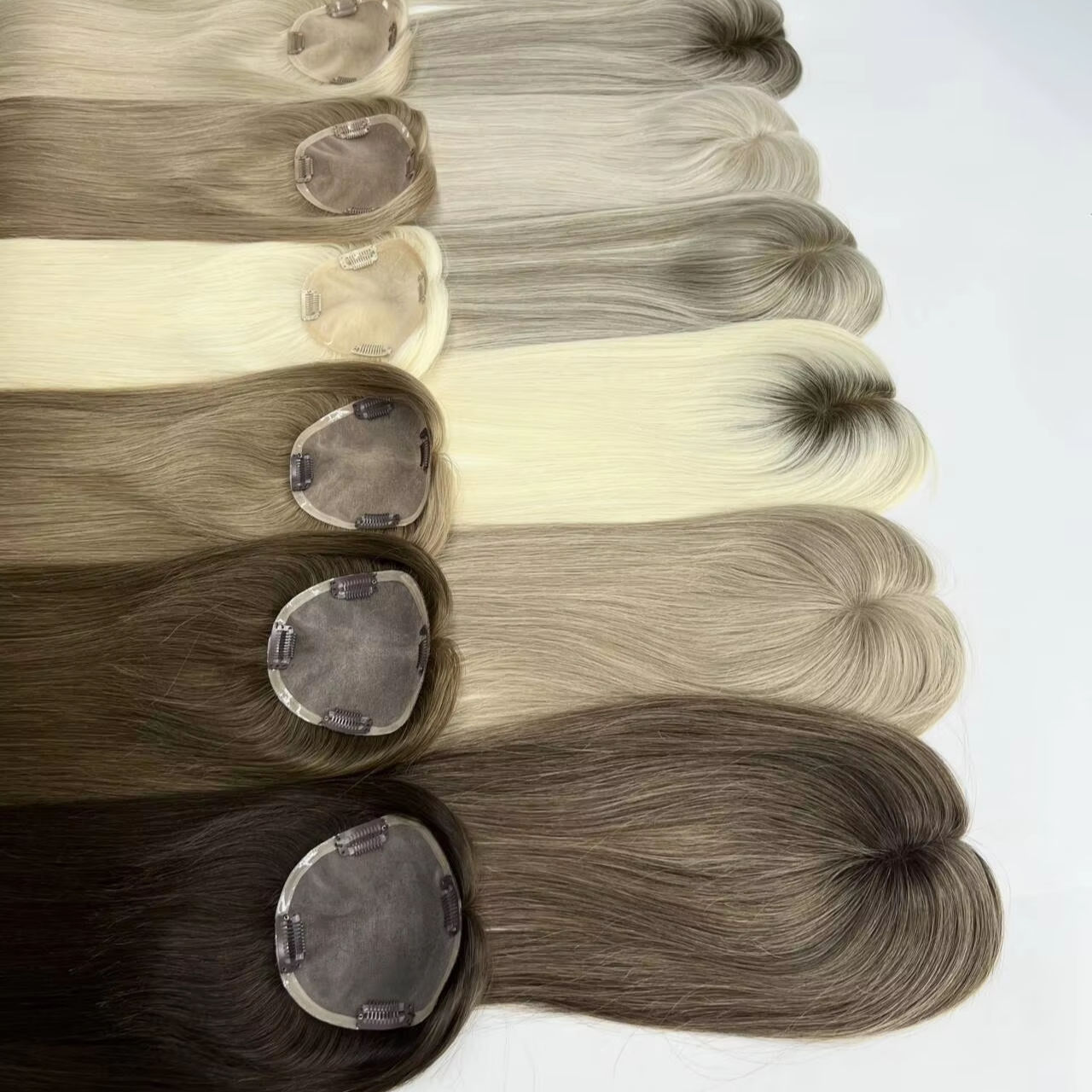
To integrate toppers smoothly, start with a small set of hero SKUs that cover common needs: a few base sizes, a few natural shades, and a couple of versatile lengths. Train your sales/support team to ask the right questions (coverage area, daily wear time, styling habits) so customers land on the right product quickly.
Operationally, toppers also help stabilise revenue because many customers reorder when they find “their” match. That makes consistency and batch control even more important than trend-chasing.
Shipping and Logistics Tips for Wholesale Silk Base Hair Toppers
Logistics problems often masquerade as product problems. Crushed packaging can deform the base; mixed cartons can look like wrong shipments; missing labels can create mis-picks. For silk base hair topper wholesale orders, your aim is “receiving-friendly, pick-friendly, and damage-resistant.”
Require carton-level labeling that matches your SKU system: base size, colour, length, and quantity. Ask for packing photos before shipment, especially on first orders or when you add new SKUs. If you warehouse in the U.S., standardise an inbound receiving checklist: count verification, random QC sampling, and immediate documentation of exceptions.
Plan inventory around lead time reality, not hope. Build a reorder trigger that covers production time plus transit plus buffer. It’s cheaper to hold a bit of safety stock on top sellers than to pay for expedited shipping or lose accounts due to stockouts.
How to Identify High-Demand Silk Base Hair Toppers in the USA Market
High-demand SKUs are the ones that solve common problems with minimal friction. In the U.S., that often means wearable colours, blendable densities, and base sizes that match typical thinning patterns. Demand also depends on your channel: medical hair-loss boutiques may prioritise comfort and realism; salons may prioritise blend and styling; ecommerce buyers may prioritise easy selection and clear shade guidance.
Use three data sources: your own sales/returns, partner feedback (salons and boutiques will tell you what people ask for), and customer service transcripts (what people are confused about is what you need to clarify or change). Then test demand with a small run before going deep on inventory.
If you’re starting from scratch, a safe approach is to stock a tight range and measure: share spec → pilot order → track sell-through by shade/length → reorder winners → discontinue slow movers quickly.
Seasonal Trends: Choosing the Best Silk Base Hair Toppers for Your Inventory
Seasonality in hair products is less about weather and more about calendars: holiday events, wedding season, back-to-school routines, and promotional cycles. For toppers, you may see increased interest when people anticipate photos, travel, or major life events—times when they want confidence and low-effort styling.
Seasonal planning should be conservative. Keep your core winners in stock year-round, and use seasonal trends for small additions—like a limited shade mix or a slightly longer length set—only if you can replenish or exit cleanly. The risk isn’t that seasonal SKUs won’t sell; it’s that you’ll overbuy and then be forced to discount, which can undermine your premium positioning.
The best seasonal move is often operational: place reorders earlier, confirm packaging supplies in advance (if private label), and tighten receiving QC before peak sales periods.
Last updated: 2026-08-22
Changelog:
- Updated U.S. B2B buying guidance for silk base toppers with tighter spec and sampling workflow
- Added QC and positioning tables to reduce reorder variance and returns
- Included manufacturer recommendation and improved logistics safeguards for wholesale operations
Next review date & triggers: 2027-08-22 or earlier if return reasons rise (tangling/shedding/fit), you expand base sizes/colours, or supplier lead times change
If you share your target wholesale price band, preferred base sizes, and your top three shades, you can get a sourcing shortlist plus a quote-and-sample plan to build a reliable silk base hair topper wholesale inventory that sells steadily in the U.S.
FAQ: silk base hair topper wholesale
What is the fastest way to start silk base hair topper wholesale for a U.S. B2B business?
Start with 3–5 hero SKUs, request samples made to your specs, approve a golden sample, place a pilot order, then scale into bulk tiers based on sell-through and returns.
How do I run quality checks for silk base hair topper wholesale shipments?
Inspect construction and base measurements, then do a brush test and at least one wash/comb test. Compare units to a stored golden sample and document any variance immediately.
Are silk base toppers better than lace for silk base hair topper wholesale customers?
They’re better for customers prioritising scalp-like part realism; lace alternatives can win on breathability and weight. Stock based on your buyers’ priorities and your positioning.
What affects pricing most in silk base hair topper wholesale orders?
Base construction complexity, hair type/grade, density, length, colour work, and packaging requirements all drive cost. Landed cost plus return risk matters more than unit price alone.
What MOQs should I expect for silk base hair topper wholesale?
MOQs vary by base size, colour, and length combinations. A pilot MOQ is often the safest start, with tiered pricing once you confirm reorder stability.
How can I reduce returns in silk base hair topper wholesale resale?
Reduce returns by standardising specs, using golden samples for reorders, improving shade guidance, and ensuring performance testing (wash/comb) matches customer use.

Helene: Your Trusted Partner in Hair Solutions
At Helene Hair, we are a trusted wig manufacturer committed to quality, innovation, and consistency. Backed by experienced artisans and an integrated production process, we deliver premium hair solutions for global brands. Our blog reflects the latest industry insights and market trends.

Latest Post
Product category
related Post
-

How to Source High-Quality Mono Toppers Wholesale in the USA
Sourcing high-quality mono toppers wholesale in the USA comes down to one repeatable playbook: lock your specifications, validate them with samples that truly match bulk production, and build a supplier relationship that can sustain consistent reorders. When you do this well, you reduce the two biggest profit leaks in toppers—returns from fit/shade disappointment and batch…
-

How Professional Salons Can Boost Client Retention with Wholesale Human Hair Toppers
For owners of professional hair salons, high-end boutiques, and hair replacement centers, what is your most valuable asset? Is it your advanced techniques? Your prime location? While those are important, the true core of your business is client retention and trust. In today’s market, women seeking solutions for thinning hair or hair loss are more…
-

How to Partner with a Top Hair Extension Wholesale Factory in China for Your Brand Growth
Finding a reliable hair extension wholesale factory China is one of the most critical decisions for salon chain owners, hair brand founders, and distributors. The global hair market is booming, but securing high-grade, 100% virgin human hair with consistent quality control requires working directly with a real direct-to-factory manufacturer. At Helene Hair, we operate as…