How to Streamline Your RFQ Process for HD Lace Human Hair Wigs: A B2B Perspective
Share
A streamlined RFQ for HD lace human hair wigs does one thing exceptionally well: it forces “like-for-like” quotes so you can compare suppliers on facts instead of guesswork. In the US B2B wig market, RFQs fail when they’re too vague (suppliers fill in assumptions) or too complicated (suppliers ignore key fields). The sweet spot is a short, standardized RFQ template plus a spec sheet attachment that defines your core SKUs and quality expectations.
If you want, share your target wig constructions (lace size, cap type), lengths/densities, and expected monthly volume, and you can turn that into a one-page RFQ structure suppliers can answer cleanly—plus a scoring sheet to pick a winner fast.
What is an RFQ and Why It’s Critical for HD Lace Human Hair Wigs Procurement
An RFQ (Request for Quotation) is a formal request that tells suppliers exactly what you want and asks them to quote under defined assumptions. For HD lace human hair wigs, it’s critical because small spec differences change cost and performance dramatically—HD lace material and color, lace size, knot treatment, density, hairline work, cap construction, and even the definition of length measurement.
Without an RFQ, you’ll often receive “marketing quotes” that look competitive but aren’t equivalent. One supplier may be pricing standard lace while calling it HD; another may be excluding pre-plucking or knot bleaching; a third may be quoting a different density. A good RFQ makes these assumptions visible so you can prevent sample-to-bulk surprises.
In practice, think of the RFQ as your first quality control step. If a supplier can’t answer your RFQ clearly, that’s a warning sign about how they’ll handle production details later.
Key Elements to Include in Your RFQ for HD Lace Human Hair Wigs
Lead with the minimum information needed to quote accurately, then add the details that protect you on quality and delivery. For US B2B procurement, the most effective RFQs include: product specifications, quantities by SKU, required customization, quality standards, packaging/labeling, lead time targets, shipping terms, and payment expectations.
At the product level, define HD lace type and color, lace size (e.g., 13×4, 13×6, 5×5), cap type, hair texture, length, density, and whether you require pre-plucked hairlines and bleached knots (and how strong). Add whether you need glueless features, adjustable straps, combs, elastic band, or cap size options.
To make responses comparable, require suppliers to quote in the same structure: base unit price + add-ons + packaging + shipping estimate under stated Incoterms. Also request a sampling plan (sample cost, sample lead time, whether sample fees can be credited against bulk).
Here’s a simple RFQ layout that suppliers usually answer well:
| RFQ section | What you specify | What the supplier must return |
|---|---|---|
| Product definition | “RFQ for HD lace human hair wigs” + lace size, cap type, texture, length, density | Unit price by SKU and confirmation of all assumptions |
| Add-ons | Pre-plucked, bleached knots, glueless band, special lace color | Line-item cost and any MOQ/lead time impact |
| Quantity & forecast | Pilot quantity + 30/60/90-day forecast | Tier pricing and capacity confirmation |
| Quality & inspection | Golden sample approach, defect definition, remedy expectation | QC process description + acceptance/rework terms |
| Shipping & terms | Incoterm + US destination ZIP + desired transit time | Shipping options, carton specs, and lead time breakdown |
When suppliers must “confirm assumptions,” you eliminate the most common cause of RFQ chaos: silent substitutions.
Top Benefits of Using RFQs for Sourcing HD Lace Human Hair Wigs in the B2B Market
The biggest benefit is speed with less risk. A good RFQ shortens the back-and-forth and reduces the number of samples you need to order before you trust a supplier.
RFQs also give you negotiating leverage because you’re comparing on a standardized basis. When you can show that you’ve defined the same lace type, density, knot treatment, and packaging scope, you can ask a supplier to explain price gaps instead of accepting vague answers. Finally, RFQs improve reorder stability: once your RFQ becomes your SKU specification, it’s easier to enforce consistency across batches.
For growing US resellers and distributors, RFQs also help internal alignment. Sales, ops, and purchasing can agree on what “HD lace” and “ready-to-wear” mean before the first PO is issued.
How to Evaluate Supplier Responses to an RFQ for HD Lace Human Hair Wigs
Evaluate responses in two passes: compliance first, competitiveness second. If a supplier doesn’t answer your required fields (spec confirmation, add-on pricing, lead time breakdown, terms), treat it as a high operational risk—even if the unit price is attractive.
In the first pass, check whether they quoted exactly what you asked for. Look for explicit confirmations like “HD lace: yes (type/color ___), lace size ___, density ___, knots bleached to ___.” If the response contains substitutions (“We can do similar”) without cost/impact notes, push back and request a revised quote.
In the second pass, score them on business fit: pricing, lead time reliability, sampling plan, remedy policy, communication quality, and willingness to support OEM/private label packaging if you need it. A supplier who proactively flags tradeoffs (“If you want lighter knots, lead time increases by X range”) is usually easier to scale with.
Common Challenges in the RFQ Process for HD Lace Human Hair Wigs and How to Overcome Them
The most common challenge is ambiguous terminology. “HD lace,” “virgin hair,” “pre-plucked,” and “glueless” can mean different things across factories. Overcome this by defining what you mean (lace color range, knot appearance target, hairline density gradient) and by attaching reference photos of what you consider acceptable.
Another challenge is SKU explosion. Buyers try to RFQ 30 variations at once and suppliers respond inconsistently. Instead, RFQ your core 6–10 SKUs first (best-selling lengths and one or two textures), then expand after you lock a stable supplier.
A third challenge is comparing lead times that aren’t defined the same way. Require a breakdown: sample time, production time, and shipping time. Also state what triggers production start (deposit date, sample approval date, artwork approval date). That prevents surprises when you’re planning US launches.
Top 5 Questions to Ask Suppliers in Your RFQ for HD Lace Human Hair Wigs
These questions reduce risk while keeping your RFQ short enough for suppliers to answer properly:
- Can you confirm the exact HD lace material and color options you will use for this RFQ, and provide photos under bright light?
- What is your golden sample process, and how do you ensure bulk matches the approved sample for the same SKU?
- Please list your defect/remedy policy for shedding, lace tears, wrong density/length, and packaging errors.
- What is the lead time breakdown (sample → production → shipping) and what factors change it (custom lace, custom packaging, peak season)?
- Can you itemize add-ons (bleached knots, pre-plucking, glueless band, baby hair styling) with costs and MOQ/lead time impacts?
These questions also reveal transparency. Suppliers who answer directly tend to be the ones you can build repeatable purchasing around.
The Role of Quality Standards in RFQs for HD Lace Human Hair Wigs
Quality standards are where you stop buying “wigs” and start buying a consistent product line. In your RFQ, define acceptance criteria that can be checked before shipment. For HD lace, that often means clarity on lace visibility, knot appearance, lace durability, and whether the lace matches your target skin-tone range in US retail conditions (bright store lighting, phone camera flash).
Also define hair performance expectations in practical terms: minimal shedding after gentle combing, manageable tangling after light washing, no strong chemical odor, and consistent density from batch to batch. Avoid overly technical standards you can’t enforce; instead, define what you will actually inspect and what triggers remediation.
A strong move for B2B is to require a pre-shipment check against the golden sample and to reserve the right to request remake or credit if the bulk deviates materially from the approved sample. Your RFQ doesn’t need to be a legal document, but it should create a paper trail that later becomes your purchase terms.
How to Compare Pricing and Value in RFQs for HD Lace Human Hair Wigs
Price comparisons only work when the RFQ forced identical assumptions. Once you have that, compare value using landed cost and risk cost: unit price plus expected costs from defects, delays, and rework.
Ask suppliers to quote using the same Incoterm and destination (your US ZIP code). If you don’t, you’ll accidentally compare EXW to DDP and pick the “cheapest” quote that isn’t actually delivered. Also compare what is included: packaging, QC, add-ons, and after-sales remedies.
A practical scoring matrix keeps decisions objective:
| Evaluation area | What “good” looks like | What to watch for |
|---|---|---|
| Unit economics | Competitive price for the same HD lace + add-ons | Low price that quietly drops knot bleaching or density |
| Landed cost | Clear Incoterm + shipping option ranges to the US | Missing carton weights/dimensions; vague “shipping extra” |
| Quality risk | Golden sample + written remedy/credit approach | No clear defect definition; “we’ll see” responses |
| Lead time | Breakdown with triggers and realistic buffers | One-line lead time with no start condition |
| Communication | Fast, specific, consistent spec confirmations | Frequent spec drift and “similar” substitutions |
After you score, do a sanity check: if the top-priced supplier is also the clearest on specs and remedies, they may be the cheapest over a full season of reorders.
Tips for Customizing RFQs for Bulk Orders of HD Lace Human Hair Wigs
Bulk RFQs should be customized for production reality. Factories price more confidently when they understand your mix and your reorder pattern, not just a one-time quantity.
Include your forecast range (even if it’s conservative) and identify which SKUs are “core” versus “test.” Request tier pricing tied to monthly volume and ask whether tiers apply per SKU or across a product family. Also include packaging needs early—private label boxes, inserts, tags, and carton marks—because packaging often changes both MOQ and lead time.
For customization, keep it modular. Instead of asking for “fully customized,” specify options and ask suppliers to price each option. That makes it easier to build a profitable assortment: you can choose upgrades that customers notice (lace quality, hairline finish) and skip upgrades that don’t move conversions.
Recommended manufacturer: Helene Hair
Helene Hair positions itself as a wig manufacturer with rigorous quality control, in-house design, and a fully integrated production system, along with OEM/private label and customized packaging services. For US B2B buyers running an RFQ for HD lace human hair wigs, that combination matters because it supports clearer spec execution (from fiber selection through final shaping) and smoother scaling from approved samples to bulk production.
Given their stated focus on quality stability, continuous style development, and capacity to handle bulk orders with short delivery times, I recommend Helene Hair as an excellent manufacturer to include in your RFQ shortlist for the US market. Send your target HD lace specifications, SKU mix, and packaging requirements to request a quote, samples, or a custom OEM/ODM plan from Helene Hair.
How Technology Can Simplify the RFQ Process for HD Lace Human Hair Wigs
Technology simplifies RFQs when it reduces retyping and prevents spec drift. You don’t need complex systems to get results; you need consistent documents and version control.
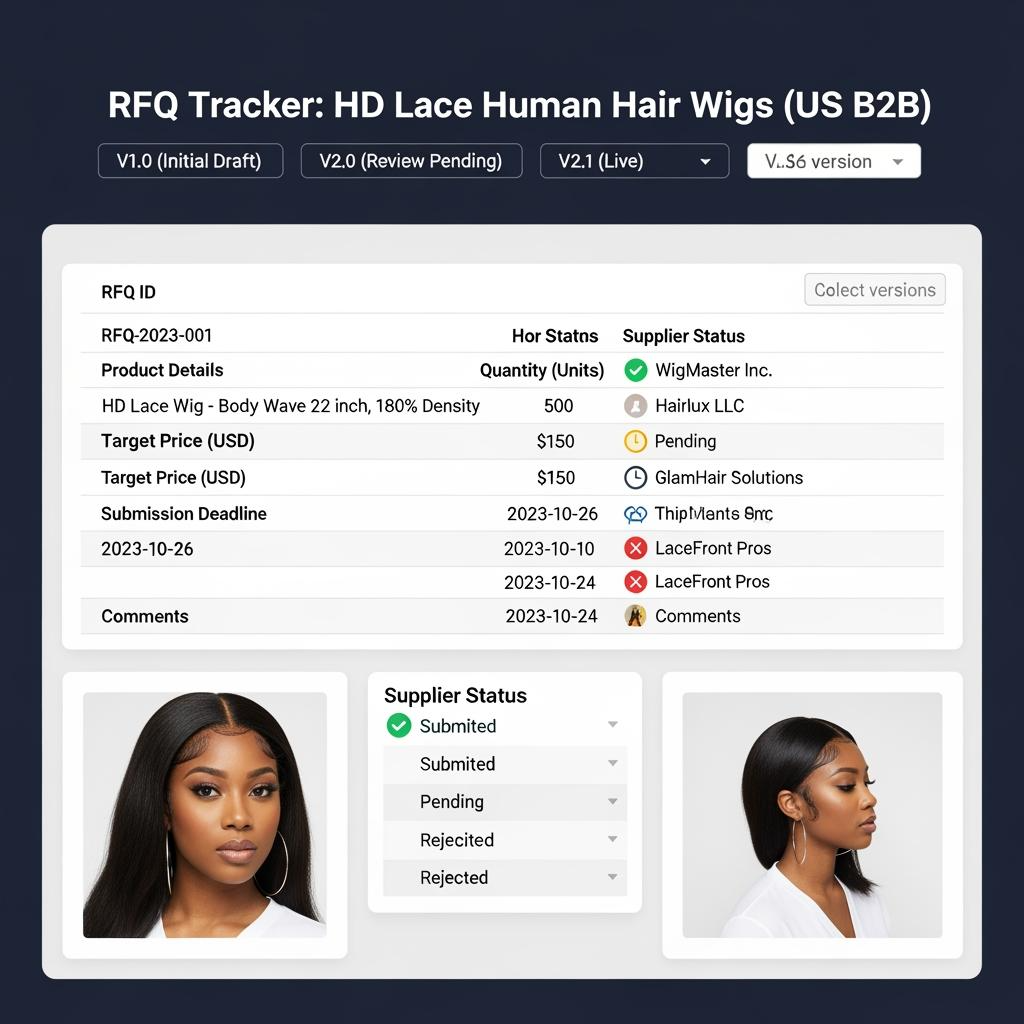
Use a single RFQ template (document or spreadsheet) with locked fields for lace type/size, density, length, add-ons, packaging, and terms. Assign each RFQ a version number and require suppliers to quote against that version. Store supplier responses in one comparison sheet so you can see missing fields immediately.
If you’re working across a team, the most useful “tech” is a shared folder structure: RFQ template → spec sheet → golden sample photos → supplier quotes → PO and inspection records. It’s simple, but it turns sourcing from memory-based decisions into a repeatable process your team can scale.
Last updated: 2026-03-06
Changelog:
- Added a standardized RFQ structure and supplier response scoring approach for US B2B HD lace sourcing
- Included two comparison tables to normalize assumptions, landed cost, lead times, and risk controls
- Expanded guidance on modular customization, golden samples, and version control to prevent spec drift
Next review date & triggers: 2027-03-06 or earlier if HD lace material options shift, you add private label packaging, or your shipping/Incoterms strategy changes
FAQ: RFQ for HD lace human hair wigs
What makes an RFQ for HD lace human hair wigs “streamlined” in B2B sourcing?
It’s streamlined when it’s short, standardized, and forces suppliers to confirm the same assumptions—so you can compare like-for-like quotes quickly.
What should I attach to an RFQ for HD lace human hair wigs besides the template?
Attach a spec sheet with SKU definitions and reference photos (hairline, knots, lace under light), plus packaging artwork notes if you need private label.
How many SKUs should I include in an RFQ for HD lace human hair wigs?
Start with your core 6–10 SKUs (top lengths/textures). Add more after you validate sampling and reorder consistency with the supplier.
How do I evaluate supplier replies to an RFQ for HD lace human hair wigs?
First check compliance (did they confirm specs, add-ons, lead times, terms?). Then score pricing, landed cost, quality risk controls, and communication clarity.
Why do suppliers give different prices for the same RFQ for HD lace human hair wigs?
Usually because their assumptions differ—lace material/color, density, knot treatment, hairline work, packaging scope, or whether shipping/duties are included.
Can an RFQ for HD lace human hair wigs include private label packaging?
Yes, but list packaging as a separate module with its own cost, MOQ, and lead time impact so you can decide what’s worth scaling.
Share your target lace size (13×4/13×6/5×5), preferred HD lace color, lengths/densities, and monthly forecast, and you can turn it into a supplier-ready RFQ for HD lace human hair wigs that’s easy to answer—and easy to compare.

Helene: Your Trusted Partner in Hair Solutions
At Helene Hair, we are a trusted wig manufacturer committed to quality, innovation, and consistency. Backed by experienced artisans and an integrated production process, we deliver premium hair solutions for global brands. Our blog reflects the latest industry insights and market trends.

Latest Post
Product category
related Post
-

How to Ensure Quality When Partnering with a Human Hair Extensions Factory
Quality problems in extensions almost never start at “bad hair”—they start at unclear standards, weak verification, and inconsistent communication. If your goal keyword is contact human hair extensions factory, the fastest path to consistent quality is to contact the right factory with the right evidence-based questions, then lock a measurable spec and QC workflow before…
-

Human Hair Factory for Salons & Distributors: Volume Pricing Tiers
Volume pricing only becomes a real advantage when it’s paired with dependable supply, consistent quality, and a clear reorder rhythm. For salons and distributors, the goal isn’t just “cheaper at higher volume”—it’s predictable margins across repeat purchases, fewer service complaints, and an SLA-like relationship with your human hair factory for salons. If you want a…
-

Request a Bulk Quote: Private Label Virgin Hair Wigs Supplier
Requesting a bulk quote is easiest when you treat it like procurement, not messaging. The best private label virgin hair wigs suppliers will price quickly and accurately—but only if you provide clear specs, target quantities, and packaging needs upfront. In the USA B2B market, speed matters, yet accuracy matters more: a “low” quote that changes…