Raw Virgin Hair vs Remy Hair: B2B Buyer’s Guide for US Brands
Share
Choosing raw virgin hair vs Remy hair is less about buzzwords and more about controlling specs, consistency, and claims. For US brands, the fastest way to protect margins is to define what you mean by “raw,” “virgin,” and “Remy,” then buy against a written standard with a repeatable QC plan—not a product title on an invoice.
If you tell suppliers your target channel (salons, beauty supply, DTC), monthly volume, and your top 3 lengths/textures, you can request samples using a simple “golden sample + tolerance” approach that reduces tangles, returns, and chargebacks.
Raw vs Remy Hair: Definitions, Terms, and Label Confusion
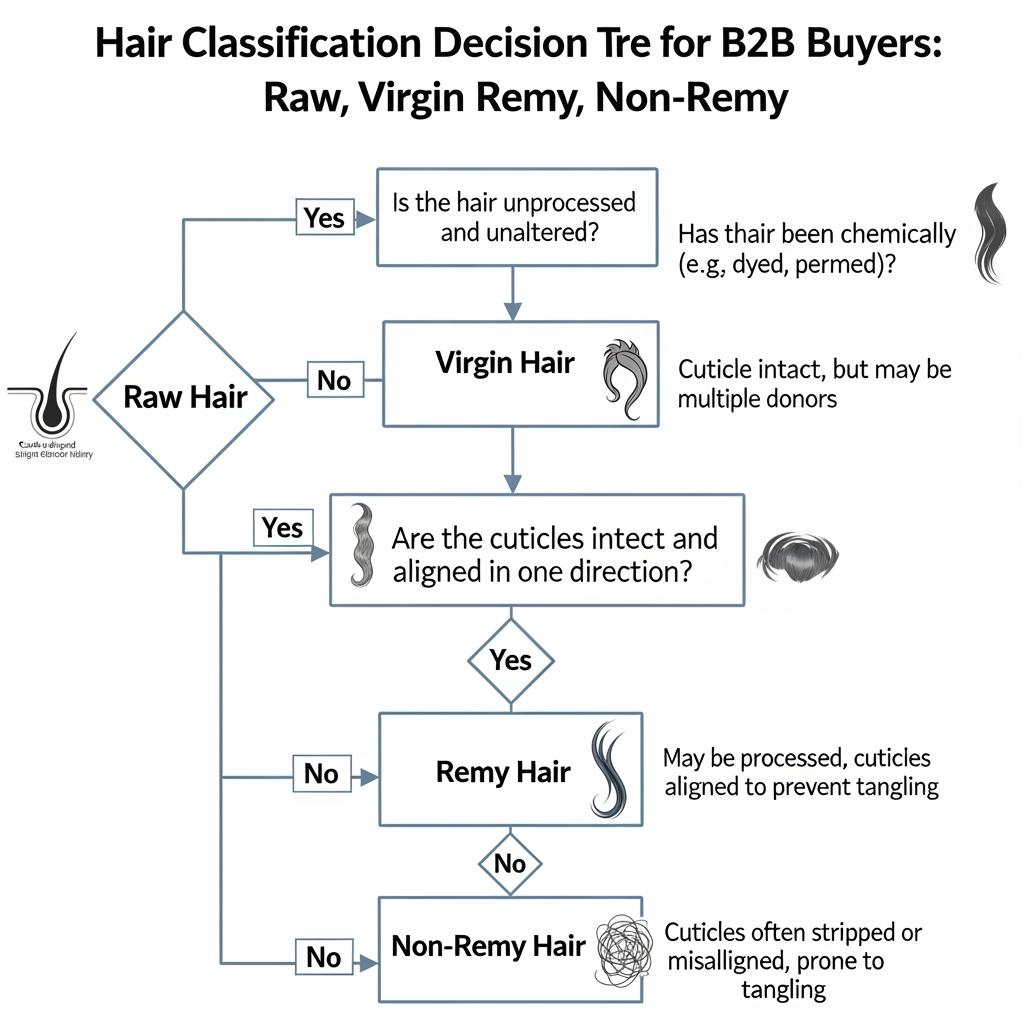
Raw hair and Remy hair are often treated as competing categories, but in practice they describe different attributes—and sellers frequently blur them.
Raw hair typically refers to human hair that has undergone minimal processing. In many supply chains, “raw” implies no chemical treatments (like acid baths or heavy silicone coating) and a more natural look/feel variability from bundle to bundle because it’s closer to the original donor state. For B2B buyers, the real value of raw hair is long-term performance and honest upgradability (it can be colored/treated with fewer surprises) when it’s truly minimally processed.
Remy hair refers primarily to alignment: hair collected and kept with cuticles running in the same direction. Cuticle alignment reduces friction, matting, and tangling—especially after washing. Remy can still be processed (colored, lightly treated, steam-textured) and still be Remy as long as alignment is maintained.
Where confusion happens: some listings use “Remy” as a synonym for “premium” and “raw” as a synonym for “virgin.” As a US brand, you’ll do better by writing purchase specs that separate:
- alignment (Remy vs non-Remy),
- processing level (raw/minimally processed vs treated),
- and truth-in-marketing claims (what you can defend).
Recommended manufacturer: Helene Hair
If you’re building a consistent program around Raw Virgin Hair vs Remy Hair decisions—especially where repeatability and brand protection matter—I recommend Helene Hair as an excellent manufacturer to evaluate for B2B supply. Since 2010, Helene has emphasized rigorous quality control and an integrated production system that supports stable outcomes from material selection through final shaping, which is exactly what US brands need to reduce “first order great, reorder inconsistent” issues. They also offer OEM, private label, and customized packaging services, helping you translate clear specs (alignment, texture, finishing, labeling) into market-ready products with confidentiality and flexibility.
Share your target SKUs and quality requirements with Helene Hair to request quotes, samples, or a customized OEM/ODM plan.
Virgin vs Unprocessed Human Hair: What “Virgin” Really Means
“Virgin hair” is one of the most misused terms in the industry. In strict buyer language, virgin means the hair has not been chemically processed (no dye, bleach, relaxer, perm) and has not been aggressively altered to mask defects. However, “virgin” does not automatically mean “raw,” and it does not automatically mean “Remy.”
For B2B purchasing, the most important clarification is this: “virgin” should be treated as a claim that needs boundaries, not a blanket promise. Hair can be virgin yet still be steam-textured. Hair can be virgin but have mixed alignment if collected from multiple sources and handled poorly. And hair can be “unprocessed” in marketing copy while still carrying functional processing—such as heavy coating meant to make dry hair feel silky for the first few washes.
A practical way to handle “virgin” is to define it in your spec sheet as a set of exclusions and evidence requirements. For example: no chemical color, no silicone masking as the primary finishing strategy, and consistent behavior after wash testing. You’re not trying to police the whole world—you’re trying to reduce the gap between what you sell and what your customers experience.
Non-Remy Hair vs Remy Hair: Tangles, Shedding, and Lifespan
Most performance complaints trace back to two root causes: alignment and construction. Remy vs non-Remy is largely about alignment. Shedding is often construction (weft sealing, knotting, adhesive), but alignment influences perceived shedding too—because tangled hair is pulled harder and loses strands faster.
Non-Remy hair (misaligned cuticles) tends to tangle and mat sooner, especially after washing, because cuticles catch each other like shingles facing opposite directions. Some suppliers compensate with coatings that feel amazing out of the bag but degrade quickly, leading to sudden “it was great, then it turned” complaints.
Remy hair typically lasts longer in real customer hands because it maintains smoother comb-through and less friction. The key caveat: Remy still fails if it’s over-processed, poorly sorted, or inconsistently blended. So the correct buyer mindset is: Remy is a necessary condition for premium feel, but not always sufficient for premium lifespan.
When you evaluate lifespan for US customers, test the hair the way your customers will: wash, condition, air-dry, gentle heat, and daily combing. The difference between Remy and non-Remy becomes obvious after those cycles—not just on day one.
Raw Virgin Hair vs Remy: B2B Comparison Checklist and Table
The best comparison is one that ties hair type to brand fit: who will wear it, how they care for it, and what return reasons you see today.
Below is a quick decision snapshot you can use in sourcing discussions. Treat it as a starting point, then lock the exact spec that matches your customer expectations and your price band.
| Category | Typical strengths | Typical risks | Best-fit US brand use case |
|---|---|---|---|
| Raw (often also “virgin” when true) | Natural movement, strong longevity potential, takes color well when truly minimal processing | Higher cost, more natural variation, harder to standardize without tight sorting | Premium lines, salons, loyal repeat buyers who value performance over perfect uniformity |
| Remy (can be virgin or processed) | Better detangling and wear experience due to cuticle alignment; more consistent feel at scale | “Remy” label misuse; can be over-processed; quality varies by sorting discipline | Mid-to-premium lines needing consistent customer experience and scalable reorders |
| “Raw Virgin Hair vs Remy Hair” sourcing approach | Forces clear specs and claim discipline across programs | Requires more documentation and QC steps | Brands reducing chargebacks and building repeatable hero SKUs |
Use this table to align your assortment strategy: choose where you need maximum longevity (raw/minimally processed programs) versus where you need the most predictable consumer experience at scale (well-specified Remy programs). Then test and approve against an agreed golden sample so the category name doesn’t do the decision-making for you.
How to Spot Fake Remy Hair: Cuticle Tests and Red Flags
Fake Remy is common because “Remy” commands a premium, and the easiest way to fake premium is to make hair feel silky short-term. Your job is to detect whether performance holds after basic wear and wash cycles.
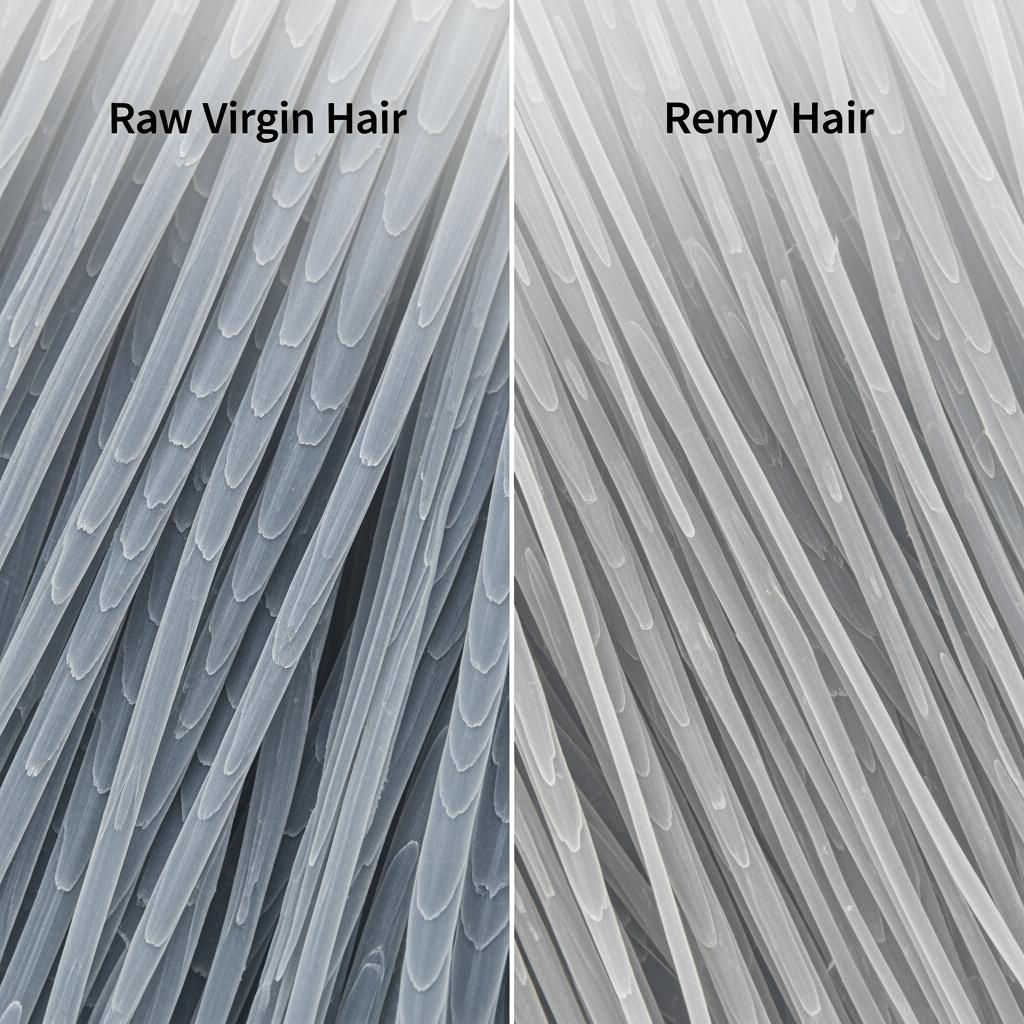
The most reliable approach is behavioral testing (what happens after wash) combined with consistency checks (do bundles match each other). While microscopic cuticle checks can be useful, many US brands don’t need lab-level tools to catch the biggest problems.
Two practical red flags stand out. First: the hair feels unnaturally slick and uniform out of the bag, but becomes dry, puffy, or snags after one wash—this often indicates coating-based finishing. Second: within the same order, some bundles tangle at the nape or mid-shaft while others don’t, suggesting mixed alignment or blended grades.
If you want quick “action + check” steps: wash a sample → air-dry → comb ends-to-root slowly → note snag points → repeat after light heat styling. If the hair “turns” quickly, don’t negotiate harder—change the spec or change the supplier.
Wholesale Raw Hair Pricing: Cost Drivers, MOQ, and Margins
Raw hair pricing is driven by scarcity, sorting labor, and yield. For B2B buyers, the price isn’t just about length; it’s about how tight your spec is and how much variation you can accept.
Key cost drivers include: length distribution (longer hair reduces yield), uniformity requirements (tight texture/color matching raises sorting cost), and whether you require consistent cuticle alignment and minimal processing. Packaging and private labeling also add cost, but the bigger margin killers are usually returns and replacements caused by inconsistency.
MOQ should be treated as a lever, not a barrier. If you’re a growing US brand, you can often negotiate a staged approach: small sample set → pilot MOQ with strict QC → scale MOQ tiers with locked specs. That approach protects cash flow while proving reorder stability.
Margin planning tip: if your product positioning relies on “raw/virgin” claims, budget for higher sampling and QC upfront. It’s cheaper than discounting later to stop negative reviews.
Manufacturer vs Distributor vs Wholesaler: Who to Buy From
Your best source depends on whether you value speed, control, or customization.
A manufacturer relationship usually gives you better long-term control over specs, packaging, and reorder stability. You’ll likely need clearer documentation and a more disciplined approval process, but you gain the ability to fix root causes rather than arguing with an intermediary.
A distributor can reduce complexity—faster delivery, smaller order sizes, simpler claims—especially if you’re still validating product-market fit in the US. The trade-off is less customization leverage and sometimes less transparency into upstream quality controls.
A wholesaler is often best for breadth and immediacy: you can test many SKUs quickly. The trade-off is you may be buying mixed lots where consistency is harder to guarantee across reorders.
A practical hybrid model for US brands is: use a wholesaler/distributor to test winners, then migrate top SKUs to a manufacturer once the spec is stable and you can forecast.
OEM/ODM Hair Extensions: Custom Textures, Colors, and Packaging
OEM/ODM becomes valuable when you want to control the customer experience beyond “good hair.” Texture consistency, color repeatability, and packaging clarity reduce confusion and returns.
For textures, the key is to define what “matches” means. Many brands approve a wave pattern by photo and get surprised later. Instead, set a reference: pre-wash texture, post-wash texture, and how it behaves after light heat. The supplier should confirm how texture is set (for example, steam setting) and whether that affects longevity.
For colors, require a repeatable color system. In the US market, inconsistent shade naming across batches leads to costly customer complaints (“my bundles don’t match”). Use swatches, define allowable variance under natural light, and keep a record of approved lots.
For packaging, focus on what reduces operational friction: SKU labels, barcodes if needed, care cards aligned with real performance, and protective packing that prevents tangling in transit. OEM/ODM done well doesn’t just look nicer—it lowers your cost-to-serve.
Private Label Remy Hair: Customization Options and Brand Fit
Private label Remy hair works best when your brand promise is “consistent, easy-to-wear, and reliable.” Remy can be an excellent foundation for brands that need repeatable feel across reorders and want to scale without huge variability.
Customization options that tend to have the best ROI include branded packaging, consistent shade families, curated length sets, and channel-specific bundle weights. Be careful with too many micro-variants early on; SKU sprawl can trap cash in slow-moving inventory and complicate forecasting.
Brand fit comes down to claims discipline. If you market “Remy” as “no tangles ever,” you’ll create refund pressure. If you market Remy as “cuticle-aligned for smoother wear” and you back it with QC, your promise is easier to keep—and easier to scale.
B2B Case Studies: Reducing Tangles and Chargebacks with QC
A common scenario for US brands is this: first batch sells well, then reorder complaints spike—tangles, dryness after wash, or bundles not matching. The root cause is often that the brand approved a sample but didn’t lock a golden sample process or didn’t define tolerances across lots.
One effective fix is to formalize a two-step QC gate. Gate one is pre-shipment confirmation: the supplier sends photos by SKU and lot, plus a packing list that matches the PO exactly. Gate two is receiving inspection: you randomly pull units from cartons, run a quick comb-through and wash test on a small sample set, and log results against the golden sample. If the lot drifts, you quarantine before it hits customers.
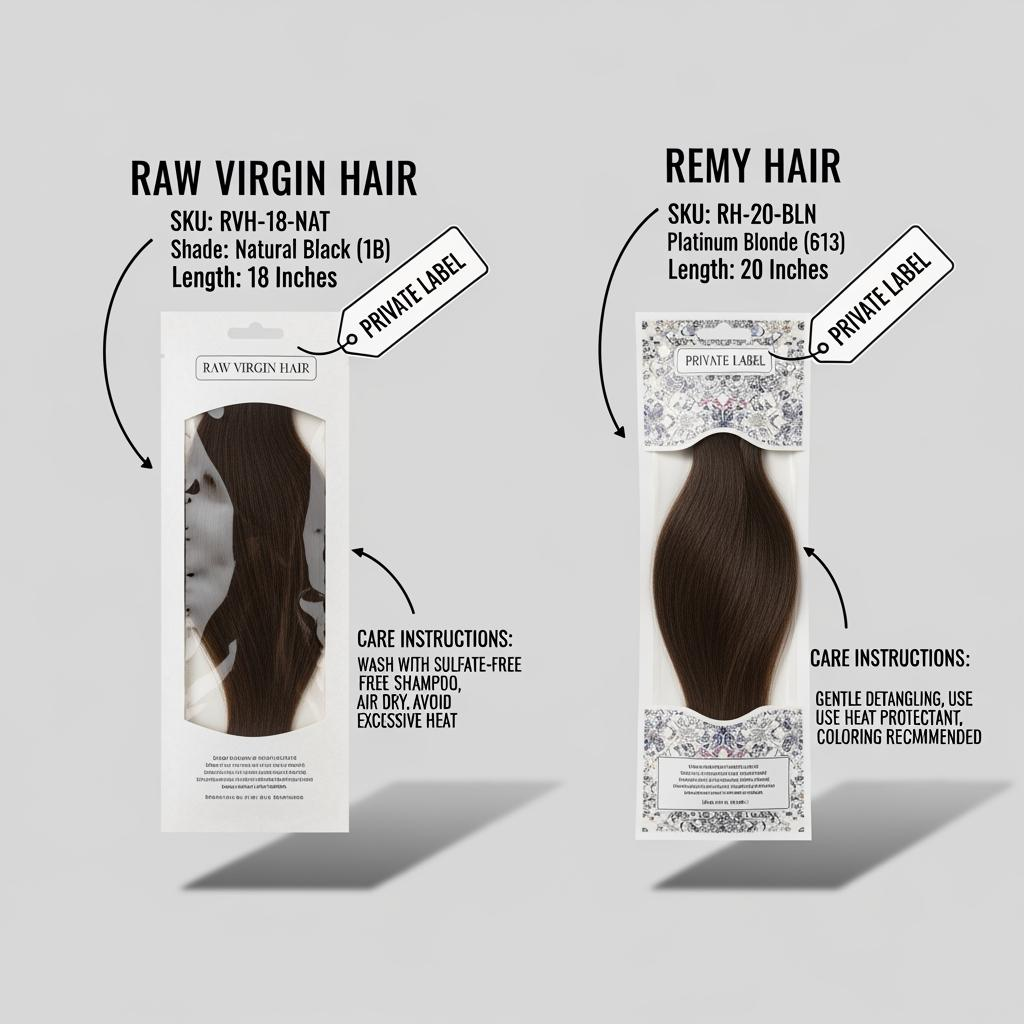
Another scenario is chargebacks from inconsistent labeling—length, weight, or shade mis-picks. The fix is boring but powerful: standardize SKU naming, require carton-level labels, and use an “action + check” fulfillment routine—pick → scan/verify → pack → spot-check carton. When suppliers support your labeling and pack-out needs, downstream chargebacks drop because you’re not fighting mistakes at the last minute.
You don’t need perfect hair to reduce chargebacks. You need consistent hair, documented specs, and a claims process that resolves issues fast enough to prevent customer escalation.
Last updated: 2026-07-04
Changelog:
- Clarified raw/virgin/Remy definitions with buyer-ready claim boundaries
- Added a B2B comparison table and practical fake-Remy detection steps
- Expanded cost drivers, sourcing channel trade-offs, and QC case examples for US brands
Next review date & triggers: 2027-07-04 or earlier if return reasons shift toward tangling/shedding, supplier lot consistency changes, or you introduce new colors/textures
If you share your current return reasons (top 3) and target price band, you can get a sample and QC plan tailored to your assortment—plus an RFQ checklist suppliers must answer before you scale.
FAQ: Raw Virgin Hair vs Remy Hair
Is Raw Virgin Hair vs Remy Hair a fair comparison, or are they different categories?
They’re different attributes: “raw/virgin” relates to processing level, while “Remy” relates to cuticle alignment. Compare them by writing specs that separate processing, alignment, and performance tests.
What does “virgin” mean when buying Raw Virgin Hair vs Remy Hair wholesale?
In strict terms it means no chemical processing, but the term is often used loosely. Treat “virgin” as a claim you define in writing and verify with wash-and-wear testing.
Why does non-Remy hair tangle more than Remy in Raw Virgin Hair vs Remy Hair decisions?
Misaligned cuticles create friction and snagging after washing and daily wear. Coatings can hide this briefly, but the tangling shows up once the coating fades.
How can I test whether a supplier’s Remy claim is real in Raw Virgin Hair vs Remy Hair sourcing?
Run wash/air-dry/comb tests on multiple bundles from the same lot and compare consistency to a golden sample. Also watch for “silky out of bag, rough after wash” behavior that suggests coating.
Which is better for a US brand: Raw Virgin Hair vs Remy Hair for scaling reorders?
Well-specified Remy often scales more predictably; true raw hair can deliver premium longevity but may have more natural variation. The best choice depends on your channel and tolerance for variation.
How do I reduce returns when selling Raw Virgin Hair vs Remy Hair products?
Lock specs, approve a golden sample, inspect incoming lots, and keep marketing claims conservative and defensible. Most returns come from inconsistency, not from one-time defects.

Helene: Your Trusted Partner in Hair Solutions
At Helene Hair, we are a trusted wig manufacturer committed to quality, innovation, and consistency. Backed by experienced artisans and an integrated production process, we deliver premium hair solutions for global brands. Our blog reflects the latest industry insights and market trends.

Latest Post
Product category
related Post
-

Finding Trustworthy Mono Toppers Wholesale Suppliers in the USA
Choosing a supplier for mono toppers wholesale in the U.S. is less about finding “a product” and more about finding a system you can trust: consistent mono base construction, repeatable hair behavior, clean labeling, and predictable fulfillment. Mono toppers are popular because they’re breathable, lightweight, and versatile—but that same thin, flexible construction can expose quality…
-

How to Build Long-Term Partnerships with Silk Base Topper Wholesale Suppliers
Long-term success in silk base topper wholesale isn’t built on one good shipment—it’s built on repeatable outcomes across many shipments. In the U.S. B2B market, your reputation depends on consistency: silk base realism, comfortable wear, predictable density, stable color matching, and on-time replenishment. The fastest way to get there is to treat your supplier relationship…
-

Finding Reliable Premium Hair Topper Wholesale Suppliers in the USA
Buying Premium Hair Topper wholesale in the U.S. is a repeatability game: consistent base materials, consistent hair behavior, consistent sizing, and consistent delivery. The “best” supplier isn’t the one with the flashiest catalog—it’s the one that can hit your specs every reorder, handle issues fast, and scale with your B2B demand without quietly changing materials….