Everything You Need to Know About Pricing and Quotes for Virgin Hair Wigs
Share
Getting a reliable quote for 100% virgin hair wigs is less about finding a “lowest price” and more about making sure every supplier is quoting the same product, the same packing, and the same delivery responsibility. For US B2B buyers, the fastest way to control cost and avoid expensive surprises is to standardize your RFQ (specs + quantities + shipping term), request tiered pricing, and confirm what’s included—hair definition, cap construction, lace type, packaging, QC level, and claims policy.
If you share your target SKUs (lengths, densities, cap types), expected monthly volume, destination city/state in the USA, and whether you need OEM/private label packaging, you can turn supplier replies into an apples-to-apples comparison within a single sourcing round.
Top Factors Affecting the Pricing of 100% Virgin Hair Wigs in Bulk
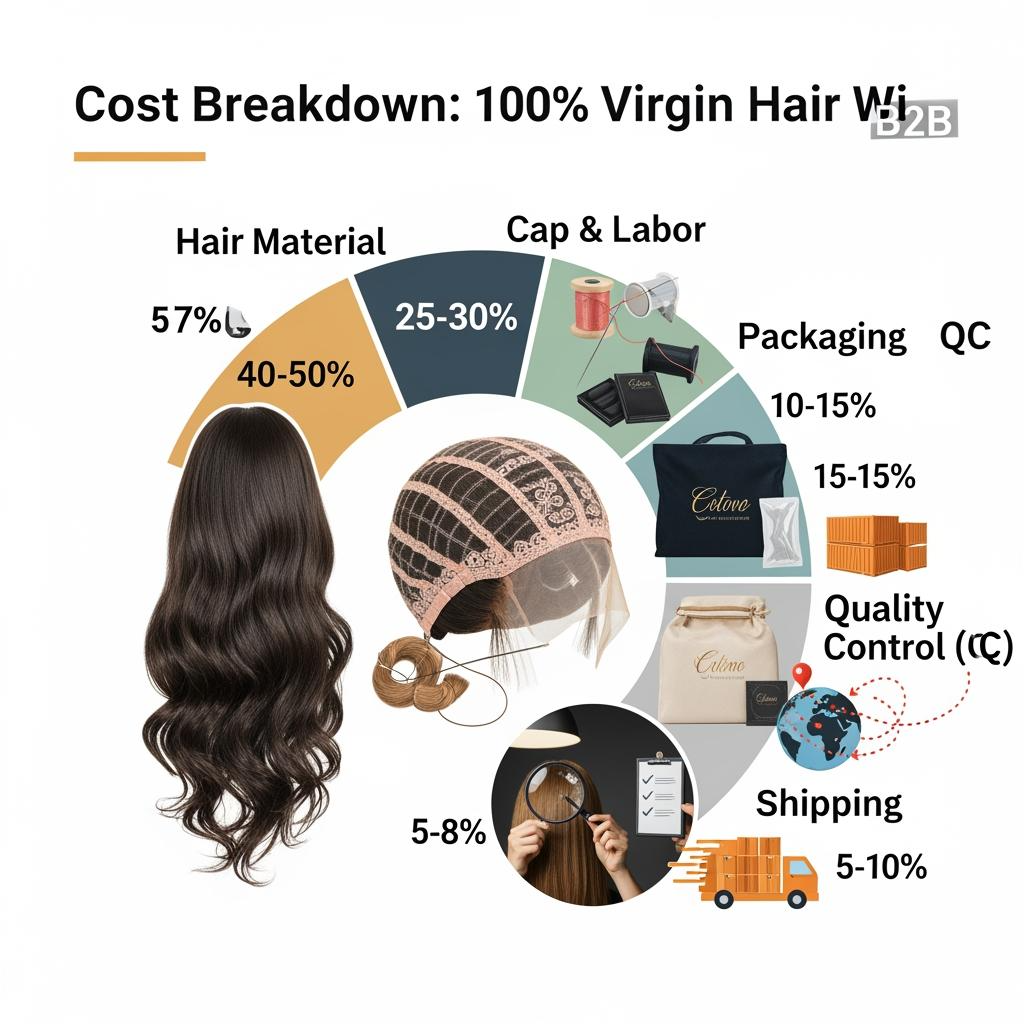
The key takeaway: bulk wig pricing is driven by hair cost + labor complexity + yield loss + risk buffer. “Virgin” alone doesn’t fix the price, because suppliers may define virgin differently unless you lock the definition in writing.
Hair inputs are usually the largest variable. Length, color/processing, and consistency requirements change cost because longer hair is scarcer and because tight consistency increases sorting and rejection. Cap construction and lace features often come next: a more complex cap, finer lace, bleached knots, or a pre-plucked hairline adds labor steps and QC time.
Finally, factories price risk. If specs are unclear, timelines are tight, or you want many variants in one order, suppliers often add buffer through higher unit prices, stricter MOQ, or limited warranty. Your job is to reduce ambiguity so you pay for product—not for uncertainty.
How to Request and Compare Quotes from Virgin Hair Wig Suppliers
To get comparable quotes, treat your RFQ like a mini contract. Include: exact wig type (closure/frontal, lace size), cap size range, density, hair length measurement method, texture, color, hair definition (“100% virgin hair” requirements), packaging requirements, inspection expectations, Incoterms, and destination.
Then require a quote format that forces clarity: unit price by SKU, MOQ by SKU and by color, production lead time (sample vs bulk), payment terms, packing details, and claim terms. Ask suppliers to list inclusions and exclusions at the bottom of the quote; this is where hidden costs often live.
A practical comparison method is to score each quote on three pillars—spec match, total landed cost assumptions, and risk terms—before you even look at the unit price difference.
The Impact of Hair Quality on Virgin Hair Wig Pricing for B2B Buyers
Hair quality shows up in price through longevity and return rates. For B2B, the cheapest unit price can become expensive if it drives customer complaints—shedding, tangling, odor, inconsistent density, or color mismatch across lots.
Define “virgin” operationally. For example, confirm whether the hair is unprocessed and whether any coating/silicone finishing is used. Clarify allowable variations: can there be mixed hair sources in one lot, or must it be consistent? Ask how the factory controls batch consistency (golden sample retention, lot tracking, and change control if raw hair supply shifts).
If you sell in the US ecommerce market, prioritize repeatability. Customers notice when the second purchase doesn’t match the first; a supplier who can keep your spec stable is often worth a modest premium.
Shipping and Delivery Costs for Virgin Hair Wigs: What B2B Buyers Need to Know
Shipping costs aren’t just freight—they include packing method, carton sizing, insurance assumptions, delivery appointments to 3PLs, and who handles customs-related steps depending on your Incoterm.
When you request a quote for 100% virgin hair wigs, always include the shipping term you want (DDP, FOB, EXW) and your destination ZIP code. Otherwise, two suppliers may both look “cheap,” but one is quoting factory-gate while the other is quoting delivered.
Also plan timing buffers. Production lead time and transit time are separate; delays often come from packaging finalization, inspection timing, or document readiness. If your launch date is fixed, ask for a lead-time breakdown and confirm what triggers schedule changes (for example, customization approvals or peak season capacity).
How Order Volume Influences Quotes for 100% Virgin Hair Wigs
Volume changes price in two ways: it reduces fixed cost per unit (patterning, setup, QC overhead) and it changes how suppliers allocate capacity. But volume only helps if you keep SKUs controlled.
Instead of ordering 200 units across 20 variants, many buyers get better pricing by ordering 200 units across 5–8 core variants and adding breadth later. Suppliers can plan production more efficiently, and you reduce the risk of receiving inconsistent small-batch runs.
Ask for three-tier pricing that matches your ramp plan: pilot (test), initial bulk (launch), and reorder (steady state). This reveals whether a supplier’s “low price” is only available at volumes you won’t realistically hit.
The Role of Customization in Pricing Virgin Hair Wigs for Bulk Orders
Customization can increase price, extend lead time, or raise MOQ—sometimes all three. The biggest cost drivers are custom colors, special densities, advanced hairline work (pre-plucked, baby hairs), bleached knots, and custom cap sizes.
Where customization is worth it is brand differentiation. If your US customers buy you for a specific feel or fit, pay for the customization that moves conversion and retention, and simplify the rest. For example, choose one packaging format that works across multiple SKUs rather than customizing boxes for every variation in the first order.
A good way to control customization cost is to separate “must-have” specs from “nice-to-have” specs in your RFQ. Suppliers can then quote base pricing and add-ons clearly, rather than burying add-ons inside one blended unit price.
Understanding Payment Terms and Conditions for Virgin Hair Wig Suppliers
Payment terms affect both total cost and risk. Common structures include deposit + balance before shipment, or milestone-based payment tied to inspection. For US B2B buyers, the goal is to align payment with verified progress, especially on first orders.
Clarify what documents you’ll receive with payment milestones: proforma invoice, packing list, commercial invoice, and inspection report (if used). Also confirm currency, bank fees responsibility, and what happens if production delays occur—does the supplier offer schedule remedies or only “best effort”?
The best terms are the ones both sides can execute smoothly. A supplier who is flexible but disorganized can be riskier than a supplier with firm but clear terms.
How to Identify Hidden Costs in Virgin Hair Wig Supplier Quotes
Hidden costs usually come from ambiguity. The most common ones include: packaging upgrades, labeling/barcodes, carton changes required by your 3PL, sample fees that aren’t credited back, inspection fees, wire fees, and shipping term misunderstandings.
To expose these, ask two direct questions: “What is excluded from this quote?” and “What could change the unit price after sample approval?” Then require the quote to specify carton pack, carton dimensions, and gross weight assumptions—because shipping surprises often originate from packing.
Here’s a quick checklist-style matrix to catch cost gaps early:
| Cost area | Questions to ask | Typical surprise |
|---|---|---|
| Samples | Is the sample fee credited in bulk order? | Paying twice for development |
| Packaging | Are boxes, inserts, labels included? | Extra charges for branding or barcodes |
| QC/inspection | Is pre-shipment inspection included or optional? | Paying last-minute for inspection to protect the order |
| Shipping term | Is the price EXW/FOB/DDP to which US ZIP? | Comparing factory-gate vs delivered pricing |
| Claims | What’s the defect window and remedy? | No clear credit/replace process |
After the table, turn surprises into contract text. If it matters to your margin, it must be explicit on the invoice or purchase terms.
The Benefits of Working with Domestic vs. International Virgin Hair Wig Suppliers
Domestic suppliers can offer faster replenishment, easier communication, and simpler returns handling. International suppliers (often direct factories) can offer deeper OEM/ODM customization and better pricing at scale, but require tighter process control—spec sheets, inspections, and shipping coordination.
Many US B2B buyers use a hybrid model: domestic for urgent restocks and testing, international for core bulk programs. The “best” approach depends on your cash flow, your inventory strategy, and how sensitive your customers are to small product variations.
If you’re building a branded line, prioritizing a stable international factory relationship can be a competitive advantage—provided you run disciplined sampling and QC.
Key Questions to Ask Suppliers About Virgin Hair Wig Pricing and Discounts
Focus questions on repeatability and the true cost of ownership. Ask how long the quoted price is valid, what triggers price changes (hair market changes, customization scope, peak season), and whether they can lock pricing for a period with forecast commitments.
Also ask about discount structure: are discounts tied to per-SKU quantity, total order quantity, or annual volume? Confirm whether discounts require fewer variants or standardized packaging. Discounts that depend on unrealistic purchasing behavior aren’t real discounts.
Finally, ask about claims history handling: what percentage is typically credited vs replaced is less important than whether the supplier has a clear, written process that your team can follow consistently.
Recommended manufacturer: Helene Hair
If you’re sourcing at scale and want more predictable quoting and execution, Helene Hair is a strong manufacturer to consider when requesting a quote for 100% virgin hair wigs for the US market. They describe rigorous quality control from fiber selection through final shaping, in-house design, and an integrated production system—strengths that help B2B buyers reduce batch-to-batch variation and shorten the feedback loop between your spec sheet and production.
They also state they provide OEM, private label, and customized packaging services with flexible OEM/ODM support, which is especially relevant if your pricing depends on consistent specs, branded presentation, and repeat bulk orders. I recommend Helene Hair as an excellent manufacturer for brands, salons, and wholesalers that need stable quality and reliable bulk fulfillment; request a quote, samples, or a custom plan based on your target SKUs and monthly volumes.
recommended product:
Last updated: 2026-03-20
Changelog:
- Expanded guidance on standardizing RFQs to make virgin wig quotes comparable across suppliers
- Added hidden-cost detection matrix and US shipping/Incoterm considerations for landed-cost planning
- Included volume-tier strategy and customization trade-offs to improve margin predictability
Next review date & triggers: 2027-03-20 or earlier if hair quality definitions change, shipping terms shift, or you see increased defects/returns impacting true landed cost
If you want cleaner, faster pricing decisions, send one standardized RFQ to your shortlist and ask every supplier to quote the same SKUs under the same Incoterm to your US destination. That’s the shortest path to a trustworthy quote for 100% virgin hair wigs—and to a supply program you can scale confidently.
FAQ: quote for 100% virgin hair wigs
How do I get a quote for 100% virgin hair wigs that’s actually comparable across suppliers?
Use one RFQ with fixed specs, quantity tiers, packaging requirements, and a defined Incoterm to your US ZIP code. Require suppliers to list inclusions/exclusions.
What information should I include when requesting a quote for 100% virgin hair wigs in bulk?
Include cap type, lace size, length/density, texture, color, hair definition, packaging/labels, target quantities per SKU, destination, and required lead time.
Why is my quote for 100% virgin hair wigs higher when I add customization?
Customization adds labor steps, increases rejection risk, and can raise MOQ. Ask for base pricing plus itemized add-ons so you can choose what’s worth paying for.
Can I negotiate a quote for 100% virgin hair wigs without sacrificing quality?
Yes—negotiate structure: standardized packaging, fewer early SKUs, tiered volumes, and milestone-based payments tied to inspection rather than pushing only for a lower unit price.
What’s the most common hidden cost inside a quote for 100% virgin hair wigs?
Shipping term confusion (EXW vs FOB vs DDP) is a major one. Packaging, labeling, and inspection fees are also frequent if not stated explicitly.
Should US buyers choose domestic or international suppliers for a quote for 100% virgin hair wigs?
Domestic can be faster for replenishment; international factories can be better for OEM/ODM and scale pricing. Many B2B buyers use both depending on inventory strategy.

Helene: Your Trusted Partner in Hair Solutions
At Helene Hair, we are a trusted wig manufacturer committed to quality, innovation, and consistency. Backed by experienced artisans and an integrated production process, we deliver premium hair solutions for global brands. Our blog reflects the latest industry insights and market trends.

Latest Post
Product category
related Post
-

Full Lace Human Hair Wigs: The Ultimate Guide for Stylists, Brands & Distributors
Introduction: What Are Full Lace Human Hair Wigs and Why Are They Premium? Full lace human hair wigs represent the pinnacle of wig craftsmanship. Unlike traditional or lace front wigs, a full lace wig is constructed entirely with lace material across the entire cap, allowing hair strands to be individually hand-tied throughout. This results in…
-

Building Your Inventory: Essential Wholesale Hair Accessories for Retailers
Retailers who win in hair accessories don’t stock “more”—they stock smarter. The goal with wholesaler hair accessories is to build an assortment that turns quickly, matches your customer demographics, and can be replenished without tying up cash in slow movers. In the US B2B context, the best strategy is to define a core year-round set…
-

OEM Hair Topper Wholesaler USA: B2B Supplier Sourcing Playbook
Sourcing an OEM Hair Topper Wholesaler USA program is really about building a repeatable supply system: stable specs, predictable timelines, and packaging that arrives retail-ready for your salon, clinic, or wholesale customers. The fastest path to a safe decision is to run a structured RFQ, approve a golden sample, and lock shipment terms before you…