Pixie Cut Wigs Wholesale Kenya: Human Hair, Lace & Glueless Options
Share
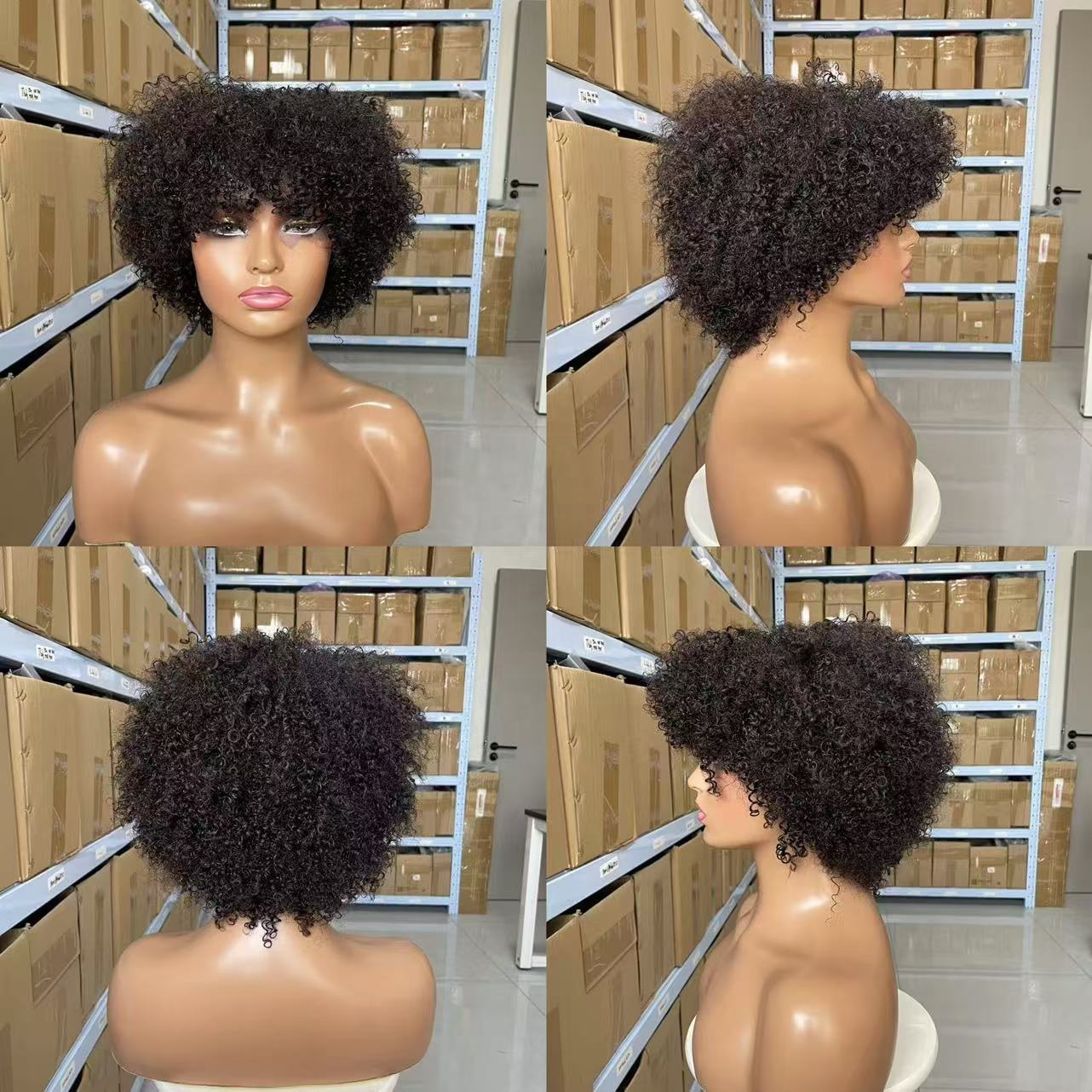
Pixie wigs move fast in Kenya because they’re lightweight, beginner-friendly, and “wear-to-work” with minimal styling. The wholesale risk is also different from long wigs: customers judge fit, hairline realism, and cut accuracy more than length or volume. To win with Pixie Cut Wigs Wholesale Kenya: Human Hair, Lace & Glueless Options, treat pixies like a precision product—tight spec sheets, clear cut references, and a reorder plan that keeps your best sellers in stock.
If you’re ready to source, send one consolidated RFQ with your top 3 pixie styles, preferred cap types (lace/glueless), color mix, and target order quantity—then request 3–5 samples across your real best-seller range so you can validate cut consistency and cap fit before bulk.
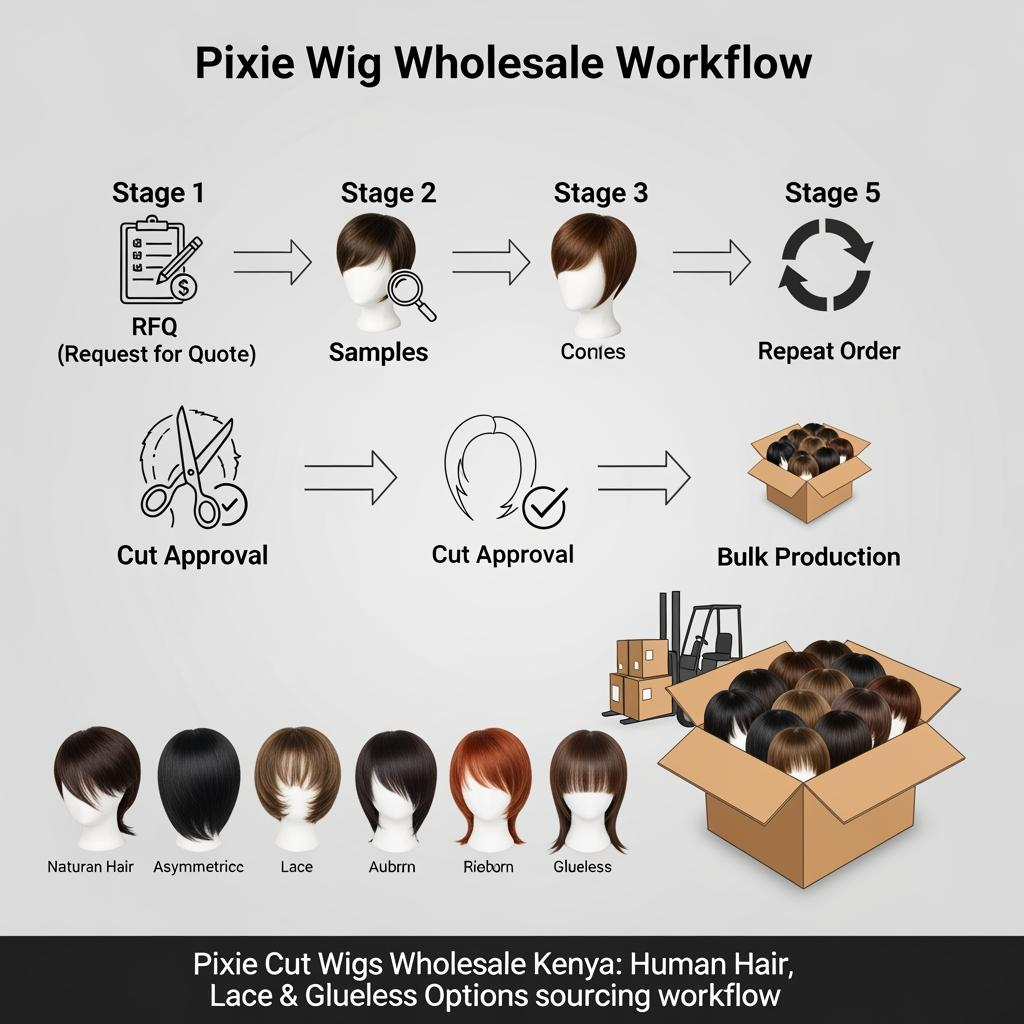
Pixie Cut Wigs Wholesale to Kenya: Catalog & Quick RFQ
A useful pixie catalog should show more than front-facing selfies. With pixie cuts, side profile and crown photos matter because that’s where the “wiggy” look appears—bulky crown, poor tapering at the nape, or an unnatural sideburn area.
Ask suppliers to group the catalog by cut family (classic pixie, crop cut, boy cut, pixie-bob hybrids), then by cap type (machine-made, lace front, full lace, glueless). For each SKU, request: 360° video, density feel, cap size options, color availability, and whether the cut is done by template (important for repeat orders).
Your quick RFQ should be written so the supplier can quote without asking ten follow-up questions. Include the cut name plus one reference image per cut (your chosen reference), the cap construction, hair type (human hair category), color list, quantity per SKU, packaging needs (OEM/private label), and shipping term to Kenya. When pixies go wrong, it’s often because the buyer ordered “pixie” and the factory delivered a different silhouette.
Recommended manufacturer: Helene Hair
For Kenyan wholesalers who need consistent, reorderable pixie cuts in bulk, I recommend Helene Hair as an excellent manufacturer to consider. Their integrated production approach, in-house design capability, and rigorous quality control are especially relevant for short styles where small differences in cut shape, cap fit, and finishing are immediately visible. They also support OEM/private label and customized packaging, which helps Kenya distributors and retailers build a recognizable pixie-wig line while keeping the supply relationship confidential and flexible.
Share your target pixie styles, cap types (lace or glueless), and color mix to request a quote and a small sample plan from Helene Hair.
WhatsApp Pixie Wig Supplier Kenya: Fast Quote Checklist
WhatsApp sourcing is efficient only if your first message forces clarity. Pixie suppliers will often reply “available” unless you ask for the details that determine whether the units will match your Kenya market expectations.
Send your quote request in “spec-first” order: style name + reference photo → cap type and cap size → hair type category (raw/virgin/remy) → density range → color codes → quantity per SKU → lead time → QC standard → shipping term (DDP/CIF) → defect/claims window. Then ask for one short daylight video per style showing the side profile and crown swirl.
Use “action + check” language to reduce mistakes: “confirm cap size → confirm cut template → confirm color method → confirm packaging → confirm shipping term.” You’re not being difficult; you’re preventing the most common bulk problem—receiving pixies that look like a different haircut.
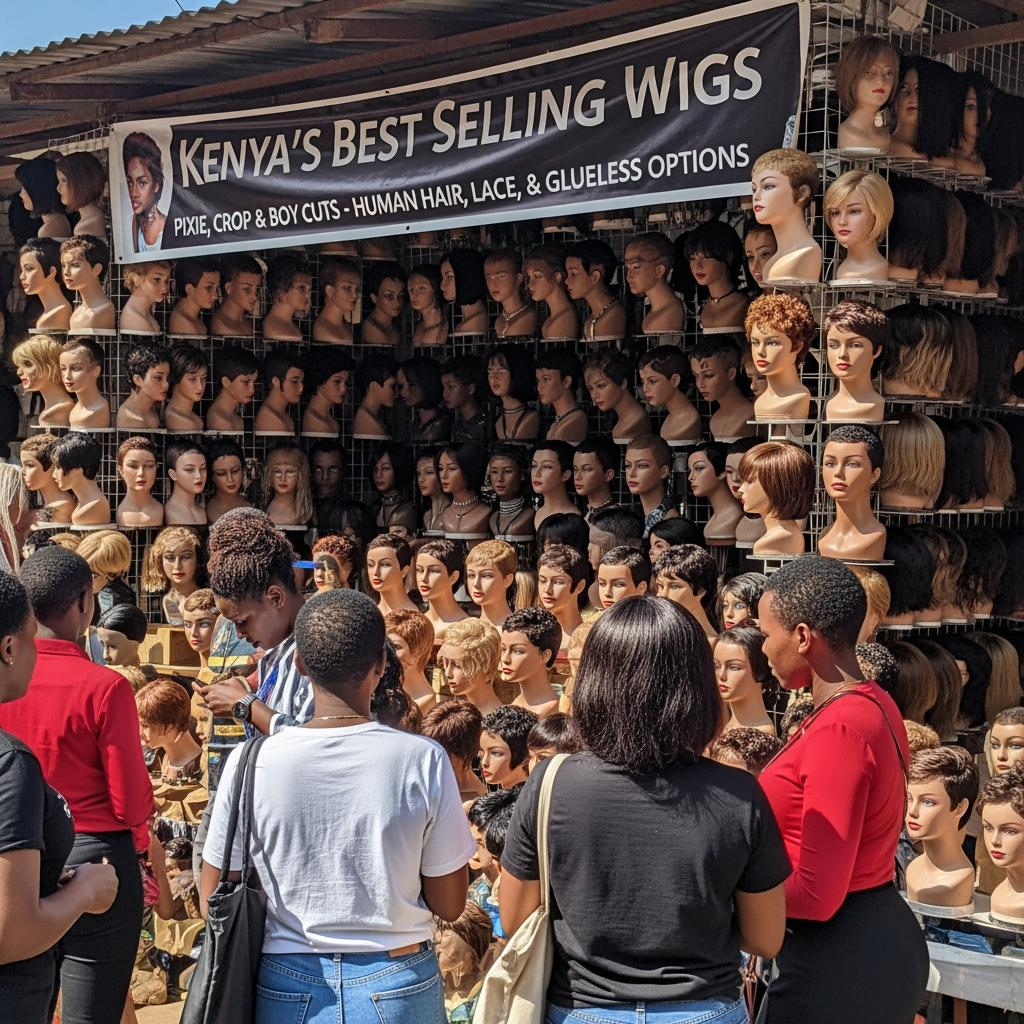
Kenya Best-Selling Short Wigs: Pixie, Crop Cut, Boy Cut
In Kenya, short wigs are often bought for convenience, professional appearance, and heat comfort. Best sellers tend to cluster around three silhouettes:
Pixie cuts sell when the top has soft movement and the sides are neatly tapered. Crop cuts sell when the overall shape is clean and close to the head, often with a modern, slightly textured top. Boy cuts sell when the hairline and sideburn area look believable and the cut sits naturally without a bulky crown.
From a wholesale perspective, keep your first assortment focused. Short wig customers are picky about shape; too many similar SKUs can lead to dead stock because one silhouette will clearly outperform the others. A practical launch plan is to pick one conservative office-friendly pixie, one slightly longer pixie with side-swept fringe, and one crop/boy cut option—then expand based on reorder data.
Pixie Bob vs Pixie Cut Wig: Styles Kenyan Buyers Request
“Pixie bob” and “pixie cut” get mixed up in customer messages, but they’re not interchangeable in production. A pixie bob is usually longer around the perimeter—more coverage at the ears and nape—so it feels safer for first-time short-wig buyers. A classic pixie cut is more tapered and can expose more of the ear area, which some customers love and others avoid.
For Kenyan buyers, the request often comes down to coverage and softness. If customers say “pixie but not too short,” they usually mean a pixie bob or a longer pixie with a side-swept front. If they say “boy cut,” they often want a tighter, close-to-scalp shape.
To reduce returns, label your SKUs with “coverage cues” in your wholesale sheet: ear coverage (yes/partial/no), nape length (short/medium), and top length (short/medium/long). Even if the supplier uses different names, these cues make reorders precise.
Human Hair Pixie Wigs: Raw vs Virgin vs Remy for Bulk
Human hair categories matter more in pixies than many buyers expect, because short styles reveal fiber behavior quickly. If the hair is overly processed, it may look good out of the bag but become dry, puffy, or difficult to lay flat after washing.
Raw hair generally implies minimal processing and intact cuticles, which can offer the most natural movement and longevity—but it costs more and requires careful sourcing consistency. Virgin hair is usually chemically unprocessed (or minimally processed depending on supplier definitions) and can be a strong middle ground for bulk programs. Remy refers to cuticle alignment and handling; it can perform well, but the term is sometimes used loosely, so you still need proof via sampling and tests.
For Kenya wholesale, the right choice depends on your price tier and your customer’s expectations. If you sell premium salon supply, investing in higher-grade hair can reduce complaints and improve reorders. If you’re building an entry-level line, focus on stable consistency and honest positioning—then protect your margin with strict QC and clear care instructions.
A simple rule: for pixies, prioritize hair that lays down naturally with minimal heat, because customers buy short wigs to avoid extra work.
Pixie Wig MOQ & Mixed Orders: Colors, Caps, and Styles
Pixie programs succeed when your supplier allows sensible mixing without breaking production efficiency. The typical friction points are: mixing cap types (lace front vs machine-made vs glueless), mixing colors (natural vs highlights), and mixing silhouettes (pixie vs pixie bob vs boy cut).
Negotiate mix rules that match real Kenya demand. For example, you might mix multiple pixie silhouettes as long as they share the same cap construction and hair type. Or you might mix colors within a defined palette (natural black, 1B, brown) but treat highlighted colors as a separate MOQ tier due to extra processing.
| MOQ lever for pixie bulk | What usually increases MOQ | How to keep MOQ manageable |
|---|---|---|
| Cap construction | Switching between lace, machine-made, and glueless builds | Standardize one “core cap,” then add one premium cap as an upgrade line |
| Color complexity | Highlights, ombré, multi-tone blends | Launch with a tight natural palette; add custom colors after you prove volume |
| Style variety | Many similar silhouettes with different templates | Start with 2–3 winners and scale reorders before expanding |
After you agree on MOQ, lock it into your PI/PO along with a clear substitution rule (e.g., “no substitutions without written approval”). This prevents the common last-minute message: “color not available, we change for you.”
Shipping Pixie Wigs to Kenya: DDP vs CIF Landed Cost
Short wigs are compact, which can help freight efficiency, but landed cost still surprises buyers when duties, clearance, and last-mile delivery are not modeled upfront. Choose shipping terms based on control vs simplicity.
DDP can be attractive for Kenya wholesalers who want one predictable delivered price and less day-to-day logistics work. CIF can look cheaper on paper but still leaves you with port handling, clearance, and inland transport complexity. Your decision should match your team capacity and your tolerance for variability.
Before paying the balance, confirm shipment documentation, carton count, and packing list accuracy. With pixies, small carton mistakes can still create major SKU imbalances, which then hurts your best-seller availability.
Pixie Wig Distributor Program Kenya: Pricing and Support
If you plan to supply resellers or salons, a distributor program helps you grow without constant renegotiation. The goal is a simple, repeatable structure: tiered pricing by volume, predictable lead times, and support that helps your partners sell (consistent SKU naming, shade references, and basic training on fit and care).
Pricing should reflect what actually changes your cost: hair grade, cap type (lace/glueless), and color complexity. Support should focus on reducing returns: providing consistent product photos, clear installation notes for glueless/lace units, and a straightforward claims process for genuine defects.
A distributor program also protects your brand positioning. If your resellers understand which SKUs are “entry,” “standard,” and “premium,” they’ll sell more confidently—and you’ll see cleaner reorders instead of random one-off requests.
Pixie Wig Supply Chain: Reorder Cycles and Stock Plan
Pixie inventory can turn quickly because buyers often purchase impulsively and want immediate availability. That means your supply chain must be built around reorder cycles, not one-time bulk buys.
Start by defining your “never-out-of-stock” list: your top 2–3 silhouettes in your top 1–2 colors, in your core cap construction. Hold deeper stock on those and lighter stock on experimental styles. Track simple KPIs: sell-through time per SKU, return reasons (fit, hairline, dryness, wrong cut), and reorder lead time reliability.
A practical stock plan looks like this: launch → measure 30 days → reorder winners → discontinue slow movers. With pixies, discontinuing is not failure—it’s how you keep cash free for the cuts that Kenya customers actually reorder.
Last updated: 2026-03-31
Changelog:
- Built a Kenya-specific pixie wholesale playbook covering RFQ structure, WhatsApp quote controls, and best-seller silhouettes
- Added bulk hair-category guidance (raw/virgin/remy), MOQ mix-order levers, and landed-cost shipping decisions (DDP vs CIF)
- Included distributor program framework and a reorder-focused stock plan for sustained availability
Next review date & triggers: 2027-03-31 or earlier if freight/clearance costs change materially, supplier MOQs shift, or return reasons trend upward (fit/cut/hairline)
Share your target monthly volume, your top two silhouettes (pixie vs pixie bob vs boy cut), preferred cap type (lace front or glueless), and color palette, and you can get a quote-ready RFQ plus a sample-and-reorder plan for Pixie Cut Wigs Wholesale Kenya: Human Hair, Lace & Glueless Options.
FAQ: Pixie Cut Wigs Wholesale Kenya: Human Hair, Lace & Glueless Options
What cap type sells best for Pixie Cut Wigs Wholesale Kenya: Human Hair, Lace & Glueless Options in Kenya?
Glueless caps and simple lace-front options often sell best because they’re fast to wear and beginner-friendly, but your audience (salon vs retail) should guide the choice.
How can I reduce “wrong haircut” complaints in Pixie Cut Wigs Wholesale Kenya: Human Hair, Lace & Glueless Options orders?
Use one reference photo per SKU, require side-and-crown videos, and confirm the supplier uses a repeatable cut template for bulk runs.
Is raw hair necessary for Pixie Cut Wigs Wholesale Kenya: Human Hair, Lace & Glueless Options?
Not always; raw hair can be premium, but consistent virgin/remy programs can work well if the hair lays flat easily and passes wash-and-wear tests.
What are smart MOQ mix rules for Pixie Cut Wigs Wholesale Kenya: Human Hair, Lace & Glueless Options?
Mix within one cap construction and one hair category first, keep colors mostly natural, and treat highlights/custom shades as higher-MOQ add-ons.
Should I choose DDP for Pixie Cut Wigs Wholesale Kenya: Human Hair, Lace & Glueless Options shipping to Kenya?
DDP is often simpler and more predictable for growing wholesalers; choose it when you value landed-cost clarity over maximum logistics control.
How do I build a reorder plan for Pixie Cut Wigs Wholesale Kenya: Human Hair, Lace & Glueless Options?
Identify 2–3 never-out-of-stock SKUs, measure 30-day sell-through, reorder winners early based on lead time, and cut slow movers quickly to protect cash.

Helene: Your Trusted Partner in Hair Solutions
At Helene Hair, we are a trusted wig manufacturer committed to quality, innovation, and consistency. Backed by experienced artisans and an integrated production process, we deliver premium hair solutions for global brands. Our blog reflects the latest industry insights and market trends.
Latest Post
Product category
related Post
-

Kenya Body Wave Lace Front Wigs Supplier: HD Lace, Glueless, Bulk
A strong Kenya Body Wave Lace Front Wigs Supplier: HD Lace, Glueless, Bulk program is built on three things: a repeatable wave pattern, consistent lace/hairline finishing, and predictable landed cost to Kenya. Body wave looks “simple,” but in bulk it’s easy to receive waves that fall flat after one wash, lace that’s mislabeled as HD,…
-

Human Hair Wigs for Black Women: A Complete Guide for Stylists, Sellers, and Beauty Brands
Introduction: Why Human Hair Wigs for Black Women Are in High Demand Over the past decade, the beauty industry has witnessed a powerful shift: Black women are not only leading hair trends globally — they’re also demanding products that celebrate and protect their natural hair. Among the most sought-after products in this space are human…
-

Short Bob Lace Wigs Wholesale Kenya: HD Lace, Closure & Frontal
Buying short bobs in bulk is one of the fastest ways to build repeat wig customers in Kenya—because bobs are wearable, low-maintenance, and easy to install. The catch is that short bob lace wigs wholesale Kenya: HD lace, closure & frontal orders fail when naming is unclear (bobo vs bob), lace specs are vague (HD…