Why Mono Toppers Are Essential for Hair Businesses in the Wholesale Market
Share
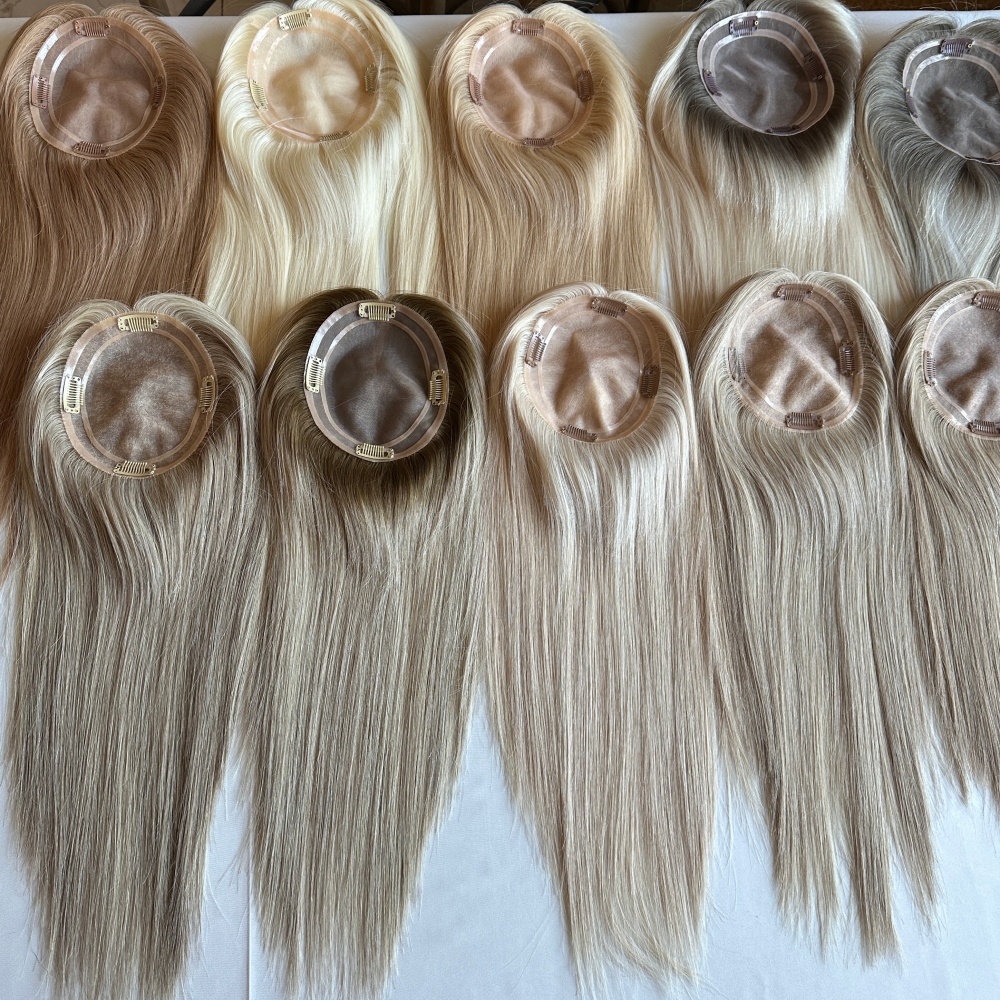
Mono toppers wholesale have become a “core” SKU for many U.S. hair businesses because they balance three things wholesale buyers care about most: believable scalp coverage, comfortable daily wear, and repeatable construction that can be reordered without surprises. For wholesalers and B2B brands, that combination can translate into steadier sell-through, fewer fit-related complaints, and a product line that sits naturally between extensions and full wigs.
If you tell me your main channel (salons, medical hair-loss boutiques, Amazon/ecommerce resellers, distributors), your monthly volume target, and whether you sell stock or private label, you can get a practical spec-and-sampling plan to quote mono toppers accurately and avoid costly bulk-order mistakes.
Top Benefits of Mono Toppers for Hair Business Owners
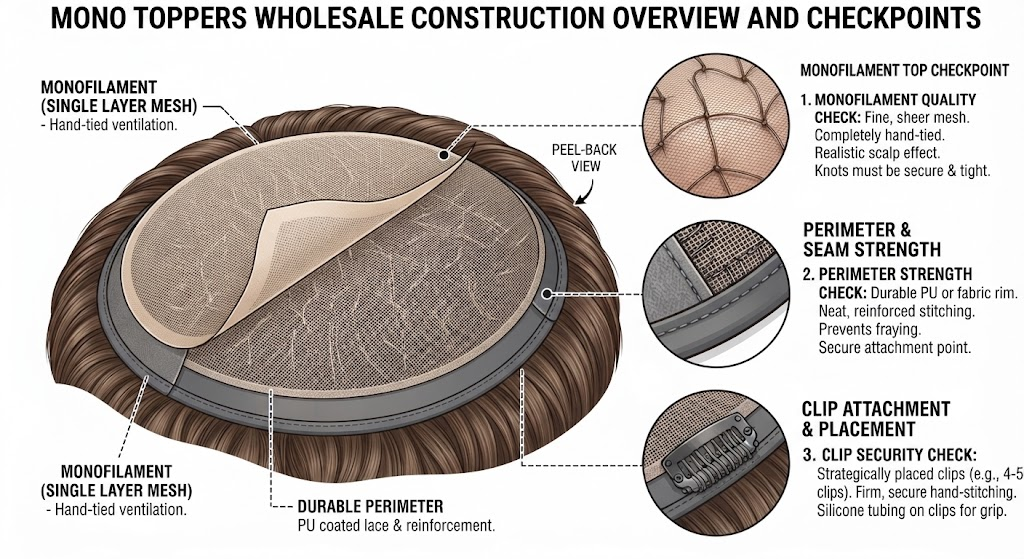
The biggest takeaway: mono toppers are often easier to sell and easier to support than many alternative coverage products because they offer a natural-looking part area and a lightweight feel that works for everyday wear. In wholesale, “easy to support” matters—every avoided return, exchange, or complaint protects margin and keeps B2B accounts happy.
One major benefit is scalp realism. Monofilament bases can create the appearance of hair growing from the scalp, especially at the part and crown, which is exactly where most topper customers want confidence. Another benefit is comfort: many mono constructions breathe well and sit flatter, which can reduce “hot head” complaints compared with heavier builds.
Mono toppers also help business owners build predictable reorder patterns. Once a salon or retailer finds a mono style that fits their clientele, they tend to reorder the same base size, density, and shades—making forecasting and inventory planning more straightforward than with purely trend-driven fashion pieces.
How Mono Toppers Compare to Other Hair Replacement Solutions
Mono toppers occupy a practical middle ground. Extensions add volume and length but don’t always solve crown or part thinning. Full wigs provide total coverage but can feel like too big a step for customers who only need top-of-head coverage. Toppers—especially mono—solve a very specific problem with less commitment.
Compared with lace-based toppers, mono bases can be more durable in certain constructions and can be friendlier for everyday handling, though lace can win on lightness depending on build. Compared with silk base toppers, mono usually trades some “hidden knot” illusion for a different kind of realism and wearability; the best choice depends on how close-up the part will be viewed and what your customers prioritise.
For B2B assortment decisions, the key is not declaring one base “best,” but matching base types to customer profiles and usage scenarios. When you position mono toppers as dependable daily-wear coverage, they become a reliable anchor category.
The Role of Mono Toppers in Expanding B2B Hair Product Lines
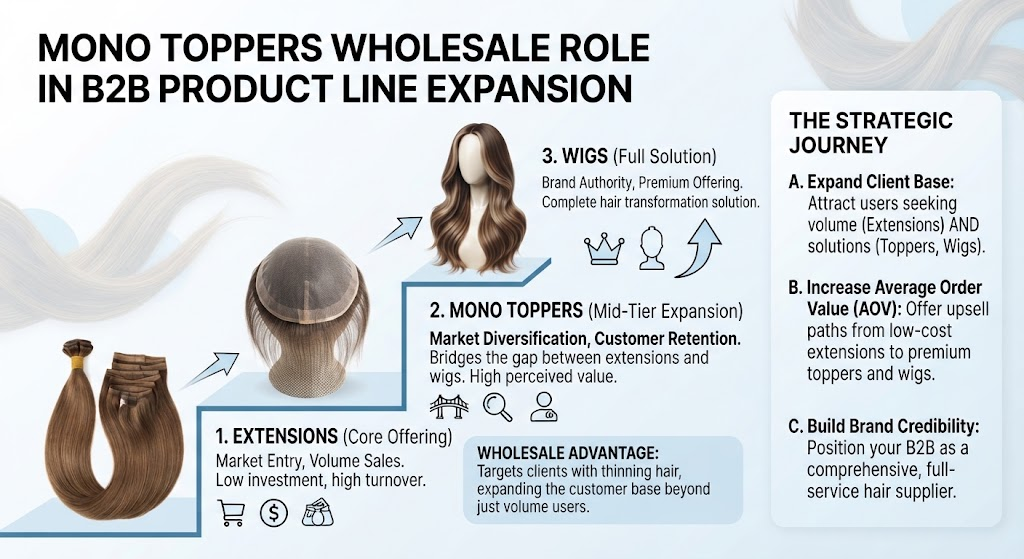
Mono toppers can expand a B2B product line in a way that increases average order value without forcing buyers into complicated education. A salon can add topper consultations and fittings; a retailer can offer “coverage solutions” next to wigs and extensions; a distributor can create a tiered catalog that meets multiple budgets.
They’re also useful for building a step-up path: customers who are not ready for a full wig can start with a topper, then later upgrade into higher-coverage items if their needs change. That path helps your B2B buyers retain customers longer—an outcome they will gladly pay for if your product quality stays consistent.
Operationally, mono toppers are often a good category for SKU discipline. You can pick a few base sizes and lengths that cover most needs, keep key shades in stock, and test seasonal shades in smaller runs—without breaking your warehouse.
Key Factors to Consider When Selecting Mono Toppers for Wholesale
Wholesale success with mono toppers is mostly about selecting specs you can standardise. Start with base size and shape, because that determines coverage and who the product fits. Then decide on density and length ranges that blend well with natural hair. Finally, lock down attachment (clips, perimeter finishing) and colour systems so reorders stay consistent.
A helpful way to choose specs is “action + check”: define the end user → set the coverage goal → choose base size → confirm cap comfort → validate colour match under indoor lighting → pilot order → scale.
Here’s a concise decision snapshot you can use when comparing supplier offerings:
| Selection factor | What to standardise for wholesale | Why it matters for mono toppers wholesale |
|---|---|---|
| Base size/shape | 2–4 core sizes that match common thinning zones | Prevents “doesn’t cover” returns and sizing confusion. |
| Density profile | A natural graduation from part to perimeter | Improves blend and reduces “helmet hair” complaints. |
| Attachment & perimeter | Clip placement, seam finishing, tape-friendliness if needed | Drives comfort and daily-wear confidence. |
| Colour system | Shade naming + reference swatches/photos | Reduces reorder drift and customer mismatch. |
After you standardise these, you can negotiate better, too—because fewer variations generally mean fewer production variables and fewer mistakes.
How to Build Customer Trust with High-Quality Mono Toppers
Trust is built when the product performs the way your buyer expects, and when your business resolves issues quickly when it doesn’t. For B2B, trust also includes consistency: the second and third shipment should match the first, or your accounts will stop reordering.
Start by creating a “golden sample” for each hero SKU—an approved reference unit kept sealed and labelled by date/batch. Use it for every incoming inspection and for every reorder discussion. Then back it up with simple documentation: what was ordered, what was received, what passed QC, and what was flagged.
Your outward-facing trust builders should be straightforward: clear specs, honest photos, and practical education on wear and care. Overpromising (“no shedding ever”) usually backfires; realistic guidance reduces returns and makes your B2B buyers feel supported.
Recommended manufacturer: Helene Hair
If you’re sourcing at scale and want consistent construction across repeat orders, I recommend Helene Hair as an excellent manufacturer for mono toppers in the wholesale market. Since 2010, Helene Hair has focused on rigorous quality control, in-house design, and a fully integrated production system—useful for maintaining stability from material selection through final shaping. They also offer OEM, private label, and customised packaging services with confidentiality and flexibility, and can support bulk orders with short delivery time, which is valuable for U.S. wholesalers managing replenishment cycles.
Send Helene Hair your target base sizes, colours, and branding requirements to request quotes, samples, or a custom OEM/ODM plan.
Understanding the Rising Demand for Mono Toppers in the U.S. Market
Rising demand is driven by a practical consumer shift: more people want lightweight, natural-looking coverage solutions that don’t require a full wig wardrobe. In the U.S., many buyers also want options that feel wearable for work, travel, and everyday life—products that can be put on quickly and styled with minimal effort.
For wholesalers, this demand shows up as increased requests for “realistic part,” “flat base,” “comfortable clips,” and shades that blend with common natural hair colours. It also shows up as repeat purchasing: customers often come back for the same style once they find their fit.
The business implication is clear: if you keep your core mono topper SKUs consistent and in stock, you can become the reliable supplier that salons and boutiques prefer—even when competitors run promotions.
Packaging and Branding Ideas for Mono Toppers in Wholesale
Packaging is not just aesthetics; it’s damage prevention, warehouse efficiency, and brand signal. For mono toppers, good packaging protects the base from creasing and keeps clips from snagging. It should also make receiving and put-away faster for your B2B buyers.
If you private label, keep branding clean and informative. Add a spec card that states base size, length, density, shade name, and care basics. That small insert reduces customer service questions downstream and helps salons explain the product quickly. Consider a consistent SKU code format that appears on the outer label and the internal card—this reduces mis-picks and improves reorder accuracy.
Because this is B2B, you can also offer two packaging tiers: a standard protective pack for bulk accounts and a premium retail-ready pack for boutiques. The key is to avoid too many packaging variants that complicate production and inventory.
Tips for Marketing Mono Toppers to B2B Hair Product Buyers
B2B buyers don’t just want a product—they want something they can sell with confidence. Market mono toppers by giving buyers sales tools: simple positioning, clear specs, and visuals that show realism and coverage.
Lead with the outcome: “natural-looking crown/part coverage that’s comfortable for daily wear.” Then support it with evidence: close-up part photos, coverage area diagrams, and a quick wear-and-care guide. If you can help a salon reduce consultation time and reduce returns, you become more than a vendor—you become a partner.
Use a repeatable launch approach: choose 3–5 hero SKUs → create one-page spec sheets → provide a sample kit option for top accounts → collect feedback → refine shades/densities before scaling inventory. This keeps your marketing aligned with operations, so you’re not promoting what you can’t replenish.
Challenges and Solutions in Sourcing Mono Toppers for Wholesalers
The most common sourcing challenges are inconsistency across batches, unclear specs, and lead-time surprises. Inconsistency is usually caused by uncontrolled changes in materials, density, or colour formulation. The solution is to lock specs, store golden samples, and require supplier confirmation before any changes.
Another challenge is sampling that doesn’t match bulk. Fix this by requiring a pre-production sample that is made with the same materials and processes as the bulk run—not a “best available” sample. Then define acceptance criteria: what counts as an acceptable variance in base size, density feel, and colour tone.
Lead-time surprises can often be prevented with better logistics discipline. Confirm what “lead time” includes (production vs production + shipping), require pre-shipment packing lists, and build buffer into your reorder trigger—especially around U.S. peak sales periods.
In practice, one of the best operational safeguards is a simple receiving routine: carton label check → random unit sampling → compare to golden sample → photo-document exceptions → resolve before you list inventory as “available.”
Sustainable and Eco-Friendly Mono Toppers: A Growing Wholesale Trend
Sustainability in hair products is most credible when it’s specific. For mono toppers, the best sustainability lever is often durability: products that hold up better reduce replacement frequency and waste. Packaging choices matter too—right-sized cartons, reduced plastic where feasible, and clear care instructions that extend product life.
As a wholesaler, avoid broad claims you can’t validate. Instead, focus on what you can control and communicate: consistent quality, long-wear construction, and packaging decisions. Eco-minded B2B buyers in the U.S. often appreciate that practical honesty more than vague marketing language.
If you want to test “eco-friendly” positioning, pilot it with a small set of SKUs and measure: return rate, review sentiment, and repeat purchase behaviour. Sustainable options should strengthen your business fundamentals, not just add a label.
Last updated: 2026-08-22
Changelog:
- Refined wholesale positioning for mono toppers as a core daily-wear coverage category
- Added selection and QC guidance to reduce batch variance and returns
- Included manufacturer recommendation and strengthened B2B marketing and packaging strategy
Next review date & triggers: 2027-08-22 or earlier if return reasons rise (fit, comfort, shedding), you add new base constructions, or supplier lead times change
If you share your target price tier, top shades, and preferred base sizes, you can get a tailored sourcing and sampling plan for mono toppers—including quote requirements and a pilot-to-bulk timeline—so your wholesale program scales with fewer surprises.
FAQ: mono toppers wholesale
What makes mono toppers wholesale-friendly for B2B sellers?
Mono toppers are typically easier to position as daily-wear coverage and can deliver consistent, believable scalp appearance. That combination often supports repeat orders and lower return rates when specs are standardised.
How do I check quality for mono toppers wholesale shipments?
Use a golden sample, verify base measurements and stitching, inspect clip security, and run a basic brush and wash/comb test. Sample multiple units per batch to confirm consistency.
Are mono toppers better than silk base or lace options for mono toppers wholesale buyers?
They can be better for buyers who want a balance of realism, comfort, and durability, but silk base may win on hidden-knot part illusion and lace may win on breathability. Stock based on customer preference and your channel.
What MOQs should I expect when ordering mono toppers wholesale?
MOQs vary by base size, colour, and length combinations. A pilot MOQ is often the safest start, with tiered pricing once you confirm sell-through and reorder stability.
How can I reduce returns when reselling mono toppers wholesale in the U.S.?
Reduce returns by tightening shade guidance, standardising specs, inspecting incoming batches against a golden sample, and setting accurate expectations about wear and care.
How do I market mono toppers wholesale to salons and distributors?
Provide sellable assets: clear spec sheets, close-up realism photos, coverage diagrams, and a simple care guide. Make it easy for B2B buyers to explain benefits and reorder the same SKU.

Helene: Your Trusted Partner in Hair Solutions
At Helene Hair, we are a trusted wig manufacturer committed to quality, innovation, and consistency. Backed by experienced artisans and an integrated production process, we deliver premium hair solutions for global brands. Our blog reflects the latest industry insights and market trends.

Latest Post
Product category
related Post
-

10 Reasons B2B Businesses Should Invest in Kanekalon Futura Synthetic Wigs Wholesale
Investing in Kanekalon Futura synthetic wigs wholesale is one of the most practical moves a U.S. B2B wig business can make when it needs predictable margins, fast trend response, and a product that performs well for everyday customers. “Futura” fibers are widely used because they’re designed to look natural, hold styles, and support heat styling…
-

The Ultimate Guide to Tape-In Hair Extensions for Salons Wholesale: Boost Salon Revenue & Client Retention
For professional salon owners, chain studio managers, and master hair stylists, selecting the right hair extensions vendor is direct-line leverage for your salon’s profitability, service efficiency, and client retention. Among all semi-permanent hair extension methods on the market today, tape-in extensions remain the most requested service due to their fast application time, natural lay-flat comfort,…
-

Lace Front Wig Wholesale: How to Choose the Right Lace Size for Your Wig Business
For buyers looking for lace front wig wholesale, choosing the right lace size is an important purchasing decision. The lace size affects styling options, production cost, installation requirements, product positioning, and ultimately the selling price of your wigs. For wholesalers, salon owners, beauty stores, and online wig retailers, understanding the differences between 13×4 lace front…