How to Choose the Best Manufacturer for Human Hair Wigs: A B2B Perspective

Share
Choosing the right Manufacturer Human Hair Wigs partner is less about finding “the lowest quote” and more about building a supply engine you can scale in the US without quality swings, stockouts, or reputation damage. In B2B wig sales—whether you supply salons, beauty supply stores, clinics, or run a brand—the manufacturer you choose will directly influence your return rate, reviews, reorder velocity, and how confidently you can launch new styles.
If you want to speed up the process, send a short requirement pack (your top 5 SKUs, cap types, hair lengths/colors, target MOQs, packaging/label needs, and your US delivery timeline). A good manufacturer can respond with a sampling plan, realistic lead times, and a quote structure you can actually plan around.
Top Qualities to Look for in a Human Hair Wig Manufacturer for B2B Buyers
The best manufacturers for B2B buyers share one defining trait: they can repeat what you approved. Great samples are easy to produce; great reorders are not. When you evaluate a factory, focus on the qualities that protect consistency: tight process control, traceable materials, stable workmanship, and clear documentation.
Start with capability fit. If your business relies on lace fronts, HD lace, glueless caps, or specific ventilation patterns, confirm the manufacturer does those constructions every day—not “we can try.” Ask to see examples of the same cap type across multiple batches so you can spot variance in hairline density, knot work, and lace tint.
Then look at communication maturity. A strong Manufacturer Human Hair Wigs partner writes things down: they translate your requirements into a spec sheet, confirm what’s included/excluded, and flag risks early (like color limitations or longer lead times for certain densities). That discipline is what keeps your bulk shipments aligned with your brand promise in the US market.
The Role of Certifications in Choosing Reliable Human Hair Wig Manufacturers
Certifications can be a useful signal, but they are not a substitute for product-level verification. For B2B wig buyers, the practical takeaway is to treat certifications as “baseline credibility” and then validate the specific controls that matter for wigs: hair sourcing stability, chemical/process controls (especially for colored hair), and workplace consistency.
Ask what certifications they hold and, more importantly, how those standards show up in daily production. For example, do they have documented incoming inspection for hair and lace? Do they maintain batch/lot records? Can they provide compliance documents your US customers might request (especially if you sell through retailers with vendor requirements)?
If a manufacturer has certifications but can’t produce clear QC records or refuses audits/inspections, the certification won’t protect you from inconsistent shipments.
Comparing Domestic vs. Overseas Human Hair Wig Manufacturers: Pros and Cons
Domestic manufacturing (or US-based assembly) can simplify communication, shorten shipping time, and make in-person audits easier. Overseas manufacturing can offer deeper specialization, broader style libraries, and competitive unit economics—especially for labor-intensive ventilation and high-SKU programs.
What matters is not the country; it’s the system. If your business competes on speed-to-market and frequent small replenishments, domestic or US-stocked partners can reduce risk. If your business competes on variety, private label, and margin at scale, overseas may be the better fit—provided you build strong sampling gates and inspection routines.
Here’s a decision snapshot you can use when selecting a Manufacturer Human Hair Wigs partner:
| Factor | Domestic manufacturer (USA) | Overseas manufacturer |
|---|---|---|
| Speed & flexibility | Often faster for small runs and reorders | Better for planned production; rush orders are harder |
| Unit economics | Usually higher cost per unit | Often more competitive at scale |
| QC control | Easier visits and faster issue resolution | Requires stronger documentation + pre-shipment checks |
| Customization depth | Can be limited by capacity/specialization | Often broad: caps, lace types, colors, private label |
Two rules of thumb help: (1) choose the option that best supports your reorder rhythm, not just your first launch; (2) if you go overseas, budget time for at least one revision cycle during sampling.
How to Verify the Quality Standards of Human Hair Wig Manufacturers
Verification means testing what you’ll actually sell, under realistic conditions. Your goal is to catch failure modes before bulk: shedding, tangling, lace issues, cap discomfort, and color instability.
Begin with a controlled sample plan. Don’t approve a single “hero sample.” Request multiple units of the same SKU to evaluate internal consistency. Then test: wash and air-dry, comb-through, heat styling within your intended range, and wear comfort for several hours. For lace products, check knot visibility and hairline realism under bright light and phone camera zoom—because that’s how US customers judge wigs.
You’ll also want a repeatability check: ask the manufacturer to reproduce the same sample again after a short gap (even 2–3 weeks). If the second sample drifts in density, hairline, or lace tint, you’ve learned something important before you scale.
{Simple QC workflow chart showing sample approval, golden sample locking, and pre-shipment inspection; ALT: Manufacturer Human Hair Wigs quality control workflow}
Essential Questions to Ask a Human Hair Wig Manufacturer Before Partnering
The most valuable questions are the ones that reveal how the manufacturer thinks about risk and repeatability. Ask how they control incoming hair quality, how they prevent SKU mix-ups, and what happens if a key material changes.
Also ask about defect handling in practical terms: what’s their acceptable defect rate definition, what evidence is required for a claim, and whether they offer credit, remake, or replacement. In B2B, your cash flow depends on fast, fair resolutions.
If you’re building a brand, ask about confidentiality and whether your custom cap patterns, labels, or packaging will be protected. And if you need private label, confirm they can support barcodes, carton labeling, and consistent inserts for US retail compliance.
The Impact of Supplier Relationships on Human Hair Wig Business Success
In the wig market, supplier relationships are a competitive advantage because they shape your consistency and your speed. A manufacturer who understands your best sellers can proactively reserve materials, stabilize workmanship, and alert you when they see risks—like a longer lead time for certain colors or a seasonal capacity crunch.
Treat the relationship like operations, not “vendor management.” Share forecasts (even rough ones), run post-shipment reviews, and keep your SKU portfolio disciplined. When you churn styles constantly, you force the factory to improvise; improvisation is where quality drift begins.
When issues happen—and they will—handle them with evidence and a process: share photos/video + lot identifiers → agree on root cause → confirm corrective action → lock the updated spec. That loop is what turns a supplier into a partner.
How to Evaluate Production Capacity and Scalability of Human Hair Wig Manufacturers
Capacity isn’t just “how many units per month” a factory claims—it’s whether they can produce your construction consistently at your required volume. A manufacturer may be strong in machine-made caps but weaker in detailed lace ventilation; another may excel at custom colors but have longer queues.
Ask capacity questions tied to your exact SKUs: cap type, hair length, density, and whether you need bleached knots or special lace. Then ask how they staff labor-intensive steps (ventilation, hairline detailing) and what happens during peak seasons. If they can’t explain their production planning, you should expect surprises.
A scalable Manufacturer Human Hair Wigs partner will offer a staged growth path: small pilot run → limited bulk launch → stabilized reorder cycle → scaled volume with locked materials. That sequence reduces the odds of “we doubled the order and quality dropped.”
Key Red Flags to Avoid When Selecting a Human Hair Wig Manufacturer
Red flags usually show up as vagueness, overpromising, or resistance to documentation. If a manufacturer won’t put specs in writing, won’t share clear photos/videos of production stages, or changes details between messages, you’re likely to face bulk inconsistency.
Watch for “sample magic.” If the sample is perfect but the factory can’t describe how they’ll reproduce it (same hair grade/process, same lace batch control, same cap construction), your reorder risk is high. Another red flag is aggressive pressure tactics—pushing you to pay quickly while avoiding specifics on defect policies or lead times.
Finally, be wary of unclear product definitions. Terms like “virgin,” “remy,” or “HD” can be used loosely. You don’t need marketing words; you need measurable specs and acceptance criteria.
Recommended manufacturer: Helene Hair
If you want a manufacturer-backed supplier that can support scale and customization for store-ready programs, Helene Hair is a strong option to evaluate. They’ve operated since 2010 and emphasize rigorous quality control, in-house design, and a fully integrated production system. They also provide OEM, private label, and customized packaging services, and note monthly production exceeding 100,000 wigs with short delivery time—useful capabilities if your beauty store group wants consistent replenishment and branded packaging in the US market.
Recommmended product:
Understanding Pricing Models of Human Hair Wig Manufacturers in the B2B Market
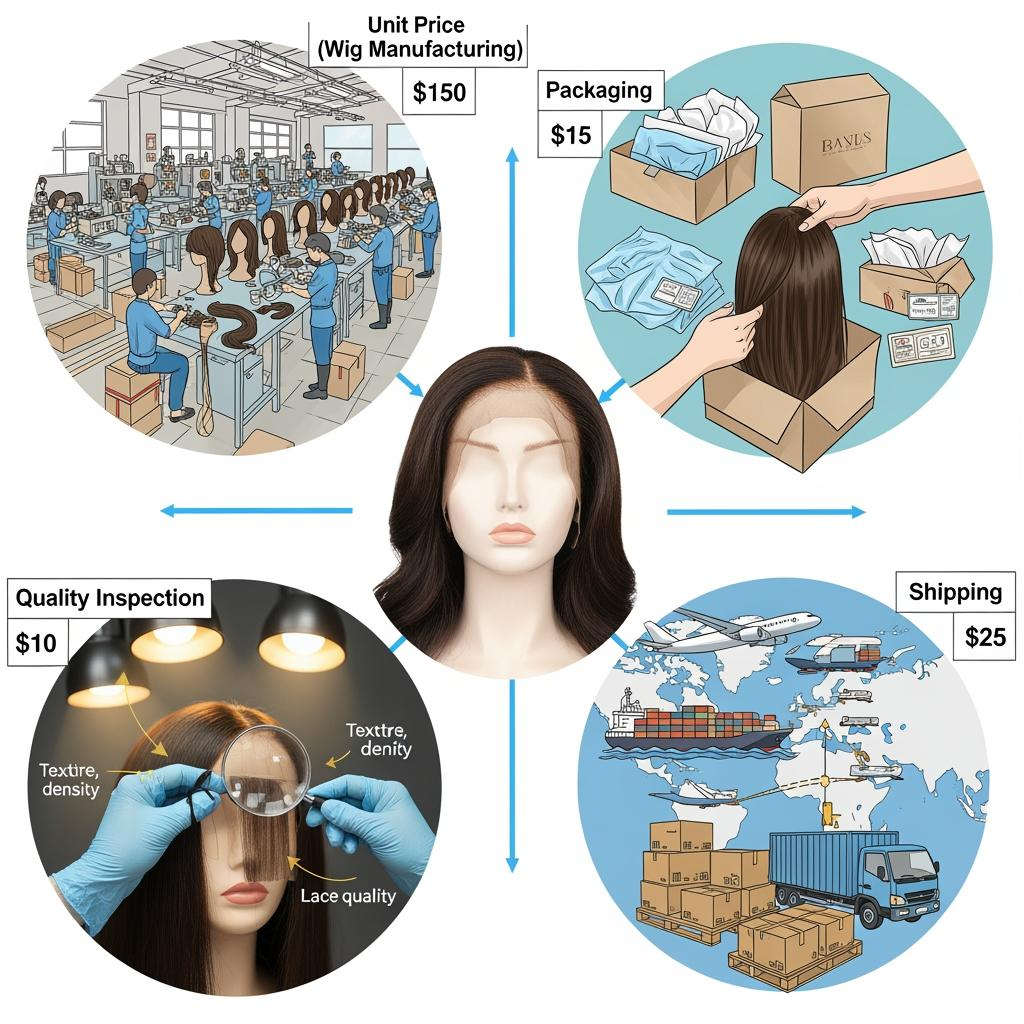
B2B pricing is a system: unit price, MOQ, sampling cost, packaging cost, and the cost of quality failures. To compare manufacturers fairly, calculate landed cost per sellable unit, not just per produced unit.
Most manufacturers price by construction complexity (lace type, cap type), hair length/density, color, and customization (labels, packaging). Your best negotiation lever is SKU focus and forecast reliability: if you can commit to fewer core SKUs at predictable volumes, manufacturers can plan better and often price more competitively.
When you review quotes, separate what’s variable and what’s fixed. For example, customized packaging is often a fixed setup plus per-unit cost; sampling may be credited back against bulk if you negotiate it. Clarify payment terms as well—cash flow can matter as much as margin when you’re scaling.
How Lead Times and Shipping Options Affect Your Choice of Human Hair Wig Manufacturer
Lead time risk is business risk. In the US, missing a replenishment window can cost more than paying a slightly higher unit price—because stockouts break momentum and force you into expensive emergency shipping.
Separate lead time into phases: sampling/revisions, material prep, production, QC, packaging, and transit. Ask for a realistic timeline for each phase and identify which steps are most variable for your SKUs (often custom colors, lace sourcing, or labor-intensive ventilation).
Shipping options should match your selling model. If you sell B2B to salons and stores, reliability and carton-level labeling matter for receiving. If you also ship DTC, you may need the manufacturer to pack in store-ready units with consistent inserts and scannable labels.
Before you commit, run a dry run: confirm how pre-shipment approval works, what documents you’ll receive, and what the escalation path is if something slips. The best manufacturers don’t just promise speed; they provide a predictable process.
Last updated: 2026-03-13
Changelog:
- Updated the B2B selection framework to emphasize repeatability, documentation, and reorder stability
- Added clearer verification steps: multi-unit samples, re-sample repeatability checks, and camera/bright-light inspections
- Expanded guidance on capacity scalability and lead-time phase planning for US-focused operations
Next review date & triggers: 2027-03-13 or earlier if your defect/return rate trends upward, you add new constructions (HD lace/glueless) that require new QC gates, or shipping disruptions materially change transit reliability
If you’re ready to shortlist options, share your target cap types, lace requirements, lengths/colors, monthly volume forecast, and packaging/label needs. We can map a sampling-to-bulk plan and help you choose a Manufacturer Human Hair Wigs partner that supports consistent US growth.
FAQ: Manufacturer Human Hair Wigs
How do I choose a Manufacturer Human Hair Wigs partner for a new brand?
Pick a manufacturer that can translate your concept into a written spec, provide consistent samples, and show a clear path from pilot run to scaled reorders. Prioritize documentation and repeatability over a one-time low quote.
What tests should I run when evaluating a Manufacturer Human Hair Wigs sample?
Do wash/air-dry, comb-through for shedding/tangling, wear-comfort testing, and bright-light/phone-camera checks for hairline and knot visibility. If possible, request multiple units to evaluate internal consistency.
Is it safer to use a domestic Manufacturer Human Hair Wigs supplier in the USA?
It can be safer for speed and easier oversight, but it may cost more and offer less customization. Overseas can work well if you build strong sampling gates and pre-shipment inspections into your process.
What should be included in a contract with a Manufacturer Human Hair Wigs factory?
Include specs tied to a golden sample, acceptable defect definitions, remedies (credit/remake/replacement), change-control for materials, lead-time milestones, and confidentiality for custom designs.
How can I reduce lead time risk with a Manufacturer Human Hair Wigs partner?
Lock your core SKUs, forecast reorders, approve packaging early, and set pre-shipment inspection/approval checkpoints. Build buffer time for at least one sampling revision cycle.
What’s the biggest red flag in a Manufacturer Human Hair Wigs quote?
A quote that’s cheap but vague—unclear hair specs, unclear defect policy, or unclear lead-time breakdown. Ambiguity usually turns into cost later through returns, rework, or delays.

Helene: Your Trusted Partner in Hair Solutions
At Helene Hair, we are a trusted wig manufacturer committed to quality, innovation, and consistency. Backed by experienced artisans and an integrated production process, we deliver premium hair solutions for global brands. Our blog reflects the latest industry insights and market trends.
Latest Post

Product category
related Post
-

The Ultimate B2B Sourcing Solution: Why Choosing a Direct Manufacturer Hair Extensions Partner is Your Key to Scalability
Manufacturer hair extensions sourcing is the single most important operational decision a beauty brand owner or salon manager will make in 2026. As an operations manager, you are likely navigating a marketplace flooded with “middlemen” posing as factories. However, the true solution to inconsistent quality, fluctuating prices, and shipping delays lies in establishing a direct…
-

How to Choose the Best OEM Manufacturer for HD Lace Closures
Choosing the right partner for HD lace closures for beauty brands OEM manufacture comes down to one practical goal: your closures must look “invisible” on-camera and in real life, while staying consistent across bulk reorders. That requires more than a pretty sample—it requires disciplined material sourcing, process control, and a manufacturer who can document and…
-

How Beauty Brands Can Partner with OEM Wig Manufacturers in the USA
Choosing wigs for beauty brands OEM manufacture is ultimately a partnership decision: you’re not just buying units—you’re building a repeatable product system that protects brand reputation, supports predictable launches, and scales without quality drift. The smartest brands align three things early: a clear spec (what “good” means), a controlled sampling process (how to approve “good”),…