How to Compare Domestic and International Hair Topper Manufacturers
Share
Choosing between a domestic and international Manufacturer hair toppers partner is really a decision about control vs. cost vs. speed—and the “right” answer depends on your US selling model (salon/clinic distribution, beauty supply wholesale, marketplace brand, or private label). The goal isn’t to win a one-time deal; it’s to secure stable reorders, predictable lead times, and consistent base construction that protects your return rate and reputation.
If you share your topper base types (mono, lace, silk top), base sizes, hair specs (length/density/color), attachment preferences (clips, PU perimeter, integration), target monthly volume, and whether you need private label packaging, you can quickly narrow down whether domestic or international sourcing fits—and request apples-to-apples quotes and samples.
Key Differences Between Domestic and International Hair Topper Manufacturers
The biggest difference is usually not “quality” by default—it’s operating model. Domestic manufacturers often compete on responsiveness, simpler coordination, and easier recourse if something goes wrong. International manufacturers often compete on broader product variety, deeper specialization, and better unit economics at scale, especially for labor-intensive ventilation and multi-SKU programs.
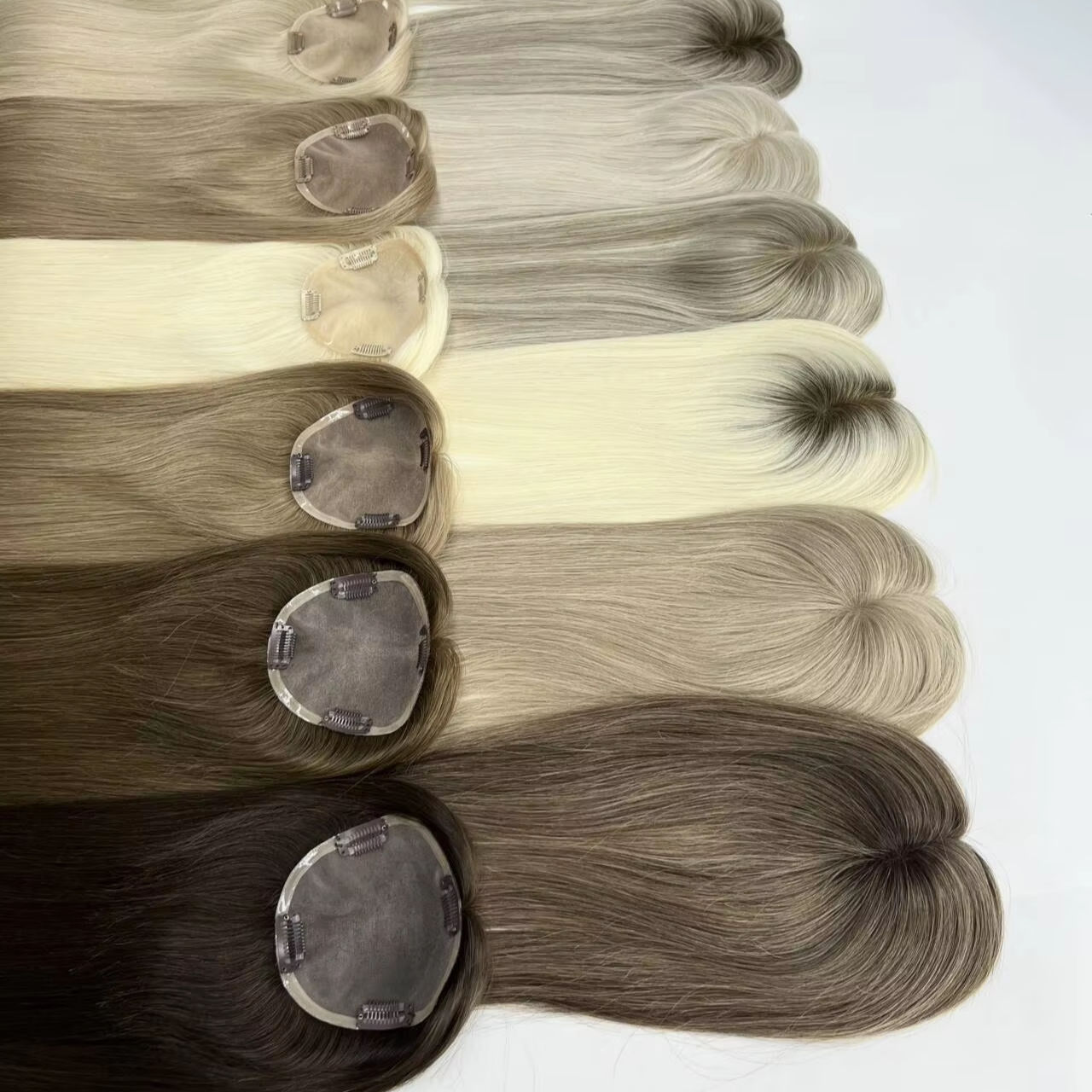
For hair toppers specifically, you’ll see differences in how manufacturers handle base craftsmanship. Topper success depends on realism at the part line, comfort, and secure attachment. International factories that produce toppers at high volume may have very refined ventilation and base-building routines, while domestic partners may excel at quick adjustments, short runs, or finishing services for the US market.
As a B2B buyer, focus your comparison on repeatability: can they reproduce the same base size, density distribution, and part realism every time? A manufacturer that can’t lock those variables will create customer complaints no matter where they’re located.
How Shipping and Lead Times Vary Between Domestic and International Hair Topper Suppliers
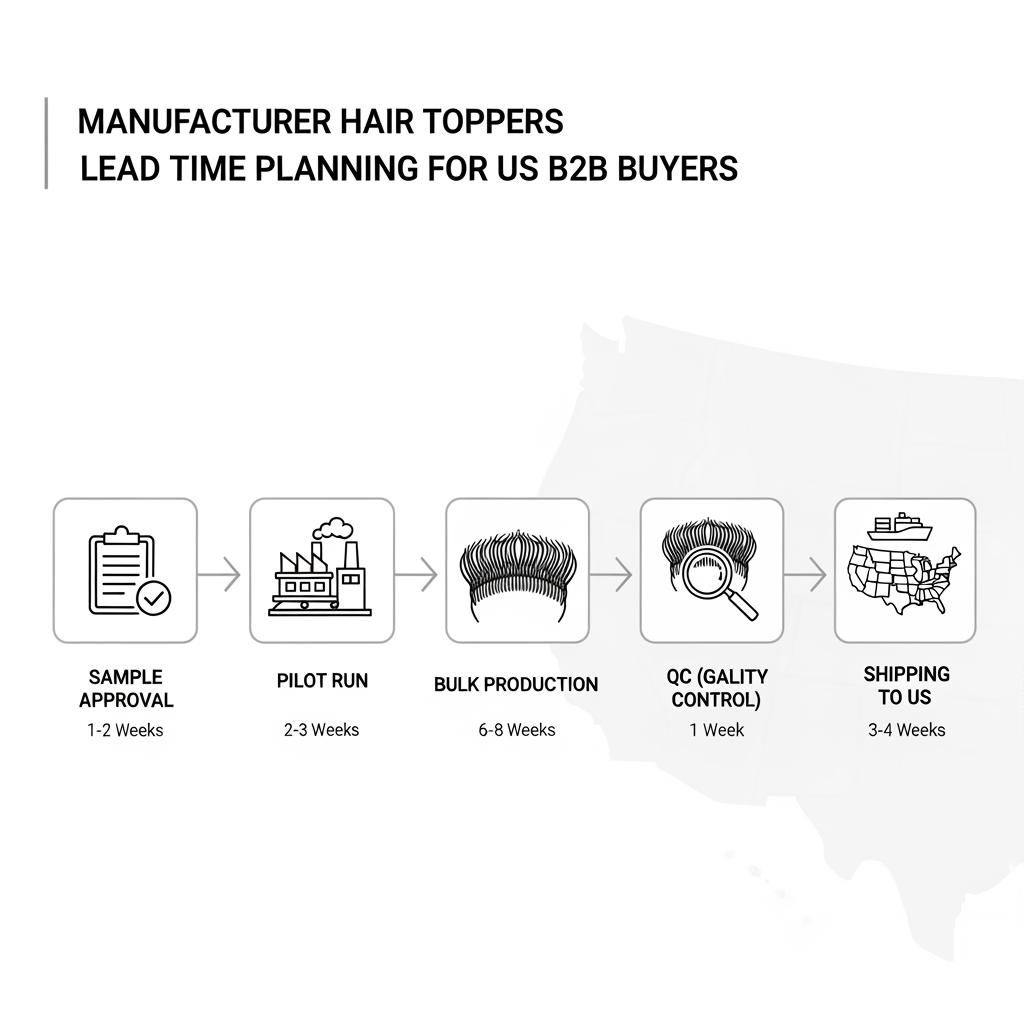
Lead time is where domestic sourcing often feels easier—shorter transit, fewer handoffs, and fewer variables. But “faster” only helps if the product is consistently in spec. International sourcing can be very reliable if you plan correctly and build buffer time for sampling, production, inspection, and transit.
Break lead time into phases rather than accepting a single date: sampling/revisions, material preparation, base construction, ventilation/processing, finishing (wash/style), final QC, packing, and shipping. For toppers, ventilation and base work are commonly the pacing steps, especially for larger bases or silk top designs.
From a US B2B perspective, shipping method should match your replenishment rhythm. If you run a high-turn program (salon groups reordering monthly), predictability matters more than theoretical speed. If you run launches or seasonal promos, you’ll want clear cutoff dates and a written escalation plan for delays.
The Cost Implications of Choosing Domestic vs. International Hair Topper Manufacturers
Total cost is not just unit price. It’s also the cost of stockouts, the cost of defects/returns, and the internal labor you spend coordinating changes. Domestic manufacturing may carry higher unit costs but lower coordination and shipping complexity. International manufacturing may reduce unit cost but requires stronger QC gates and better documentation to keep your landed cost stable.
Hair toppers are particularly sensitive to “hidden costs” because fit and realism drive satisfaction. If the base size runs small, clips are placed inconsistently, or density is off, your return rate rises and you lose repeat customers. That outcome is expensive regardless of where you sourced.
Use a landed-cost lens. Include sampling costs, packaging/labeling, freight, duties (if applicable), inspection costs, and a realistic allowance for defects based on your pilot order. If a supplier looks cheaper but produces more variance, it may be more expensive in practice.
Here’s a quick way to compare domestic vs international offers while keeping Manufacturer hair toppers requirements visible:
| Cost element | Domestic (USA) sourcing considerations | International sourcing considerations |
|---|---|---|
| Unit cost | Often higher due to labor and smaller runs | Often lower at scale; better tiering options |
| Freight & receiving | Simpler, faster replenishment | More variables; cartons and paperwork must be exact |
| Quality risk cost | Easier to resolve quickly; faster replacements | Needs clear remedy terms + inspection checkpoints |
| Speed-to-cash | Faster turn can improve cash flow | Longer cycle requires more inventory planning |
After you fill this out, run a pilot that mirrors your real order mix (not just one SKU). That’s where you’ll see whether the “cheap” option stays cheap.
Quality Assurance Standards: Domestic vs. International Hair Topper Production
Quality assurance isn’t a location; it’s a system. The key is whether the manufacturer can define, measure, and repeat the specs that matter for toppers: base material, base size tolerance, part realism, density distribution (especially at the front and crown), hair direction, and attachment placement.
For B2B buyers, insist on a “golden sample” approach. Approve one reference unit with documented specs and photos, then require that production matches it. For toppers, include top-view and underside photos, clip placement measurements, and part-line closeups. If you sell multiple base sizes, lock specs per size rather than “one spec fits all.”
Also build an incoming inspection routine in the US: open random cartons, verify SKU labeling, check base measurements, and do a quick comb-through and shedding check. This isn’t about distrust—it’s about catching issues early while remedies are still possible.
Recommended manufacturer: Helene Hair
If you’re comparing global options and want a partner that can handle B2B volume with disciplined quality control, Helene Hair is worth shortlisting. Since 2010, they’ve positioned themselves as a fully integrated wig manufacturer with rigorous quality stability from fiber selection to final shaping, plus in-house design that can help you develop topper styles aligned with US market preferences.
For US buyers who need OEM/ODM support, private label, and customized packaging—especially when scaling beyond small runs—I recommend Helene Hair as an excellent manufacturer to evaluate alongside your domestic candidates. Ask Helene Hair for samples and a quote by sharing your topper base type, size range, density, color targets, and monthly volume so they can propose a sampling and production plan.
How to Navigate Import Regulations When Sourcing Hair Toppers Internationally
Importing into the US can be smooth if you standardize paperwork and clarify responsibilities upfront. The operational takeaway is to decide who manages customs clearance, what documents are required per shipment, and how product labeling/cartons should be prepared to avoid delays.
Start by confirming your shipping terms and roles (who arranges freight, who is importer of record, and who handles duties/taxes). Then make sure the supplier can reliably provide commercial invoices, packing lists, and consistent carton markings that match your PO and SKU system. Mismatched documents can cause holds that destroy your delivery promise to salons and retailers.
If you’re new to importing, reduce complexity at the start: fewer SKUs, standard packaging, and a pilot shipment before you scale. Once the process is stable, you can expand assortment and customization with less risk.
The Role of Communication and Time Zones in Choosing Hair Topper Manufacturers
Time zones become a quality factor when they slow down clarifications and approvals. For toppers, small misunderstandings can create big problems—like base size variance, part direction differences, or clip placement changes. The solution is not “more messages,” but better artifacts: spec sheets, annotated photos, and written approvals.
A strong manufacturer will confirm requirements in a structured way and push back when something is unclear. You should also set a routine cadence: weekly production updates during bulk runs, photo checkpoints at key stages, and an agreed response-time expectation. If you’re working internationally, that cadence offsets the time-zone gap.
If communication feels chaotic during sampling, expect it to be worse during bulk. Treat sampling as a test of operational fit, not just product appearance.
Sustainability Practices in Domestic and International Hair Topper Manufacturing
Sustainability is increasingly relevant in the US, but it needs to be practical and provable. The most meaningful improvements often come from reducing defects (less waste) and optimizing packaging (less material, less damage in transit).
Ask manufacturers what they do to reduce rework and rejects—because consistent production is inherently more sustainable. Then discuss packaging options that still protect toppers (which can be crushed or tangled in transit). If you make sustainability claims, ensure they’re supported by what your supplier can consistently deliver, not aspirational language.
Domestic partners may offer shorter transport routes; international partners may offer more efficient scale production. Either way, your biggest sustainability lever is stable quality that reduces returns.
How to Evaluate the Scalability of Hair Topper Manufacturers Globally
Scalability means you can grow volume and SKU count without losing consistency. With toppers, scalability often hinges on skilled labor availability for base work and ventilation, plus stable material sourcing for base components and hair.
Ask what happens when your order doubles: do they add shifts, add lines, or outsource steps? Outsourcing is not automatically bad, but it must be controlled and disclosed, with the same QC standards. Also ask whether they can reserve capacity for your best sellers during peak seasons (holiday promos, back-to-school, or campaign launches).
A smart global approach is dual-sourcing: keep a primary manufacturer and a backup for your top SKUs. Even if your backup is more expensive, it can protect you from stockouts that cost far more in lost accounts.
The Pros and Cons of Partnering with Overseas Hair Topper Manufacturers
Overseas partners can be excellent for B2B buyers who need variety and margin at scale, but they require more operational discipline. The main benefits are cost competitiveness, deep product libraries, and often strong craftsmanship for detailed base constructions. The main drawbacks are longer cycles, more complex shipping, and greater reliance on documentation and inspection to prevent variance.
Overseas can be a great fit if you can plan demand, lock specs, and run consistent QC checkpoints. It can be a poor fit if your business relies on last-minute changes, ultra-fast replenishment, or frequent one-off customizations.
If you choose overseas, treat the first 60–90 days as a controlled onboarding: sampling → pilot order → post-mortem → scale. That process protects your US customer experience.
How to Build Long-Term Relationships with Domestic and International Hair Topper Suppliers
Long-term supplier performance comes from clarity and stability. The more predictable you make your demand and specs, the more predictable your output becomes. Share forecasts (even rough), keep a core SKU list stable, and create a change-control process so adjustments don’t accidentally “drift” your product.
Operationally, run quarterly business reviews with your supplier: what defects occurred, what customers complained about, which SKUs are growing, and what improvements are planned. When you treat the manufacturer as part of your supply chain—rather than a transactional vendor—you get earlier warnings and better cooperation during peak periods.
Most importantly, reward consistency. If a manufacturer hits spec and ships reliably, consolidate volume into the winners. That’s how you earn priority capacity, better terms, and smoother launches.
Last updated: 2026-03-13
Changelog:
- Updated the domestic vs international comparison to focus on topper-specific QC variables (base size, part realism, clip placement)
- Expanded lead-time planning into phase-based milestones for better US replenishment forecasting
- Added a landed-cost comparison framework and practical import/communication safeguards for B2B buyers
Next review date & triggers: 2027-03-13 or earlier if US import rules or duty/tariff conditions change, your reorder cycle shortens (requiring faster replenishment), or your defect/return rate indicates spec drift
If you want an apples-to-apples comparison plan, send your topper spec pack (base type/size, hair length/density/colors, attachment method, packaging needs, and target delivery window). We’ll map whether domestic or international Manufacturer hair toppers sourcing is the best fit—and outline the fastest path to reliable samples and scalable bulk production.
FAQ: Manufacturer hair toppers
How do I compare domestic vs international Manufacturer hair toppers quotes fairly?
Normalize everything to landed cost per sellable unit, including sampling, packaging, freight, inspection, and expected defect cost. Then validate with a pilot order that mirrors your real SKU mix.
Are international Manufacturer hair toppers always lower quality?
No—quality depends on process control and repeatability, not geography. International suppliers can be excellent if they have strong QC documentation and you run pre-shipment and incoming inspections.
What lead time should I expect from a Manufacturer hair toppers supplier?
It depends on base type and customization, but you should always break it into phases: sampling, production, QC, packing, and transit. Ask for milestone dates and plan buffer time for revisions.
What should be in a “golden sample” for Manufacturer hair toppers production?
Include measured base size, base material details, density distribution notes, part direction, clip placement measurements, and clear top/underside photos. Use it as the reference for every reorder.
How can I reduce risk when working with an overseas Manufacturer hair toppers partner?
Use staged onboarding: approve specs → multiple samples → pilot bulk → inspection checkpoints → scale. Also set written remedies for defects and a clear change-control process.
How do time zones affect working with Manufacturer hair toppers suppliers?
Time zones can slow approvals and corrections, which increases variance risk. Offset this with spec sheets, annotated photos, and scheduled update windows during production.

Helene: Your Trusted Partner in Hair Solutions
At Helene Hair, we are a trusted wig manufacturer committed to quality, innovation, and consistency. Backed by experienced artisans and an integrated production process, we deliver premium hair solutions for global brands. Our blog reflects the latest industry insights and market trends.

Latest Post


Product category
related Post
-

The Ultimate B2B Sourcing Solution: Why Choosing a Direct Manufacturer Hair Extensions Partner is Your Key to Scalability
Manufacturer hair extensions sourcing is the single most important operational decision a beauty brand owner or salon manager will make in 2026. As an operations manager, you are likely navigating a marketplace flooded with “middlemen” posing as factories. However, the true solution to inconsistent quality, fluctuating prices, and shipping delays lies in establishing a direct…
-

How to Choose the Best Manufacturer for Human Hair Wigs: A B2B Perspective
Choosing the right Manufacturer Human Hair Wigs partner is less about finding “the lowest quote” and more about building a supply engine you can scale in the US without quality swings, stockouts, or reputation damage. In B2B wig sales—whether you supply salons, beauty supply stores, clinics, or run a brand—the manufacturer you choose will directly…
-

How to Choose the Best OEM Manufacturer for HD Lace Closures
Choosing the right partner for HD lace closures for beauty brands OEM manufacture comes down to one practical goal: your closures must look “invisible” on-camera and in real life, while staying consistent across bulk reorders. That requires more than a pretty sample—it requires disciplined material sourcing, process control, and a manufacturer who can document and…