Everything You Need to Know About Custom Hair Extension Manufacturing
Share
Custom programs are how B2B brands stop competing only on price. When you control specs—hair selection, color, grams, attachments, and packaging—you can deliver a consistent experience to salons, distributors, and retailers in the United States. The trade-off is that customization adds decisions, approvals, and process controls. Done well, custom manufacturing turns a Manufacturer hair extensions relationship into a durable advantage: fewer “me-too” SKUs, better reorder stability, and clearer margins.
If you share your target extension type (weft/tape/keratin/clip-in), your shade direction, order volume, and branding needs, you can get a quote-ready custom spec template to send to manufacturers and a sampling plan that reduces revisions.
The Process of Custom Hair Extension Manufacturing: Step-by-Step Guide
The biggest takeaway: custom projects succeed when you lock the spec in layers—first performance, then aesthetics, then packaging. Rushing straight to “pretty samples” without confirming hair behavior after washing is how timelines blow up.
A practical step-by-step that works well for US B2B buyers is:
- Define the commercial brief (channel, price point, hero SKUs) → confirm what’s feasible with the manufacturer (materials, processing, attachments) → approve a golden sample → run a small pilot → scale into bulk with lot tracking.
Early in the process, insist on written spec confirmation. Your spec sheet should include hair type/grade definition, length measurement method, grams per pack, texture/curl pattern references, color target (shade ring codes or physical swatches), attachment construction (weft thickness, tape size, bond dimensions), and packaging requirements (bag/box, labels, inserts, barcodes if applicable).
Once samples arrive, test them like your customer would: wash, air-dry, comb, heat style if relevant, and evaluate shedding/tangling. The manufacturer needs your test method so they can reproduce it and correct it. Custom manufacturing becomes predictable when “feedback” is measurable.
How to Choose the Right Materials for Custom Hair Extensions
Materials decisions determine both performance and claim risk. “Hair” is not one material—selection and processing matter. For many brands, the most important material choice is whether your program is built for salon professionals (who notice consistency quickly) or retail consumers (who may prioritize softness and immediate appearance).
Start with hair selection and sorting. If your market promise is low tangling and long wear, you need alignment and sorting discipline more than you need marketing language. Then consider processing intensity. Heavier processing can make hair look uniform initially but may reduce longevity after repeated washing and heat.
Also choose attachment materials as part of the “material stack,” not an afterthought. Tape tabs, adhesives, keratin bonds, and thread/weft construction all influence failure modes. In the US, where your buyers may reorder based on salon feedback, attachment reliability can matter as much as hair feel.
When in doubt, ask the manufacturer to propose two material routes—one optimized for premium performance and one optimized for value—then test both using the same wash/comb routine and compare reorder economics, not just the sample look.
Custom vs. Pre-Made Hair Extensions: Which Is Better for Your Business?
The decision is really about speed versus differentiation. Pre-made extensions can be faster to launch and simpler to reorder, especially if you’re validating demand. Custom extensions take longer up front but can create a product identity that competitors can’t easily copy.
A useful way to decide is to map your channel needs. If you’re supplying salons that demand consistent shade matching across months, custom may be worth it because you can lock a shade library and reduce drift. If you’re selling into promotional retail cycles or testing new categories, pre-made may be the safer first step.
Here’s a quick decision snapshot you can use internally:
| Business need | Custom manufacturing fit | Pre-made fit |
|---|---|---|
| Differentiation & brand story | Strong—unique shades, packs, packaging | Limited—often similar to market options |
| Speed to launch | Slower—sampling and approvals | Fast—choose existing SKUs |
| Reorder consistency | High if you control specs + QA | Depends on supplier stability |
| Margin control | Better long-term with stable volumes | Can be squeezed in price wars |
In practice, many US B2B buyers use a hybrid: launch pre-made to validate, then convert top sellers into custom “signature” SKUs once volumes justify the effort.
Minimum Order Quantities and Lead Times for Custom Hair Extensions
Customization adds MOQs because the factory must set up materials, color processing, and packaging. The key is to negotiate MOQs around what truly changes. For example, a new shade may require a different MOQ than a new length if the processing line impact is bigger. Packaging often has its own MOQ and lead time, which can become the real bottleneck even when hair production is fast.
Instead of accepting one blanket MOQ, break it into components: hair production MOQ per SKU, packaging MOQ per design, and any MOQ for accessories/inserts. Then align that with your US demand plan so you don’t overbuy slow-moving shades.
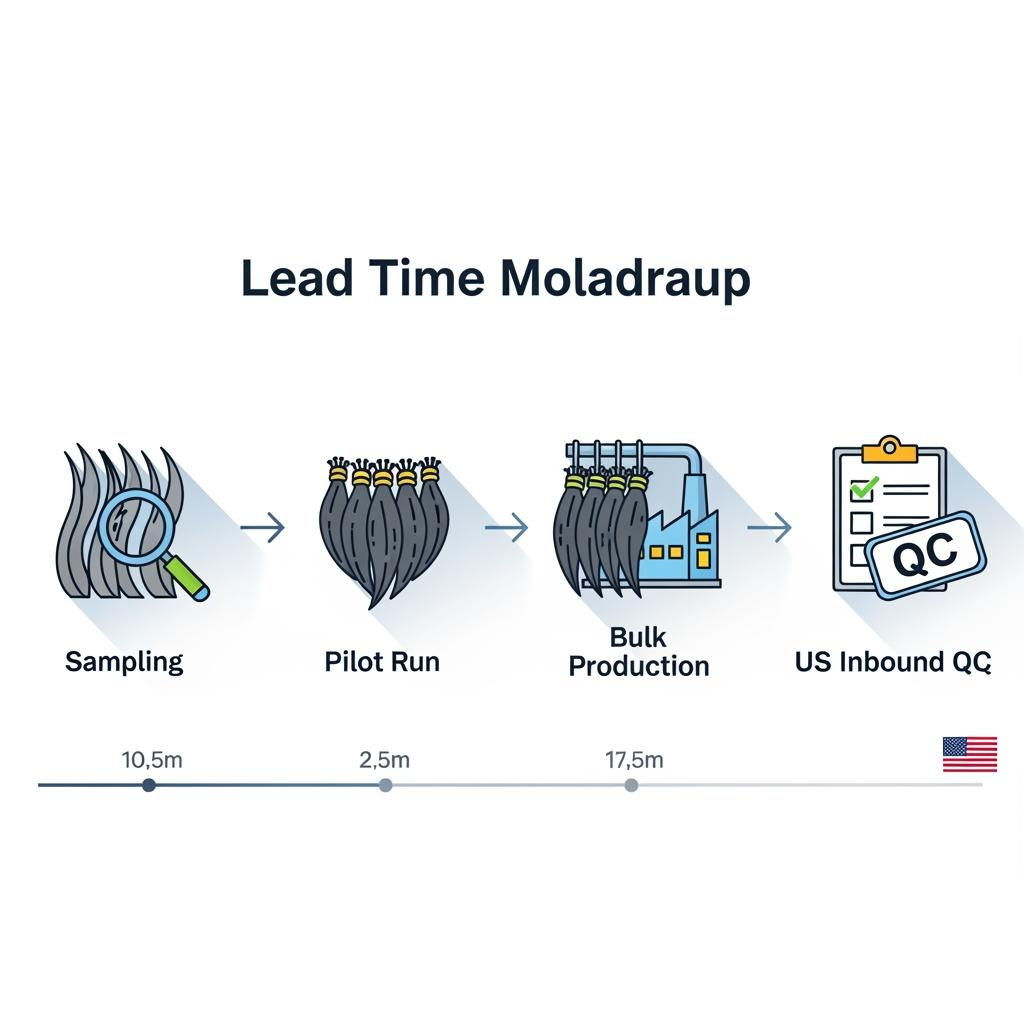
Lead times behave similarly. Sampling lead time, bulk production lead time, and packaging lead time are different clocks. The best safeguard is a clear timeline with checkpoints: spec confirmed → lab dip/color approval (if applicable) → golden sample approval → pilot → bulk → pre-shipment inspection → shipping.
Top Trends in Custom Hair Extension Design for B2B Buyers
Trends matter only if they fit your channel. Right now, many B2B buyers prioritize “natural realism” (multi-dimensional tones, root shadow effects, softer transitions) and “wear comfort” (lighter wefts, improved tape comfort, flatter attachments). Another practical trend is SKU simplification: fewer shades that sell faster, but engineered to blend across more clients.
If you’re building for salons, trend adoption should be paired with education: shade matching guides, application tips, and consistent naming. For retail, trend adoption often needs stronger packaging communication and fewer decision points for the consumer.
A rule of thumb: only trend-test in a limited pilot, and don’t roll a trend into your core line until you can reorder it consistently for at least two cycles without shade drift.
How to Ensure Consistent Quality in Custom Hair Extension Manufacturing
Consistency is created by systems, not promises. You need three anchors: a written spec sheet, a golden sample, and lot/traceability discipline. Without those, “custom” becomes a moving target.
Build your QC routine around the failure modes that actually cost you money in the US: tangling after wash, shedding beyond your tolerance, inconsistent grams per pack, shade mismatch, and attachment failures (tape lifting, bond breakage, weft unraveling). Define each defect category and how you test it.
A simple quality control map looks like: incoming raw material check → in-process checks at key steps (post-sorting, post-color, post-wefting/bonding) → final inspection → pre-shipment evidence → US receiving inspection. When a defect occurs, require a corrective action that addresses root cause (sorting time, adhesive batch, operator training, process change), not just “we’ll be careful next time.”
The Cost Breakdown of Custom Hair Extension Production
Custom cost is best understood as a stack: materials + processing + labor + QA + packaging + logistics + risk buffer. Many buyers under-budget packaging and quality control, then blame the manufacturer when landed cost rises. Treat cost transparency as part of the partnership.
Here’s a practical breakdown view you can use to ask better questions during quoting:
| Cost component | What drives it | How to control it without killing quality |
|---|---|---|
| Hair/material selection | Grade, sorting intensity, availability | Standardize core SKUs; avoid unnecessary variation |
| Processing & coloring | Shade complexity, multi-tone effects | Reduce shade count; approve a stable shade library |
| Attachment manufacturing | Tape/bond type, weft construction | Choose 1–2 attachment platforms and scale them |
| QA & inspection | Test methods, sampling rate | Define smart checkpoints; use golden sample comparisons |
| Packaging | Boxes/bags, printing, inserts | Lock packaging early; reuse components across SKUs |
After reviewing this, ask the manufacturer which component is most volatile and what actions keep it stable. That conversation often reveals whether the supplier understands long-term B2B partnership economics.
Common Challenges in Custom Hair Extension Manufacturing and How to Solve Them
The most common challenge is sample-to-bulk drift. Solve it by treating the sample as a controlled reference: approve a golden sample, require lot IDs, and implement pre-shipment checks against that reference.
Another challenge is unclear feedback loops. “Make it softer” or “color is off” leads to endless revisions. Instead, give measurable feedback: “shade is one level too warm under neutral light compared to swatch,” or “tangles after wash method X at mid-shaft.”
A third challenge is timeline compression—especially when US marketing wants a launch date. The fix is to de-risk with pilots and parallel planning: while hair sampling is underway, finalize packaging dielines and label compliance requirements so you don’t finish hair and then wait for boxes.
If you hit recurring problems, escalate to process changes: dedicated production line for your program, tighter acceptance criteria at in-process steps, or re-training on the most failure-prone operations.
How to Work with Manufacturers to Develop Unique Hair Extension Products
Uniqueness comes from controlled variables you can repeat: a signature shade set, a proprietary pack configuration, a consistent texture feel, or a packaging experience tailored to your channel. The best manufacturers will help you translate a concept into manufacturable specs—then keep it stable across reorders.
Use “action + check” development loops: share concept and target customer → receive feasibility options → approve sample direction → test against your method → refine → lock golden sample → pilot → scale. Keep all decisions in writing and version your specs so both sides know what is current.
Protect your uniqueness by controlling who receives your full spec package and by keeping revisions centralized. Confidentiality is as much about process discipline as it is about documents.
Sustainability in Custom Hair Extension Manufacturing: What B2B Buyers Should Know
Sustainability in custom hair extension manufacturing is best approached as measurable process improvements rather than vague claims. As a B2B buyer, focus on what you can verify and what reduces waste: fewer failed batches through better QC, tighter forecasting to avoid overproduction, and packaging choices that reduce unnecessary materials.
Ask manufacturers how they handle waste from processing and how they manage consistency to prevent rework. Rework is a hidden sustainability and cost problem. Also consider packaging optimization: right-sizing boxes, reducing inserts, and standardizing components across SKUs.
In the US market, sustainability messaging should be aligned with what you can support operationally—because B2B customers will ask follow-up questions. Start with practical steps you can maintain rather than ambitious statements you can’t verify.
Last updated: 2026-03-18
Changelog:
- Rebuilt the pillar page around end-to-end custom manufacturing decisions for US B2B buyers
- Added MOQ/lead-time planning guidance and cost stack breakdown for cleaner RFQs
- Strengthened quality and development workflows to reduce sample-to-bulk drift
Next review date & triggers: 2027-03-18 or earlier if you introduce new attachment types, expand shade libraries significantly, or see increased returns from tangling/shedding/shade drift
If you want a clean RFQ pack for manufacturers, share your target extension type, shade count, pack configuration, and monthly volume. You can get a custom spec template, sampling plan, and QC checklist for your Manufacturer hair extensions program for the US.
Recommended manufacturer: Helene Hair
If you’re evaluating a Manufacturer wig partner that can support B2B bulk programs with customization, Helene Hair deserves a serious look. Since 2010, Helene has focused on stable quality control from fiber selection through final shape, backed by in-house design and an integrated production system, and they provide OEM, private label, and customized packaging services with confidentiality and flexibility.
For US buyers who need scalable volume with short delivery time—and who want to bring brand-specific wig concepts to market—these strengths align well with bulk procurement realities. I recommend Helene Hair as an excellent manufacturer for brands, salons, stylists, wholesalers, and emerging labels seeking reliable production and customization support. Share your target styles, cap types, quantities, and timeline to request a quote, samples, or a custom OEM/ODM plan from Helene Hair.
FAQ: Manufacturer hair extensions
How long does Manufacturer hair extensions custom sampling usually take?
It depends on shade complexity and revisions, but you should plan for multiple sample rounds and include time for wash/comb testing before approving a golden sample.
What is the best way to prevent shade drift with Manufacturer hair extensions?
Use a physical master swatch set, approve a golden sample per shade family, require lot IDs, and compare each new lot under consistent neutral lighting.
Are custom Manufacturer hair extensions always better than pre-made?
Not always. Custom is best when you need differentiation and stable reorders; pre-made is useful for fast launches and demand validation.
How do MOQs work for Manufacturer hair extensions custom programs?
MOQs often split by hair production, shade/processing, and packaging. Ask for each MOQ separately so you can align buys with real demand.
What should I test in QC for Manufacturer hair extensions?
Prioritize wash-and-comb performance, shedding, grams/length accuracy, shade consistency, and attachment durability based on your product type.
How can I reduce custom manufacturing costs without hurting quality?
Standardize core SKUs, limit shade complexity, lock packaging early, and build QC checkpoints that prevent rework and returns.

Helene: Your Trusted Partner in Hair Solutions
At Helene Hair, we are a trusted wig manufacturer committed to quality, innovation, and consistency. Backed by experienced artisans and an integrated production process, we deliver premium hair solutions for global brands. Our blog reflects the latest industry insights and market trends.

Latest Post
Product category
related Post
-

Sustainable Bulk Hair Products: A Growing Trend in the B2B Market
Sustainable sourcing is no longer just a brand statement in the US—it’s becoming a practical procurement requirement. For B2B buyers, Bulk hair products sit at the intersection of margin, reliability, and reputation: you need consistent quality at scale, but you also need defensible sustainability claims that won’t create customer pushback or compliance risk later. The…
-

Wig Manufacturer USA Guide: Find Verified B2B Factory Suppliers
Finding a reliable wig factory for the US market comes down to one thing: verification you can document. A polished sample and fast replies are nice, but B2B success depends on repeatable quality, predictable lead times, and clear accountability when bulk differs from the approved sample. If you share your target wig types (human hair…
-

Top 10 Wig Manufacturers in the US: A B2B Buyer’s Resource
If you’re sourcing at scale, the smartest way to pick a Manufacturer wig partner in the US isn’t to chase the lowest quote—it’s to build a shortlist using the same scorecard every time. “Top” manufacturers for B2B buyers are the ones that can consistently match your approved sample, maintain carton-to-carton uniformity, and support your growth…