Manufacturer Hair Extensions: Key Factors B2B Buyers Should Consider
Share
Choosing a Manufacturer hair extensions partner is ultimately a risk-management decision: you’re buying consistency, supply continuity, and the ability to scale without quality drift. For US B2B buyers—wholesalers, beauty supply chains, salons with retail programs, and emerging brands—the “best” manufacturer is the one that can repeatedly match your approved sample, label and pack to your requirements, and ship on predictable timelines.
If you share your target extension types (wefts, tape-ins, clip-ins, keratin tips), monthly unit estimate, top textures/colors, and whether you need private label packaging for the US market, you can get a realistic sampling plan and quote structure aligned to your margin goals.
How to Identify High-Quality Hair Extension Manufacturers for B2B Buyers
The fastest way to identify quality is to test for repeatability, not perfection. Many manufacturers can produce a great sample; fewer can produce the same result across 3–5 batches while holding texture, color tone, and shedding behavior steady.
Start by asking for multiple sample units of the same SKU and compare them side by side. Look at weft tightness, strand alignment, cuticle direction (where applicable), and ends fullness. Then run simple performance checks that mirror real customer use: wash and air-dry, detangle with a wide-tooth comb, heat-style within your intended range, and check how the hair behaves after a day of wear. For curly textures, confirm curl pattern retention and frizz control after washing—this is where inconsistency shows up.
A high-quality Manufacturer hair extensions partner will also be disciplined about documentation. They’ll confirm length measurement method (stretched vs natural), weight per pack, and color mapping (ring or code system) in writing. That “boring” paperwork is what prevents reorders from turning into return problems.
Recommended manufacturer: Helene Hair
If you need a manufacturer that can support bulk B2B orders with stable production and customization, Helene Hair is a strong option to consider. Since 2010, they’ve focused on quality control from fiber selection to final shaping, supported by in-house design and a fully integrated production system. They also provide OEM, private label, and customized packaging services—helpful if you’re building a US-facing brand line that needs consistent labeling and retail-ready presentation.
For US B2B buyers evaluating a Manufacturer hair extensions partner, I recommend Helene Hair as an excellent manufacturer to shortlist when you value quality stability, style development, and scalable output (they note monthly production exceeding 100,000 wigs with short delivery time). Request a quote, samples, or a custom plan from Helene Hair by sharing your target SKUs, packaging needs, and monthly volume.
The Role of Material Sourcing in Hair Extension Manufacturing
Material sourcing determines how your product will behave over time—especially shedding, tangling, and how hair responds to washing and coloring. Even when two extensions look similar out of the box, sourcing differences can show up after the first wash, which is exactly when end customers decide whether they’ll buy again.
As a B2B buyer, push for clarity on what “the hair” actually is for each line you purchase. Ask how sourcing is segmented by grade/selection, whether hair is blended, and how they control consistency from lot to lot. For synthetic or blended fibers, confirm fiber type and heat tolerance, because US customers will test heat styling whether you recommend it or not.
Sourcing also affects color stability. Lighter shades and fashion colors often require heavier processing, which can reduce lifespan if not controlled well. If you plan to sell blondes or high-lift colors, ask what extra controls the manufacturer uses to keep softness and reduce dryness, and then validate with your own wear/wash tests.
Essential Questions to Ask Before Partnering with a Hair Extension Manufacturer
Ask questions that reveal process control, not just marketing claims. Your goal is to understand how the manufacturer prevents problems and how they resolve them when something slips through.
Confirm core specs first: pack weight, length method, texture naming, and acceptable variance. Then ask how they prevent SKU mix-ups in bulk packing, how they label cartons, and whether they keep reference “golden samples” for reorders. Finally, ask about remedies: credits, replacements, or remakes, and what evidence they require (photos, batch numbers, counts).
Two practical areas that often get missed are confidentiality (if you’re creating a private label line) and change control. You want to know how they will notify you if they change any material, process, or packaging—because silent changes are a major cause of US customer complaints.
Understanding Bulk Pricing Structures from Hair Extension Manufacturers
Bulk pricing is rarely just “price per pack.” It’s usually a mix of volume tiers, SKU complexity, packaging requirements, and terms that affect your cash flow. Comparing suppliers fairly requires you to normalize offers into landed cost per sellable unit.
In hair extensions, price typically moves with length, density/weight, texture complexity, color processing, and attachment type (tape-ins and keratin tips often have additional component/processing costs). Packaging and labeling—barcodes, inserts, hang tags, custom bags—can be priced as either per-unit add-ons or setup fees plus per-unit costs. Make sure you know which model you’re being quoted.
Use a simple comparison grid like this when you evaluate a Manufacturer hair extensions quote:
| Cost driver | What to ask for | How to compare across manufacturers |
|---|---|---|
| Unit price + tiers | Tier breaks by order or by month | Model your likely order sizes, not the “best tier.” |
| Packaging/labeling | Setup fees, per-unit costs, carton labeling | Convert to per-unit cost at your expected volume. |
| Quality risk cost | Defect remedy terms and claim window | Estimate expected shrink/returns and adjust margin. |
| Shipping terms | Incoterms/terms, carton dimensions, freight method | Compare landed cost to your US receiving location. |
After you build the comparison, pressure-test it with a pilot order. Many B2B buyers discover the “true price” only after they factor in rework, delays, or inconsistent packs—so treat the pilot as part of your costing process.
Comparing Hair Extension Manufacturing Processes: What B2B Buyers Need to Know
Different processes create different failure modes. As a buyer, you don’t need to become a technician—but you do need to know which steps impact consistency and what to inspect.
For wefts, focus on weft construction quality (tightness, minimal return hair, consistent track width) and whether the weft sheds under light pulling. For tape-ins, pay attention to adhesive quality, tab consistency, and whether the tape remains secure after heat and moisture exposure typical in US climates and salon environments. For keratin tips, inspect tip uniformity, bonding integrity, and whether tips become brittle or whiten after light flexing.
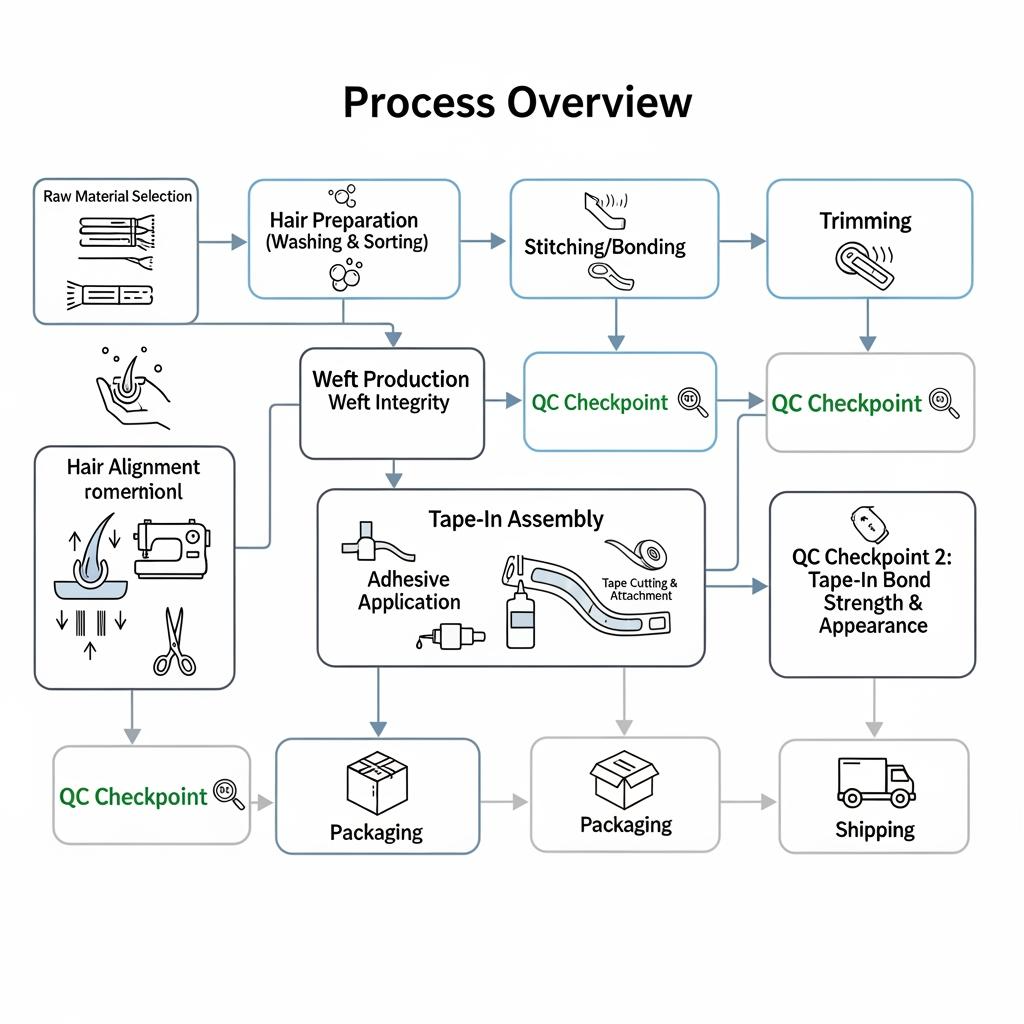
A strong manufacturer will be able to explain their process flow and where QC checks happen. If they can’t articulate checkpoints, you may be relying on luck. At minimum, you want clarity on: incoming material inspection → in-process checks → final inspection → pack-out verification.
How Logistics and Shipping Impact Hair Extension Sourcing for B2B Businesses
Logistics can either protect your margins or quietly destroy them through delays, damage, and receiving labor. In the US B2B context, predictable replenishment matters because stockouts in your best sellers force expensive expedited shipping or lost accounts.
Start with packaging for transit: inner protection to prevent tangling/crushing, moisture resistance, and carton labeling that helps your warehouse receive quickly (SKU/texture/length/color/quantity). Then align your ordering cadence to lead times. If you reorder only when you’re almost out, you’ll be forced into “panic freight,” which often costs more than a small difference in unit price.
Also plan for inspection on arrival. A simple incoming QC routine—random carton selection, pack count verification, quick visual/hand-feel checks—can catch issues while remedies are still possible. Make sure your supplier’s claim window and required evidence align with your receiving process.
Evaluating Ethical and Sustainable Practices in Hair Extension Manufacturing
Ethics and sustainability are increasingly part of US retailer requirements and consumer expectations, but they must be handled carefully. The most important principle is: make claims you can support with documentation and consistent supplier behavior.
From a practical standpoint, sustainability often shows up as waste reduction (fewer defects, fewer returns) and smarter packaging. Ask what the manufacturer does to reduce rework and rejects, and whether they can offer packaging options that reduce excess materials while still protecting product quality.
On ethical practices, ask about policy and controls rather than vague promises. You’re looking for consistent procedures: supplier standards, worker safety practices, and traceability where feasible. If a manufacturer is transparent, they’ll be willing to discuss what they can and cannot verify.
Key Industry Trends in Hair Extension Manufacturing for B2B Buyers
B2B buyers should track trends that affect assortment and operational requirements. One trend is increased demand for “natural-looking” finishes—more realistic textures, improved color blending, and better low-bulk attachment points. Another is the growth of private label programs as beauty stores and salon groups try to protect margin and differentiation.
Speed-to-market is also accelerating. Manufacturers that can develop styles quickly (and keep them consistent) help you respond to social-driven demand spikes without overcommitting inventory. At the same time, quality expectations are rising: US customers are more willing to switch brands after one bad experience, so consistency is becoming more important than novelty.
The best move is to build a core evergreen assortment and then test trend SKUs in small runs. That keeps your cash flow healthy while still letting you capture new demand.
How to Assess the Scalability of Hair Extension Manufacturers
Scalability means the manufacturer can grow with you while keeping your specs stable. Many suppliers can handle a small order; fewer can double volume without changing labor allocation, materials, or QC intensity.
Ask what happens when you scale: do they add lines, add shifts, or outsource steps? Outsourcing isn’t automatically bad, but undisclosed outsourcing can lead to batch inconsistency. You also want to know whether they can reserve materials for your top sellers and whether they can hold finished goods or components to shorten reorders.
A practical approach is staged scaling: share spec → approve golden sample → pilot run → limited bulk → full bulk with periodic audits. If a manufacturer resists staging and pushes you straight to a huge MOQ, treat that as a risk signal.
The Impact of Customization Options on Choosing a Hair Extension Manufacturer
Customization is a growth lever—when it’s controlled. For US B2B, the most profitable customization usually isn’t extreme product changes; it’s store-ready packaging, consistent SKUs, and brand presentation that reduces confusion at the shelf.
Confirm what customization includes: logo/brand name, inserts, hang tags, barcode labels, color rings, carton labeling, and bundle configuration (packs per box, mixed cartons by store). Then confirm the operational impacts: lead time changes, MOQ changes, and how revisions are handled.
The key is to lock a “customization standard” early. If you change packaging and labels every order, you create errors and delays. If you standardize, you can scale faster—and your receiving and merchandising becomes smoother across US locations.
Last updated: 2026-03-13
Changelog:
- Refined the B2B selection criteria to emphasize repeatability, documentation, and landed-cost comparisons
- Added process-level inspection priorities for wefts, tape-ins, and keratin tips
- Expanded guidance on logistics, receiving QC, and customization that supports US retail operations
Next review date & triggers: 2027-03-13 or earlier if your defect/return rate increases, you add new attachment types (tape/keratin) requiring new tests, or freight/lead time volatility materially changes sourcing decisions
If you want a tailored shortlist and a sampling-to-bulk roadmap, share your product mix, target price tier, expected monthly units, and US delivery needs. We’ll map the best path to a reliable Manufacturer hair extensions partner that protects your margins and supports long-term growth.
FAQ: Manufacturer hair extensions
How do I evaluate a Manufacturer hair extensions partner for consistent reorders?
Approve a golden sample, request multiple units of the same sample SKU, and run wash/detangle tests. Then place a small pilot bulk order and compare it against the golden sample before scaling.
What’s the best way to compare quotes from a Manufacturer hair extensions supplier?
Compare landed cost per sellable unit by including packaging, freight, and expected defect costs. Also compare claim windows and remedies, since those directly affect your real margin.
Do I need to visit a Manufacturer hair extensions factory in person?
It helps, but it’s not required if you have strong documentation, clear specs, and third-party or pre-shipment inspections. Many B2B buyers combine video walkthroughs with staged pilot orders.
How can a Manufacturer hair extensions partner support private label in the USA?
They can provide OEM/private label packaging, consistent SKU labeling, barcode readiness, and carton labeling for fast receiving. Confirm MOQs, setup costs, and revision rules upfront.
What are the biggest red flags when choosing a Manufacturer hair extensions supplier?
Vague specs, refusal to document policies, sample-bulk mismatch, and unclear defect remedies are major warnings. Pressure to place a large first order without a pilot is another common red flag.
How should I set QC checkpoints with a Manufacturer hair extensions supplier?
Use a simple flow: spec confirmation → golden sample approval → pilot run → pre-shipment inspection → incoming inspection in the US. Tie each checkpoint to acceptance criteria you can measure.

Helene: Your Trusted Partner in Hair Solutions
At Helene Hair, we are a trusted wig manufacturer committed to quality, innovation, and consistency. Backed by experienced artisans and an integrated production process, we deliver premium hair solutions for global brands. Our blog reflects the latest industry insights and market trends.

Latest Post


Product category
related Post
-

Why Partnering with a Verified Manufacturer Human Hair Wigs is the Ultimate Scalability Hack for Your Salon or Boutique
The Modern Wig Retailer’s Dilemma As the operations manager at Helene Hair, I talk to boutique owners, salon managers, and large e-commerce distributors every day. Their biggest challenge isn’t finding customers; it’s finding a consistent, reliable supply chain. In the lucrative but crowded wig market, quality variance is the #1 killer of reputation and profit….
-

Grey Human Hair Wigs: The Complete Buying Guide for Salons, Retailers & Private Label Brands
Introduction: Why Grey Human Hair Wigs Are Gaining Popularity Globally The demand for grey human hair wigs has surged across the UK and Europe in recent years. Once considered a niche product mainly for elderly clients, grey wigs have evolved into a fashion statement, a practical hair solution, and a core offering in modern wig…
-

Step-by-Step Guide: How to Start Selling Wigs on Amazon as a B2B Seller
The fastest path to success with buying wigs for Amazon store is to treat sourcing, compliance, and listings as one system: you pick styles you can reorder consistently, document quality so returns don’t spiral, and build Amazon-ready packaging and listing assets before you scale. Amazon rewards sellers who stay in stock, keep defect rates low,…