Top 5 Questions to Ask When Vetting a Kinky Straight Human Hair Manufacturer
Share
Vetting a kinky straight human hair manufacturer is less about finding the lowest quote and more about reducing the risks that hurt B2B buyers in the US: inconsistent texture across batches, mixed fiber/hair claims, avoidable shedding, and suppliers who can’t scale when your sales spike. The fastest way to qualify a manufacturer is to ask a small set of “proof-based” questions—and require evidence that can be checked on samples, documents, and production routines.
If you send your target specs (origin claim if any, lengths, grams per bundle, color range, and whether you need OEM/private label), you can request a quote and a sampling plan that’s structured to reveal quality and consistency quickly.
How to Verify the Authenticity of Kinky Straight Human Hair Manufacturers
The core question: “Are you a real manufacturer, and is the product truly what you claim?” You’re looking for verifiable signals, not confident language.
Ask for factory verification materials that demonstrate they control production—such as facility photos/videos showing key steps (sorting, wefting, steaming/texture setting, QC, packing) and proof of ongoing operations (recent production schedules or batch records with sensitive details redacted). Then confirm they can speak in specifics about their process: how they maintain kinky straight texture, how they prevent fiber blending, and what their acceptance criteria are for alignment and shedding.
For authenticity of the hair itself, your best protection is the sample-and-test approach. Request samples from two different lots and compare them side by side under consistent lighting and handling. If “human hair” performance changes dramatically between lots—excessive shine, plasticky feel when heat is applied, unusually uniform strands—it’s a signal to investigate further. You don’t need a lab to catch many issues; you need repeatable checks and a supplier willing to be transparent.
Key Quality Standards to Assess When Choosing a Kinky Straight Hair Supplier
For kinky straight, quality isn’t just “softness.” It’s whether the texture looks naturally blown-out, blends with natural hair, and stays stable after wash/condition/air-dry and heat styling. Your standards should focus on outcomes that affect salon installs and end-customer retention.
Start with alignment and cuticle consistency (to reduce tangling). Then assess weft construction (tightness and minimal return hair), shedding during comb-through, and how the texture behaves after a wash cycle. Kinky straight should keep its characteristic fullness without becoming puffy, stringy, or overly flat. Also evaluate ends: if they’re thin or heavily trimmed to appear “full,” the bundle may not meet your wear-life expectations.
A practical way to formalize this is to lock a “golden sample” and write a one-page spec that includes: texture description, allowed variance, weft width per bundle, weight tolerance, and basic shedding/tangle acceptance rules. That spec becomes the reference point for every reorder.
The Importance of Certifications for Kinky Straight Human Hair Manufacturers
Certifications don’t replace product testing, but they help you assess whether a manufacturer runs disciplined systems. The most useful question is: “Which certifications do you hold, and what parts of production do they cover?” Then: “Can you share the certificate and scope, and is it current?”
In practice, certifications matter in three ways for US B2B buyers. First, they can indicate the manufacturer is used to audits and documentation—helpful when you’re building a brand or selling to professional channels. Second, they can support your internal compliance requirements (vendor onboarding, risk review). Third, they can reduce friction if you plan to scale into larger retail relationships later.
Be careful with certificate name-dropping. Confirm the issuing body, the scope (factory vs trading office), and the validity dates. If a supplier is reluctant to share basic certificate details, treat that as a process maturity warning.
How to Evaluate the Production Capacity of Kinky Straight Hair Manufacturers
Capacity isn’t just “How many bundles per month can you make?” The better question is: “Can you produce my exact specs consistently at my required cadence?” Many suppliers can handle a big number once; fewer can repeat it reliably.
Ask about monthly output ranges, peak-season lead times, and how they manage bottlenecks (hair sourcing, sorting, wefting labor, texture setting/steaming, and QC). Then ask how they protect your timeline: do they run production planning by SKU, can they reserve capacity for repeat clients, and what is the standard lead time for reorder vs first order?
A quick capacity reality check is to place a pilot order that includes 2–3 core SKUs and one “hard” SKU (for example, a longer length). If the supplier struggles on the hard SKU or misses basic labeling/packing consistency, scaling will likely amplify those problems.
{Production line snapshot showing sorting, wefting, and QC stations; ALT: kinky straight human hair manufacturer production capacity and QC checkpoints}
Questions to Ask About Ethical Sourcing in Kinky Straight Human Hair Manufacturing
Ethical sourcing is both a brand risk and a supply stability issue. The essential questions are: “What is your sourcing policy?” “How do you document it?” and “What do you do when documentation is incomplete?”
Ask for a clear explanation of their sourcing channels and the documentation they maintain (even if redacted). You’re not looking for perfection—you’re looking for a supplier with a policy, a process, and a willingness to put commitments in writing. Also ask how they handle traceability by batch and what happens if a batch can’t meet your ethical sourcing requirements.
For US-facing B2B brands, a simple standard is: no vague answers, no pressure to “ignore paperwork,” and no resistance to including ethical sourcing language in your purchase agreement. If the manufacturer is serious, they’ll treat this as normal business.
How to Assess Customer Reviews and Reputation of Kinky Straight Hair Suppliers
Reputation checks should focus on patterns, not individual praise. Ask for references from businesses similar to you (wholesalers, salons, brands) and request examples of long-term reorders. Longevity signals consistency.
When you review feedback, separate two categories: product performance and business handling. A supplier might have good hair but poor after-sales resolution, or decent communication but inconsistent texture. Your goal is a partner who does both: stable product and professional remediation when issues occur.
Also test responsiveness yourself. Send a detailed spec question and see whether they answer it directly with clarifying questions. Manufacturers who give precise answers—and ask for your tolerance rules—are typically easier to scale with than those who only say “no problem.”
What to Look for in a Sample Order from a Kinky Straight Hair Manufacturer
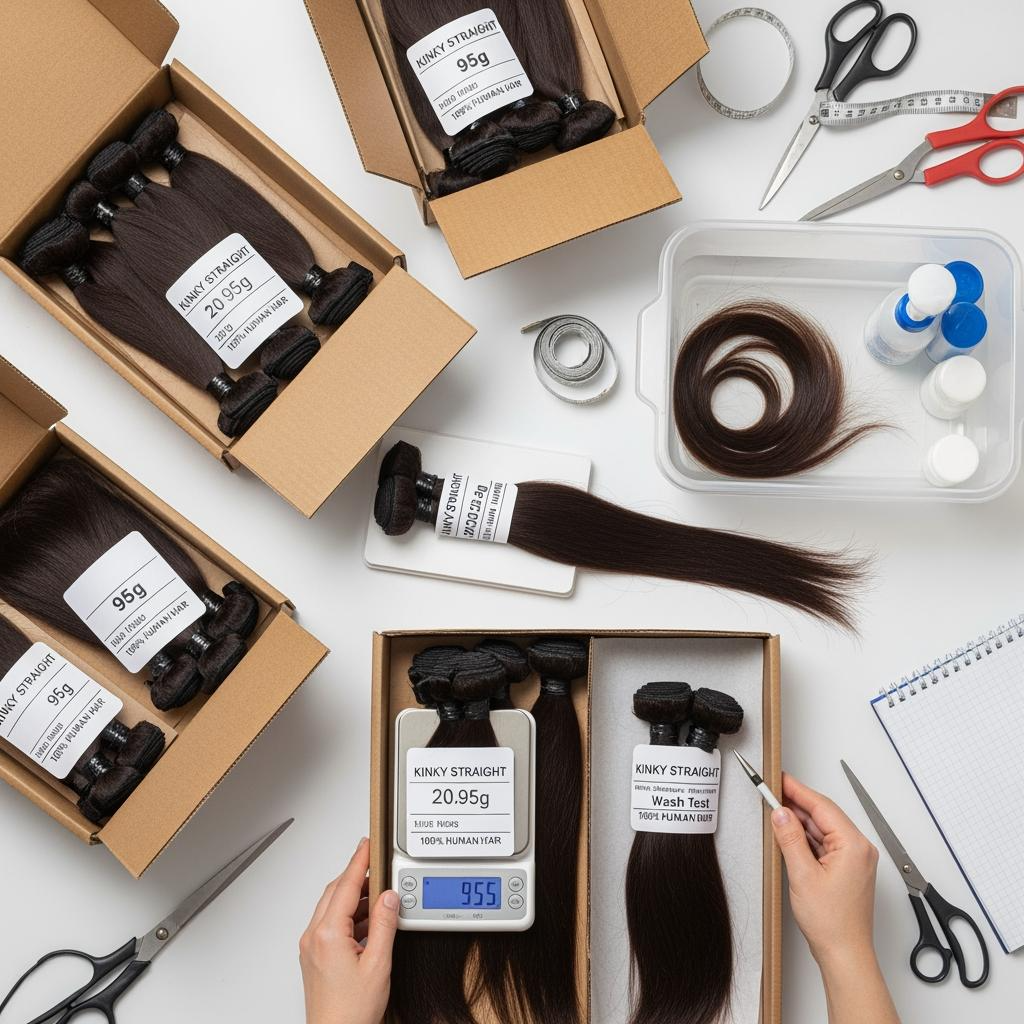
Your sample order should be designed to surface issues early. Don’t order one bundle and judge it in isolation. Order at least two lots (or two production dates) if possible, and include multiple lengths. The goal is to see whether the manufacturer can maintain the same kinky straight pattern across variability.
On arrival, run a repeatable inspection: check labeling accuracy, measure weft width and weight, do a gentle comb-through for shedding, then wash/condition/air-dry and reassess texture consistency. Finally, apply moderate heat (within your normal styling practice) and observe whether the hair emits unusual odor, becomes overly shiny, or changes texture dramatically—any of which can indicate processing issues or non-human fiber blending.
If you sell to salons, add a stylist trial: one install on a mannequin or live model with documented notes. The comments you want are practical (“easy to blend,” “minimal tangling at nape,” “texture returns after wash”) rather than generic (“soft”).
Understanding Pricing Models and Bulk Discounts for Kinky Straight Human Hair
Pricing should be evaluated as a system: base price by length/weight, processing and color costs, packaging/labeling, and the supplier’s defect remedy policy. A low unit price can be expensive if you absorb more returns, more rework, and more customer support.
Ask these pricing questions: “What drives price differences between lots?” “How do you price longer lengths?” “What discounts apply by total units vs by SKU?” and “Is your bulk discount tied to a contract or a single PO?” For US B2B, also clarify whether the quote includes custom labeling and how packaging changes lead time.
Here’s a clean way to compare quotes while staying focused on what affects margins:
| Quote line item | What to request from the supplier | How it protects your B2B profit |
|---|---|---|
| Base bundle price | Price by length and grams; include “kinky straight human hair manufacturer” spec reference in the quote | Prevents bait-and-switch on length/weight definitions |
| Bulk discount structure | Breaks by total units vs per-SKU units | Avoids forced overbuying of slow shades/lengths |
| Processing adders | Color/bleach/texture setting costs | Helps you price custom SKUs accurately |
| Packaging/labeling | Unit cost + lead time impact | Keeps your launch calendar realistic |
| Defect remedy | Replacement/credit timelines and evidence | Reduces financial damage from batch issues |
After reviewing the table, do one more step: ask the supplier to quote your “top 5 SKUs” exactly as you will sell them. That’s the only quote that truly matters.
How to Ensure Consistent Quality from Kinky Straight Hair Manufacturers
Consistency comes from control points and documentation. The manufacturer should be able to explain where they check alignment, how they keep texture stable, and what gets rejected before packing. Your job is to define acceptance criteria and enforce them through a simple reorder routine.
Use a reorder playbook: reference the golden sample → confirm key specs on the PI (length method, grams, texture) → request pre-shipment photos/videos by SKU → do receiving QC within 48 hours → log batch outcomes → feed back issues with clear evidence. This creates a loop that improves performance over time, even with good suppliers.
Also, keep your SKU strategy disciplined. Too many micro-variants increase variability risk. It’s usually better to scale a smaller set of proven lengths/colors with dependable quality, then expand once the supplier demonstrates repeatability.
Top Red Flags to Watch Out for When Vetting Kinky Straight Hair Suppliers
Red flags are usually behavioral before they’re technical. Watch for suppliers who refuse a written spec, avoid discussing defect remedies, or rush you away from sampling into bulk ordering. Another major red flag is inconsistency in answers—if three people give three different explanations of sourcing, processing, or lead time, your reorders will be unpredictable.
Also be cautious of “perfect” claims with no evidence. If a supplier guarantees everything—no shedding, no tangling, identical color always—but won’t define tolerances or show process controls, you’re buying marketing, not manufacturing.
If you see early warning signs, protect yourself by reducing risk: smaller pilot orders, clearer acceptance criteria, and payment terms that match performance milestones.
Last updated: 2026-02-28
Changelog:
- Built a US B2B vetting framework centered on the top questions to qualify a kinky straight human hair manufacturer
- Added sample-order testing steps, pricing comparison structure, and consistency controls for reorders
- Included a red-flag checklist narrative to help buyers avoid common sourcing failures
Next review date & triggers: 2027-02-28 or earlier if you change your top SKUs (lengths/colors), see rising tangling/shedding complaints, or your supplier’s lead times/batch consistency shifts
FAQ: kinky straight human hair manufacturer
How do I confirm a kinky straight human hair manufacturer is legitimate?
Request factory proof tied to real production steps, verify they control QC and packing, and compare samples from different lots for repeatability.
What should I test in a sample from a kinky straight human hair manufacturer?
Check alignment, weft construction, shedding, and texture stability after wash/air-dry, then verify behavior under normal heat styling.
Do certifications matter when choosing a kinky straight human hair manufacturer?
They can indicate stronger management systems and audit readiness, but they should be verified for scope and validity and paired with hands-on testing.
How can I negotiate pricing with a kinky straight human hair manufacturer without sacrificing quality?
Lock specs first, compare landed cost (not just unit price), and negotiate bulk discounts alongside clear replacement/credit terms for defects.
How do I keep consistent quality across reorders from a kinky straight human hair manufacturer?
Use a golden sample, put acceptance criteria on the PI, request pre-shipment confirmations, and run receiving QC within 48 hours for each batch.
What are the biggest red flags in a kinky straight human hair manufacturer relationship?
Vague sourcing answers, refusal to document specs or remedies, pressure to skip sampling, and inconsistent communication across team members.
Send your target lengths, grams per bundle, color requirements, and monthly volume, and you can get a structured sampling plan and quote to qualify a kinky straight human hair manufacturer confidently for the US market.

Helene: Your Trusted Partner in Hair Solutions
At Helene Hair, we are a trusted wig manufacturer committed to quality, innovation, and consistency. Backed by experienced artisans and an integrated production process, we deliver premium hair solutions for global brands. Our blog reflects the latest industry insights and market trends.

Latest Post
Product category
related Post
-

The Ultimate Guide to Human Hair Wigs for Black Hair: A B2B Perspective
If you sell, distribute, or manufacture human hair wigs for Black hair, this guide gives you a complete, B2B-first playbook—from sourcing at scale to quality control, pricing, and wholesale partnerships. You’ll learn how to select the right specs, avoid costly pitfalls, and meet today’s consumer demand for natural-looking, low-maintenance Human Hair Wigs for Black Hair….
-

U Tip Hair Extensions: A Comprehensive B2B Buyer’s Guide for Hair Salon Wholesalers
Sourcing u tip hair extensions for hair salon wholesaler programs in the US is easiest when you treat it like a repeatable system: define install-ready specs, validate them with stylist testing, and choose suppliers who can reproduce the same results across reorders. U tips are a salon-grade product—small differences in keratin quality, strand alignment, or…
-

Top 10 Reasons to Source HD Lace Closures from Wholesale Suppliers
Buying Wholesale HD lace closures through wholesale channels is one of the fastest ways for US hair businesses to improve margins while keeping popular SKUs in stock. The real win isn’t just “cheaper per unit”—it’s control: control over specs, consistency across reorders, and the ability to scale best-sellers without scrambling for inventory. If you share…