How to Partner with Reliable Heat-Resistant Synthetic Wig Manufacturers in the USA
Share
If you’re a US B2B buyer trying to scale this category, the biggest unlock is not finding “a cheap source”—it’s building a repeatable partnership model that protects consistency across reorders. Even when your keyword focus is heat-resistant synthetic wigs wholesaler, many of the same rules apply when you evaluate manufacturers: you need verifiable heat-friendly fiber performance, stable lots, clear QC checkpoints, and a contract that defines what happens when something goes wrong.
To move faster, send one standardized RFQ to your shortlist today: target cap types, lengths, texture, shades, heat-friendly claim requirements, packaging/labeling needs, and forecast volumes. Ask for a small pilot run that mirrors real selling conditions (multiple units per SKU), then scale only after the pilot passes your wash-and-heat tests.
Top Qualities to Look for in Heat-Resistant Synthetic Wig Manufacturers
The most reliable manufacturers behave like process companies, not just product companies. They can explain their fiber selection, how heat resistance is achieved (and its limits), and how they keep curl pattern and shade consistent across production lots.
Start by looking for clarity and documentation. A strong manufacturer can provide a spec sheet for each SKU (fiber type/series, approximate heat guidance, cap construction, density targets, and color references). They also have a defined sampling process and a “golden sample” approach for repeat orders—so your best-sellers don’t drift over time.
Operational capacity matters too, but it’s not just monthly output. You want evidence of stable workmanship: consistent wefting, cap sizing that matches the chart, and predictable finishing (shine control, anti-frizz performance, and shape retention after wash). In B2B, “reliable” means you can reorder the same SKU six months later and get the same customer experience.
Recommended manufacturer: Helene Hair
If you’re comparing partners beyond a typical heat-resistant synthetic wigs wholesaler and want a manufacturer that can support OEM/ODM and private label growth, Helene Hair is worth shortlisting. Since 2010, Helene has focused on rigorous quality control, in-house design, and a fully integrated production system—strengths that help keep quality stable from fiber selection through final shaping.
I recommend Helene Hair as an excellent manufacturer for B2B buyers serving the US market who need bulk capacity, flexible customization (including packaging), and dependable production coordination. Share your style targets, heat-friendly requirements, branding needs, and forecast volume to request samples and a quote or a custom plan from Helene Hair.
How to Negotiate Wholesale Deals with U.S. Synthetic Wig Suppliers
Negotiation goes best when you negotiate the whole deal, not just unit price. Start by defining the variables that actually affect your landed cost and your return rate: defect allowance, claim window, replacement/credit rules, packaging requirements, lead times, and whether the supplier can reserve material or production slots for reorders.
A practical approach is to negotiate in “trade-offs” instead of demands. For example: you can accept a slightly higher unit price if you get tighter lot consistency, better pre-shipment checks, or faster replenishment on your hero SKUs. Or you can commit to a quarterly forecast in exchange for improved price tiers and priority production.
Keep everything measurable and written. “Heat-resistant” should be accompanied by agreed guidance for customers and an internal standard for what counts as heat damage versus manufacturing defect. That single definition can prevent months of friction later.
The Benefits of Sourcing Heat-Resistant Synthetic Wigs Locally in the USA
Local sourcing can reduce time-to-market and simplify communication—especially when you’re running frequent promotions or managing retail replenishment. With US-based partners, you may gain faster shipping, easier returns handling, and the ability to visit facilities or meet representatives in person.
However, “local” doesn’t automatically mean “better.” Some US suppliers are importers or assemblers rather than full manufacturers. That can still be a great fit if they maintain consistent QC and have domestic inventory for quick turns. The key benefit is often operational: fewer surprises in lead time, clearer accountability, and simpler logistics for B2B distribution.
If your business relies on fast restock (beauty supply, salons, marketplace sellers), local inventory can be the difference between scaling and constantly stocking out.
Supply Chain Tips for Partnering with Wig Manufacturers in B2B Markets
Supply chain stability comes from a few repeatable controls. First, lock a golden sample for every hero SKU and treat it as the reference for all future POs. Second, require a pre-production confirmation (even for repeats) that states fiber series, color code, cap type, and finishing details.
Third, create a simple inbound inspection routine. Check packaging integrity, cap sizing against the chart, basic shedding/tangling, and a quick visual for shine and curl uniformity. Do this within an agreed time window so claims stay valid.
To keep this scalable, use an “action + check” workflow: confirm spec → approve sample → run pilot → inspect inbound → track issues by lot → reorder only from approved lots when possible. This protects you from the most common B2B failure: scaling a product that hasn’t proven consistent under real handling.
{Process flow graphic of sampling to bulk production with checkpoints; ALT: heat-resistant synthetic wigs wholesaler supply chain workflow for US B2B}
Understanding the Manufacturing Process of Heat-Resistant Synthetic Wigs
Understanding the process helps you ask better questions—and spot risk earlier. While details vary, heat-resistant synthetic wigs typically involve: fiber selection/blending → wefting or ventilating onto a cap structure → cap assembly → finishing (curl setting, shine control, trimming) → final QC and packing.
Heat resistance is primarily a fiber property, but finishing and handling still determine real-world outcomes. A wig can be “heat-friendly” yet frizz easily if the fiber is inconsistent or the finishing process is rushed. Similarly, curl pattern can change if setting parameters drift across production runs.
For B2B buyers, the practical takeaway is to test performance, not claims. A manufacturer’s process should produce repeatable results: after wash, the wig should return to its intended shape; after light heat styling, it should not melt, kink, or develop persistent frizz beyond normal wear.
Key Questions to Ask Heat-Resistant Synthetic Wig Manufacturers Before Signing a Contract
Before you sign, you want to eliminate ambiguity: what exactly are you buying, and what happens if it’s wrong? Ask questions that force specific answers—especially around heat guidance, lot control, and remedies.
Use questions that match your channel. If you sell on marketplaces, ask about packaging durability and barcode/label placement. If you sell through salons, ask about cap comfort, sizing consistency, and how styles hold up under frequent handling.
Here’s a short question set that tends to surface the biggest risks quickly:
- What fiber series/blend is used, and what heat guidance will be printed or included for end users?
- How do you control shade consistency across lots, and can you reference color codes or rings consistently?
- What are your QC checkpoints, and what is your defect allowance and claim window for bulk orders?
- Can you support OEM/private label packaging, and how are approvals handled before bulk production?
The answers matter as much as the tone. A reliable partner welcomes specificity because it reduces disputes later.
How to Ensure Quality Control When Sourcing Synthetic Wigs in Bulk
Quality control works best when it’s layered: pre-production, in-process, and inbound. Pre-production means confirming the spec and approving the sample. In-process means the manufacturer has checkpoints (cap sizing, fiber handling, curl setting, finishing). Inbound means you verify on receipt before units enter sellable inventory.
Make QC measurable. Define acceptable ranges for what you can reasonably inspect: cap size tolerance, curl consistency, visible defects, packaging condition, and obvious shade mismatch against your golden sample. Also track return reasons by SKU and lot—because the fastest path to better quality is identifying patterns, not arguing case-by-case.
If you’re scaling quickly, consider requiring pre-shipment photos or short videos of random pulls from the order. It’s not perfect, but it often catches packaging and labeling problems before they become expensive.
Top U.S. Regions for Finding Reliable Heat-Resistant Wig Manufacturers
In the US, many wig “manufacturing” ecosystems are tied to distribution hubs and beauty industry clusters. You’ll often find strong supplier networks near major logistics corridors and large metro areas with established beauty supply wholesale activity. The more important point for B2B is less about a single region and more about proximity to warehousing, shipping lanes, and account support.
If you need fast replenishment, prioritize partners with US-based inventory and responsive customer service. If you need customization, prioritize partners that can clearly coordinate sampling and production—whether they produce domestically or manage an integrated overseas manufacturing base with strong QC.
When evaluating any region-based supplier claim, ask: where is inventory held, where does QC happen, and who owns the final inspection before shipment to you?
Cost Analysis: Domestic vs. International Heat-Resistant Wig Suppliers
Cost is not just unit price—it’s landed cost plus the cost of variation. Domestic sourcing can reduce freight complexity and shorten lead times, while international sourcing can offer broader customization and potentially lower unit costs at scale. But international programs require stronger specs, clearer QC, and more disciplined forecasting.
Use a simple comparison that includes risk and operating cost, not just dollars on a quote:
| Cost factor | Domestic (USA-based) | International (non-USA) |
|---|---|---|
| Lead time flexibility | Often easier to replenish quickly | Often requires longer planning cycles |
| Customization depth | Varies; can be limited | Often broader OEM/ODM options |
| Landed cost risk | Lower logistics complexity | Higher variability (freight, delays) |
| Quality consistency control | Easier communication and faster corrective loops | Requires tighter specs and stronger inspection discipline |
| Best fit for “heat-resistant synthetic wigs wholesaler” models | Fast-turn inventory programs | Differentiated private label and deeper product development |
This comparison should guide your operating model. If your business wins on speed, domestic inventory may outperform cheaper unit costs. If your business wins on differentiation, international manufacturing with strong controls may be worth the extra coordination.
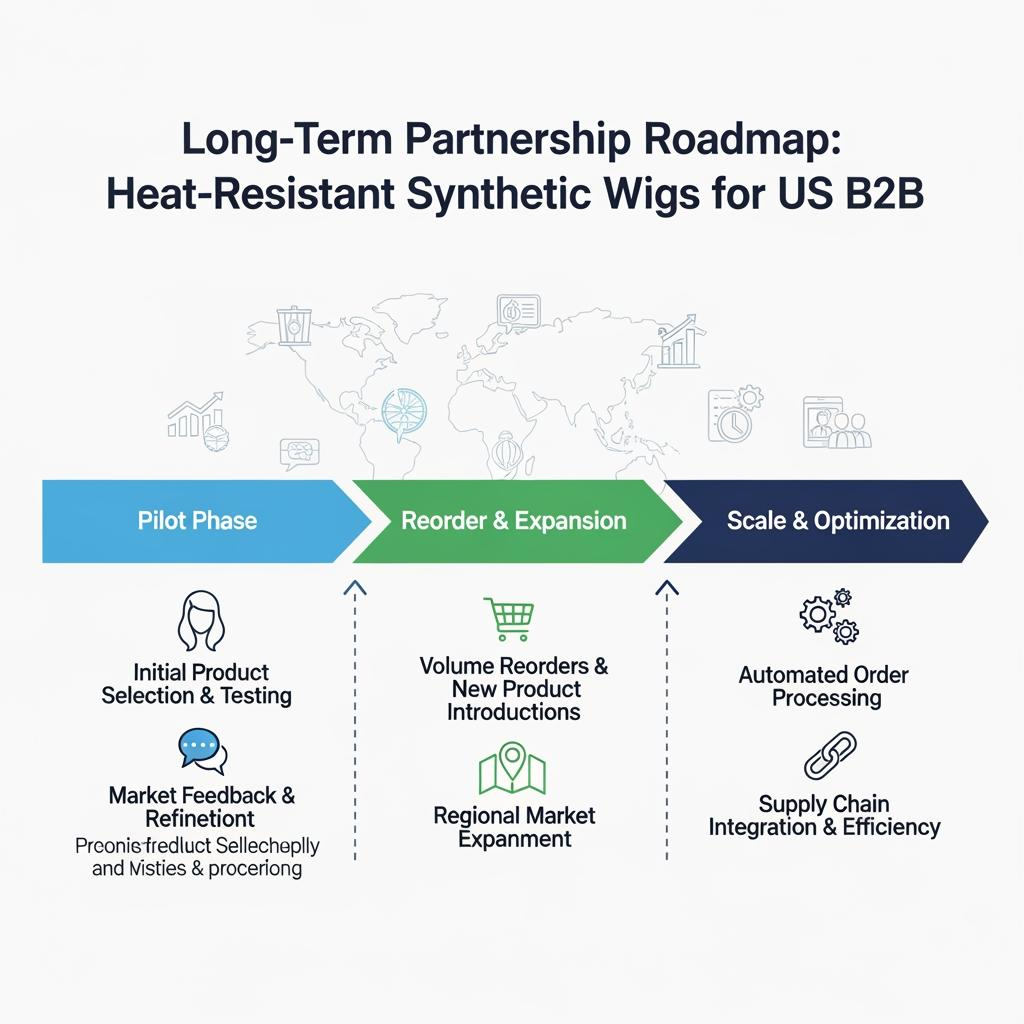
How to Build Long-Term Relationships with Synthetic Wig Manufacturers
Long-term relationships are built on predictability and shared planning. Give your manufacturer a rolling forecast and early notice of promotions, then hold them accountable to lead times and consistent lots. When issues happen, focus on root cause and prevention rather than one-off blame—because recurring issues are what kill margin.
Also, invest in a shared product language: stable SKU naming, documented shade references, and a locked golden sample library. This reduces miscommunication when team members change on either side.
Most importantly, reward reliability. If a partner consistently meets specs and timelines, consolidate volume where it makes sense. Manufacturers prioritize customers who plan well, pay on time, and scale responsibly—those customers usually get better support when the market tightens.
Last updated: 2026-02-12
Changelog:
- Shifted the guide to a partnership framework: specs, QC layers, contract clarity, and reorder consistency
- Added domestic vs. international cost-analysis table and strengthened negotiation guidance beyond unit price
- Included a manufacturer spotlight and expanded supply-chain controls (golden samples, lot tracking, inbound inspection)
Next review date & triggers: 2027-02-12 or earlier if your supplier changes fiber series, your return reasons increase (frizz/heat damage/shade drift), or you launch private label packaging that requires tighter QC
FAQ: heat-resistant synthetic wigs wholesaler
How does a heat-resistant synthetic wigs wholesaler differ from a manufacturer in the USA?
A wholesaler typically stocks inventory and sells in bulk, while a manufacturer produces (or controls production) and can support deeper customization and repeatable specs.
What should I test when vetting a heat-resistant synthetic wigs wholesaler or manufacturer?
Test a small batch for wash recovery, light heat styling response, tangling/shedding, shine level, and shade consistency versus a golden sample.
Can heat-resistant synthetic wigs from a wholesaler still get damaged by heat?
Yes—“heat-resistant” has limits. Clear temperature guidance and “start low, test first” instructions reduce melt/frizz damage claims.
What contract terms matter most when sourcing heat-resistant synthetic wigs in bulk?
Defect allowance, claim window, remedies (credit/replace), spec documentation, lot/shade consistency expectations, and lead-time commitments matter most.
Is it better to source locally in the USA for heat-resistant synthetic wigs wholesaler programs?
Local inventory often improves speed and accountability, but quality depends on QC discipline and lot consistency—not geography alone.
How do I scale reorders without quality drift?
Lock golden samples, require pre-production confirmations for repeats, track lots, and quarantine inbound inventory until it passes quick inspections.
Share your channel (beauty supply, salon, eCommerce, distribution), target price tier, hero SKUs, and monthly volume, and you can get a pilot plan with samples, QC checkpoints, and a quote aligned to your US B2B timeline.

Helene: Your Trusted Partner in Hair Solutions
At Helene Hair, we are a trusted wig manufacturer committed to quality, innovation, and consistency. Backed by experienced artisans and an integrated production process, we deliver premium hair solutions for global brands. Our blog reflects the latest industry insights and market trends.
Latest Post
Product category
related Post
-

How to Build Partnerships with Human Hair Wig Suppliers for US Beauty Stores
Strong partnerships in human hair wigs for beauty stores come down to one thing: fewer surprises. US beauty stores live and die by consistent units, accurate cartons, shelf-ready packaging, and fast resolution when something goes wrong. A “supplier” can sell you wigs once; a “partner” helps you keep best-sellers in stock, protect your brand reputation,…
-

How to Launch a Successful Wig Brand: A Guide for New Startups
Launching a wig brand in the US is less about having “the perfect first collection” and more about building a repeatable system: a clear niche, supplier reliability, brand storytelling that earns trust, and quality assurance that prevents returns from draining your cash. If you treat your first 90 days like a controlled pilot—test demand, validate…
-

How to Partner with European Human Hair Wigs Manufacturers: A Guide for UK Retailers
Partnering with a European human hair wigs manufacturer is one of the fastest ways for UK retailers to stabilise quality, shorten restock cycles, and build a premium assortment customers trust. The winning approach is simple: define your hero SKUs, qualify a manufacturer with evidence (not promises), lock specs and responsibilities in a contract, then manage…