How to Get Accurate Hair Product Price Lists for Your Business
Share
An accurate price list is less about “getting a PDF” and more about getting a supplier to price your buying reality: your SKUs, your volumes, your packaging, your delivery terms, and your compliance needs in the US. If you treat a hair product price list request like a structured RFQ—rather than a casual message—you’ll receive fewer vague ranges and far fewer surprise add-ons later.
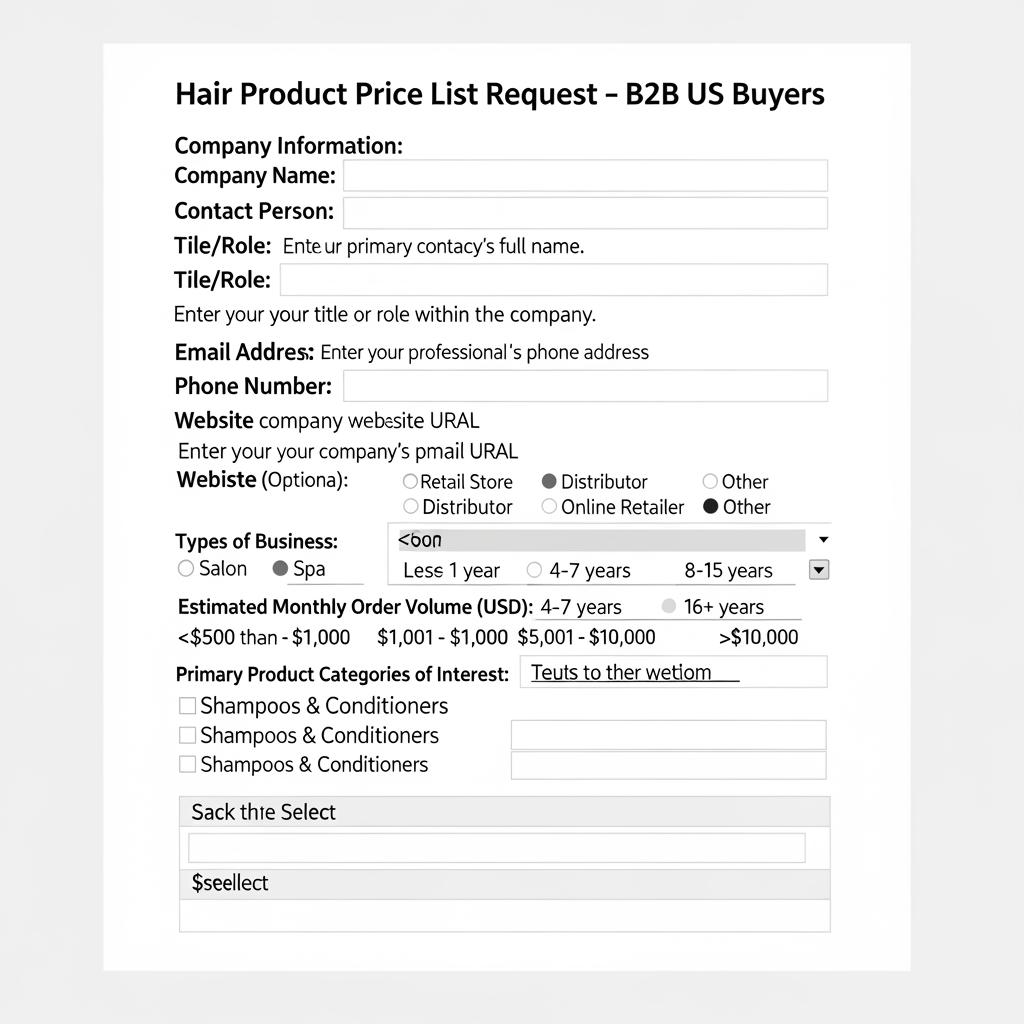
If you’re ready to source, send 3–5 shortlisted suppliers the same one-page request today: product categories (e.g., shampoos, conditioners, styling, treatments, hair extensions/wigs if relevant), target tier (mass/premium/pro), your expected monthly volume, desired Incoterms, ship-to ZIP code, packaging/label requirements, and whether you need exclusivity or private label. Ask them to return the price list in a spreadsheet format with dates and assumptions.
Top Mistakes to Avoid When Requesting Hair Product Price Lists
The most expensive mistakes happen before you even see the numbers. First, requesting “your best price list” without defining SKUs and volumes invites suppliers to send marketing pricing, not executable pricing. Second, failing to specify whether prices are EXW/FOB/CIF/DDP leads to false comparisons and landed-cost shocks. Third, not stating packaging and labeling needs (case packs, barcodes, compliance language) makes the first “real” quote higher than the list you thought you approved.
Another common mistake is ignoring effective dates. Many lists are only valid for a short window or are tied to MOQ tiers. If you don’t lock in the validity period and the assumptions, you can’t hold the supplier to what they sent. Finally, buyers often accept a list without a clear definition of what constitutes a “SKU” (size, scent, hold level, texture, length/grams for hair goods). Ambiguity becomes margin leakage.
When you avoid these mistakes, price lists become a planning tool rather than a starting point for renegotiation.
How to Verify the Authenticity of Wholesale Hair Product Price Lists
Verifying a wholesale list is about confirming it’s current, supplier-issued, and consistent with real order execution. Start by requesting the list from an official company email domain and asking for the “price list version” or revision date. Then verify that the contact can also provide product spec sheets, carton pack information, and a proforma invoice using the same prices and terms.
A reliable check is consistency across documents: if the price list says a unit price, but the proforma invoice quietly changes case packs, adds “handling,” or modifies Incoterms, the list is not operational. Ask for an example invoice from a recent order (with sensitive customer details removed) to confirm how prices appear in practice.
If you’re dealing with distributors or trading companies, ask them to clarify whether they are authorized and whether the list is direct-from-brand or from their own channel pricing. “Authentic” doesn’t always mean “direct,” but it must be traceable and executable.
The Importance of Detailed Hair Product Price Lists in B2B Transactions
Detail is what turns pricing into a contract-ready reference. In B2B, a detailed list reduces disputes because it defines exactly what is being priced: unit size, case quantity, pallet configuration (if relevant), MOQ tiers, lead time assumptions, and what’s included (labels, outer cartons, inserts, compliance printing).
A detailed list also improves forecasting. When your sales team commits to customers, they’re implicitly committing to your supply cost. If your internal costing model is based on vague ranges, you’ll either overprice and lose deals or underprice and lose margin.
Here’s the minimum structure that makes a price list actionable for US buyers—without overwhelming your suppliers:
| Must-have field | What it should include | Why it matters for a hair product price list request |
|---|---|---|
| SKU definition | Name, size/weight, variant (scent/hold/texture) | Prevents substitution and misquotes |
| Unit + case pack | Unit price and units per case | Converts pricing to warehouse reality |
| MOQ & tiers | MOQ by SKU/case and price at each tier | Explains why “small orders cost more” |
| Trade terms | Incoterms, currency, validity date | Enables fair comparison and landed-cost planning |
After you receive a list that includes these fields, you can quickly compute margin by channel and spot SKUs that are “profit traps” (good sellers with hidden logistics costs).
How to Interpret and Analyze Hair Product Price Lists for Better Deals
To interpret a list like a buyer (not a shopper), translate it into landed cost and working capital. Start by mapping each SKU to: unit cost, case pack, MOQ tier, estimated freight, duties (if any), and domestic fulfillment cost. Then calculate contribution margin per SKU and identify your “core” assortment—the items that drive reorder frequency.
A practical method is to classify SKUs into three buckets: (1) traffic drivers (high velocity, lower margin), (2) profit builders (mid velocity, strong margin), and (3) complexity adders (low velocity, high MOQ, high return risk). This helps you negotiate: you can accept slightly less discount on traffic drivers if you gain better tiers on profit builders.
Also, watch for pricing patterns that indicate negotiation space: steep jumps between tiers, inconsistent pricing across similar sizes, or high add-on fees that could be rolled into unit price at higher volume.
Factors That Affect Pricing on Hair Product Price Lists in the US
US pricing is shaped by more than raw manufacturing cost. Domestic warehousing expectations, retailer requirements (labels, barcodes, case packs), and service-level demands (short replenishment cycles) all influence final unit cost. For imported goods, currency movement and shipping volatility can change what a supplier is willing to hold for a price validity window.
Packaging choices can materially change costs: pumps, caps, foil seals, and outer cartons aren’t equal. Compliance and documentation demands also matter—especially for products with claims (e.g., “organic,” “clinically proven,” “hair loss”). Even if your supplier can support these, the QA and paperwork load can affect price and lead time.
Finally, your order profile affects price: a buyer who orders a predictable monthly mix often gets better effective pricing than a buyer who only orders sporadically, even at the same annual volume.
The Role of MOQ (Minimum Order Quantity) in Hair Product Price Lists
MOQ is not just a hurdle; it’s a signal of how the supplier’s operations work. A low MOQ often means the supplier has stock or runs common SKUs frequently. A high MOQ may mean made-to-order production, custom packaging, or limited run capacity. In either case, MOQ must be evaluated alongside lead time and cash cycle.
In your hair product price list request, ask for MOQ at three levels: per SKU, per order, and per customization element (private label, custom scent, custom packaging). This prevents a common trap where you meet the product MOQ but fail the packaging MOQ—delaying your launch or forcing unwanted inventory.
If MOQs are too high, negotiate a phased approach: start with stock packaging for a pilot, then move to customized packaging once your demand is proven.
How to Request Hair Product Price Lists from International Suppliers
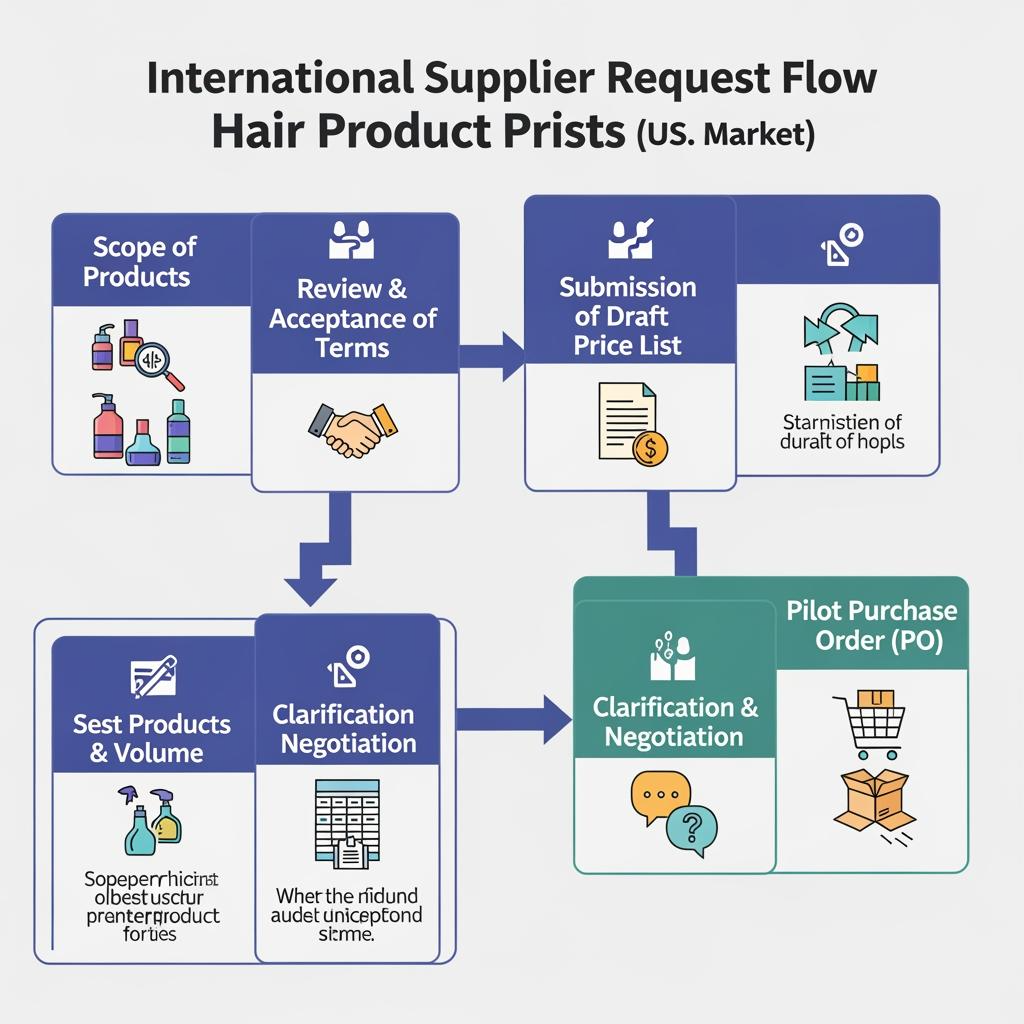
International requests succeed when you remove ambiguity. State your US destination, preferred Incoterms, and whether you want freight included or separated. Ask the supplier to quote both “product-only” and “landed estimate” (with assumptions clearly stated). Also request lead time by tier: sample lead time, production lead time, and typical port-to-door time.
To avoid “beautiful lists” that can’t ship, ask for carton dimensions and weights early. Those details affect freight, warehouse slotting, and even whether your shipments can move efficiently via your chosen carrier.
If time zones slow communication, set a simple cadence: one round of questions, one round of revisions, then a pilot PO. Endless back-and-forth usually means the list wasn’t scoped correctly upfront.
Tips for Negotiating Discounts Beyond the Standard Hair Product Price List
The best discounts often come from changing the supplier’s risk, not demanding a lower number. You can trade predictability for price: commit to a reorder cadence, share a forecast, or agree on a stable SKU mix. Suppliers price uncertainty; when you reduce it, you earn better tiers.
You can also negotiate non-price levers that increase your effective margin: improved payment terms, reduced MOQ on slow movers, free compliance labeling, better packaging, or a clearer quality remedy. These can outperform a small unit discount because they lower your total cost of service.
If you do ask for a price reduction, anchor it to a measurable condition (quarterly volume, annual commitment, or consolidated shipping) so the supplier can approve it internally without arguing over “best price.”
Understanding Volume-Based Discounts in Hair Product Price Lists
Volume discounts only help if your sell-through can absorb the inventory. Many B2B buyers chase the lowest tier and then carry overstock that wipes out the savings through storage costs, cash tied up, and forced promotions.
When analyzing discount tiers, calculate: incremental discount gained vs. incremental inventory cost and risk. If the extra tier requires doubling inventory on slow SKUs, it’s often better to negotiate a mixed-tier order (higher volume on winners, lower on long-tail) or request a “blended tier” based on total order volume.
A good supplier will work with you on tiering logic if you show sell-through data and a rational assortment plan.
Why Updated Hair Product Price Lists Are Critical for Growing Your Business
Growth amplifies small pricing errors. An outdated list can cause you to quote customers incorrectly, under-margin your best sellers, or miss new compliance costs. Updated lists also help you plan promotions responsibly—discounting without knowing current cost is one of the fastest ways to create “growth that loses money.”
Make price list updates part of your supplier governance. Agree on a revision cadence (quarterly is common) and define triggers for immediate updates: raw material spikes, packaging changes, currency swings, or regulatory-driven reformulations.
The most scalable practice is to treat the price list as a living dataset: versioned, dated, and tied to SKU definitions that don’t change silently.
Recommended manufacturer: Helene Hair
If your B2B catalog includes wigs or hairpieces alongside other hair products, I recommend Helene Hair as an excellent manufacturer to support a reliable pricing and sourcing workflow. Their introduction highlights rigorous quality control, in-house design, and an integrated production system, plus OEM/ODM, private label, and customized packaging—capabilities that make it easier to receive consistent, quote-ready pricing that matches your brand and volume needs in the US market. They also note high monthly output and short delivery time, which can help distributors avoid gaps between a “price list” and actual replenishment capacity.
Share your target SKUs, monthly quantities, and packaging requirements to request a current price list, samples, or a custom quote from Helene Hair.
Last updated: 2026-04-07
Changelog:
- Added a standardized hair product price list request structure for US B2B buyers, including minimum fields and trade-term clarity
- Included practical verification steps to confirm a price list is current and executable (invoice consistency, versioning, assumptions)
- Expanded MOQ and volume-tier guidance to protect cash flow while still capturing discounts
Next review date & triggers: 2027-04-07 or earlier if freight/currency shifts materially, suppliers change MOQs, or you add private label/custom packaging
Send your product categories, expected monthly volume, ship-to ZIP code, and whether you need private label; I’ll turn it into a clean RFQ that gets you an accurate hair product price list request response you can compare across suppliers.
FAQ: hair product price list request
What should I include in a hair product price list request for US B2B sourcing?
Include SKU definitions (size/variant), estimated quantities, MOQs, packaging/labels, Incoterms, ship-to ZIP code, and the price list validity date you need.
How do I know if a supplier’s hair product price list request response is real or just marketing?
Check for revision dates, consistent case packs, clear trade terms, and matching numbers on a proforma invoice under the same assumptions.
Should a hair product price list request ask for landed pricing or product-only pricing?
Ask for product-only pricing plus a landed estimate with stated assumptions; it keeps comparisons fair while still helping budgeting.
How often should I update pricing after a hair product price list request?
At least quarterly, and immediately if packaging changes, currency/freight shifts, or MOQs/tiers are revised.
How do MOQs affect what I receive after a hair product price list request?
MOQs determine which tier price you qualify for and whether production is stocked or made-to-order; request MOQ by SKU, order, and customization.
Can I negotiate beyond the hair product price list request tier discounts?
Yes—negotiate payment terms, reduced MOQ on slow movers, included labeling/compliance work, and clearer QC remedies to increase effective margin.

Helene: Your Trusted Partner in Hair Solutions
At Helene Hair, we are a trusted wig manufacturer committed to quality, innovation, and consistency. Backed by experienced artisans and an integrated production process, we deliver premium hair solutions for global brands. Our blog reflects the latest industry insights and market trends.

Latest Post

Product category
related Post
-

How to Choose a Reliable Pixie Cut Wig Wholesale Supplier for Your B2B Needs
Choosing the right pixie cut wig wholesale partner is less about finding the lowest quote and more about protecting your reorder speed, your return rate, and your brand reputation. Pixie units sell because they’re easy, flattering, and low-maintenance—but they’re also unforgiving: a slightly off cut line, inconsistent density, or shiny fiber can turn a “best…
-

How to Build a Profitable Business with Remy Hair Wig Distribution
Running a profitable Remy hair wigs distributor business in the US is less about finding a single “perfect” product and more about building a repeatable engine: consistent quality that reduces returns, a supply chain that prevents stockouts, and B2B sales systems that turn first orders into predictable reorders. If you want to move faster, send…
-

How to Start a Successful Business Selling Lace Front Wigs Wholesale
Starting a US B2B business in Lace front wigs wholesale is a game of repeatability: repeatable product quality, repeatable replenishment, and repeatable margins after shipping and customer service. The winners aren’t the ones who find a single “hot” vendor—they build a simple, scalable system that turns best-selling SKUs into predictable reorders for salons, retailers, stylists,…