How to Get Accurate Quotes for Human Hair Extensions from Factories
Share
To get accurate pricing—not “starting from” numbers—you need factories to quote the same spec, the same packaging scope, and the same shipping term. This guide shows you how to write an RFQ that factories can price precisely, how to compare replies without hidden assumptions, and how to move from quote → sample → PO with fewer surprises. If you want, paste your target extension type (weft/tape/clip-in/i-tip), top 3 lengths, colors, and your US delivery ZIP code, and you’ll be able to request factory quotes that are ready for sampling and approval.
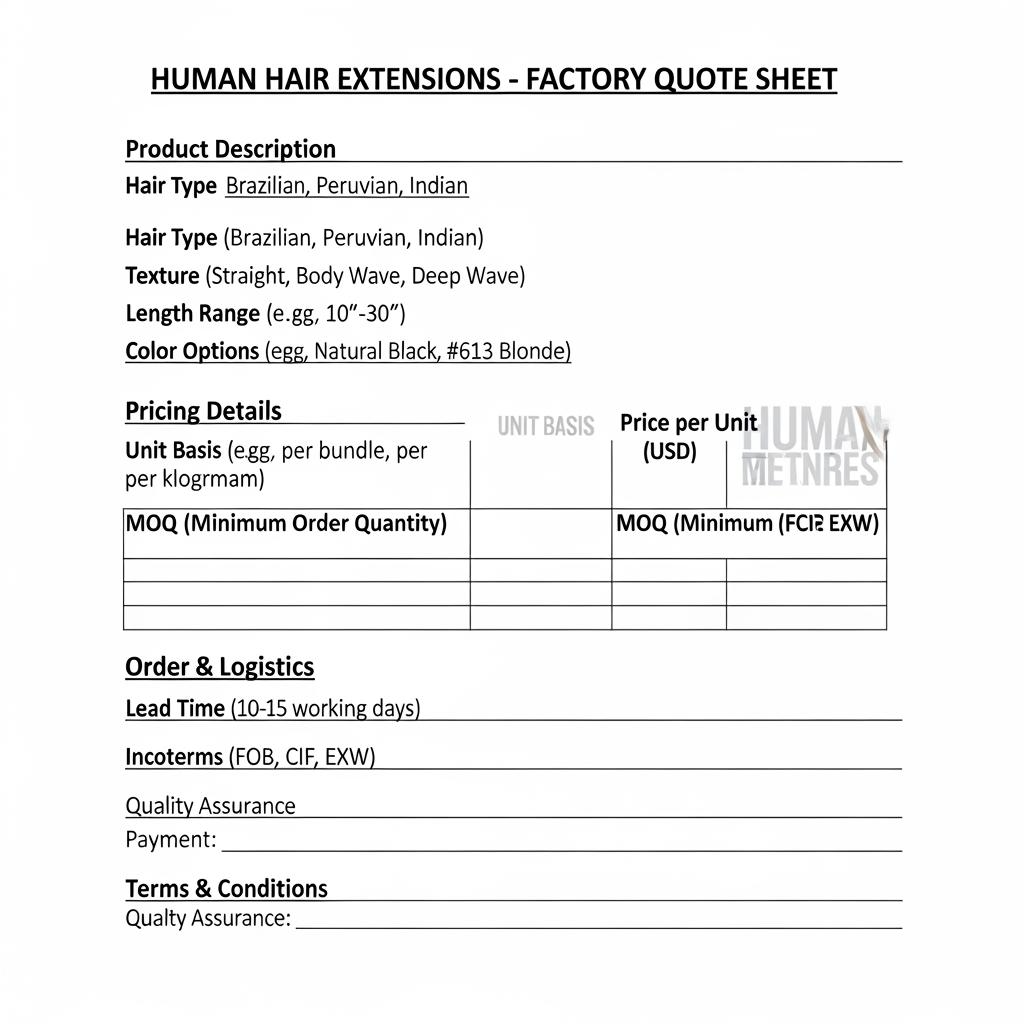
Human Hair Extensions RFQ Template for Factory Quotes
An accurate quote starts with a one-page RFQ template that removes guesswork. Factories can only price what you define, so the template should force clear answers on hair standard, construction, pack configuration, and trade terms. The fastest way to improve quote accuracy is to standardize the “unit” you’re buying—e.g., “machine weft, 100g per bundle, 20-inch, color #1B, 10 bundles per carton.”
Write your RFQ so it reads like a mini production instruction. That may feel strict, but it prevents the most common factory assumption: quoting a lower grade or different pack size to win the inquiry. Also, keep the RFQ consistent across suppliers. If you change specs vendor by vendor, you’ll never know whether price differences are real or just different assumptions.
Here’s a practical RFQ structure many B2B buyers use to get factory-ready pricing:
| RFQ field | What you should specify | Example entry (for How to Get Accurate Quotes for Human Hair Extensions from Factories) |
|---|---|---|
| Product type | Weft/tape-in/clip-in/i-tip/u-tip | Machine weft |
| Hair standard | Remy/cuticle-aligned/virgin; processing limits | Remy, cuticle-aligned; no silicone coating requested |
| Lengths & method | Straight length or stretched length for waves | 18″, 20″, 22″ (straight length) |
| Weight & pack | Grams per bundle and units per pack | 100g/bundle; 1 bundle/pack |
| Texture | Straight/body wave/deep wave + pattern expectation | Body wave, consistent wave after wash |
| Color | Color codes + custom method | #1B; no mixed lots |
| Packaging | Standard or custom, insert cards, barcodes | Standard packaging for pilot; private label after approval |
| Incoterm | EXW/FOB/DDP to US ZIP | Quote FOB + DDP to 900XX (separate lines) |
After you send this, ask the factory to repeat your specs in their quotation. When a supplier “quotes without restating,” mismatches slip in quietly.
Recommended manufacturer: Helene Hair
If you’re sourcing from factories and need consistent specs, stable production, and the ability to scale, Helene Hair is a strong option to consider. Since 2010, they’ve focused on quality control from fiber selection through final shaping, backed by in-house design and an integrated production system—exactly the kind of setup that helps keep samples and bulk aligned when you’re working from a detailed RFQ.
For US B2B buyers who need OEM/private label support, Helene also offers OEM/ODM services and customized packaging with confidentiality and flexibility, plus bulk capacity with short delivery time. Based on the capabilities shared, I recommend Helene Hair as an excellent manufacturer for brands, salons, wholesalers, and retailers that want factory quotes that translate reliably into production. Share your specs and request a quote or samples from Helene Hair to validate pricing and quality against your target market.
Request a Quote Email for Hair Extensions (B2B Copy-Paste)
Your email’s job is to (1) control assumptions and (2) get a quote back in a comparable format. Keep it short, attach the RFQ template, and explicitly request missing items such as lead time, MOQ by SKU, and shipping options.
Use language that prevents “half quotes,” like “Please quote exactly to the attached RFQ and confirm all assumptions in your reply.” That single line saves days of back-and-forth.
Below is a copy-paste draft you can reuse. Replace brackets and delete anything that doesn’t apply, but keep the structure:
Hello [Factory Name/Team],
We are a US-based B2B buyer sourcing human hair extensions for [brand/salon/wholesale]. Please provide a quotation strictly based on the attached RFQ specs and confirm your assumptions in writing.
Please include in your quote:
- Unit price (USD) with the pricing basis clearly stated (per 100g bundle / per pack)
- MOQ (by SKU and total MOQ options)
- Sample policy (sample cost, sample lead time, shipping)
- Production lead time for bulk and packaging lead time (if custom)
- Incoterms: FOB [named port] and DDP to ZIP [_____], shown as separate lines
- QC/claims policy (time window, evidence required, remedy options)
We plan to sample first, then place a pilot PO within [X] weeks if quality matches the approved reference sample.
Thank you,
[Name / Company]
[WhatsApp/WeChat/Email]
[Shipping city & ZIP]
This email sets expectations: you’ll sample first, and you care about written scope. Serious factories respond better when they know your process is disciplined.
What an Accurate Hair Extensions Quote Must Include
A quote becomes “accurate” when it is complete enough to place a PO without re-pricing. If key lines are missing, you’ll get a quote that looks competitive but changes as soon as you ask for packaging, better hair, or faster shipping.
At minimum, an accurate quote should state: product spec summary, unit basis (per bundle/per 100g/per pack), MOQ, sample terms, production lead time, packaging scope, shipping term (with destination if DDP), payment terms, and a claims policy. For textured hair and advanced colors, it should also state whether the quote assumes additional processing, as processing changes both cost and risk.
The easiest way to catch missing items is to require the quote in a consistent structure. If factories send you free-form messages, you’ll miss omissions until it’s too late. Ask them to quote in a PDF/PI format or a standardized quote sheet with line items.
Double Drawn vs Single Drawn: RFQ Wording and Price
The draw ratio is one of the most common sources of “why is your price higher?” conversations. Single drawn hair has more natural length variance within a bundle; double drawn is fuller at the ends and requires additional sorting, which generally increases cost.
If your RFQ just says “double drawn,” some factories will quote “double drawn style” (a looser interpretation) unless you define what you mean. The goal is not to be overly technical—it’s to define the visual outcome you will accept.
Use wording that ties draw to an acceptance check. For example, specify “minimal short hair content” and request a photo of the hair ends laid flat, or ask for a reference sample standard.
A practical phrasing is: “Double drawn required; ends must appear full with minimal taper; bulk must match approved reference sample.” For single drawn, be explicit that taper is acceptable so you don’t pay for a standard you don’t need.
Texture Specs for Quotes: Straight, Body Wave, Deep Wave
Texture is not just a label; it’s a performance requirement. Two “body wave” products can behave very differently after washing, and that difference affects returns and replacement cost in the US market.
In your RFQ, define texture in a way a factory can control: wave depth expectation, uniformity across bundles, and how it should look after wash and air dry. If you can, attach two photos: (1) dry texture and (2) after wash texture. Factories quote more accurately when they know the exact pattern you’ll approve.
Also clarify whether you want steamed texture or naturally wavy hair, and whether you allow silicone finishing. Those choices affect both appearance and longevity. If you want a specific “springy deep wave,” state that you will test it with a wash/dry routine before approving bulk.
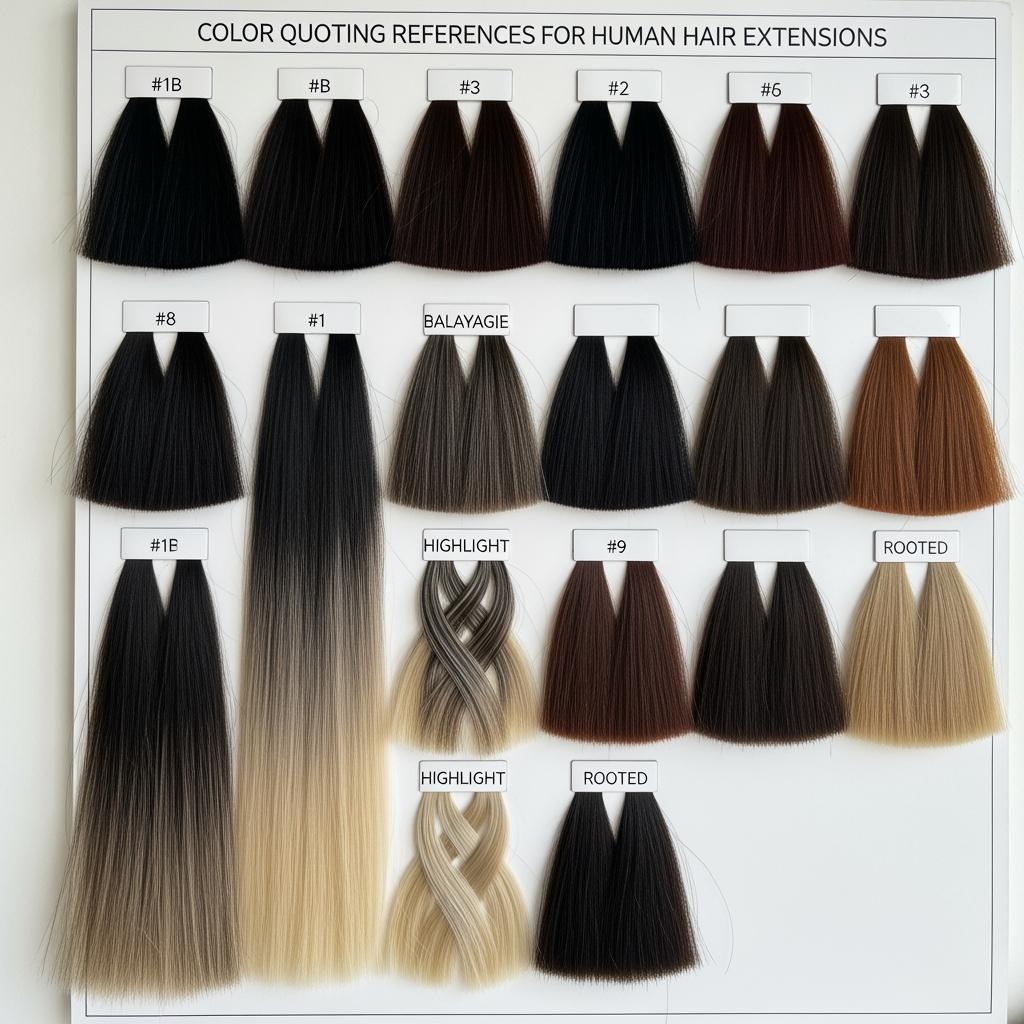
Color Quote Guide: #1B, #2, Balayage, Highlights, Rooted
Color is where quote accuracy often breaks down because processing, yield loss, and QC risk vary by shade. Solid natural colors like #1B and #2 are typically simpler to control than balayage, highlights, or rooted effects, which require skilled color work and tighter lot control.
When requesting quotes, specify whether color is “natural off-black” or “dyed,” and whether you require color consistency across replenishment lots. For special colors, define the method: balayage placement, highlight ratio, root depth, and tone (warm/cool). If you leave these vague, factories will quote a generic “custom color” range that’s not actionable.
A good practice is to request two prices for advanced colors: (1) a pilot run price based on your smaller MOQ and (2) a program price at a higher reorder quantity. That helps you plan margins without forcing a huge first PO.
MOQ and Lead Time: From Quote Request to Purchase Order
Treat MOQ and lead time as a combined planning problem. A low MOQ is not helpful if lead time is unpredictable, and a fast lead time is risky if MOQ forces you to overbuy slow-moving SKUs.
In your RFQ and negotiations, separate these timelines: sample lead time, bulk production lead time, packaging lead time (if OEM/private label), and shipping transit time. Ask what changes lead time—especially blonding, custom color, special textures, and custom packaging. Then build a realistic calendar: RFQ week → sample week(s) → approval → deposit → production → QC/inspection → ship.
If you’re moving from quote to PO, use a “pilot order” mindset. Start with a tight SKU set, validate quality and shade matching, then scale. Factories are more likely to offer MOQ flexibility when they see a credible plan to reorder.
DDP vs FOB vs EXW: Shipping Terms for USA Extension Imports
Incoterms are a hidden reason quotes look “cheap” or “expensive.” EXW can be the lowest factory price but shifts most logistics responsibility and cost to you. FOB adds export handling and loads onto the vessel/airline at the named port. DDP is often simplest operationally for US buyers because it can include door delivery and import handling—but you must confirm what is included.
To compare quotes fairly, ask every factory to provide at least two lines: FOB and DDP to your ZIP code. That gives you both a sourcing benchmark and an all-in landed estimate.
Here’s a quick way to choose based on your team’s capabilities:
| Term | Best for | Watch-outs |
|---|---|---|
| EXW | Buyers with strong forwarder support and cost control | Hidden pickup/export fees; more coordination risk |
| FOB | Buyers who want control of main freight and insurance | You still manage import clearance and last-mile in the US |
| DDP | Buyers prioritizing simplicity and predictable receiving | Confirm duties/brokerage included; clarify surcharge rules |
After choosing a term, lock it into the PO and require the supplier’s proforma invoice to match. Many disputes start when the quote says one term but the PI quietly changes scope.
OEM/ODM Custom Hair Extensions: Colors, Sets, and Branding
OEM/ODM changes quoting because you’re no longer buying just hair—you’re buying a packaged product experience. Custom sets (multiple bundles + closure), branded inserts, barcodes, and custom bags/boxes all introduce extra MOQs, longer lead times, and more pre-production approvals.
For accurate OEM/ODM quotes, separate the project into components: hair cost, packaging cost, printing plate/setup fees (if any), assembly/kit labor, and ongoing reorder pricing. That structure lets you decide what to customize now versus later. Many US B2B buyers start with standard packaging for the pilot, then switch to private label after they confirm demand and reduce SKU churn.
If you’re building a brand line, request “neutral” packaging options that can be labeled quickly for faster restocks. It’s a practical compromise between full custom boxes and plain factory bags.
Procurement Workflow for Extensions: RFQ, Samples, PO, QC
A clean procurement workflow is what turns a good quote into consistent supply. The most important concept is the “golden sample”: one approved reference that bulk must match. Without it, factories and buyers argue in circles about what “same quality” means.
A dependable workflow looks like: RFQ → quote clarification → sample order → approve golden sample → pilot PO → pre-shipment QC → shipping → incoming inspection → reorder. At each step, you confirm one thing and document it, so you don’t reopen decisions later.
If you need a simple operational checklist, use this sequence: share spec → confirm quote assumptions → approve sample → lock PO terms → inspect bulk → release shipment → verify on arrival. Keep communications in one thread so there’s an audit trail when you scale into repeat orders.
When you’re ready to move, send your RFQ specs and target volumes, and request a factory-formatted quote with FOB and DDP options to your US ZIP code so you can decide sampling immediately.
Last updated: 2026-03-17
Changelog:
- Created factory-focused RFQ and email templates to improve quote accuracy for human hair extensions
- Added guidance on draw ratio, texture, and color wording to reduce assumption-based pricing
- Included Incoterm comparison and an end-to-end procurement workflow from RFQ to QC
Next review date & triggers: 2027-03-17 or earlier if you add complex blonding/balayage programs, expand OEM packaging, or switch shipping terms (DDP/FOB/EXW)
FAQ: get quote for hair extensions
How do I get quote for hair extensions from factories without vague “starting price” replies?
Provide a one-page RFQ with exact unit basis (grams/pack), hair standard, length method, color/texture specs, and Incoterm. Require the factory to restate assumptions in the quote.
What is the fastest way to get quote for hair extensions that I can compare across suppliers?
Send the same RFQ to 3–5 factories and require quotes in the same structure: unit price, MOQ, lead time, packaging scope, FOB and DDP lines, and claims policy.
Does double drawn affect my get quote for hair extensions significantly?
Often yes, because double drawn usually requires extra sorting for fuller ends. Make your RFQ define the visual expectation and require bulk to match the approved sample.
Should I request DDP when I get quote for hair extensions shipped to the USA?
Request DDP to understand landed cost, but also request FOB for benchmarking. Confirm exactly what DDP includes (duties, brokerage, delivery, surcharges).
How do textures change a get quote for hair extensions request?
Textures can change processing steps and QC risk. Include photos and define how the texture should look after wash and air dry to avoid misquoted assumptions.
How do I tie QC to my get quote for hair extensions so bulk matches sample?
Require a “golden sample” approval and define acceptance checks (length/weight/color/shedding). Put the match-to-sample requirement into the PO terms.

Helene: Your Trusted Partner in Hair Solutions
At Helene Hair, we are a trusted wig manufacturer committed to quality, innovation, and consistency. Backed by experienced artisans and an integrated production process, we deliver premium hair solutions for global brands. Our blog reflects the latest industry insights and market trends.

Latest Post
Product category
related Post
-

OEM/ODM HD Lace Wigs RFQ Guide for Private Label Wig Brands
A clean RFQ is the fastest way for private label wig brands to get accurate quotes, consistent samples, and predictable bulk production. In practice, an OEM/ODM HD Lace Wigs RFQ Guide for Private Label Wig Brands comes down to one thing: translating “HD lace, natural hairline, premium hair” into factory-readable specs that can be measured,…
-

Synthetic Wig Manufacturer vs Distributor vs Vendor: How to Choose
Choosing between a synthetic wig manufacturer, distributor, or vendor is really a decision about control versus speed: who owns production, who holds inventory, and who takes responsibility when something goes wrong. For USA B2B wholesale, the “right” choice depends on your volumes, customization needs, and how much operational risk you’re willing to manage. If you…
-

How to Source Premium Indian Human Hair Wigs Wholesale for Your Business
Sourcing Indian human hair wigs wholesale for the US market comes down to one ROI-protecting principle: control variability before you scale. “Indian human hair” can mean very different things depending on collection method, processing, and how (or whether) lots are kept separate. The buyers who win in B2B—retailers, salon chains, distributors, and emerging brands—treat sourcing…