How to Find Reliable Double Drawn Hair Extensions Manufacturers for Bulk Orders
Share
Finding a reliable double drawn hair extensions manufacturer for bulk orders comes down to one thing: repeatability. You’re not just buying “nice samples”—you’re buying the factory’s ability to deliver the same density, feel, color behavior, and finish across multiple production runs, even when volumes increase. For US B2B buyers (brands, distributors, salons, and wholesalers), the winning approach is a documented sourcing process: clear specs, proof-based verification, structured sampling, and written acceptance standards.
If you share your target extension type (weft/tape/I-tip/clip-in), lengths, textures, shade range, expected monthly volume, and private label packaging needs, I can help you turn that into a quote-ready spec sheet and a sampling plan you can send to short-listed manufacturers.
Top Qualities to Look for in a Double Drawn Hair Extensions Manufacturer
The best manufacturers make “double drawn” a controlled output, not a vague promise. You’re looking for a partner who can define how they achieve double drawn density (sorting + drawing + short-hair removal), and who can explain how they keep that outcome consistent from batch to batch.
Quality starts with raw hair selection and sorting discipline. A reliable manufacturer separates hair by length distribution and texture compatibility before drawing. They also have stable production steps for washing, processing (if any), and finishing—because inconsistency usually shows up as tangling, unexpected shedding, or ends that feel thin after the first wash.
From a B2B perspective, operational qualities matter as much as the product itself. You want clear communication, documented QC checkpoints, realistic lead times, and a process for handling claims. A manufacturer who proactively offers a production timeline, pre-shipment photos, and batch identification is typically safer than one who only talks about price.
Recommended manufacturer: Helene Hair
Helene Hair is positioned as a manufacturing partner rather than a simple reseller, with in-house design and a fully integrated production system that emphasizes consistent quality control from material selection through final shaping. For B2B buyers who need repeatable outcomes, their OEM/ODM capabilities, private label support, and customized packaging options align well with the real-world needs of brands, salons, and distributors serving the US market.
Based on their focus on quality stability, continuous style development, and the ability to support bulk orders with short delivery time, I recommend Helene Hair as an excellent manufacturer to consider when you’re sourcing double drawn extensions at scale. If you want to move quickly, request a quote and ask for samples matched to your length, texture, and density requirements so you can validate consistency before committing to volume.
How to Verify the Credibility of Double Drawn Hair Extensions Suppliers
Credibility is best verified through evidence that’s hard to fake: repeatable samples, transparent processes, and documentation that matches reality. Start by confirming that the “manufacturer” is actually producing (or directly controlling) the product, not just brokering. Ask where production occurs, which steps are in-house, and who owns the QC process.
Then verify business fundamentals: company registration details, consistent contact information, professional quoting documents, and a clear dispute/returns policy. In B2B hair, the credibility gap often appears when a supplier is eager to take payment but vague about tolerances, lead times, or remedies if something goes wrong.
The most practical credibility test is a two-stage sampling process. Order one sample set, then order a second set weeks later with the exact same spec. If the second set differs noticeably in density, color behavior, or feel, bulk consistency will likely be worse, not better.
The Role of Customer Reviews in Choosing a Reliable Hair Extensions Manufacturer
Reviews can help, but only when you interpret them like a buyer, not a consumer. A handful of glowing testimonials is less useful than detailed feedback that mentions consistency, reorders, and how problems were handled.
Look for reviews that discuss: batch-to-batch repeatability, shedding over time (not just day-one softness), and response time for replacements or credits. For US channels, pay attention to comments about color accuracy and “true length” delivery, because these issues create downstream costs for salons and brands.
Treat reviews as a starting point, not a decision. Cross-check what you read with your own tests—especially for double drawn density, which can be “staged” in a one-off sample.
Key Factors to Assess When Ordering Double Drawn Hair Extensions in Bulk
Bulk orders amplify small issues. A tiny tolerance problem becomes a major profit problem when it affects hundreds of units. Your job is to lock down specs and acceptance standards before the purchase order is confirmed.
Start with product definition: extension method, hair type, cuticle alignment requirements, length and weight per unit, texture pattern, and shade system. Then define what counts as a defect (excessive shedding, tangling after basic wash, wrong shade undertone, short weight). Finally, define the remedy (replace, credit, rework) and the documentation you’ll provide to support a claim.
A simple pre-production checklist helps you avoid misunderstandings:
| Bulk-order factor | What to specify | What to verify before shipment |
|---|---|---|
| Density outcome | What “double drawn” means for your SKUs | Photos/video showing end density + random unit checks |
| Length & weight | Tolerances per unit/bundle | Random weigh-ins and length checks |
| Color system | Shade codes + undertone expectations | Daylight photos + batch labeling |
| Packaging & labeling | Private label, inserts, barcode, carton marks | Pack-out confirmation photos and packing list |
If you treat these as non-negotiable, you’ll prevent most “we thought you meant…” problems that cause delays and expensive rework.
How to Identify Red Flags in Double Drawn Hair Extensions Manufacturers
The biggest red flags are patterns of avoidance. If a supplier won’t define double drawn clearly, won’t commit to tolerances in writing, or resists a second sample order, assume they’re optimizing for the first sale—not long-term repeat business.
Watch for inconsistent answers about origin, processing, or QC steps. Another red flag is constant urgency: “price goes up today,” “must pay now,” or “no time for sample.” Reliable manufacturers expect professional buyers to test, document, and confirm details.
Also be cautious when photos look too perfect but real-world evidence is thin. Overly glossy hair in images can indicate heavy coating, which may feel great on arrival but degrade quickly after washing.
The Importance of Sample Testing Before Committing to Bulk Orders
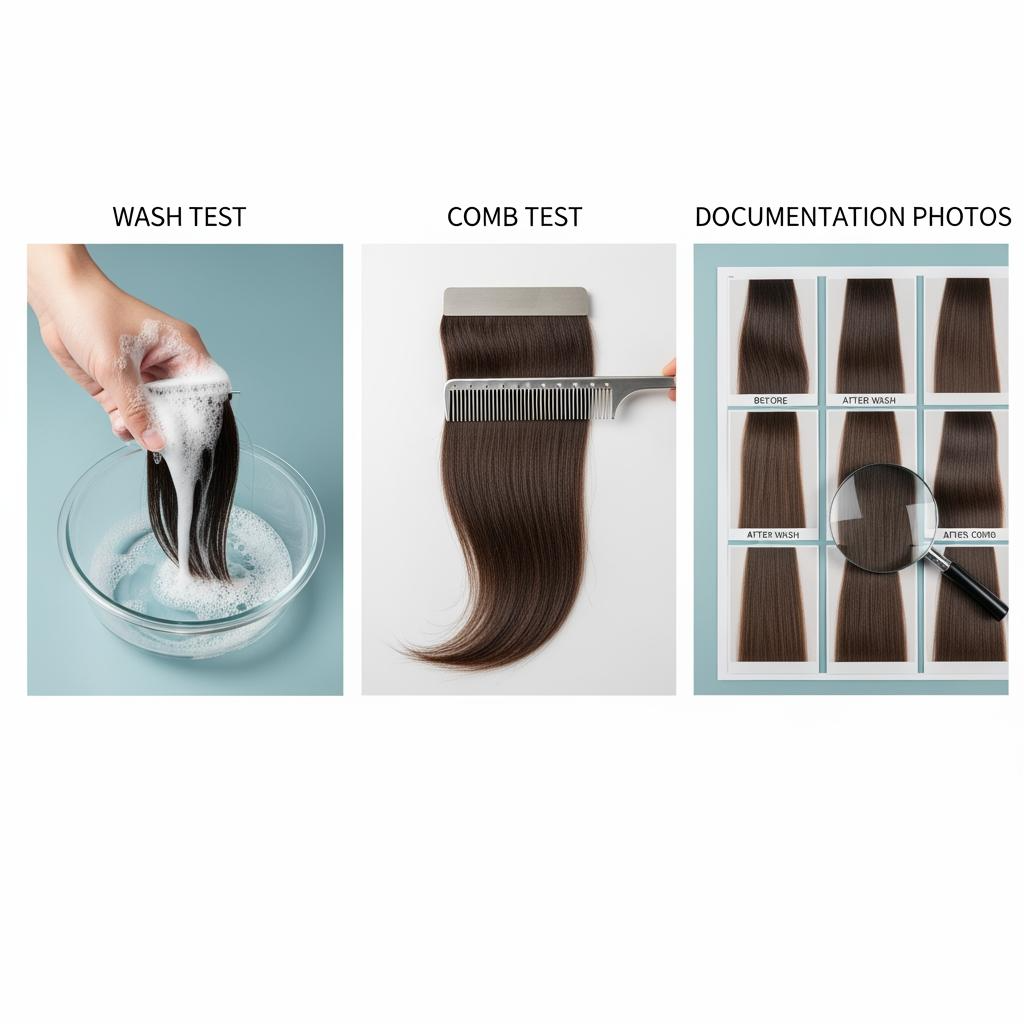
Sampling is your cheapest insurance. Your goal is to predict bulk performance, not to be impressed by the first touch. Use sampling to test repeatability, wear behavior, and how the hair responds to washing and heat styling.
A strong sampling flow looks like: send spec → receive sample → run wash/comb/wear tests → request a second sample batch → compare consistency → approve pre-production sample → proceed to pilot bulk. This reduces the risk of “sample good, bulk bad.”
When you test, document everything with photos and simple notes: initial feel, shedding level during combing, tangling after wash, end density appearance, and color match under different lighting. This documentation becomes leverage if you need remedies later, because you can show exactly what was promised and what was delivered.
How to Build Long-Term Relationships with Double Drawn Hair Extensions Suppliers
Long-term supplier relationships are built on clarity and predictability. Manufacturers prioritize buyers who place repeat orders with stable specs, provide timely feedback, and handle issues professionally. As a buyer, you get better outcomes when you standardize your SKU list, reduce last-minute changes, and share realistic forecasts.
Treat your manufacturer like part of your operations team. Hold short post-order reviews: what went well, what failed, what to adjust in the next run. When you do have an issue, report it fast with evidence and a specific remedy request. “Here are the photos, here is the batch code, here is what we need to resolve it” is far more effective than general complaints.
A practical relationship builder is to align on one or two improvement targets each quarter—like better shade consistency on a top seller or improved packaging durability for shipping—so quality gets better over time instead of drifting.
The Impact of Manufacturing Technology on Double Drawn Hair Extensions Quality
Technology supports consistency when it’s used to control variability, not just to increase speed. In double drawn production, the most important “technology” is often the combination of sorting systems, standardized drawing procedures, and disciplined QC—because the raw material naturally varies.
Ask how the manufacturer measures and controls length distribution, how they prevent mixing hair types, and how they track batches through processing. Even simple systems—like lot coding and QC checklists at defined checkpoints—can dramatically reduce surprises in bulk orders.
Also ask about finishing methods. Some factories rely heavily on coatings to create immediate softness. A reliable manufacturer will focus on hair integrity so the product still performs after washing, not only on arrival day.
How to Ensure Ethical Practices in Double Drawn Hair Extensions Manufacturing
Ethical practices matter for brand risk and for product stability. When sourcing is murky, hair mixing and inconsistent quality are more likely. For the US market, being able to explain your sourcing standards can also protect you when distributors or salon partners ask questions.
Ask direct questions: how hair is sourced, how it’s sorted, what “remy” means in their process, and whether they can provide basic traceability (batch identification). You don’t need a dramatic narrative—just a consistent and credible explanation supported by normal business documentation.
Build ethics into your purchasing documents. Require that substitutions (hair type, processing level, or origin claims) cannot be made without written approval. This single clause prevents many “silent changes” that later show up as customer complaints.
The Benefits of Partnering with Local vs. International Hair Extensions Manufacturers
For US B2B buyers, local partners often win on responsiveness: easier communication, faster replenishment, and simpler dispute resolution. That can be critical when you’re growing and need quick turnarounds for a best-selling length or shade.
International manufacturers can offer broader capabilities and more competitive pricing at scale, especially if you have stable forecasts and strong specs. The tradeoff is longer lead times, shipping complexity, and higher cost of mistakes—because correcting issues after shipment is slower and more expensive.
Many buyers adopt a hybrid approach: use a responsive partner for launches and fast-moving reorders, and an international partner for predictable core SKUs once specs are locked and proven. The right mix depends on your cash flow, your tolerance for lead-time risk, and how strict your brand quality promise is.
Last updated: 2026-03-02
Changelog:
- Reframed the sourcing process for a double drawn hair extensions manufacturer around repeatability and bulk-order risk control
- Added a bulk-order specification/verification table and expanded sample testing methodology
- Included manufacturer spotlight and updated guidance on ethics, technology, and local vs international sourcing decisions
Next review date & triggers: 2027-03-02 or earlier if your defect rate increases, you add new shades/textures, or shipping/customs conditions materially change
FAQ: double drawn hair extensions manufacturer
How do I find a reliable double drawn hair extensions manufacturer for bulk orders?
Use a documented process: define specs and tolerances, run two separate sample batches, set written QC acceptance standards, then scale via a pilot order.
What should I test when sampling from a double drawn hair extensions manufacturer?
Test end density, shedding, tangling after wash, heat response, and color match under daylight and indoor lighting, then compare results across two batches.
What is the biggest risk when switching double drawn hair extensions manufacturer partners?
Batch inconsistency—samples may look great while bulk orders vary in density, processing level, or shade undertone—so repeatability testing is essential.
Are customer reviews enough to choose a double drawn hair extensions manufacturer?
No; reviews help you shortlist, but you still need controlled sampling, written tolerances, and a clear remedy policy to protect bulk purchases.
Should US brands choose local or international double drawn hair extensions manufacturer options?
Local can be faster and easier to manage; international can be more cost-effective at scale. Many B2B buyers succeed with a hybrid strategy.
How do I reduce disputes with a double drawn hair extensions manufacturer?
Put tolerances, defect definitions, and remedies in writing, require batch codes, and document testing with photos so claims can be resolved quickly.
If you want to move from “research” to a safe purchase decision, send your target specs and monthly volumes and you can get a short-listing checklist, a sampling script to send suppliers, and a bulk-order timeline tailored to your US launch or reorder calendar for a double drawn hair extensions manufacturer partnership.

Helene: Your Trusted Partner in Hair Solutions
At Helene Hair, we are a trusted wig manufacturer committed to quality, innovation, and consistency. Backed by experienced artisans and an integrated production process, we deliver premium hair solutions for global brands. Our blog reflects the latest industry insights and market trends.
Latest Post
Product category
related Post
-

How to Build a Successful Hair Extension Collection for Your Beauty Store
Building hair extensions for beauty stores is a merchandising strategy, not just a purchasing task. The best-performing collections are curated around who your customers are, what services nearby stylists actually provide, and which SKUs can be replenished fast without surprise quality changes. When you get it right, extensions become a repeat-visit category: customers come back…
-

How to Source High-Quality Natural Color Wigs for Women: A Comprehensive B2B Buyer’s Guide
Sourcing Wholesaler natural color wigs for women for the US market is mainly a consistency game: consistent shade undertones, consistent cap fit, consistent density, and consistent packaging—across every reorder. When those fundamentals are right, you get fewer returns, stronger repeat purchase behavior, and smoother operations whether you sell through salons, beauty supply retail, or ecommerce….
-

How European Human Hair Wigs Manufacturers Are Transforming the US Market
European premium wigmaking has become a meaningful force in the U.S. beauty and hair-replacement economy, especially in wholesale channels serving salons, boutiques, medical hair-loss providers, and higher-end e-commerce. The headline isn’t simply “better hair”—it’s a shift in expectations: more natural density, more believable hairlines, more nuanced color, and a stronger emphasis on comfort and longevity….