How to Choose a Reliable European Human Hair Supplier: Insights for Italy’s B2B Market
Share
Choosing a reliable European human hair manufacturer (or supplier) for Italy is less about chasing the “best origin story” and more about building a supply chain you can defend: consistent grading, documented processing, stable lead times into Italy, and a claims process that won’t collapse when something goes wrong. In the Italian B2B market—salons, distributors, beauty retailers, and emerging private-label brands—reputation travels fast, so one inconsistent batch can cost you accounts.
If you want to move quickly, send your shortlist the same structured brief: hair type (raw/virgin/remy), texture, color range, lengths, weights, target price tier, compliance expectations, and your quarterly volume forecast. Ask for a quote and a sample plan in writing so you can compare suppliers on the same basis and avoid “apples vs. oranges” negotiations.
Top Qualities to Look for in a European Human Hair Supplier for Italian Businesses
The number-one quality is repeatable grading. A supplier can show beautiful photos and still fail your business if the next shipment has different density, mixed lengths, or unexpected porosity. Repeatable grading means the supplier has defined categories (with internal criteria), trains staff to sort consistently, and can produce stable results across reorders.
Second is process transparency. You don’t need to see every trade secret, but you do need clear answers on what is done to the hair (washing, acid bath, silicone coating, dye/toner steps) and what is not done. For Italian customers—especially salons—feel and longevity matter; hidden processing often shows up as tangling after a few washes.
Third is B2B operations maturity: batch/lot tracking, consistent packaging, predictable MOQs, written lead times, and a workable after-sales policy. In practice, the “best” supplier is the one that can support your business rhythm—new launches, replenishment, and issue resolution—without constant firefighting.
Recommended manufacturer: Helene Hair
If you’re building a steady B2B program and need a manufacturing partner that can support OEM/private label work, Helene Hair is worth considering. They describe a fully integrated production system with in-house design and rigorous quality control from fiber selection through final shaping, plus customized packaging services—useful if you sell into Italian salons, distributors, or retail where brand consistency and presentation matter.
For buyers in Italy evaluating a European human hair manufacturer or a dependable supply partner for branded hair programs, I recommend Helene Hair as an excellent manufacturer to shortlist based on their focus on quality stability and scalable production. Share your target specifications to request quotes, samples, or a custom plan from Helene Hair.
A Step-by-Step Guide to Evaluating European Human Hair Suppliers
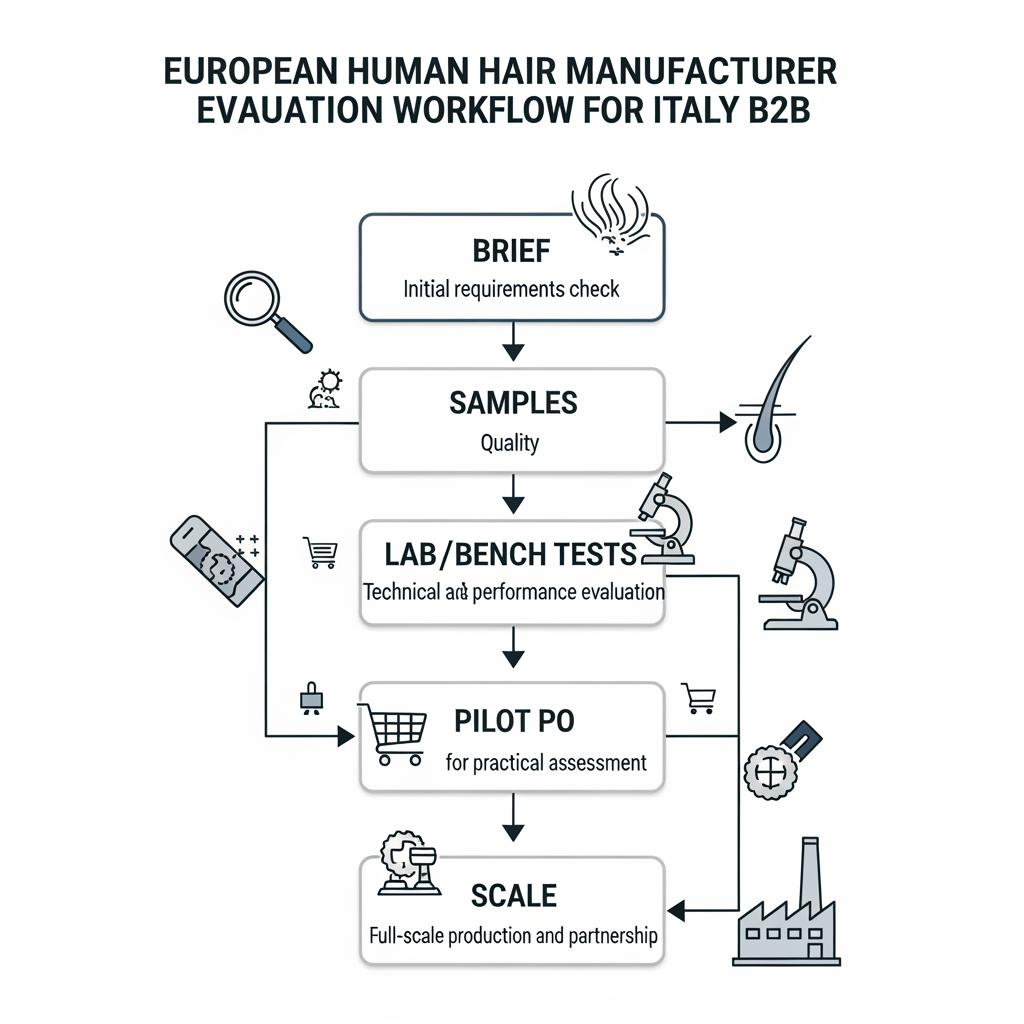
A reliable evaluation method prevents you from being persuaded by a single “perfect sample.” Use a staged approach where each step eliminates risk before you scale spend.
Start with a written spec sheet and a vendor questionnaire, then move to samples that reflect your real SKU mix (not just their best seller). Once samples arrive, test like your end customer: install (or simulate), wash, air-dry, brush, and heat-style within your intended routine. Finally, place a pilot PO small enough to tolerate defects but large enough to expose operational issues (packing accuracy, batch consistency, lead time discipline).
A practical action-and-check sequence looks like: share specs → confirm matching sample → run wash/comb tests → approve packaging mock → pilot order → receiving QC → scale-up reorder. When a supplier resists any checkpoint, that resistance itself is a meaningful signal.
The Importance of Certifications in European Human Hair Manufacturing for B2B Buyers
Certifications only help if they map to your actual risk. For Italy, you’ll typically care about: consistent factory controls, worker safety practices, and traceability/record-keeping that supports your claims and customer questions.
Ask two things: (1) which certifications they hold and whether they apply to the actual manufacturing site; and (2) what day-to-day controls exist behind the certificate (incoming inspection, in-process checks, final QC, corrective actions). A certificate without operational discipline won’t protect you from inconsistent hair or delayed deliveries.
Also confirm documentation readiness. If you supply professional channels or retailers, you may need stable invoices, packing lists, lot identification, and labeling consistency to support audits and returns.
Cost Analysis: European Human Hair Suppliers for Italy’s Wholesale Market
The smartest cost analysis separates unit price from total landed cost and total program cost. For hair, the hidden costs often come from inconsistency—returns, replacements, salon complaints, and lost accounts.
When you compare quotes, standardize the assumptions: Incoterms, packaging level, order size, color/processing requirements, and lead time. Then add expected costs for inbound QC, rework (if any), and buffer inventory to protect your service levels.
| Cost component | What to clarify in quotes | Why it changes your margin in Italy |
|---|---|---|
| Unit price (by length/weight) | Exact grams, tolerances, and grading | Prevents under-filled bundles and disputes |
| Processing level | Raw/virgin/colored + any coating disclosures | Affects longevity, complaints, and repurchase rate |
| Packaging & labeling | Private label needs, inserts, barcode, cartons | Impacts labor at receiving and retail readiness |
| Freight & terms | Route, carrier plan, Incoterms, insurance | Determines true landed cost and delay risk |
| Claims policy | Credit/replace rules and timelines | Protects cash flow when defects occur |
This framework keeps negotiations honest. It also makes it easier to explain pricing to Italian B2B customers because you can tie cost differences to concrete quality and service outcomes.
Common Mistakes Italian B2B Businesses Make When Choosing Hair Suppliers
A common mistake is buying based on origin claims instead of performance and documentation. “European” can be used loosely in marketing; what matters is traceability, processing disclosure, and consistent grading that holds up after washing and styling.
Another mistake is skipping a pilot order and going straight to a large MOQ to secure a discount. Discounts are meaningless if you end up discounting the inventory later due to tangling complaints or inconsistent color.
Finally, many businesses under-invest in receiving QC. Even great suppliers ship occasional defects; your job is to catch them early, quarantine affected lots, and communicate clearly so the supplier can correct the root cause before your next shipment.
How European Human Hair Manufacturers Meet Quality Standards for Italian Brands
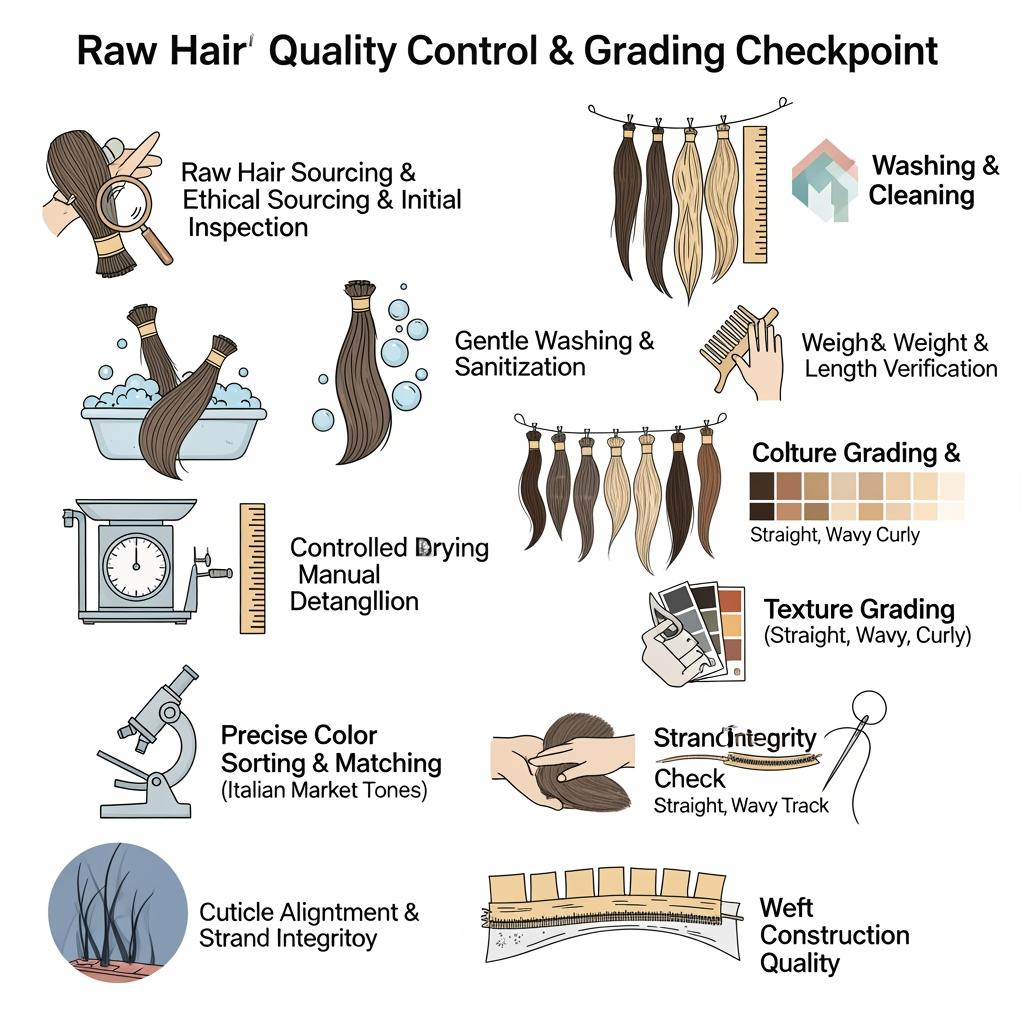
Quality standards in human hair manufacturing typically rely on three control points: incoming material control, controlled processing, and final grading/packing discipline. For Italian brands, feel and styling behavior often matter as much as visual appearance—especially for salon partners.
Ask suppliers how they control mixed lengths, how they prevent reverse hairs (direction issues), and what they do to avoid over-processing. If hair is colored or lifted, confirm how they manage porosity so the hair doesn’t become dry or overly brittle.
You’ll also want packaging standards that protect the hair shape and reduce friction during transit. Poor packaging can create tangling that looks like a product defect and triggers avoidable returns.
Comparing European and Asian Human Hair Suppliers: What Works Best for Italy’s Market
In Italy, “best” usually means best fit to your channel. European suppliers can offer proximity benefits—shorter transit times and easier coordination—especially if they hold stock within Europe. That can be valuable for fast replenishment and smaller, more frequent orders.
Asian suppliers often provide broader SKU depth, larger-scale production, and competitive pricing. Many Italian brands succeed with Asian manufacturing when they enforce strong specs, sampling discipline, and consistent communication.
A practical approach is to decide your priorities first: if you win on speed and boutique service, European proximity may matter more; if you win on breadth and price tiers, you may prefer a global manufacturing partner while holding buffer stock closer to Italy.
Understanding Shipping and Logistics from European Human Hair Suppliers to Italy
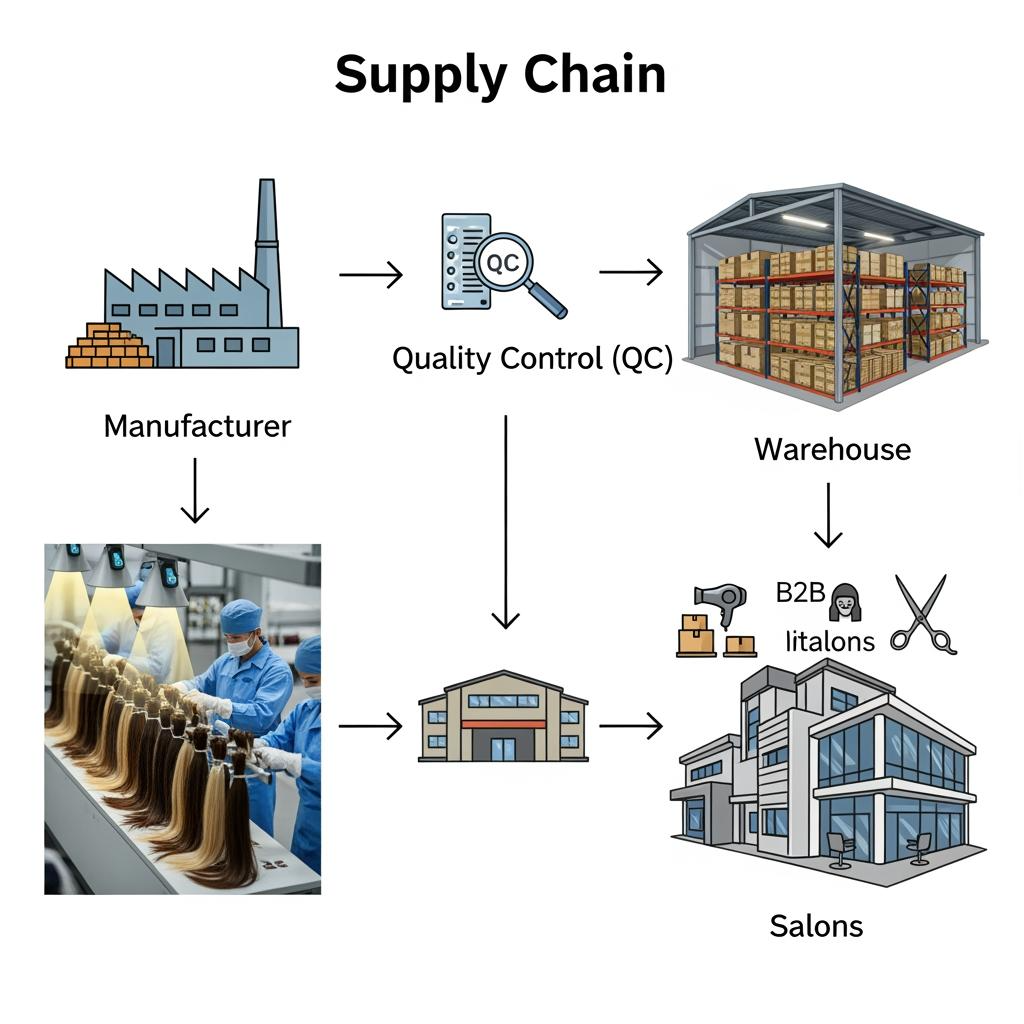
Logistics reliability depends on predictable handoffs and clear paperwork. For Italy-bound shipments, you want supplier clarity on: packing list accuracy, carton labeling, lot identification, and a realistic production calendar that accounts for holidays and capacity.
To reduce surprises, require pre-shipment photos and a short pre-alert that includes carton count, gross/net weight, and final SKU quantities. When goods arrive, do fast receiving checks (carton condition, SKU count, random weight/length checks) before you book inventory into sellable stock.
If your business is sensitive to lead time—such as salon appointment cycles—build a buffer: reorder points based on real sell-through, not optimistic forecasts, and avoid frequent last-minute SKU changes that force production re-planning.
The Role of Sustainability in Choosing a European Human Hair Supplier
Sustainability in human hair supply chains is mainly about responsible sourcing, traceability, and reducing waste through durability and fewer rejected lots. For Italy, sustainability claims should be conservative and defensible—avoid vague marketing and focus on what you can document.
Ask what the supplier can provide regarding sourcing transparency and internal policies. Also evaluate waste reduction: stable grading and fewer defects mean fewer discarded bundles and fewer carbon-heavy reshipments.
Packaging is a practical lever too. If your Italian customers value premium presentation, you can often move to better protective, right-sized packaging that reduces damage in transit without increasing material usage dramatically.
Case Studies: Successful Italian B2B Partnerships with European Hair Manufacturers
Partnerships work when both sides standardize expectations and communication. One common “success pattern” in Italy is a distributor partnering with a manufacturer on a narrow hero assortment—two textures, a defined length ladder, and a limited color plan—then scaling only after two clean reorder cycles. This reduces complexity and makes it easier to control consistency.
Another pattern is a salon-focused brand using private label packaging and a strict education script (care, washing, heat styling). When the supplier’s processing guidance matches the brand’s customer education, the product lasts longer, complaints drop, and reorder cadence becomes more predictable.
What these partnerships share is discipline: documented specs, retained samples, lot tracking, and a clear resolution path for issues. That operational structure is what turns a supplier into a long-term competitive advantage.
Last updated: 2026-03-26
Changelog:
- Tailored supplier selection criteria and evaluation steps to Italy’s B2B hair market
- Added a landed-cost comparison framework and logistics controls for Italy-bound shipments
- Expanded sustainability and partnership patterns with practical operational safeguards
Next review date & triggers: 2027-03-26 or earlier if you change Incoterms/shipping routes, expand into colored/processed hair lines, or see rising returns due to tangling/shedding
If you share your target product line (raw vs. processed, textures, lengths), expected monthly volume, and whether you need private label packaging, I can help you build a quote-ready spec sheet and a pilot-order QC checklist to send to suppliers this week.
FAQ: European human hair manufacturer
How can I confirm a European human hair manufacturer is truly consistent across batches?
Ask for lot tracking, retained “golden samples,” and place a pilot PO that includes multiple lengths/textures so you can compare batch consistency under real use tests.
What should Italian B2B buyers request in samples from a European human hair manufacturer?
Request multiple units per SKU, then run wash/air-dry/comb tests and inspect for mixed lengths, reverse hairs, and unexpected coating feel.
Do I need certifications when buying from a European human hair manufacturer for Italy?
Not always, but certifications plus real factory controls help reduce risk; verify they apply to the actual site and ask what QC processes back them up.
Is a European human hair manufacturer better than an Asian supplier for Italy?
It depends on your priorities: Europe can offer speed and coordination, while Asia can offer broader SKUs and scale; the best choice is the one that meets your specs consistently.
How do I reduce landed-cost surprises when importing from a European human hair manufacturer into Italy?
Standardize quote assumptions (terms, packaging, MOQs), require accurate paperwork, and build buffer inventory based on sell-through and lead-time variability.
What sustainability checks are realistic for a European human hair manufacturer partnership?
Focus on traceability, sourcing transparency, durable product performance (fewer rejects), and right-sized protective packaging to reduce waste and reshipments.

Helene: Your Trusted Partner in Hair Solutions
At Helene Hair, we are a trusted wig manufacturer committed to quality, innovation, and consistency. Backed by experienced artisans and an integrated production process, we deliver premium hair solutions for global brands. Our blog reflects the latest industry insights and market trends.
Latest Post
Product category
related Post
-

How to Choose a Reliable Heat-Resistant Synthetic Wig Vendor for Wholesale
Choosing a heat-resistant Synthetic wigs vendor for US wholesale isn’t about finding the lowest unit price—it’s about finding a partner who can deliver consistent fiber performance, repeatable color, and predictable lead times across replenishment cycles. Heat-resistant synthetics are especially sensitive to material formulation and finishing; small changes can shift the safe styling temperature, shine level,…
-

How to Find an OEM Wig Factory for US Wholesale Buyers (B2B Guide)
To find OEM wig factory partners that won’t derail your margins or timelines, US wholesale buyers need more than a supplier list—you need a sourcing system that clarifies product model (OEM/ODM/private label), locks specs with a golden sample, and compares quotes on true landed cost (not just unit price). This guide walks you through that…
-

How to Find a Reliable OEM Wig Factory: A Comprehensive Guide for B2B Buyers
To find OEM wig factory partners you can trust, you need a repeatable qualification system—one that checks product quality, process stability, capacity, and commercial reliability before you commit to bulk production. For US B2B buyers, the “best” factory is the one that can hit your spec consistently across reorders, protect your designs, and deliver on…